
A working SEO checklist turns search visibility into a series of repeatable steps, and it now has to cover both Google results and AI-driven answers. Going through each task in order keeps the foundation strong, the content aligned with intent, and the site ready for AI crawlers and agents that read and act on pages.
The checklist below is organized into six sections: basic SEO, keyword research, technical SEO, on-page content, link building, and AI search. Address all six for a complete strategy, and return to any skipped section when time allows.
How to use this SEO checklist
Treat each section as a phase. Start with the basic setup so measurement and crawling work, then move into keyword research to guide content, fix technical issues that block indexing, optimize on-page elements, build authority through links, and finish with AI-specific checks. If resources are limited, prioritize the sections tied to the biggest visibility gap first.
Basic SEO practices checklist
These tasks create the foundation that every later step depends on.
1. Set up Google Search Console and Bing Webmaster Tools
Google Search Console and Bing Webmaster Tools are free platforms that let you monitor performance, submit sitemaps and URLs, and identify crawl errors. Bing Webmaster Tools now includes an AI Performance report covering Bing Copilot, AI summaries, and some partner integrations. Search Console surfaces performance for AI Overviews and AI Mode in its Generative AI section.
2. Set up Google Analytics
Google Analytics 4 (GA4) tracks traffic and user behavior once visitors land on the site. Pair GA4 with Search Console so the picture covers how people arrived and what they did next. A heatmap or session-recording tool like Microsoft Clarity adds page-level interaction data. Because AI-driven search often answers questions without sending a click, engagement on-site is a more reliable signal than raw visit counts.
3. Install and configure an SEO plugin (for WordPress sites)
A WordPress SEO plugin generates sitemaps, manages robots.txt, handles canonical URLs, and adds schema. Two widely used options are Yoast SEO and Rank Math, both of which include AI-assisted content suggestions and structured data support. Other content management systems often include similar features, so check before installing an extra plugin.
4. Create a robots.txt file
A robots.txt file tells crawlers which pages they can and cannot access and is part of a broader indexability check. View the current file by adding “/robots.txt” to the homepage URL. Beyond the file itself, confirm that meta robots tags, X-Robots-Tag headers, canonical tags, sitemap accuracy, and 4xx/5xx status codes are all clean. Pages that AI crawlers cannot reach will not appear in AI-generated answers, so important pages should stay accessible.
5. Create and submit an XML sitemap
An XML sitemap helps search engines understand site structure and find pages. WordPress and most modern platforms generate sitemaps automatically. Submit the sitemap in Search Console and Bing Webmaster Tools, and reference it inside robots.txt. Run a site audit to catch and fix sitemap errors.
6. Check Google Search Console for manual actions
Manual actions are penalties applied by Google reviewers for practices such as link schemes. Find them in Search Console under Security and Manual Actions. If a manual action appears, resolve it promptly. Avoid questionable link-building tactics, since they can lead to penalties in both traditional and AI search.
7. Make sure Google can index your website
Indexability is the ability of a page to be added to Google’s index, and unindexed pages cannot rank. Many AI tools pull from Google’s index, so being indexed also supports AI visibility. Run a site crawl, review the Crawlability section, and check the AI Search category for problems that block AI crawlers. Confirm that the main pages are indexed before publishing new content.
Keyword research checklist
Keyword research identifies the search queries and AI prompts that align with the products or services offered. Use these steps to prioritize terms and shape a keyword strategy.
8. Identify competitor keywords
Look for queries competitors rank for and the site does not. Keyword gap tools show terms labeled Missing or Weak, and those gaps are the first opportunities to target.
9. Find core topics and keywords
Use a keyword research tool to explore terms in the niche. The Questions tab surfaces question-based queries, which often signal high intent. Prioritize topics with consistent search demand, achievable difficulty, and intent that matches an existing or planned page.
10. Identify prompts your audience uses in AI tools
Survey customers and scan platforms like Reddit to learn the language people use when researching. Prompt research tools show estimated volume and the actual prompts users enter, and competitor research tools reveal which prompts competitors appear for. Use those prompts to plan new pages.
11. Create a keyword map
Group search keywords and AI prompts by topic and intent in a spreadsheet so each page targets a cluster of related queries. A keyword strategy builder can automate the clustering.
12. Analyze the search intent of highly visible pages
Search the target query in Google and review the top results, then run the same query in AI tools like ChatGPT or Perplexity. Note the page types, depth, and whether users want to learn, compare, or take action, and align new content with those patterns.
13. Identify additional questions people ask
Use Google’s People Also Ask boxes and community platforms like Reddit and Quora to collect follow-up questions. Add the most useful ones as headings, FAQ entries, or subsections.
Technical SEO checklist
These steps keep the site crawlable, indexable, and fast.
14. Make sure you are using HTTPS
HTTPS is a confirmed Google ranking factor. Confirm a padlock icon in the browser and run an HTTPS audit to check certificates, server protocols, and architecture. Resolve every issue flagged.
15. Check for duplicate versions of your site in Google’s index
Variants such as https://www.domain.com, https://domain.com, http://www.domain.com, and http://domain.com can all exist at once. Set 301 redirects so every variant points to a single primary domain, and verify the redirects in a browser.
16. Find and fix crawl errors
Open the Page indexing report in Search Console. Crawl errors appear under Not indexed. Resolve each one and investigate why specific URLs were excluded.
17. Improve your site speed
Google measures speed with Core Web Vitals: Largest Contentful Paint (LCP) for load time, Interaction to Next Paint (INP) for responsiveness, and Cumulative Layout Shift (CLS) for visual stability. Run a site speed audit, address the worst pages first, and re-test after fixes.
Tracking rank and visibility across locations is part of a technical audit. SEOScanPro’s comprehensive website audit checks the same areas and shows the measured result behind each one.
FAQ
What should an SEO checklist include?
An SEO checklist should cover basic setup (Search Console, analytics, plugins), keyword research, technical SEO (HTTPS, crawl errors, speed), on-page content, link building, and AI search readiness. Working through each section keeps visibility intact across Google and AI-driven surfaces.
How often should an SEO checklist be reviewed?
The basic and technical sections should be reviewed monthly or whenever major site changes are made. Keyword research, content, and link building tasks are ongoing, and the AI search section should be revisited whenever a new AI surface or crawler becomes relevant.
Why does AI search need its own SEO checklist section?
AI search engines and agents use their own crawlers, pull from indexes in their own ways, and surface answers without always sending a click. The AI search section covers prompt research, AI crawler access, structured data, and content patterns that make pages easier for AI tools to read and cite.
Related coverage
Try the site audit tool
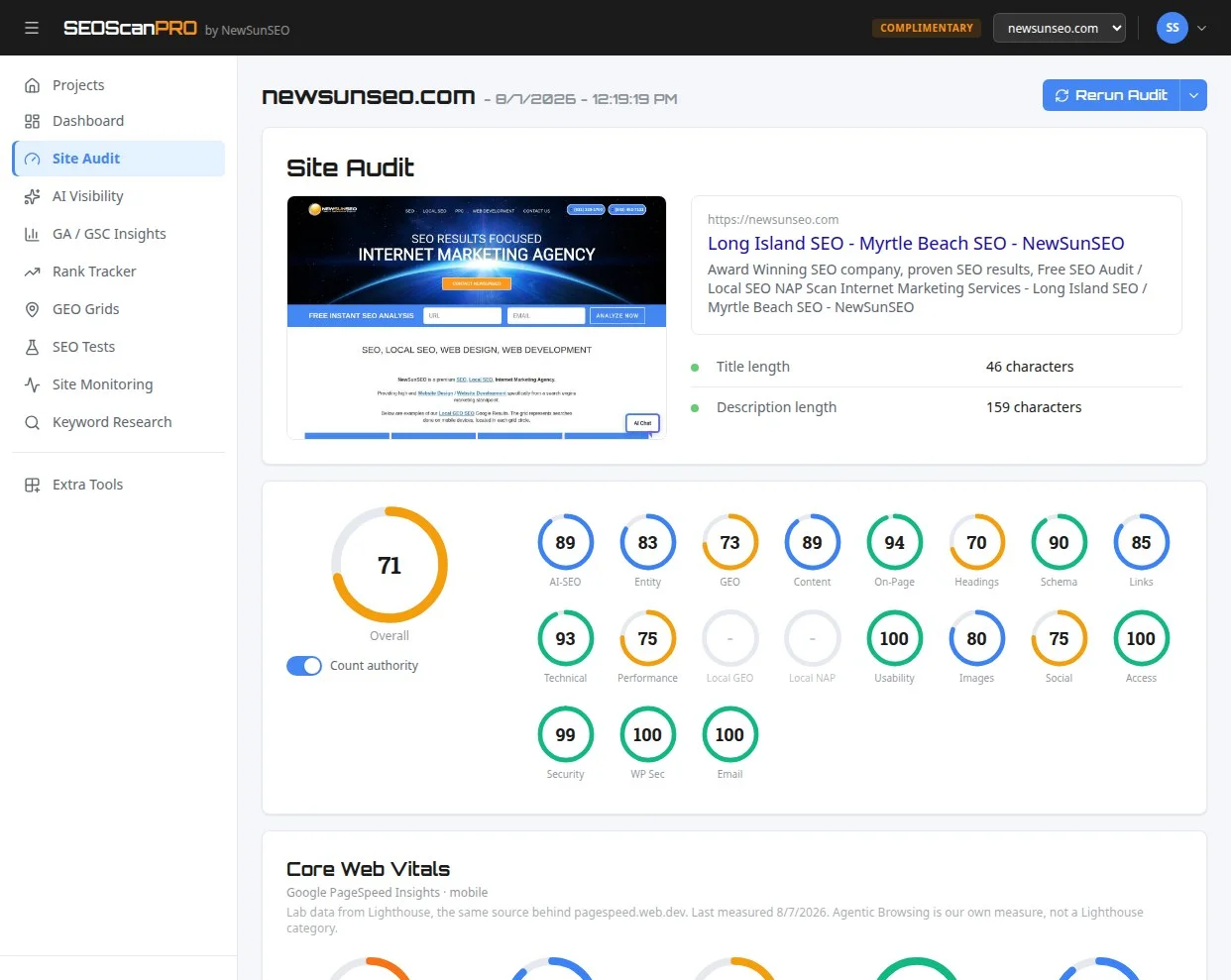
The site audit tool runs a full technical audit of a site and shows the measured result behind every check. Open the site audit tool.
This article summarizes reporting from semrush.com.