Category: AI Visibility

  • B2B Answer Engine Optimization: A Practical Guide for Vendor Shortlists

    B2B Answer Engine Optimization: A Practical Guide for Vendor Shortlists

    B2B answer engine optimization gives a brand a consistent place in the AI-generated shortlists that buying committees assemble during long vendor evaluations. Done well, AEO makes sure the right roles see the right facts about your offering every time an AI assistant is asked.

    The work spans multiple stakeholders, months of research, and a long tail of third-party sources that AI systems lean on. AEO for B2B is therefore less about ranking a single page and more about building a body of accurate, extractable information that survives every question a different committee member will eventually ask.

    What Is B2B Answer Engine Optimization?

    B2B answer engine optimization is the practice of increasing how often a brand is named in the AI-generated answers that prospective buyers see. Marketers also call this B2B generative engine optimization, and the two labels are used interchangeably.

    The unit of success is the named brand inside an AI response, not the click on a webpage. That difference shapes everything that follows, from how prompts are researched to where brand presence is built.

    How Is AEO Different for B2B Brands?

    AEO plays out differently in B2B because of who asks, how long the cycle runs, and what AI draws on for facts.

    Different stakeholders ask different questions

    Buying committees are made up of multiple roles, and each one searches with a different lens. A security reviewer will ask about certifications, access controls, and compliance posture. A finance lead will ask about affordability, contract terms, and total cost of ownership. The same brand often needs to rank for both sets of questions, not just one.

    In a side-by-side test with ChatGPT, a security-focused prompt about the best customer relationship management system for a mid-market company returned Salesforce and Microsoft Dynamics 365 at the top. An affordability-focused prompt on the same category put Zoho CRM first and described Salesforce as the expensive enterprise option, while Freshsales and Pipedrive appeared only in the affordability answer. Different prompts pulled entirely different shortlists.

    Buying cycles last for months

    B2B buyers spend an average of 10.1 months on a purchase, and the shortlist forms almost immediately, according to a 6sense report from 2025. The rest of the cycle is spent validating that shortlist, and large language models are a regular part of that long research pass.

    AI answers draw heavily on specific third-party sources

    For B2B vendors, AI answers lean heavily on business review platforms, third-party comparison content, and practitioner communities. AEO work has to extend to platforms you do not own. The most-cited source families in digital technology categories include:

    • Business review platforms: G2, Capterra, TrustRadius, Clutch, and GoodFirms category pages and profiles.
    • Third-party comparison content: Best-of-category roundups, alternative lists, and head-to-head comparisons published by trade publications and mainstream media sites.
    • Practitioner communities: Subreddits and industry forums where buyers compare options with peers.

    Why Does B2B AEO Matter Right Now?

    Buying committees already use AI to research vendors, so the ability to be shortlisted depends on appearing in AI-generated answers with accurate information. In a survey of more than 600 U.S. B2B professionals, 92% of those who use AI said it shapes their vendor shortlist, and 54% of those AI users were final decision-makers.

    Being named is necessary but not enough. If an AI answer says your business does not offer something it actually does, such as a service you launched recently, buyers can rule you out without ever contacting you. Accurate descriptions are therefore part of the same shortlisting game as being named at all.

    How to Do B2B Answer Engine Optimization

    Map questions by buying-committee role, not just by keyword

    Most B2B buying committees draw from a stable cast of roles, each with its own question set:

    • Technical evaluator: fit with existing systems, implementation effort, and integration scope.
    • Security and compliance reviewer: certifications such as SOC 2 and ISO, data handling, and access controls.
    • Legal reviewer: contract terms, liability, and data processing agreements.
    • Finance lead: pricing, total cost, and expected return on investment.
    • Procurement manager: vendor stability, service-level commitments, and renewal terms.
    • End user: day-to-day usability and fit with existing workflows.

    To find out who actually sits on the committees buying from you, ask your sales team who joined the calls on your last ten closed deals. That gives real roles to map questions to.

    Next, find the prompts these buyers type into AI tools. A prompt research workflow can start with a broad topic that represents what committee members would search, then filter the resulting prompt list by role-specific terms such as "security" or "pricing." From there, click through the rows to see how different AI platforms answer and which brands they mention, then group every relevant prompt by stakeholder in a spreadsheet. An AI assistant can take a first pass at the sorting, but the result should still be reviewed by a human for accuracy.

    Structure your website content for AI extraction

    Content that is easy for AI to extract is easier to be quoted in AI answers. A few fundamentals apply across categories:

    • Phrase subheadings as questions, in the wording buyers use.
    • Lead each section with a direct answer to its subheading, so AI systems can match the prompt to the response cleanly.
    • Give each heading one job: if a section covers certifications, it should list certifications.
    • Keep each section self-contained, and repeat the product or feature name rather than referring back with pronouns.

    These patterns make a page more useful to an LLM looking for a quotable answer to a specific question, and they tend to improve on-page clarity at the same time.

    Build your brand in places where AI tools actually look

    Keeping review profiles current, briefing the right analysts, and showing up in peer communities are the three places AI systems read about B2B vendors most often.

    Keep your review profiles current

    The right platforms depend on the category. Software vendors should focus on G2, Capterra, and TrustRadius. Agencies and service firms should focus on Clutch and GoodFirms. Manufacturers and industrial suppliers should focus on directories such as ThomasNet. Where possible, aim to collect reviews from across the buying committee, not just from the sponsor who signed the contract. Customer success teams are well placed to ask recently onboarded security, finance, and IT contacts for reviews.

    Brief the analysts covering your category

    A Gartner vendor briefing is free and does not require a subscription: registering once and submitting the briefing form routes the request to the analysts covering the relevant market. Forrester offers a similar free briefing through its own analyst request form. The published analyst reports are usually behind a paywall, but any public content informed by them can still be read and interpreted by AI systems.

    Build a presence in buyer communities

    Find the subreddits, industry forums, and Slack or Discord groups in your niche, and have subject-matter experts on your team answer questions using their own names and job titles. Those threads are among the sources AI draws on when answering category questions.

    Catch and correct inaccurate AI descriptions of your offering

    Inaccurate descriptions can rule you out before a buyer ever talks to sales, and they deserve their own correction loop.

    An AI perception report can show how platforms currently describe a brand, including an "Areas for Improvement" panel and the sources behind each description. Sorting what turns up there into two lists is a good starting point:

    • Inaccurate: details such as a pricing tier that changed, an integration now supported, or a feature shipped recently. These are correctable with current facts.
    • Unfavorable but fair: a steep learning curve, or a capability a specialist tool has that the brand does not. These only shift when real evidence is published or the offering itself changes.

    For inaccurate descriptions, the fix depends on where the bad information lives. Owned content can be updated directly. Third-party content usually requires a correction request to the publisher. For unfavorable but fair descriptions, the move is to publish evidence that outweighs them, from improved documentation to a customer success story that addresses the same concern. Sentiment moves slowly, so this is a quarterly measurement rather than a weekly one.

    How to Measure B2B AEO Success

    Track manually

    Periodic manual checks still have a role. Run the stakeholder question sets built up earlier through priority AI tools in logged-out sessions, on a fixed schedule, and log whether the brand appears, how prominently it is placed, and whether the description is accurate.

    Manual tracking has real limits: the same prompt can return different answers across users and sessions, and the volume of prompts, platforms, and roles that need to be covered quickly outgrows what one person can check.

    Use an AI visibility tool

    Tracking brand mentions, citations, and cited pages at scale across AI platforms gives a more reliable read on how AI visibility is moving over time. An AI visibility score on a 0 to 100 scale summarizes the overall standing, while breakdowns by large language model show where a brand is strongest and weakest. Drilling into cited pages shows which URLs are earning citations and, inside each row, which specific prompts produced those answers. That view makes it easy to see which buying-committee roles the existing content addresses and which ones it still misses.

    AI visibility tracking also overlaps with what an AI Agent Readiness check covers, the question of whether an AI agent can actually read and use the site. Both readings are useful for any team trying to grow the share of AI-generated answers their brand shows up in.

    Make B2B AEO an Ongoing Practice

    Buying committees keep using AI through every stage of a multi-month evaluation, so B2B AEO is repeated rather than finished. The cycle is consistent: identify what each buyer role is asking, shape the brand’s owned and third-party presence so AI can extract accurate answers, and measure how those answers change over time. Treating AEO as a recurring practice rather than a one-time project is what keeps a brand on the shortlist that actually forms within the first weeks of a long buying cycle.

    FAQ

    What is B2B answer engine optimization?

    B2B answer engine optimization is the practice of increasing how often a brand is named in the AI-generated answers that prospective B2B buyers see during vendor research. It is also called B2B generative engine optimization, and the two terms are used interchangeably.

    Why does B2B AEO matter now?

    Buying committees already use AI to build and validate vendor shortlists. In a survey of more than 600 U.S. B2B professionals, 92% of those who use AI said it shapes their shortlist, and 54% of AI users were final decision-makers. Being named accurately in those answers directly affects whether a vendor is considered at all.

    How is AEO different for B2B brands?

    B2B AEO has to cover multiple stakeholder question sets, a buying cycle that averages 10.1 months according to a 6sense 2025 report, and a heavy reliance on third-party sources such as G2, Capterra, TrustRadius, Clutch, GoodFirms, comparison content, and practitioner communities.

    BizScoreAI
    BizScoreAI, which includes the AI visibility scan

    BizScoreAI has the AI visibility scan scores how visible a business is to AI search and shows what its listing looks like to the engines people ask. Open the AI visibility scan.


    This article summarizes reporting from semrush.com.
  • Using AI Chatbots for Keyword Research: What Works and What to Validate

    Using AI Chatbots for Keyword Research: What Works and What to Validate

    AI chatbots can generate dozens of keyword ideas in seconds, giving content teams a fast starting point for any topic. Pairing those ideas with real search data turns a quick list into a usable keyword strategy.

    Chatbots like ChatGPT, Claude, Gemini, Perplexity, and Microsoft Copilot can suggest related keywords and analyze search intent, but they don’t have direct access to search engine data. That gap means a plausible-sounding keyword isn’t the same as a validated one, and building content around unvalidated keywords wastes time and budget.

    Can You Use AI Chatbots for Keyword Research?

    Yes, and the strengths and weaknesses of the technology matter before getting started. AI chatbots are good at identifying common terms found in written content because they learn from large datasets. They also handle keyword meanings and connections well, thanks to natural language processing and machine learning algorithms. Asking a free chatbot for keyword ideas around a topic returns a list of related terms, and asking for intent analysis is also possible.

    What chatbots cannot do is reliably report how popular a keyword is or how difficult it is to rank for, because they don’t pull from search engine data. That makes prioritization hard, which is why many marketers combine AI tools with keyword research tools that provide the missing numbers.

    Five Free Chatbots Tested for AI Keyword Research

    Free options include ChatGPT, Claude, Gemini, Perplexity, and Copilot. A few habits improve the output across all of them:

    • Write clear, conversational prompts and include relevant context
    • Upload supplementary files, like keywords already being ranked for, when relevant
    • If the tool has web access, ask it to refer to your domain and competitor domains
    • Remember that AI chatbots can hallucinate, meaning they can provide false information
    • Refine the output with clear follow-up prompts
    • Experiment with different models, search settings, and options to find what works best

    Each tool was tested with two prompts: Please provide keyword ideas for a blog post about AI keyword research and What is the intent behind someone searching AI keyword research? Results vary by run.

    ChatGPT

    ChatGPT returned roughly 70 unique keywords, split into lists such as primary, tool-focused, and question keywords. Some suggestions were relevant, but the volume can overwhelm a beginner, and a follow-up prompt to narrow the list is useful. A few primary suggestions, like AI SEO keyword research and AI keyword research, have different search intents, so combining them means the content won’t fully match what the reader wants, which can hurt conversions and potentially rankings.

    On the intent question, ChatGPT said the keyword is mainly informational but also flagged several possible intents. A working grasp of keyword strategy basics helps get the most out of the output.

    Claude

    Claude returned around 40 keywords, with primary keywords closely matching ChatGPT’s set. Claude was the only tool tested that pointed out keyword data isn’t something a chatbot can do. On intent, Claude gave a similar mixed-intent answer to ChatGPT.

    Gemini

    Gemini listed around 20 keywords in four sections: high-intent and primary keywords, informational and beginner queries, actionable how-to and workflow keywords, and commercial and tool comparison terms. On intent, Gemini called the query mostly commercial, a different answer from Claude and ChatGPT. Getting intent wrong matters: writing commercially angled content for an informational query tends to produce high bounce rates even when rankings improve. The gap between Gemini’s answer and the others highlights why chatbots can’t be relied on alone, because they don’t have the search data keyword tools do and their analysis can be wrong.

    Perplexity

    Perplexity returned 20 keywords broken into primary, supporting, and topic-cluster lists. It provides a list of web sources by default, which gives some insight into competing content. Reviewing top-ranking results on Google’s SERP is still the better check when Google is the target. The shorter list is manageable for a single blog post but thin for a content plan.

    Perplexity gave a concise breakdown of three intents, informational, commercial, and transactional, plus the content searchers likely want inside an article.

    Copilot

    Microsoft’s Copilot returned roughly 20 keywords in five lists: core, long-tail, semantic related, problem-based, and content angle keywords. Unlike the others, Copilot didn’t assign a specific intent label but still surfaced search intent signals. It’s a starting point rather than an answer, and real search data fills the rest.

    Validate AI-Generated Keywords With Real Search Data

    Run AI-suggested keywords through a dedicated keyword research tool to get the numbers chatbots can’t provide: searches per month, ranking difficulty, and estimated traffic. Chatbots suggest ideas, but keyword tools confirm which terms have real demand and realistic competition.

    For example, Semrush’s Keyword Overview shows metrics useful for choosing SEO keywords:

    • Intent: The type or types of intent behind the keyword, from a machine-learning algorithm that weighs keyword terminology and SERP features
    • Search volume: The average monthly searches, from real search engine data and machine learning
    • Trend: How search volumes have fluctuated over the past year, from real search engine data
    • Personal Keyword Difficulty (PKD %): How hard it will be for a specific domain to rank in Google’s top 10 organic results, from an AI algorithm that weighs the domain and top-ranking competitors
    • Potential Traffic: An estimate of the traffic a keyword could earn, from an AI algorithm that assesses thematic relevance, competition, and other factors

    Running ChatGPT’s eight primary keywords through Keyword Overview surfaced one keyword with no registered search volume and a couple flagged as difficult to rank for. That kind of check shows which terms have low volume or unrealistic competition before content is built around them.

    For more keyword ideas once a base list is validated, Keyword Magic Tool finds related queries people search. Enter a validated keyword, pick a match type, such as Phrase Match, and pull a wider list with real metrics attached.

    For a large list, Keyword Strategy Builder organizes keywords into structured content plans. Inside Keyword Overview or Keyword Magic Tool, select the keywords to build a strategy around and click Send keywords, then Keyword Strategy Builder, then Apply. The tool groups keywords so each page knows which terms to target.

    For prompt-level work, Prompt Research, part of Semrush Enterprise AIO, returns relevant prompts for a topic along with a relevance score for each. Enter a topic and click the Prompts tab. The tool also shows the AI response for each prompt, plus mentions and sources, so it’s clear which AI models are citing which pages and where gaps exist that new content could fill.

    Get More From AI Keyword Research

    AI tools are fast, which is the main reason to use them for keyword research, because they generate lists of keywords in seconds. The strongest results come from pairing AI output with keyword research tools that validate ideas against real search data and turn them into a structured content strategy.

    For teams that want a single view of where a site stands on the technical side, SEOScanPro runs a full technical audit and shows the measured result behind every check, which gives a clear baseline before keyword work begins.

    FAQ

    Can AI chatbots replace keyword research tools?

    No. Chatbots can suggest keyword ideas and discuss search intent, but they don’t have direct access to search engine data, so they can’t reliably report search volume, ranking difficulty, or potential traffic. Combining chatbot output with a keyword tool that has real search data gives the best results.

    Which free chatbots work for keyword research?

    ChatGPT, Claude, Gemini, Perplexity, and Microsoft Copilot are all usable for generating keyword ideas and analyzing intent. ChatGPT and Claude tend to return the longest lists, while Gemini, Perplexity, and Copilot return shorter, more structured sets. Results vary by run.

    How do you validate keywords suggested by AI?

    Run the AI-suggested keywords through a dedicated keyword research tool that reports real metrics, such as search volume, trend, personal keyword difficulty, potential traffic, and intent. Any keyword with no registered search volume or with a difficulty score above what the site can compete with should be filtered out before content is built around it.

    Try the rank tracker

    SEOScanPro, which includes the rank tracker

    The rank tracker runs a full technical audit of a site and shows the measured result behind every check. Open the rank tracker.


    This article summarizes reporting from semrush.com.
  • Why growing restaurant chains win at local search and AI visibility

    Why growing restaurant chains win at local search and AI visibility

    Growing restaurant chains consistently outrank independent operators in local search results and AI-generated answers, and the reason is operational discipline. Chains centralize their business data, standardize their menus and location pages, and maintain consistent entity signals across every market they enter. The result is stronger visibility on Google Maps, in the local pack, and inside the answers that AI assistants pull when someone asks where to eat nearby.

    Understanding how chains build this advantage points to specific moves any multi-location restaurant can make to compete more effectively in both traditional search and AI-driven discovery.

    What chains do differently with their location data

    Restaurant chains treat every location listing as a connected piece of a single brand entity rather than an isolated storefront. Each restaurant shares the same brand name, the same category structure, and the same hours format across Google Business Profiles and third-party directories. Independent restaurants often let listings drift: hours change without updates, addresses get formatted inconsistently, and menu information varies from one directory to the next.

    This consistency matters because Google uses entity understanding to decide which businesses match a searcher’s intent. When a chain’s data is uniform, Google can confidently associate every location with the parent brand and surface the right restaurant for queries like “coffee near me” or “fast food open now.” AI systems that pull from web sources rely on the same signals, and uniform data gives them cleaner information to work with.

    How centralized menus and structured content help AI answers

    Chains publish their menus in machine-readable formats, often using schema markup that explicitly labels menu items, prices, and dietary information. Structured data lets search engines and AI crawlers parse menu contents reliably, which means a chain’s items are more likely to appear when someone asks an AI assistant for restaurants with specific options, like vegan, gluten-free, or breakfast served all day.

    Independent restaurants typically rely on PDF menus, image-based menus, or unstructured HTML that AI systems struggle to interpret. The chain advantage here is not better food, it is better-organized information. A menu that a machine can read is a menu that gets recommended.

    Why review volume and response patterns favor chains

    Growing chains generate steady review volume because every customer transaction produces a review prompt. Over hundreds of locations and thousands of daily transactions, chains accumulate review counts that single-location operators cannot match. Higher review volume and consistent average ratings give chains a measurable trust signal in local ranking factors.

    Chains also tend to respond to reviews systematically, often through templated but prompt replies that address both positive and negative feedback. Google has confirmed that response patterns factor into local ranking, and chains that respond at scale signal active engagement with their customers. Independent restaurants that leave reviews unanswered lose ground on this dimension even when their food quality is equal.

    The role of consistent NAP across directories

    NAP consistency (name, address, phone number) across the web is a foundational local SEO signal, and chains enforce it as a policy. Every listing on Yelp, TripAdvisor, Apple Maps, Bing Places, and dozens of smaller directories carries the same brand name in the same format, the same address with identical abbreviations, and the same phone number. This uniformity removes the ambiguity that confuses search engines when trying to match a business to a query.

    Independent restaurants accumulate inconsistencies over time: a “St.” on one listing becomes “Street” on another, a suite number appears on some directories but not others, and phone numbers change without updates propagating everywhere. Each inconsistency weakens the entity signal. Tools that audit directory presence and flag NAP mismatches help close this gap, and rank tracking that maps position across an entire service area shows exactly where visibility is thin. GEO Grids, the kind of report that plots rank position by town or suburb, reveal which markets a restaurant group is missing in.

    How chains handle AI-generated local recommendations

    When AI assistants like Google’s AI Overviews or ChatGPT recommend restaurants, they draw from the same structured web sources that feed traditional local search. Chains that invest in clean schema markup, accurate directory listings, and well-maintained Google Business Profiles give these AI systems more usable material to cite. The outcome is that chains appear more often in conversational answers, not because AI favors brands, but because chains provide the clearest, most consistent information for AI to work with.

    Independent restaurants can compete on this front by adopting the same practices: structured menu data, directory cleanup, review response workflows, and entity-consistent branding across every listing. The gap is not budget, it is process.

    What multi-location operators should focus on

    The advantage chains hold in local search and AI visibility comes down to a short list of operational habits that any growing restaurant group can adopt:

    • Treat every location listing as part of one brand entity, not a separate business.
    • Publish menus in structured, machine-readable formats with schema markup.
    • Maintain identical NAP data across every directory and platform.
    • Build review generation and response into the daily workflow at every location.
    • Audit directory presence regularly and fix inconsistencies before they compound.

    Each of these steps directly improves how search engines and AI systems understand and recommend a restaurant. The chains winning at local search today are not spending more, they are systematizing the basics and keeping their data clean at scale.

    FAQ

    Why do restaurant chains rank higher in local search than independent restaurants?

    Chains maintain consistent business data across all locations and directories, generate higher review volume through systematic prompting, and publish structured menu information that search engines can parse reliably. These signals give chains stronger entity recognition and trust scores in local ranking algorithms.

    How do AI assistants choose which restaurants to recommend?

    AI assistants pull from structured web data, directory listings, review sites, and schema markup to build their answers. Restaurants with clean, consistent, machine-readable information across these sources are more likely to be cited in AI-generated local recommendations.

    Can independent restaurants compete with chains on local search and AI visibility?

    Yes. Independent restaurants can close the gap by adopting structured menu data, cleaning up directory listings for NAP consistency, responding to reviews consistently, and treating their online presence as a unified brand entity rather than a collection of disconnected profiles.

    BizScoreAI

    BizScoreAI, which includes the AI visibility scan

    BizScoreAI has the AI visibility scan scores how visible a business is to AI search and shows what its listing looks like to the engines people ask. Open the AI visibility scan.


    This article summarizes reporting from searchengineland.com.

  • Local AI Visibility Study: 200,000 Prompts Show How Often AI Recommends the Same Businesses

    Local AI Visibility Study: 200,000 Prompts Show How Often AI Recommends the Same Businesses

    Local businesses can reach more customers by understanding how often AI platforms return the same recommendations. A new study of 200,085 prompts and 1.9 million citations found that the same search run multiple times returns a different set of local businesses each time, with Google Maps surfacing tracked businesses 66% of the time compared to 32-38% for AI surfaces. The work was carried out using the Local AI Visibility Tracker across ChatGPT, Google AI Mode, and Google AI Overviews.

    What the study measured

    Researchers ran 200,085 non-branded prompts across three AI platforms: ChatGPT, Google AI Mode, and Google AI Overviews. The prompts covered searches that a local business could realistically be recommended for, spread across 1,300 business locations. Each prompt was then re-run several times over a 60-day period, and again from multiple points on a map within the same city, to measure how much the list of recommended businesses changed between runs (variance) and how often a single business reappeared (persistence).

    For each prompt run, the team logged which businesses were named, how many were mentioned, and how many businesses appeared across the different sets of answers.

    How consistent are local AI recommendations?

    There is significant variance in the businesses that AI platforms recommend when the same prompt is run repeatedly. Only 20-33% of businesses overlap between repeat runs on average (ChatGPT 23%, AI Mode 21%, AI Overview 33%). A business that appears once is seen again in about half of subsequent attempts (50% persistence for ChatGPT and AI Mode, 58% for AI Overview). 71-80% of businesses appear in half the attempts or fewer, so inconsistent inclusion remains the norm.

    A worked example shows why. For the prompt “best pizza place in manhattan for a tourist that only has time to try one pizza” run four times on ChatGPT, the four responses named different sets of businesses: one response added three extra businesses that appeared only once. Across the four runs the average similarity was 43% and the average persistence 50%.

    AI Overview had the highest consistency of the three platforms, but it also returned the fewest businesses per response. Part of the reason is that AI Overview grounds its answers in traditional search results and only fires for a smaller share of queries, while ChatGPT and AI Mode produce a response every time.

    How many businesses does each AI mention?

    ChatGPT surfaces the most businesses per response, but the median across platforms is 2-4. ChatGPT averages 4.1 businesses per response (range 1-7, median 4), Google AI Mode averages 3.5 (range 0-6, median 4), and Google AI Overview averages 2.5 (range 0-4, median 3). Empty responses are not rare either: 10% for ChatGPT and 11% for both Google surfaces.

    This tighter count from AI Overview mirrors the size of a traditional Local Pack, while ChatGPT’s longer lists are one of the main reasons its answers look less consistent from run to run.

    Does Google Maps ranking translate to AI visibility?

    Ranking well on Google Maps does not translate directly into being recommended by AI. Google Maps mentioned a tracked business in 66% of searches, compared to 38% for AI Overview, 33% for ChatGPT, and 32% for AI Mode. Maps is also far more stable: 99% average agreement across attempts vs 91-96% for the AI platforms.

    The platforms disagree with each other as well. AI Mode and AI Overview share only 29% of named businesses on average, despite both relying heavily on Google Business Profile. ChatGPT overlaps only 19-20% with either Google surface, reflecting its heavier use of Yelp and Bing sources rather than Google Business Profile.

    When an AI answers a prompt, it runs a “fan-out” of related sub-queries before blending the results. A prompt like “best lawyer in downtown LA for family law” gets broken into searches such as “best family law attorney Downtown Los Angeles,” “divorce custody reviews Los Angeles family law attorneys,” and “certified family law specialist downtown Los Angeles.” This is different from a single keyword match on Maps and helps explain why strong Maps rankings do not guarantee AI inclusion.

    How does moving across a city change the results?

    Like traditional local search, moving the searcher across a city changes what AI surfaces, and ChatGPT is the most volatile of the three. Overlap across different points in the same town runs at 36.2% for ChatGPT, 46.9% for AI Mode, and 47.4% for AI Overview. Only 3.5% of ChatGPT results are always present across points, compared to 8.8% for AI Mode and 25.0% for AI Overview.

    Proximity still matters. 52.8-59.3% of business picks fall within 5 km of the searcher, and 71.7-78.2% fall within 10 km. Both AI Overview and AI Mode keep tight radii, with around 5% of picks within 1 km. ChatGPT starts close to this but weakens with distance; its “circle of influence,” the radius covering 90% of its results, stretches to 287 km, compared to 64 km for AI Mode and 38 km for AI Overview.

    Where do AIs get their local information?

    The study also tallied which sources the AIs cited. Across all three platforms, business websites dominated: 93% of all unique domains cited were business sites, and they accounted for 42% of all citations. Google Business Profile was the single largest source at 28.5% of all citations across the three platforms. All three platforms rely on Yelp, with the Google surfaces leaning on Facebook as well, while ChatGPT pulls more from Yelp and Bing.

    What this means for local businesses

    The same prompt will return a different shortlist each time it is run, and a single business that appears once will reappear in roughly half of subsequent attempts. Treating that volatility as background noise is risky when visibility drops well below 50%. Tracking which prompts surface a business, how often, and alongside which competitors makes it possible to act on the pattern rather than leave it to chance.

    Practical steps that come out of the data: make the business address and NAP (name, address, phone number) easy to find and consistent across the website and off-site listings, keep location pages clear, build reviews, get listed on relevant local and industry directories, and review the Google Business Profile category. These are the same fundamentals that feed traditional local search, and the study shows they feed AI citation sources too.

    For businesses that want to see how their rankings shift across a service area rather than one city average, a geo grid report shows rank position mapped across towns and suburbs, and SEOScanPro’s GEO Grids do this.

    FAQ

    How often does AI recommend the same local business for the same prompt?

    About 50% of the time for ChatGPT and AI Mode, and 58% of the time for AI Overview. A business that appears once is seen again in roughly half of subsequent attempts.

    Does ranking on Google Maps mean a business will appear in AI answers?

    Not directly. Google Maps mentions a tracked business in 66% of searches, compared to 32-38% for AI platforms (38% AI Overview, 33% ChatGPT, 32% AI Mode). Maps rankings and AI recommendations are driven by different processes.

    How many businesses does each AI platform recommend per response?

    ChatGPT averages 4.1 businesses per response (range 1-7, median 4), Google AI Mode averages 3.5 (range 0-6, median 4), and Google AI Overview averages 2.5 (range 0-4, median 3). Empty responses occur in 10-11% of runs across the three.


    This article summarizes reporting from brightlocal.com.

  • How to Rank in ChatGPT Search: A Practical Guide

    How to Rank in ChatGPT Search: A Practical Guide

    You can win visibility inside ChatGPT by becoming the brand it recommends and describes favorably when people ask about your market. Ranking in ChatGPT works differently from ranking in Google: the interface is different, the tactics you prioritize are different, and the payoff comes less from holding a numbered spot than from how the assistant talks about you when you appear. This guide covers how ChatGPT builds its answers and eight things you can do to improve where and how your brand shows up.

    Why how ChatGPT describes you matters more than position

    In traditional search, the goal has been to rank as close to the top as possible. In ChatGPT, the bigger prize is being the brand the assistant recommends and describes in positive terms for the prompts your audience cares about. Two facts explain the shift.

    First, position does not reliably predict traffic. A high Google ranking still tends to drive clicks, even though features like AI Overviews have weakened that link. Appearing as the first link or recommendation in ChatGPT does not carry the same pull. One leaked document suggests most ChatGPT click-through rates land between 0% and 2%, while one study put the click-through rate for the top Google result at about 28%. Being cited or named in an answer does not lead to visits the way a strong Google ranking can.

    Second, context carries more weight than position. Google listings below any AI features usually appear as a title and description, giving users limited detail about a page. ChatGPT responses skip that format and instead add context, recommendations, pros and cons, and alternatives. Users often learn much more about where a link leads. If a brand listed second or third is described more favorably than yours, people may go straight to it. So the aim is to be described well, not simply to appear first.

    You can show up as a linked citation, a brand mention, or both. Ranking in ChatGPT means appearing in the answer in some form, whether or not it links to your site.

    How does ChatGPT form its answers?

    ChatGPT retrieves information relevant to a prompt from selected sources, passes it to its large language model, and generates a response. There are two main sources: live search and model training data.

    Live search

    For live search, ChatGPT uses several methods to find sources. It fetches pages from the open web, and it draws on its own index of webpages, built by a crawler called OAI-SearchBot that decides which pages to store. Because OpenAI partners with Microsoft, ChatGPT can also pull from the Bing index, whose main crawler is Bingbot, and it uses Google’s index as well. OpenAI has partnered with trusted news and data providers so the assistant can show current information such as game results. ChatGPT also visibly pulls from review sites and industry publications outside any formal partnership. Your visibility depends heavily on your presence across many sources, not only your own site.

    Training data

    Training data is information the model can reference without live search or alongside it. It comes from publicly accessible content, partnerships with specific publications, and synthetic data created by OpenAI. Training data only changes when the model is retrained, on the order of months to years. A brand well represented in that data is more likely to be recommended in answers that rely on training alone, and possibly in answers that also use live search.

    Eight tactics to rank in ChatGPT search

    These eight actions improve your odds of being included in both training data and live retrieval.

    1. Make sure ChatGPT can retrieve your content

    Confirm you are not blocking AI crawlers so your pages stay eligible for retrieval. Visit yourdomain.com/robots.txt and check for lines that disallow these bots: OAI-SearchBot (live retrieval), OAI-AdsBot (ad safety checks, not needed for organic visibility), GPTBot (model training), and ChatGPT-User (user-triggered crawling). Also check that your host’s firewall allows these bots. In Cloudflare, open your domain, go to Security then Settings, find Block AI Bots, click edit, and select "Do not block (allow crawlers)" so AI crawlers can reach your pages.

    2. Get your content indexed in search engines

    Because ChatGPT sources content from Google and Bing, confirm your pages are indexed in both. In Google Search Console, open Indexing then Pages and review the "Why pages aren’t indexed" section. In Bing Webmaster Tools, open Site Explorer, choose an issue type from the drop-down, and review the URLs to spot important pages missing from Bing.

    3. Structure content to be extractable

    Clear structure helps ChatGPT match your content, business, and products to relevant prompts, and it helps human readers too. Use definitive phrasing, since words like "may," "might," and "potentially" leave the model unsure of your meaning. Write clearly and concisely, avoiding complex sentences and heavy metaphor. Use question headings that state a clear question and answer it immediately in the text below.

    4. Optimize for what your customers ask ChatGPT

    Optimizing for prompts works like optimizing for keywords: it helps the assistant understand what your content and business are relevant to. Use a prompt research tool to find the questions your audience enters, filter to ChatGPT, and review the responses. Check the Sources section to see which sites are already cited. If those sources are best-of lists on third-party sites, getting your brand onto those lists will often drive more visibility than trying to get your own page cited.

    5. Publish original content

    Give ChatGPT a reason to cite you instead of sources it already trusts. Original content does not require a large study, though it can. It could be a framework, process, or methodology that is yours; a clear point of view where most content restates the consensus; first-hand comparisons that go beyond generic top-ten posts; or a term you coined. Content that explains what your product does differently, who it is built for, and how it performs against named alternatives gives the assistant material to recommend you. Honest comparison pages help here: Mailchimp has a page comparing its offering to Brevo, and ChatGPT cited that page when asked which platform to choose. Detailed use-case pages work the same way, as with Garmin’s page on the best tactical watches, which appears for prompts about top brands for military and tactical watches.

    6. Build brand consensus off your site

    Mentions across the web make you more likely to be recommended. Appear in third-party listicles, engage on forums like Reddit, and create content on YouTube. To build this consensus: run digital PR campaigns that get journalists talking about your brand, encourage positive reviews on third-party sites, earn links to your site, list your business in relevant directories, keep active social profiles, and use reputation management to counter negativity.

    7. Maintain a consistent narrative

    Describe your brand and offerings the same way everywhere they appear, across your site, social media, and directories. Consistency helps ChatGPT build one clear picture of who you are rather than several conflicting ones.

    8. Keep your content up to date

    Make regular, meaningful updates so your content stays fresh, relevant, and accurate. Current content is easier for ChatGPT to trust and reuse in its answers.

    FAQ

    What does ranking in ChatGPT actually mean?

    It means appearing in a ChatGPT answer in some form, either as a linked citation to your site, a brand mention, or both. The goal is to be the brand ChatGPT recommends and describes favorably for prompts your audience uses, not simply to hold a numbered position.

    How does ChatGPT decide what to include in an answer?

    It retrieves relevant information from selected sources, passes it to its large language model, and generates a response. It draws on live search, including its own index built by OAI-SearchBot plus the Bing and Google indexes, and on model training data, which only changes when the model is retrained every few months to years.

    How do I check whether ChatGPT can access my site?

    Visit yourdomain.com/robots.txt and confirm you are not disallowing OAI-SearchBot, GPTBot, or ChatGPT-User. Then check your host’s firewall, such as Cloudflare’s Block AI Bots setting, and confirm your pages are indexed in Google Search Console and Bing Webmaster Tools.

    Related coverage


    This article summarizes reporting from semrush.com.

  • How AI Answers Are Reshaping Manufacturing SEO Visibility

    How AI Answers Are Reshaping Manufacturing SEO Visibility

    Manufacturing brands have a new way to get found: AI answers now recommend products and companies directly inside search results, opening fresh visibility for anyone doing manufacturing SEO. A study built on three Semrush datasets tracked AI Overviews, traffic channels, and AI mentions and citations across the sector between January and July, and it found AI Overviews growing fast while AI-referred traffic stays small. Legacy manufacturers lead in mentions, but the sites earning citations are a different group entirely.

    How much are AI Overviews growing in manufacturing search?

    Across a set of 458 manufacturing and industrial keywords, AI Overviews grew from 38% of all search volume in January to 57% in July, a jump of 19 points. They are becoming a standard part of the results page in this sector. They no longer appear only on informational queries like "what is a transformer." They also showed up on specific product searches such as "pneumatic cylinder" and part-number queries like "csla2gf," and on brand searches including National Instruments.

    Where does manufacturing web traffic actually come from?

    Clickstream data shows the channels sending people to these domains. Direct and organic search together account for nearly 80% of all sessions to manufacturing sites. AI Mode and AI assistants combine for just under half a percent, at 0.48% of all sessions. AI-referred traffic to this industry is still in its early stages.

    The mix is shifting even so. Direct traffic share is growing while organic search share is declining, a pattern consistent with the rise of zero-click search. Demand for industrial services can hold steady while the path people take to reach those websites changes.

    Visibility inside AI answers can still pay off. A survey of more than 600 B2B professionals found that buyers already use AI to shortlist vendors and inform purchases worth over $1,000. Those buyers often follow up on an AI conversation with a Google search or a direct visit to a brand named in the answer. That delayed visit is hard to measure with standard analytics, a gap some marketers call the dark funnel. Rising direct traffic or branded search can signal improving AI visibility even when the AI referral never shows up in reports.

    Why are brand mentions and cited sources two different rankings?

    A mention is a brand name appearing in the text of an AI answer. A citation is a link the AI points to as a source. Using the Semrush AI Visibility database, the study benchmarked both, and the two lists barely overlap. Of the top 15 domains on each list, only two, Vevor and Grainger, appear on both.

    The top-mentioned brands are 3M, John Deere, and Boeing, names buyers already trust before they type a prompt. Most of these companies existed roughly a century before OpenAI or Gemini, and their wide product lines make them relevant across many prompts. The most-cited domains are a mixed group: reference site engineerfix.com, retailer vevor.com, manufacturers thermofisher.com, sigmaaldrich.com and carrier.com, marketplace made-in-china.com, distributors rs-online.com and grainger.com, directories thebluebook.com, thomasnet.com and globalspec.com, construction software procore.com, the Royal Society of Chemistry at rsc.org, review site protoolreviews.com, and energysage.com.

    Do the most authoritative sites get the mentions or the citations?

    Authority Score, Semrush’s measure of domain trust based on organic traffic, backlinks, and spam signals, was far more consistent across the top-mentioned brands than the top-cited sources. The top-cited list runs wide: engineerfix.com scored only 17, while made-in-china.com scored 77, higher than any of the top-mentioned brands. That points to a useful conclusion for marketers: website authority appears to correlate more with earning AI mentions than with earning citations, so the same work that builds authority can build mention volume.

    Why does one site get cited by ChatGPT but not Google?

    Citation behavior differs sharply by platform. engineerfix.com dominates citations on ChatGPT yet does not crack the top-cited sources on any Google AI surface, including Gemini, AI Mode, and AI Overviews. The site ranks for only about 3,700 keywords on Google with little estimated traffic, yet pulls close to 300,000 monthly organic visits overall. Its Traffic Journey shows DuckDuckGo, Bing, and Yahoo driving more than 68% of that traffic, with Google under 2%. A strategy that wins citations on ChatGPT will not necessarily win them on Google’s AI surfaces at the same rate, so tracking AI visibility means looking beyond Google to every engine AI draws from.

    Do more mentions mean more AI traffic?

    Mentions and citations do not translate cleanly into visits. Vevor.com and grainger.com show AI traffic that matches or beats their mention counts, and siemens.com’s AI traffic exceeds its mention count outright. engineerfix.com leads on ChatGPT citations but earns only a fraction of the AI traffic that domains lower on the list receive. Made-in-china.com and rsc.org draw some of the highest AI traffic among the top-cited sources.

    Content type helps explain the gap. engineerfix.com offers general guides and FAQ-style articles with little to act on beyond reading, so there is weak incentive to click a citation. Made-in-china.com is a marketplace where a citation can lead straight to a product and a purchase. Grainger, a major distributor, gives buyers a place to order, with one top AI-traffic page being a product listing for a Motorola two-way radio. At rsc.org, the pages cited most sit in an /element/ subfolder covering periodic-table elements, while the pages earning the most clicks are peer-reviewed papers in a /content/ subfolder on topics like PFAS chemistry, composite materials, and biodegradable coatings. Dense original research offers something an AI answer cannot fully reproduce, which gives readers a reason to follow the link.

    FAQ

    How often do AI Overviews appear in manufacturing searches?

    Across 458 tracked manufacturing and industrial keywords, AI Overviews appeared on 57% of search volume in July, up 19 points from 38% in January.

    How much website traffic in manufacturing comes from AI search?

    AI search tools and assistants account for 0.48% of all sessions to manufacturing sites, with direct and organic search together making up nearly 80%.

    Does being mentioned more in AI answers bring more traffic?

    No. The data shows mention and citation counts do not correlate cleanly with AI-driven visits; content type and buyer intent influence whether people follow a link.

    Related coverage


    This article summarizes reporting from semrush.com.
  • AI Visibility Has Two Jobs: Execute SEO and Mobilize the Organization

    AI Visibility Has Two Jobs: Execute SEO and Mobilize the Organization

    AI visibility has grown into two distinct jobs: optimizing what SEO and development teams control, and mobilizing the rest of the organization to solve everything else. A company can have a technically sound website that AI crawlers reach and understand, and its brand can be mentioned and cited often in informational answers, yet still be left out when a buyer asks what to purchase. That gap opens because AI applies different criteria when it moves from sharing information to making recommendations.

    Why being visible and being recommended are separate wins

    Most of the current conversation about generative engine optimization centers on getting found: whether AI crawlers can access content, whether a brand is mentioned and cited, which sources influence responses, and how often a brand appears next to competitors. Measuring and improving those signals is a real job on its own.

    A buyer request changes the task. Consider a prompt like: "I need a compressed air system for a food manufacturing facility that maintains consistent pressure during variable production demand without introducing oil contamination into the process. What should I consider?" The buyer has set specific requirements and asked AI to help make a decision. To answer, AI has to judge which solutions suit food manufacturing, which handle variable demand, which address contamination, and what tradeoffs apply. It compares products using documentation, technical specifications, customer experiences, third-party sources, and its understanding of manufacturers and the buyers they serve, then weighs what matters most in that scenario. At that point being understood and citable is no longer the same as being recommendable.

    When AI understands a product well enough to leave it out

    Picture a manufacturer with strong domain authority, extensive content, and technically sound product pages. Its products appear reliably for informational questions about the category. Then a buyer asks which equipment to use when minimizing downtime matters more than initial cost, and the manufacturer drops out of the recommendations.

    The reflex is to look for a content fix: maybe the site does not explain the product in that application, maybe operational advantages are undocumented, maybe the information exists but is hard to retrieve. Those are fixable search and content problems. Analysis of leading brands surfaces reasons that sit outside that scope, including higher maintenance requirements than competing products, missing capabilities that matter for a specific application, consistent customer reports of difficult support for complex issues, a component with a reputation for frequent failure, and cloud connectivity reported to drop often.

    In these cases AI was not failing to find the company. It understood the products extremely well, recognizing their limitations and where buyers were likely to face risk, higher total cost of ownership, more downtime, and longer repair times. Specific prompts surface evidence within AI’s context window that it uses to decide whether a company is a good fit for that buyer. This is a recommendation problem, and solving it reaches into cross-functional teams well beyond SEO.

    How product design and policy shape recommendations

    Consider a SaaS company that leads its niche but loses recommendations when buyers want a native integration with a particular enterprise platform that its top competitors offer and it does not. The site can explain the workaround, publish implementation documentation, and show customer examples, which may improve AI’s perception. Content cannot turn a workaround into a native integration, so if that capability matters, AI treats the product as a poorer fit or a higher-risk choice.

    A more striking example came from research on a complex manufacturing machine. AI recognized that one component used a different material than its competitors, understood the performance implications, and surfaced both the component and its material once throughput became important later in the conversation. Product design itself became a factor in the recommendation. Design has rarely influenced marketing channels beyond reviews, listicles, and ecommerce filters, and this is where AI visibility moves past the traditional boundaries of SEO. The SEO or GEO team can spot the pattern, measure how often it affects important buyer scenarios, and diagnose why the product loses, but it cannot change a material, add an integration, or rewrite a warranty policy.

    How to mobilize other teams behind AI visibility

    The expanded role is to carry a business problem to the team that owns it. If AI repeatedly excludes a product because buyers need a capability it lacks, that conversation belongs with Product. If customer evidence about poor support for complex issues costs recommendations, it belongs with Technical Support leadership. If a return policy or refund timeline blocks recommendations, it belongs with Finance leadership.

    The framing to bring each team is direct: when buyers ask AI about this requirement, we lose, here is why, here is how often it happens, and here are the products or revenue opportunities it affects. From there the business decides. Sometimes it changes the product, policy, or process. Sometimes the answer is that it cannot change, and the team relies on better positioning, stronger evidence, and clearer content to improve AI’s perception. Sometimes the company decides the scenario is not important enough to act on.

    This creates two layers of ownership. The SEO and GEO team owns monitoring recommendations, investigating losses, and diagnosing causes, while the function where the cause lives owns the solution. The leading programs will be the ones that know what SEO can fix, what it cannot, and how to move the organization when the answer sits elsewhere.

    FAQ

    What is the difference between AI visibility and being recommended by AI?

    Visibility means AI can access, understand, mention, and cite a brand in informational answers. Being recommended is a separate outcome that occurs when a buyer states specific requirements and AI advises which product fits. AI uses different criteria for recommendations, comparing products on documentation, specifications, customer experiences, and third-party sources, so a brand can be visible yet left out of the recommendation.

    Why would AI leave out a product it understands well?

    Because it accurately recognizes limitations that matter for a buyer’s scenario. Analysis of leading brands surfaced reasons such as higher maintenance requirements, missing capabilities for a specific application, difficult support for complex issues, a component known for frequent failure, and cloud connectivity that drops. AI uses that evidence to judge fit and risk for the buyer.

    Which teams need to be involved in fixing AI recommendation problems?

    When the cause sits outside content, the work moves to the function that owns it. A missing capability goes to Product, poor support for complex issues goes to Technical Support leadership, and a blocking return policy or refund timeline goes to Finance leadership. The SEO and GEO team owns monitoring and diagnosis while those teams own the solution.


    This article summarizes reporting from searchengineland.com.

  • How to Build an AI Brand Visibility Report for Executives

    How to Build an AI Brand Visibility Report for Executives

    An AI brand visibility report combines how a brand appears on Google search and AI platforms (ChatGPT, Gemini, and AI Overviews) with the business results that visibility produces, including traffic, leads, and revenue. AI search attribution is difficult to pin down, but directional metrics still tell a clear story. SEO performance is more straightforward to measure directly. The right platform brings both AI search and SEO metrics into a single report that tells the full story of a brand’s visibility and its impact on the business.

    What Executives Need to See in an AI Visibility Report

    Before opening a report builder, it helps to agree on what the report is actually for. Executives do not need every metric tracked day to day. They need enough information to answer three core questions: Are we visible? Is the brand showing up where buyers search, on Google and on AI platforms like ChatGPT, Gemini, and AI Overviews? How do we compare? Is the brand gaining or losing ground against competitors leadership already watches? Does it matter to the business? Is that visibility turning into traffic, leads, or revenue?

    These three categories form the backbone of any executive-ready report, and the data comes from two places. Visibility metrics like share of voice, mentions, citations, and sentiment live in an AI Visibility Toolkit, where competitor comparison is also possible. Business metrics include conversions, traffic, and revenue, which usually live in Google Analytics 4 (GA4) and the company’s CRM. GA4 and HubSpot connect directly to a My Reports dashboard, so they can sit alongside search and AI visibility data. Other CRMs can be added as text or image widgets.

    How to Choose the Right Metrics

    Not every metric belongs in front of leadership. The strongest reports focus on a small set that ties back to revenue, demand, or brand visibility, organized in tiers based on how close they are to business value.

    • Tier 1 (Primary KPIs): One or two metrics that directly reflect business impact, such as assisted revenue or qualified leads from organic and AI traffic.
    • Tier 2 (Secondary metrics): Context that explains why KPIs moved, like AI citations or share of voice.
    • Tier 3 (Supporting metrics): Other signals that round out the picture, like backlinks or sentiment.

    Choosing KPIs That Connect Visibility to Revenue

    For SEO and AI search KPIs, pick metrics that show how visibility contributes to the business: organic traffic conversions, AI referral conversions, organic and AI referral traffic to purchase pages, and revenue from organic and AI referral traffic. Several of these KPIs can be tracked in GA4 with proper event tracking, then reported inside a dashboard. To capture AI-influenced conversions that do not appear as AI referral traffic, such as when someone finds a brand in ChatGPT but visits the site directly later, a simple “How did you hear about us?” form with an AI search option captures self-reported attribution.

    Choosing Secondary Metrics for Overall Visibility

    Visibility metrics explain why KPIs moved, across both organic search and AI platforms: AI Visibility Score, AI citations and mentions, keyword rankings, and share of voice per channel. A Domain Overview provides the high-level view. For share of voice specifically, Position Tracking covers organic search while Brand Performance covers AI search.

    Choosing Supportive Metrics

    Supportive metrics explain the visibility itself. They rarely go in front of leadership alone, but they are the first place to look when a visibility metric drops.

    • Site Health: Check whether the site is healthy enough to be crawled and cited, including its AI Search Health widget.
    • Backlinks: Track referring domains and total backlinks.
    • Branded mentions: See how often the brand appears across the web.
    • AI sentiment: See whether AI platforms describe the brand favorably.

    What an Executive AI Visibility Dashboard Should Include

    Only metrics that answer a question leadership actually asks deserve a place in the report.

    • AI referral conversions: Direct link between AI visibility and business outcomes. Source: GA4.
    • Organic + AI traffic to purchase pages: Shows whether visibility reaches the pages that matter. Source: GA4.
    • AI Visibility Score: Single directional number for AI presence. Source: Domain Overview.
    • AI share of voice: Competitive framing on AI platforms. Source: Brand Performance.
    • Organic share of voice: Same competitive framing for SEO. Source: Position Tracking.
    • AI mentions and citations: Leading indicator before traffic appears. Source: Domain Overview.
    • AI sentiment: Protects against more visibility with worse perception. Source: Brand Performance.
    • Backlinks and referring domains: Supports both SEO and AI citation potential. Source: Backlink Analytics.
    • Keyword rankings: The organic half of the visibility story. Source: Position Tracking.
    • Organic impressions and clicks: Ties rankings to real search demand. Source: Google Search Console.
    • Pages ranked on Google and cited by AI: Shows which assets to protect. Source: Top Pages.

    How to Build the Report

    There are two practical approaches to building this report. The first uses a drag-and-drop dashboard builder for streamlined creation. The second uses a Google Sheet for full customization with slightly more manual work.

    Option 1: Build It With Drag-and-Drop Widgets

    The reports that carry the most weight with executives combine AI Visibility Toolkit data (share of voice, mentions, citations, sentiment) with GA4 and CRM metrics that show business impact. A My Reports dashboard is where those data sources sit side by side. AI Visibility Toolkit widgets include Visibility Overview, Brand Performance, Competitor Research, and Prompt Tracking, alongside GA4 and HubSpot widgets for business metrics.

    Useful templates to start with include Brand Performance for measuring share of voice and sentiment on a specific AI platform like ChatGPT, Visibility Overview for measuring a domain’s overall AI visibility, and an AI Traffic Report for measuring AI-driven visit behavior via GA4.

    When assembling the report, drag and drop relevant widgets for primary KPIs, then filter for the right traffic sources:

    • Organic traffic: Filter for organic to measure SEO performance.
    • AI referral traffic: Filter for referrals from ChatGPT, Gemini, and Perplexity.
    • Direct traffic: Filter for direct to measure brand awareness performance.

    Add screenshots from tools that lack dedicated widgets, such as a Prompt Research table or Top Pages cross-channel view, to provide additional context. One screenshot from Domain Overview can include many high-level SEO and AI search metrics at once.

    How to Explain AI Visibility Trends to Leadership

    Charts alone do not land with an executive audience, but commentary turns numbers into a story they can act on. Aim to cover the same set of questions every time: What changed? Where did visibility move (platform, page, or query cluster)? How does the brand compare to competitors? Which prompts or queries drove the change? What is the business impact, or is it too early to tell? What is the recommended next step?

    A consistent template keeps every section aligned: [Metric] moved [direction] by [amount] this month, driven mainly by [platform/query/page]. Compared to [competitor], share was [gained/lost]. [Business impact, or too early to confirm business impact]. Next step: [action].

    Option 2: Build It in a Google Sheet

    For teams not ready to use a dashboard builder or wanting more customization, a Google Sheet can track all metrics over time. Each month, update the corresponding metric from Google Analytics and other tools in use.

    Connecting AI Visibility Data to BI Dashboards

    AI visibility data does not need to live in a separate silo. The simplest path is a dashboard where the AI Visibility Toolkit, GA4, and HubSpot widgets already share one view. If leadership works in Looker Studio, Tableau, or Power BI instead, export the metrics from toolkit reports on the reporting cadence and load them next to the traffic and revenue tables those dashboards already hold. The goal is to track AI visibility beside the metrics leadership already watches. From there, the data can be segmented further by product line, region, language, or audience, turning AI visibility from a standalone SEO metric into a single line item in the same dashboard finance and sales already trust.

    How to Share the Report With Stakeholders

    Automate monthly report emails for leadership, clients, or internal teams. In a dashboard builder, generate the report as an online dashboard or emailed PDF and schedule the timing. In Google Sheets, export manually each month and email it to stakeholders or use a plugin or script to send automated emails.

    FAQ

    What is an AI brand visibility report?

    An AI brand visibility report combines how a brand appears on Google search and AI platforms like ChatGPT, Gemini, and AI Overviews with the business results that visibility drives, such as traffic, leads, and revenue.

    What metrics should an executive AI visibility report include?

    It should include Tier 1 KPIs like AI referral conversions and revenue from organic and AI traffic, Tier 2 metrics like AI Visibility Score and share of voice, and Tier 3 supporting metrics like backlinks, branded mentions, and AI sentiment.

    How do you measure AI search attribution?

    AI search attribution is tricky, but it can be tracked through GA4 referral traffic from AI platforms, self-reported attribution via “How did you hear about us?” forms, and directional metrics like AI citations, mentions, and share of voice.

    Related coverage


    This article summarizes reporting from semrush.com.
  • Tracking LLM Citations: The Next Step Beyond Ranking Reports

    Tracking LLM Citations: The Next Step Beyond Ranking Reports

    Backlinko published a study on LLM prompt tracking that measures how often brands get cited when real buyer questions go into ChatGPT, Perplexity, and Google AI Overviews. The core finding is straightforward: tracking which prompts trigger a citation in each large language model is now a more useful signal for AI search visibility than legacy rank tracking alone.

    The study introduces a workflow that goes well beyond running a keyword rank report and hoping for the best. It maps prompts to the AI engines that answer them, records whether the engine cited the brand or skipped it, and then turns those answers into a fix list that an SEO or content team can act on.

    Why LLM prompt tracking is different from rank tracking

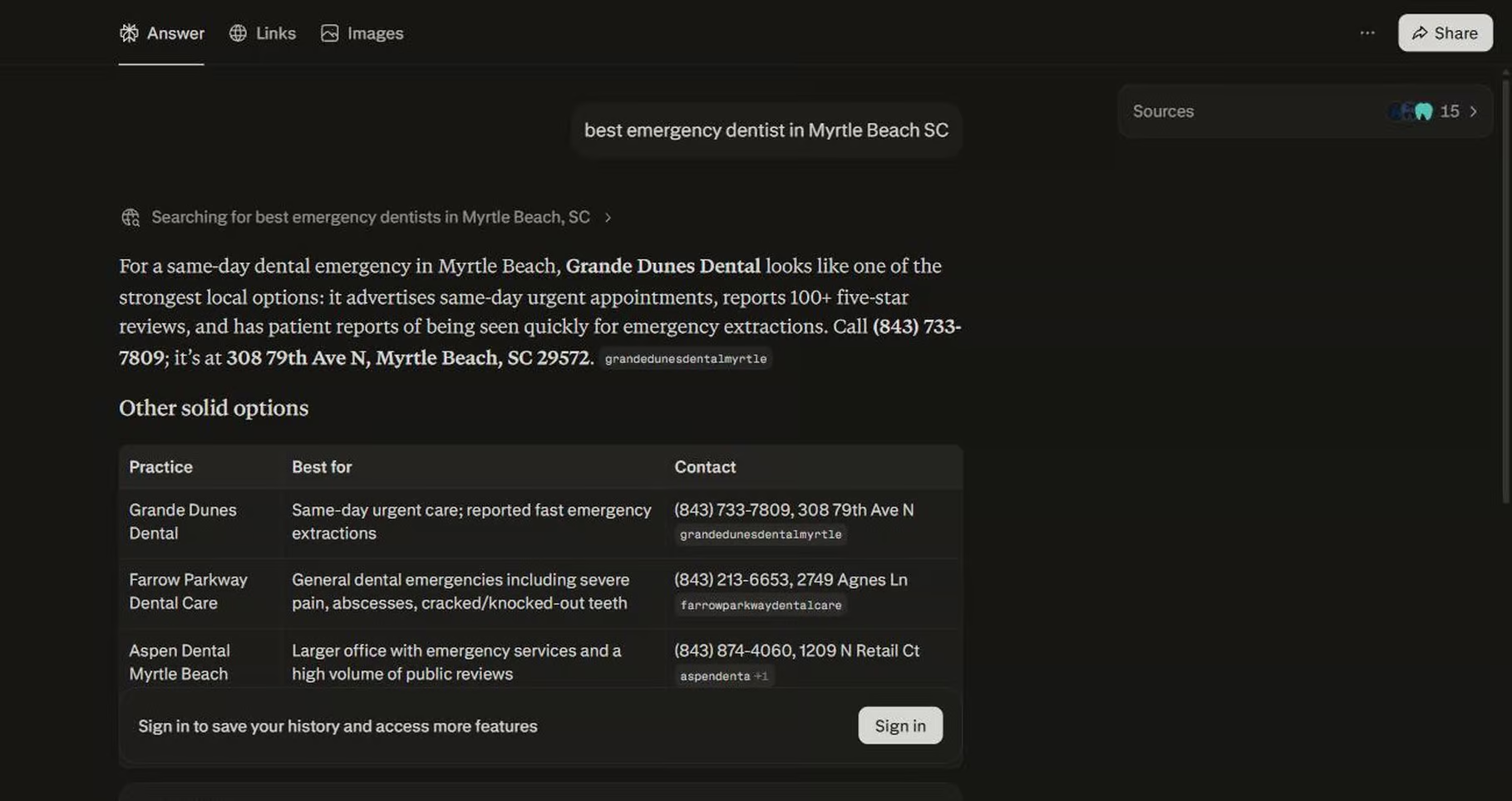
    Perplexity answering a local buyer-intent query by naming specific businesses with citations
    A real buyer-intent prompt. The assistant names specific businesses and cites its sources. If you are not in that answer, the customer never sees you.

    Ranking tools measure one thing: where a URL sits in a list of blue links. AI assistants do not return a list. They return a written answer, sometimes with a citation, often without one. A site that ranks fourth on Google can be the only brand named in a Perplexity answer, and a site that ranks first on Google can be missing from the ChatGPT reply entirely.

    The Backlinko research highlights three patterns:

    • Citations in AI answers do not track with traditional rankings. A page that ranks on page two can outcite a page that ranks on page one for the same query.
    • AI engines pull from different surfaces. Google AI Overviews lean on Google’s own index. ChatGPT leans on its own retrieval stack plus live browsing. Perplexity behaves like a research engine with citations on most sentences.
    • Citation sources cluster. A small set of pages, mostly listicles, reviews, and directories, account for a large share of citations across many prompts.

    What Backlinko measured

    The study ran a set of buyer-intent prompts through ChatGPT, Perplexity, and Google AI Overviews and recorded which brands were named, which URLs were cited, and how those answers changed prompt to prompt. The prompts were commercial in nature, the kind a buyer types when they are close to a decision. The output was a citation report per engine, per prompt.

    Backlinko also pulled in third-party context. The Orbit Media annual survey gives the long view on how SEO teams spend their time. The Airops benchmark gives a snapshot of which AI engines brands appear in most often. G2’s category data rounds out the picture by showing how review platforms influence which product gets recommended. Together these sources make a case that AI citation tracking needs its own measurement layer.

    How to run an LLM citation audit

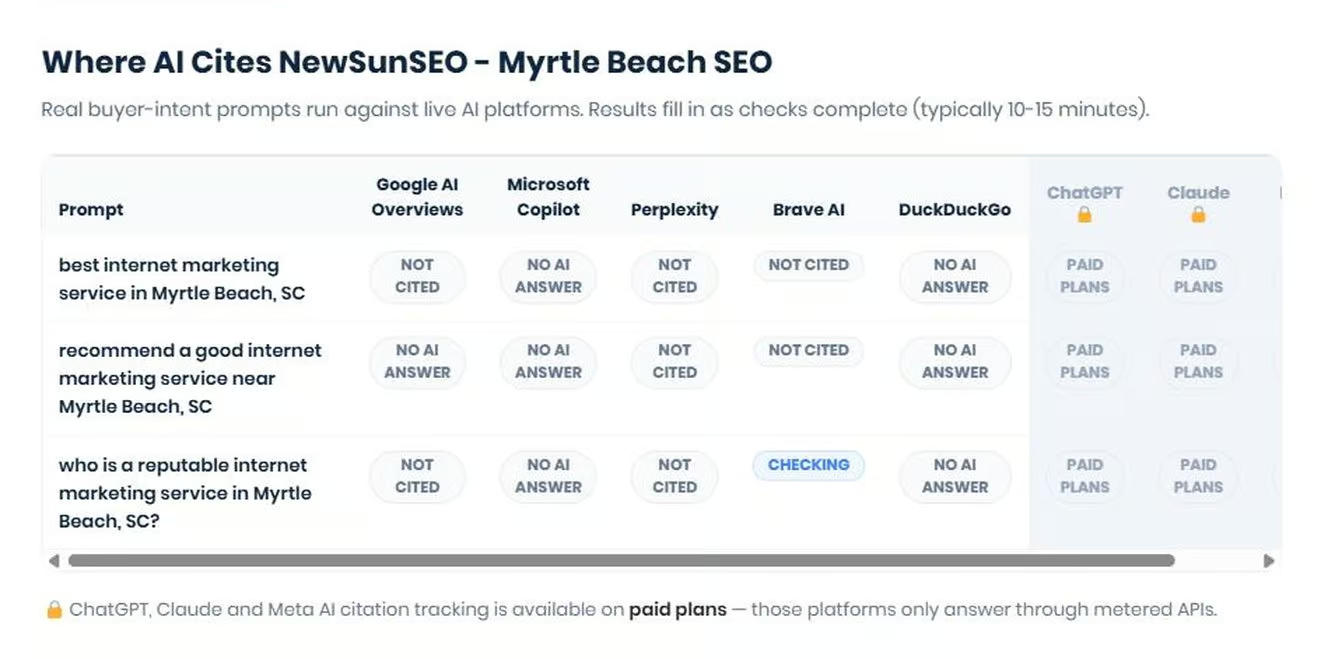
    BizScoreAI prompt tracking matrix showing cited and not cited per AI platform
    BizScoreAI runs real buyer-intent prompts against Google AI Overviews, Microsoft Copilot, Perplexity, Brave AI and DuckDuckGo, and reports cited or not cited for each.

    A practical audit follows four steps.

    1. Build a prompt list from real buyer questions

    Pull questions from sales calls, support tickets, Reddit threads, and the People Also Ask box. Group them by intent: comparison, best of, how to, near me, pricing. Each prompt becomes a row in a tracking sheet.

    2. Run each prompt in each AI engine

    Send every prompt to ChatGPT, Perplexity, Google AI Overviews, and any other engine the brand cares about. Record whether the brand is cited, which URL is cited if any, and which competitors are named.

    3. Score visibility, not just presence

    Being mentioned is not the same as being recommended. Count first-position recommendations, count mentions inside the body of the answer, and count appearances in cited source lists. The Backlinko work treats these as distinct outcomes.

    4. Turn the audit into a fix list

    Most citation gaps come from the same handful of issues: pages that AI crawlers cannot reach, structured data that is missing or malformed, content that does not answer the prompt directly, and weak third-party presence on the directories AI leans on.

    What blocks a brand from being cited

    Even with great content, a site can be invisible to AI engines for technical reasons.

    • Robots rules that block AI crawlers. A blanket Disallow against GPTBot also blocks OAI-SearchBot and ChatGPT-User, which do different jobs. One is for training, one is for indexing ChatGPT Search, and one fetches pages in real time when a user asks ChatGPT to look something up. Blocking all three shuts a brand out of citations even when the content is good.
    • Missing or thin llms.txt. Claude and Perplexity both confirm they read llms.txt. Google says it ignores the file. The choice matters for the engines that respect it.
    • No structured data. FAQ schema, Organization schema, and Product schema give AI engines fast access to the facts they need to cite a brand confidently.
    • Weak third-party footprint. Review platforms, business directories, and Wikipedia entries often determine which brand an AI assistant names. A brand with strong content and no third-party presence gets passed over.

    How to measure AI visibility in practice

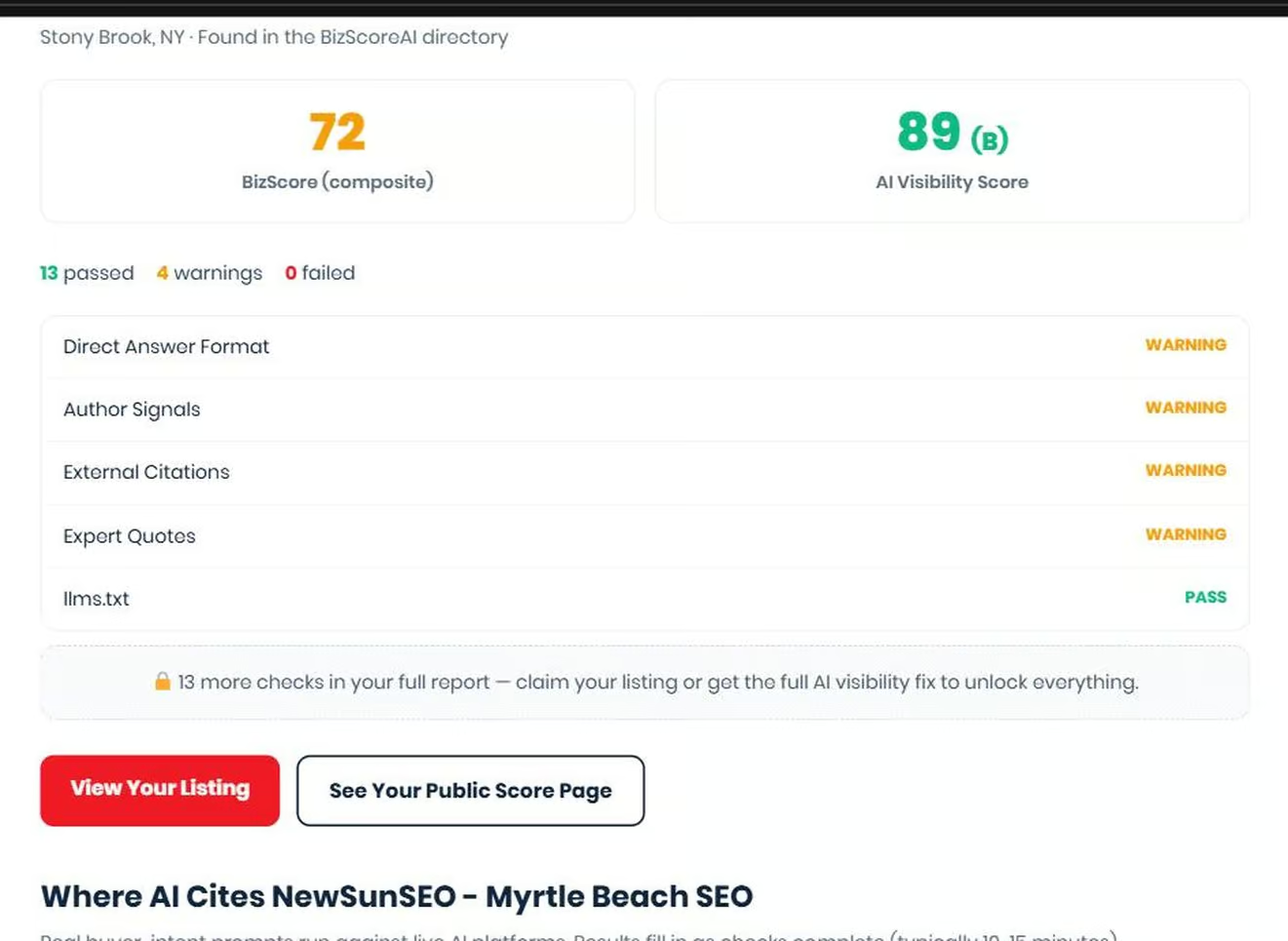
    BizScoreAI scan result showing an AI visibility score with checks passed and warnings
    The same scan grades the site itself: an AI visibility score, and the checks that passed or need work.

    The fastest way to see whether AI engines can read a site is a free scan that checks the technical layer. BizScoreAI runs 17 checks across AI search, SEO, local SEO, and directory accuracy, then sends real buyer-intent prompts into Google AI Overviews, Microsoft Copilot, Perplexity, Brave AI, and DuckDuckGo and reports cited or not cited for each platform. ChatGPT, Claude, and Meta AI tracking are on paid plans. The free scan takes under a minute and shows which fixes will move the score fastest.

    For a deeper review, the BizScoreAI AI Audit takes the scan further with a prioritized fix list and hands-on changes applied to the site. Pair that with the SEOScanPro AI Visibility tool, which scores the technical layer across AI Discovery, AI Trust Signals, Structured Data, and Content Readiness and ties each score to the measured value on the page. Together they cover both the citation question and the underlying crawlability question.

    Where local SEO fits in

    Local searches are where AI engines lean hardest on directories and review platforms. A brand that wants to be cited for “best plumber near me” needs consistent NAP data, strong reviews, and a claimed listing on every directory an AI assistant checks.

    The SEOScanPro SEO audit covers 85+ technical checks across 17 categories and shows the measured value behind every score, including structured data, crawlability, and content depth. For service-area businesses, the SEOScanPro GEO Grids tool measures ranking from dozens of points across the map rather than one city average, so a brand can see exactly where it shows up and where it does not. Rank tracking through SEOScanPro Rank Tracker fills in the keyword movement that AI citations do not yet capture.

    What to do this week

    The Backlinko research points to a short list of moves that pay off fastest:

    • Audit robots.txt for each AI crawler by name rather than as a block.
    • Add or fix structured data on the pages that answer buyer questions directly.
    • Claim and complete every directory listing that the AI engines read.
    • Build a prompt-to-citation report for the ten questions buyers ask most, and refresh it monthly.

    Each of these can be checked in under an hour with the right scan, and the gap between a brand that has done them and one that has not shows up quickly in citation reports.

    FAQ

    What is LLM prompt tracking?

    LLM prompt tracking is the practice of sending real buyer questions to large language models like ChatGPT, Perplexity, and Google AI Overviews and recording whether the brand is cited, which URL appears, and which competitors are named. The Backlinko study frames it as a separate measurement layer from rank tracking because AI answers do not behave like search result pages.

    How is AI citation tracking different from rank tracking?

    Rank tracking measures position in a list of links. AI citation tracking measures whether a brand is named or linked inside a written answer, and if so where in the answer. The same page can rank well in Google and still be absent from the ChatGPT reply for the same query, which is why the two need to be tracked separately.

    What blocks a site from being cited by AI engines?

    The most common blockers are robots.txt rules that block AI crawlers by mistake, missing or malformed structured data, content that does not answer the prompt directly, and a weak third-party footprint on the directories AI engines lean on. A free AI visibility scan can identify which of these apply to a specific site.

    Related coverage

  • AI Visibility: How to Get Your Brand Cited by ChatGPT, Perplexity, and Google AI Overviews

    AI Visibility: How to Get Your Brand Cited by ChatGPT, Perplexity, and Google AI Overviews

    Consumers are no longer typing every query into Google. They ask ChatGPT, Perplexity, Siri, and Google AI for recommendations on local businesses, contractors, law firms, restaurants, and clinics, and the AI returns a short, confident answer. The businesses that get named in that answer are the ones whose websites, listings, and structured data give AI clear trust signals. The rest stay invisible, even when their Google rankings look fine.

    This guide breaks down the signals AI platforms actually read, the gaps that keep most businesses out of the answer, and the practical steps to get cited next to (or instead of) your competitors.

    What AI looks for before it cites your business

    When a customer asks an AI assistant for a recommendation, the model looks for the same kind of evidence a careful human would: clear identity, consistent contact details, structured data that confirms what the business does, and content that directly answers the buyer’s question. If your business information is incomplete, inconsistent, or hard to parse, the model quietly drops you from the shortlist.

    Five failure modes show up again and again in audits of small and mid-sized businesses:

    • AI cannot tell what your business does because your homepage reads like a brochure, not a clear answer to a buyer question.
    • Your name, address, and phone number drift between directories, so AI treats each listing as a separate, uncertain entity.
    • Your site is missing the structured data (FAQ schema, LocalBusiness JSON-LD, llms.txt) that AI assistants rely on.
    • Your content does not directly answer the questions buyers actually ask, so AI cannot extract a quotable answer.
    • Competitors with stronger trust signals get recommended first, even when your service is comparable.

    The first step is to measure where you actually stand. A free AI visibility scan reports whether AI platforms can read, understand, and recommend your business, and shows the specific gaps to fix.

    The three layers of AI-readable trust

    AI platforms blend three sources of evidence before they recommend a business. Each layer has to be clean on its own and consistent with the others.

    1. AI discovery and crawl permissions

    AI assistants rely on a small set of named crawlers to fetch pages in real time and to confirm entities against listings. The main ones are GPTBot, OAI-SearchBot, ChatGPT-User, ClaudeBot, PerplexityBot, Google-Extended, and Applebot-Extended. Each obeys its own rules in your robots.txt. A single blanket block usually turns them all away at once, which means the AI cannot cite you even when it wants to.

    The practical fix is to know exactly which crawlers are blocked on your site today. An AI visibility check lists the seven by name and shows which get in and which are turned away, so you can decide which to allow, which to block, and which to leave alone.

    2. Structured data and on-page signals

    Structured data is the machine-readable layer that tells AI what your business is, where it operates, and what it offers. The minimum set most AI platforms look for:

    • FAQPage schema for common buyer questions.
    • LocalBusiness JSON-LD with NAP, hours, service area, and categories.
    • Speakable markup where it fits.
    • An llms.txt file that describes your site for language models. Claude and Perplexity confirm they read it; Google says it ignores the file entirely. It costs nothing to publish and may help the assistants that do read it.

    A deeper AI audit reviews your templates and tells you which pages have valid schema, which are malformed, and which stay silent.

    3. Listings and entity consistency

    AI cross-checks your business against dozens of directories before it commits to a recommendation. One mismatched address, a swapped phone number, or a missing Yelp listing erodes that confidence. Coverage across the major sources (Google, Apple Maps, Yelp, Facebook, BBB, Yellow Pages, Manta, the local Chamber of Commerce) matters more than any single citation.

    Local signals like NAP consistency and map-pack visibility can be tracked across a service area with a geo grids tool, which measures your position from dozens of points so you can see where you appear and where you do not.

    Why your Google rankings do not warn you

    The most common surprise in an AI visibility audit is that the site’s traditional SEO is fine. Googlebot and GPTBot are different crawlers obeying different rules. A plugin update or a single deploy can add one Disallow line, and from that day your site is missing from answers about your own industry. There is no warning email, no error in a dashboard, and no movement in Google Search Console. Your analytics record nothing because there was never a visit to record.

    This is why a dedicated AI visibility check belongs next to your regular technical audits, not inside them. Technical and content SEO audits cover 85+ checks across 17 categories, with the measured value behind every score; an AI visibility layer adds the named crawlers, the structured data check, and the entity clarity check that traditional audits usually skip.

    A simple, prioritized fix plan

    Most businesses do not need a rebuild to start getting cited. They need a short, prioritized list, and they need to act on it. The order matters more than the volume.

    1. Run a free AI visibility scan. A free audit takes about a minute, names which crawlers are blocked, whether llms.txt is present, and which schema is missing.
    2. Unblock the crawlers you want cited by. Decide per crawler. Keep GPTBot blocked if you do not want your content used for training, but allow OAI-SearchBot and ChatGPT-User so ChatGPT can fetch your pages live and cite you in real-time answers.
    3. Add FAQPage and LocalBusiness schema. Match the wording to the questions your customers actually type into AI. The BizScoreAI features page describes the scoring modules behind its AEO, SEO, and Local SEO categories.
    4. Tighten NAP consistency across directories. One canonical name, address, and phone number across every profile you control.
    5. Rewrite your top pages to answer questions directly. AI extracts short, confident answers. A paragraph that starts with the answer, then explains it, is more quotable than one that opens with brand history.
    6. Re-run the scan. Track the score as you fix each layer. Repeat after every deploy that touches robots.txt or templates.

    SEOScan Pro, the audit and tracking suite behind this checklist, is powered in part by BizScoreAI.com, which focuses on the AI visibility and entity consistency side of the same work.

    What an AI visibility score actually measures

    A score is only useful if you can take it apart. Useful AI visibility scores break down into four buckets: AI discovery (can crawlers reach you), trust signals (does the site look like a real business AI can stand behind), structured data (is the machine-readable layer present and valid), and content readiness (can AI extract a clean answer).

    Bands that recur across the industry look roughly like this:

    • 90 to 100: Excellent. AI assistants regularly cite this business.
    • 75 to 89: Strong. Citations happen in most queries but not all.
    • 60 to 74: Needs improvement. Cited for some queries, missing for the rest.
    • 40 to 59: Weak. Rarely cited; competitors usually win.
    • 0 to 39: High risk. Effectively invisible to AI search.

    The average business scores around 41 out of 100, and roughly 21 percent score below 30. The gap between where most businesses sit and where AI expects them to be is the room a focused fix plan closes.

    When the website itself is the ceiling

    Some scores can only climb so far on the site you have today. When outdated code, thin content, or a rigid template is holding the structured data layer back, two follow-on steps take the work further: a focused rebuild that removes the technical limits, and ongoing content creation on a steady cadence that keeps the AI visibility and search scores climbing rather than stalling.

    The order stays the same either way: measure, fix what is in your control on the current site, then decide whether a rebuild unlocks more than tuning can.

    What changes once AI can cite you

    The payoff is concrete. Businesses that move from the weak or needs-improvement bands into the strong and excellent bands start to appear in answer-engine recommendations for the queries their buyers actually run. One private investigation firm reported that two new customers said the firm popped up first when they asked AI for the best investigator in their area; they read the response, looked at the website and reviews, and hired the firm on the spot.

    That outcome depends on the same checklist above: crawlers allowed, schema present, NAP consistent, content answers the buyer’s question. The order of work is shorter than it looks, and the measurement loop is the part that keeps it honest.

    FAQ

    What is an AI visibility score?

    An AI visibility score measures how well a business can be understood, trusted, and recommended by AI assistants and search engines. It blends crawler access, structured data, entity consistency, and content readiness into a single 0 to 100 number with sub-scores per layer.

    How long does it take to improve AI visibility?

    Most of the early wins, unblocking crawlers, adding FAQ and LocalBusiness schema, and tightening NAP, ship within a day. Re-scoring usually shows movement within a week, and the gains compound as content is rewritten to answer buyer questions directly.

    Do I need a credit card to check my AI visibility score?

    No. A free scan runs the full check set on any site and returns results in under a minute, with no credit card required. Claiming a listing to track the score over time is also free.

    Related coverage


    This article summarizes reporting from bizscoreai.com, bizscoreai.com, bizscoreai.com, seoscanpro.ai, seoscanpro.ai.

  • Is GEO Working? How to Move Beyond Prompt Tracking

    Is GEO Working? How to Move Beyond Prompt Tracking

    Generative engine optimisation has quickly become the question on every ecommerce leader’s lips, and prompt tracking tools have not kept up with the answer. The dashboards show brand mentions, share of voice, and AI visibility scores across ChatGPT, Perplexity, Gemini, AI Overviews, and AI Mode, yet they cannot tell a team whether a website change actually made the business better. That gap is why more ecommerce teams are moving from passive monitoring to controlled experimentation, testing GEO changes the same way the industry learned to test SEO.

    Why prompt tracking falls short

    Prompt tracking is useful for a narrow set of jobs. It can show whether a brand appears in a sample of AI answers for a sample of prompts. It can flag early warning signs. It can describe how a brand is framed in certain contexts. It can help debug a specific visibility problem. It cannot, however, prove that a change to a website caused a measurable lift in business outcomes.

    The underlying reason is structural. Prompts are personal, often long, and shaped by prior conversation. The same user may follow up with a question that changes the entire context. Different users get different answers. The universe of possible prompts is effectively infinite, which is why some practitioners describe this as a “search volume one” world: there is one prompt per query, and almost no repeat behaviour to anchor a measurement against. A dashboard sampling a small slice of that reality cannot substitute for controlled testing.

    Why ecommerce is the right testing ground

    ChatGPT and its peers will not ship the shoes, manufacture the product, or fulfil the order. They may help a shopper research, compare, and decide, but the retailer, marketplace, travel site, or brand still owns the transaction. That gives ecommerce teams a structural advantage in the AI discovery era. Discovery may look more like a mix of search engine and chatbot, and the journey may be more conversational, but the commercial question is familiar: will the customer buy from you?

    Large ecommerce sites also have something most media and publishing sites do not: scalable templates. Product detail pages, product listing pages, category templates, internal search pages, faceted pages, buying guides, FAQs, and review blocks are all repeatable surfaces. Repeatable surfaces can be split into variant and control groups, changed, and measured. That makes ecommerce a practical place to run GEO experiments at scale.

    How LLMs find fresh product information

    AI systems draw on two broad information sources. The first is training data, the language, entities, relationships, and brand associations the model absorbed during training. Training data is largely fixed until the next training run, which makes it a slow lever. A team cannot walk into leadership with a strategy that amounts to waiting for the next model and hoping it likes the brand more.

    The second source is retrieval, often described as retrieval-augmented generation or RAG. When a user asks a question, the model can pull in fresh information during the interaction, opening fifteen or fifty tabs in the background, reading across the web, and synthesising an answer. For ecommerce, this matters because many of the questions shoppers ask depend on data the model cannot have memorised: current stock, today’s price, active discounts, latest reviews, delivery options, product availability, and new launches. Product recommendations need freshness, and that freshness typically comes from retrieving live pages, feeds, or search results.

    What fan-out queries change about optimisation

    Behind a single user prompt there is often a swarm of background searches. The model may break the task into fan-out queries for product comparisons, reviews, pricing, availability, best options for a use case, brand reputation, delivery details, and other supporting information. The user sees one answer. Behind that answer there may have been many searches.

    This shifts the optimisation question away from keyword-first thinking. In traditional search, a team asks which keyword it targets, where it ranks, and what the result looks like. In AI discovery, the hidden fan-out queries are where retrieval actually happens, and teams usually cannot see the full list. They may get clues, but they cannot treat the process as a clean keyword list. That is one reason controlled testing becomes more important than ever. A team can make a change, then measure whether that change moved LLM referrals, Google organic traffic, or the net business outcome, without needing perfect visibility into every hidden query.

    How to write a testable GEO hypothesis

    Traditional SEO hypotheses tend to work through one of three mechanisms: targeting new keywords, improving rankings for existing keywords, or changing the search result appearance to lift click-through. GEO has analogues, but the language changes. A GEO hypothesis might aim to target new fan-out queries, improve visibility for existing fan-out queries, influence the summary an LLM returns, or make a page, product, or brand easier for the model to recommend.

    The fourth mechanism feels close to conversion rate optimisation, except the converter is partly the machine. The question becomes whether the page has given the model what it needs to confidently recommend the product: product detail, comparison language, reviews, freshness, structured data, key features, FAQs, delivery information, stock signals, or buying guidance. A weak GEO hypothesis says “this might help AI visibility.” A stronger hypothesis reads: adding clearer product suitability information to product detail pages may help models retrieve and recommend these products for more specific fan-out queries while also improving confidence in the AI-generated summary. That version is testable, and that is the point.

    Where GEO testing happens on a large site

    GEO testing on large ecommerce sites happens on the same scalable surfaces SEO testing already uses. Product detail pages, product listing pages, category templates, buying guide modules, comparison content, FAQs, review summaries, key feature summaries, internal linking modules, structured data, freshness indicators, product feed-aligned content, and availability and delivery information can all be split into variant and control groups. The mechanics look familiar to anyone who has run an SEO A/B test. The difference is the journey being measured.

    In traditional search, a user might open several tabs, compare sources, read reviews, check products, and arrive at the site later. A lot of that research was visible across a trail of searches and visits. In AI discovery, more of that research happens inside the conversation. The model reads, compares, summarises, and narrows options before the user arrives. The site may only see the final click, which can be more valuable but is harder to interpret.

    Why GEO and SEO can disagree

    Many GEO changes are also plausible SEO changes. More useful content, better structure, fresher product information, clearer summaries, stronger internal links, and better structured data can all carry SEO hypotheses. That does not mean every GEO-positive change is SEO-positive. Most practical GEO work today still reaches AI systems through search-related retrieval, which creates overlap with SEO. Overlap is not sameness.

    A change can help an LLM understand and summarise a page while hurting Google organic performance. A change can make a page richer for AI retrieval while making it bloated, duplicative, or less effective in traditional search. This is where single-channel measurement becomes dangerous. A team that looks only at LLM referrals, sees a positive result, and rolls the change out could quietly lose more Google organic traffic than it gained. That is the bigger risk with guessing what works in GEO: a visible win in one channel can hide a larger loss elsewhere.

    What the Omio GEO test showed

    SearchPilot partnered with Omio to share early GEO testing results with the wider industry, and the lessons go beyond confirming that GEO can be tested. The clearest finding was that GEO and SEO do not always move together. In one test, adding brand USPs increased LLM-driven traffic by roughly 18 percent. In another, adding structured key takeaways performed positively for LLM-driven traffic, but would likely have hurt Google organic sessions by about 6.5 percent. Omio chose not to roll that change out and developed follow-up iterations instead.

    That is the practical value of testing. The AI result looked positive in isolation. The business result was not. Without measuring Google organic performance at the same time, the team could have shipped a net-negative change across a large site. This is also the strongest argument against treating GEO as a checklist. A tactic can be directionally plausible and still wrong for a specific site, page type, or business goal.

    What prompt tracking can and cannot tell you

    Prompt tracking has a role, and it is worth being precise about what that role is. The best comparison is rank tracking in traditional SEO. Rank tracking is useful for debugging. It can diagnose problems, show movement, surface early warning signs, and help teams understand where visibility may be shifting. It is not the same as business impact, and prompt tracking has the same limitation with extra complications.

    Teams do not know the full set of prompts users are typing. Many prompts are unique. Answers are personalised. The model may use memory, previous conversations, location, and other context. A brand may appear for a prompt in one run and not another. A dashboard can only sample a small portion of reality. It can help teams form hypotheses, notice issues, and explain some AI visibility patterns. It should not be the main evidence that a GEO programme is working.

    How to report GEO results to leadership

    Executive attention on AI search has arrived faster than the industry’s ability to answer it. Leadership wants to know whether the team is ready, whether it is doing the right things, and how it can move faster. Those are reasonable questions, and they deserve better answers than another dashboard of AI visibility scores.

    The answer that travels best is a measured one. Frame each GEO change as a hypothesis, test it against a control group, and report the joint outcome across LLM referrals and Google organic. Show the net business effect, not the channel effect. Be explicit about what was rolled out, what was held back, and what the next iteration will test. That gives leadership a programme it can govern rather than a checklist it has to take on faith.

    FAQ

    Why is prompt tracking not enough to measure GEO?

    Prompt tracking tools sample a small slice of how AI systems actually answer queries, and prompts are personal, long, and shaped by prior conversation. The full universe of prompts is effectively infinite, so a dashboard can show whether a brand appeared in some answers without proving that a website change caused a business outcome.

    Can GEO changes hurt Google organic traffic?

    Yes. A change that makes a page richer for AI retrieval can also make it bloated, duplicative, or less effective in traditional search. In SearchPilot’s work with Omio, one GEO-positive change was projected to lift LLM-driven traffic while costing roughly 6.5 percent of Google organic sessions, so the team chose not to roll it out.

    What surfaces on an ecommerce site can be GEO tested?

    Repeatable templates can be split into variant and control groups and tested the same way SEO A/B tests are run. That includes product detail pages, product listing pages, category templates, buying guides, comparison content, FAQs, review and feature summaries, internal linking modules, structured data, freshness indicators, product feed-aligned content, and availability and delivery information.


    This article summarizes reporting from searchpilot.com.

  • What the 403,000 Prompt AI Visibility Study Means for Your SEO Audit

    What the 403,000 Prompt AI Visibility Study Means for Your SEO Audit

    A researcher ran 403,000 prompts through 10 different large language models across roughly 100 industries, including several local search categories, then scored which business attributes most often produced mentions inside the generated answers. Ben Wills published the analysis as an attempt to map the inputs behind AI recommendations. The single category dissected in the published write-up is legal services for businesses, and the factor with the highest correlation is also the most familiar one to anyone who runs technical SEO audits: a page-one presence in Google.

    What the dataset actually covers

    The prompt pool spans 100 industries, with a deliberate skew toward local search verticals. That scope matters for site owners because the same prompts an LLM might receive for a personal injury lawyer in Cleveland are also being generated for plumbers, dentists, real estate agents, and HVAC companies. The legal category serves as the worked example in the published write-up, but the methodology is built to surface signals that travel across verticals.

    Each prompt was paired with a structured evaluation of the responding model. The output was scored for whether the model named a specific business, and if so, which attributes that business shared with other frequently named competitors. The analysis is correlational rather than causal, a point worth keeping in mind before any audit checklist gets built around it.

    The six factors that moved the needle most

    For the legal services for businesses segment, the attributes most tightly tied to LLM mentions ranked in this order:

    • Showing up somewhere on Google page one for the target query.
    • Running a homepage whose content closely matches the service being searched.
    • Holding strong backlink and overall domain authority.
    • Carrying a Wikidata entity record.
    • Showing meaningful activity in Reddit threads relevant to the service.
    • Being mentioned in Reddit discussions where buyers of the service congregate.

    The page-one Google correlation is the headline number. A business that ranks anywhere in the top ten organic slots appears far more often inside LLM answers than a business that ranks on page two or beyond, regardless of how polished its knowledge panel or schema markup looks in isolation.

    How to translate each signal into an audit action

    Check your Google SERP footprint first

    Before touching anything else, pull a clean rank report for the queries your customers actually type. Track both head terms and long-tail variations, including local modifiers. If your domain does not appear on page one for the prompts that matter, the rest of the audit is downstream work. Log which competitors own those slots, because their pages are the references the model is most likely pulling from when it composes an answer.

    Audit homepage relevance against target services

    Open your homepage with a fresh browser, ignore the design, and read the visible text. Does the H1, the first paragraph, and the navigation all reinforce the primary service and the geographic area you serve? If a crawler or a language model had to summarize your homepage in a single sentence, would the summary match what a searcher asked for? The study ranks homepage relevance ahead of backlink metrics, which suggests the model is reading the page itself, not just weighing links.

    Score your backlink profile and authority baseline

    Domain authority is not a Google metric, but the referring domain count, the ratio of branded to generic anchors, and the toxicity of inbound links all feed the same underlying signal. For local sites, focus on links from local news outlets, chamber of commerce directories, professional associations, and supplier pages. These pass the kind of corroborating context a model looks for when deciding whether to name a brand.

    Verify or build your Wikidata entry

    Wikidata is the structured-data backbone that a surprising number of language models consult for entity resolution. Search your exact legal business name on wikidata.org. If a record exists, check that the official website field, the industry field, and the location field all match your current reality. If no record exists, Wikidata’s notability bar is lower than Wikipedia’s, and a verified business with a public address and a real-world footprint can usually qualify. Keep in mind that edits go through a community review process, so plan for a few weeks of lead time.

    Map the Reddit threads where your buyers gather

    Search site:reddit.com for the service plus city combinations you target. Note the recurring subreddits. Look at how the top replies handle recommendations: do they name specific providers, or do they describe how to evaluate one? If real buyers post in those threads and your brand never appears, that is a measurable visibility gap. Genuine participation, not astroturfing, is what the data points toward.

    Why local and multi-location sites should pay attention

    Because the prompt pool includes local search verticals, the findings generalize. Service area businesses, multi-location operators, and single-location shops all sit inside the same correlation surface. Homepage relevance, entity consistency on Wikidata, and Reddit participation are all within reach for a small team with no enterprise budget. Link earning and Wikidata listing take longer to move, but they reinforce the same identity signal a model is looking for when it has to choose between naming your business or naming a competitor.

    What the correlation does not prove

    The study measures association, not cause. A page-one Google ranking may correlate with AI mentions because both draw on the same authority and entity signals, or because the models were trained on web snapshots that already reflected Google’s ordering. Either explanation points the same way for an audit: the levers that drive traditional rankings also drive AI recommendations. Treating the two as separate problems is a mistake the data does not support.

    FAQ

    Which study identified the ranking factors behind LLM recommendations?

    Ben Wills published the analysis after running 403,000 prompts through 10 different large language models across 100 industries, with a focus on local search categories. The legal services for businesses segment is the worked example in the published write-up.

    What was the strongest single signal in the study?

    Appearing on Google page one for the target query had the highest correlation with being named inside LLM answers in the legal services for businesses category, ahead of homepage relevance, domain authority, Wikidata presence, and Reddit mentions.

    What should a site owner check first based on this research?

    Start with a clean rank report for your target queries, then audit whether your homepage copy, your Wikidata record, your backlink profile, and your presence in relevant Reddit threads each reinforce the same business identity. The page-one SERP check is the gating item because every other signal stacks on top of it.

    Related coverage

  • How Creator Content Shapes AI Search Citations and What Marketers Should Track

    How Creator Content Shapes AI Search Citations and What Marketers Should Track

    AI assistants do not pull answers from brand websites alone. When ChatGPT, Gemini, Claude, or Perplexity respond to a question about a product, the cited sources are very often independent creator posts, third-party reviews, Reddit threads, YouTube transcripts, and long-form blogs written outside the brand’s own content stack. For marketers running technical SEO audits, this changes the checklist: visibility now depends on what other people publish about you, not only on what your own CMS controls.

    Why retrieval leans on third-party creators

    Retrieval-augmented generation systems score candidate sources by how independent and specific they read. A teardown video, a hands-on comparison, or a developer walkthrough that names a brand and ties it to a concrete result passes that filter more often than a polished product page. Corporate copy tends to read as promotional, so it gets deprioritized even when the underlying facts are correct.

    User-generated content fills the experience gaps brand sites leave open. Setup friction, pricing complaints, real benchmark numbers, and use-case stories show up in creator posts first, and AI systems lift that language directly into answers. The implication for an audit: scan beyond your own domain. The pages feeding AI answers about your brand may live on YouTube, Reddit, Substack, or independent blogs you do not control.

    What to check when auditing for AI visibility

    Traditional rank tracking misses this layer. AI answers do not have stable positions, and the same prompt can return different sources each run. A practical audit instead looks at prompt-level presence across the four major assistants and tracks three signals:

    • Whether your brand is named in the answer at all.
    • Whether a creator URL is cited as the source for that mention.
    • Which specific creator page keeps showing up across repeated runs.

    Pick 20 to 50 prompts your buyers actually ask. Pull them from your own search console, from sales call logs, and from autocomplete suggestions. Run that prompt set weekly, log the citations, and watch which creator URLs repeat. Patterns usually appear within a few months, and they tell you which independent voices are doing the heaviest lifting for your brand inside AI answers.

    Briefing creators so their posts get cited

    One-off sponsored placements underperform coordinated ones. The brands showing up in AI answers treat creator partnerships as a retrieval channel and brief accordingly. Four moves consistently produce citable posts:

    Anchor posts to buyer questions. AI answers are organized around queries, so a post that explicitly answers “Is [Product] good for [use case]?” is easier for retrieval to surface than a generic review. Share your real prompt list, including the long-tail questions that show up in search console, and ask creators to structure headlines around them.

    Push for specific claims. AI systems pull phrases that look like facts. “I cut my reporting time from three hours to twenty minutes using the export feature” survives retrieval. “This tool is amazing” does not. Brief creators to state the model they tested, the result they measured, what failed, and what surprised them.

    Get the brand name into the structure. Retrieval depends on entity recognition. When creators use the product name in titles, subheadings, image alt text, and the opening paragraph, the page is more likely to surface as a citation. A single mention buried in a caption pulls far less weight.

    Pick formats AI can index. Long-form blog posts, transcripts with proper headings, YouTube videos with accurate captions and descriptions, and Reddit threads with descriptive titles all feed retrieval. Short-form TikTok captions and image-only Instagram posts do much less because there is little text for an AI to lift. Briefing on format is part of the partnership.

    Common mistakes that kill citation value

    Three pitfalls show up in most creator programs that fail to move AI visibility. Treating the partnership as performance marketing. Affiliate links and conversion tracking measure clicks, not citations. AI systems cite the content, not the link, so a post optimized purely for affiliate revenue often reads as ad copy and gets filtered out of retrieval.

    Over-scripting the creator. Posts that follow a brand brief word for word lose the independent voice that makes them citation-worthy in the first place. The brief should cover questions, claims, and naming, then get out of the way.

    Ignoring creators you do not pay. Independent reviewers and community voices frequently drive more AI citations than sponsored posts, because their content reads as third-party evidence. Monitoring what those creators say about the brand, replying in comments, sending product updates, and granting access when it is requested, matters as much as the paid roster. An audit should map both groups.

    Measuring lift over time

    Track share of mention, not just presence. For each prompt in your set, record whether your brand appears and whether named competitors appear. A rising share of mention on AI answers usually tracks with creator content that names the brand and answers specific questions, rather than with broad awareness pushes.

    Layer in source attribution. When a creator URL is cited, log it. Over time you will see a short list of creators whose pages keep getting pulled, and a longer tail of one-off mentions. The short list is where to invest. The long tail tells you which formats and question types are working, so you can brief new creators to repeat the pattern.

    Run the prompt set on the same day each week, against the same four assistants, and store results in a simple sheet. The signal you want is stable citation of the same creator URLs across multiple assistants for multiple weeks. That is the pattern that separates teams showing up in AI answers from teams that do not.

    FAQ

    Why does creator content matter for AI search visibility?

    AI assistants synthesize answers from many public sources, and creator posts such as reviews, tutorials, Reddit threads, YouTube transcripts, and independent blogs are common inputs. When a creator mentions a brand by name with specific claims, the page is more likely to be cited in the AI’s answer, which lifts the brand’s visibility inside AI results.

    How should marketers brief creators to earn more AI citations?

    Share the real questions buyers ask, ask for specific named claims rather than vague praise, place the brand name in titles and headings rather than burying it in captions, and prioritize long-form formats with transcripts or text that AI systems can index.

    How do you measure AI citations from creator content?

    Track prompt-level presence. Pick 20 to 50 buyer questions, run them weekly across ChatGPT, Gemini, Claude, and Perplexity, and record whether the brand is mentioned, whether a creator URL is cited, and how share of mention compares to competitors over time.

    Related coverage

  • Claude Opus 5 release: what changed and what to audit on pages touched by AI-generated content

    Claude Opus 5 release: what changed and what to audit on pages touched by AI-generated content

    Anthropic released Claude Opus 5 on July 24, 2026, shipping the model to all of its platforms the same day. The new release keeps the list pricing of Opus 4.8 at 5 dollars per million input tokens and 25 dollars per million output tokens, while posting benchmark gains over its predecessor and approaching the frontier performance of Claude Fable 5 at roughly half the cost. For site owners running technical SEO audits, the relevant question is not the leaderboard but what a stronger, cheaper generation model means for the content, schema, and rendered pages already on a site.

    Why a frontier model release matters for SEO audits

    Every jump in generative model quality pulls more production-grade copy, agent-written code, and automated research into the open web. The Opus 5 numbers point in that direction. Anthropic reports state-of-the-art scores on Frontier-Bench v0.1 and the AA Coding Agent Index, and on CursorBench 3.2 at max effort the model lands within 0.5 percent of Fable 5 while costing half as much per task. Lower cost per task at the same quality band is the input that makes high-volume, agent-driven content generation economically rational again.

    For an auditor, that changes the prior. When a site has thousands of programmatic pages, FAQs, or templated landing pages, the assumption that a human drafted and verified each one is no longer safe. Audit checks should now actively test whether content could have been produced by a capable agent rather than assuming a human reviewer sat between the model output and the publish button.

    What Opus 5 actually changed compared with Opus 4.8

    Anthropic describes Opus 5 as materially better at verifying its own work and iterating on it. The release notes also flag enhanced visual output, stronger judgment, and more consistent reasoning. A fast mode is available, running about 2.5 times faster than the base configuration at roughly double the cost.

    Direct comparisons against Opus 4.8 are the cleanest signal for SEO work because they isolate the upgrade within the same product line. Anthropic reports the following gains, all from the company’s own announcement:

    • Organic chemistry tasks: 10.2 percentage points higher than Opus 4.8
    • Protein sequence analysis: 7.7 percentage points higher than Opus 4.8
    • Life sciences evaluations: better than Opus 4.8 on every test
    • Box data analysis workflows: 11 percent improvement
    • Box due diligence workflows: 17 percent improvement
    • Box overall workflows: 8 percent improvement
    • Financial modeling: 9 percentage points more accurate on average, one-third fewer turns, 60 percent less time
    • Trading benchmark: strongest Opus model tested, one-seventh the reasoning tokens of Opus 4.8 and under half the latency

    The shorter reasoning traces and lower latency both make bulk generation cheaper and faster. That is the part an audit spreadsheet should treat as a leading indicator.

    What the knowledge-work and agentic numbers imply for content workflows

    On agentic and knowledge-work evaluations, Anthropic reports three times the next-best score on ARC-AGI 3, 1.5 times the pass rate of the next-best model at the same cost on Zapier AutomationBench, and the best result at a given cost on GDPval-AA v2. Opus 5 is also reported as best and cost-efficient on both HLEAutomationBench and DeepSearchQA, and on OSWorld 2.0 it outperforms all models at one-third the cost of Fable 5’s result.

    For an SEO audit, agentic benchmarks matter more than raw Q&A scores. Higher pass rates on browser-driving tasks and longer-horizon workflows mean an agent can complete multi-step SEO tasks end to end: pulling SERP data, writing a draft, applying internal links, generating structured data, and publishing. The audit should therefore check for signs of end-to-end automation rather than only for traces of a single prompt.

    Pages to put on the next audit pass

    Opus 5 changes the shape of what an AI-generated page can look like in 2026. The following checks tighten that audit:

    Programmatic templates and location pages

    Audit any template that scales to thousands of URLs. With Opus 5 producing more coherent drafts at lower cost, the marginal cost of spinning up a new programmatic page is close to zero. Verify that each page has a unique value proposition, original data, and entity-level differentiation. Audit the SERP for templates that produce near-duplicate snippets across locations or products.

    FAQ and how-to content

    Agentic gains on Zapier AutomationBench and DeepSearchQA suggest that multi-step research and structured Q&A generation are now reliably within Opus 5’s range. Audit existing FAQ and how-to pages for originality, citation quality, and whether they answer a question that real searchers ask, rather than a question the template was prompted to answer.

    Schema markup and structured data

    Generating valid JSON-LD is a low-friction task for an agent that has reason to do it. Audit FAQPage, HowTo, Product, and Article schema for fields that are populated but not rendered on the page, or for types that do not match the visible content. Confirm that any Organization or Person markup points to a real entity a user can verify.

    Comparison and review pages

    GDPval-AA v2 and OSWorld 2.0 score Opus 5 strongly on knowledge-work tasks. Comparison and review content with thin first-party testing is the most exposed category. Audit these pages for original benchmarks, named methodology, and evidence that someone actually ran the product through the steps described.

    Long-form research and thought leadership

    Box due diligence and financial modeling gains point to better long-form synthesis. Audit long-form content for citation integrity, recency of sources, and whether the conclusions depend on a single model-generated summary. Cross-check statistics against primary sources before signing off.

    Alignment and safety findings that affect content evaluation

    Anthropic reports an automated behavioral audit score of 2.3 for misaligned behavior on Opus 5, described as the lowest among recent models in its evaluation. The company states Opus 5 has the lowest rates of deceptive behavior compared with Opus 4.8, Sonnet 5, and Fable 5, and is the safest model Anthropic tested in the reckless-actions risk category.

    Two findings matter for organic content audits. Anthropic notes that cyber classifiers intervene about 85 percent less often than they do for Fable 5, which means AI-generated content produced on Opus 5 will be harder to flag with classifier-style detection tools. At the same time, the model remains behind Mythos 5 on biology research and offensive cybersecurity, and does not advance the frontier in dual-use risky capabilities. Translation for SEO: detection tools will give more false negatives, so the audit now has to lean harder on content quality, originality, and entity verification rather than on a classifier score.

    Practical audit checklist for Opus 5-era sites

    Use this as a starting list for pages and templates that may have been touched by recent-generation models:

    • Check whether the content introduces a fact, statistic, or quote that is not cited to a primary source.
    • Confirm that every internal link target exists, is indexable, and is contextually relevant.
    • Verify that structured data matches the rendered HTML and is not auto-generated beyond what the page supports.
    • Audit author and publisher entities for verifiable credentials and a real byline trail.
    • Test templated pages with a paraphrase prompt to see how easily the model can reproduce the same content verbatim.
    • Compare page publish dates against the announcement timeline; pages published after July 24, 2026 and matching the assistant’s stylistic fingerprint deserve a closer review.

    FAQ

    When did Anthropic release Claude Opus 5?

    Anthropic released Claude Opus 5 on July 24, 2026, with availability across all Anthropic platforms on the same day.

    How much does Claude Opus 5 cost?

    List pricing is 5 dollars per million input tokens and 25 dollars per million output tokens, the same as Opus 4.8. A fast mode runs about 2.5 times faster at roughly double the base cost.

    What benchmark gains did Anthropic report for Opus 5?

    Opus 5 was reported as state-of-the-art on Frontier-Bench v0.1 and the AA Coding Agent Index, within 0.5 percent of Fable 5 on CursorBench 3.2 at half the cost, three times higher than the next-best model on ARC-AGI 3, and 1.5 times the pass rate of the next-best model at the same cost on Zapier AutomationBench. Science gains included 10.2 percentage points over Opus 4.8 on organic chemistry and 7.7 percentage points on protein sequence analysis.

  • What OpenAI’s GPT Live Means for Site Owners Building Conversational Interfaces

    What OpenAI’s GPT Live Means for Site Owners Building Conversational Interfaces

    OpenAI has rolled out GPT Live, a ChatGPT capability that accepts spoken input, returns spoken replies, and reads the user’s live camera feed in a single continuous session. The feature is being deployed inside the ChatGPT interface and is built around natural turn-taking, interruption handling, and visual awareness of whatever the device camera is pointed at. For product teams and SEO operators who already expose a chat or assistant surface to visitors, the launch raises concrete questions about what real-time multimodal input does to page performance, schema, and content discoverability.

    What changed in ChatGPT

    Until now, voice interactions in ChatGPT typically followed a request-and-response pattern: the user spoke, the model processed, and a single audio reply came back. GPT Live collapses that loop. The assistant can listen while the user is still talking, accept follow-up questions mid-stream, and incorporate what the camera sees at the same moment. The launch post describes the result as visual and on-screen awareness layered into spoken conversation, all running inside the existing ChatGPT product.

    Why this matters if you embed ChatGPT on a site

    Teams that drop a ChatGPT widget onto a landing page or a help center usually treat it as a self-contained component. Real-time voice and video change that assumption in three practical ways:

    • Page weight and time-to-interactive. Camera and microphone access triggers permission prompts, media negotiation, and WebRTC or equivalent transports. A page that loads a widget plus a live media stack can push past Core Web Vitals thresholds even when the chat itself is lightweight. Run a fresh Lighthouse pass after deployment and compare LCP, INP, and TBT against your pre-widget baseline.
    • Hidden content and indexability. Anything the camera frames, anything spoken aloud, and anything the assistant reads back lives outside the DOM. If your SEO strategy relies on chat transcripts or visual answers being crawlable, multimodal sessions create a parallel content layer that search engines never see. Decide in advance which interactions you still want to mirror into text or structured data.
    • Structured data and answer engines. Voice responses often surface as short, direct answers. If you publish FAQ or HowTo schema elsewhere on the same domain, audit whether the widget duplicates, contradicts, or cannibalizes those snippets. A spoken answer that drifts from your marked-up copy can fragment the entity signals you have been building.

    Technical checks to run this week

    You do not need GPT Live in production to prepare. Treat the rollout as a forcing function to tighten the surfaces a real-time assistant will touch:

    • Permissions audit. Map every page that requests camera or microphone access. Confirm each request has a clear user-initiated trigger, a visible state indicator, and a documented fallback for denied permissions. Browsers and crawlers both penalize surprise permission prompts.
    • Media transport review. Identify whether your current widget streams via WebRTC, MediaRecorder uploads, or a third-party SDK. Each transport has different latency, caching, and CORS behavior, and each one shows up differently in network and performance audits.
    • Transcript capture policy. Decide whether spoken sessions are logged, summarized, or discarded. If you keep any portion, make sure the storage path is consistent with your existing analytics and consent setup, and that the captured text is rendered somewhere on the page or feed so it can be audited later.
    • Schema reconciliation. Compare the entities and questions your assistant answers against the entities and questions covered by your JSON-LD. Gaps here are usually where answer engines pull inconsistent summaries.

    What is still unclear

    OpenAI’s launch post frames GPT Live as a feature inside ChatGPT, but the source announcement could not be retrieved in full. Pricing tiers, regional availability, and the exact rollout schedule were not confirmed in the materials available at writing time. Before you commit engineering hours, verify directly with OpenAI whether GPT Live is exposed through the API, limited to the consumer ChatGPT apps, or available to embedded widgets through a separate program.

    FAQ

    What is GPT Live?

    GPT Live is a ChatGPT capability from OpenAI that lets the assistant see, hear, and respond in real time using voice and live camera input within the ChatGPT interface.

    How does GPT Live differ from earlier ChatGPT voice mode?

    Earlier voice features worked turn by turn. GPT Live adds continuous listening, interruption handling, and simultaneous visual interpretation of what the device camera sees, all in one session.

    What should I audit on my site before deploying a real-time voice and video assistant?

    Run a permissions and media-transport review, recheck Core Web Vitals with the widget enabled, decide how spoken and visual content will be captured or surfaced for indexing, and reconcile assistant answers against your existing FAQ and HowTo structured data.

    Related coverage