
Category: Technical SEO

  • Internal Links: How They Work and Why They Matter for Search and AI

    Internal Links: How They Work and Why They Matter for Search and AI

    A deliberate internal linking strategy gives both users and crawlers a clear signal about which pages on a site matter most. Poor internal linking leaves orphaned pages, redirect chains, and pages buried too deep in the structure, all of which reduce a site’s visibility in search and in AI-driven results.

    What are internal links?

    Internal links are hyperlinks that lead users to other pages on the same website and help search engines and AI crawlers understand a site’s structure.

    Types of internal links

    Internal links fall into two groups: structural links, which stay the same across a site, and contextual links, which change with the content.

    Types of structural links include:

    • Navigational links: appear in the site’s main menu.
    • Footer links: placed in the site’s footer area.
    • Breadcrumb links: show a page’s location within the site hierarchy.
    • Sidebar links: located in the sidebar for easy navigation.

    Types of contextual links include:

    • Call-to-action links: prompt conversions or actions within the text.
    • Image links: hyperlinked images.
    • In-content links: links within content like blog posts and web pages.

    Internal links vs. external links

    Internal links direct users from one page of a site to another page within the same domain, as opposed to external links, which point from a site to a page on another domain. Internal links improve navigation, pass link authority among pages, and help bots crawl the site.

    External links cite references and add context from other domains. When those domains are reputable, the links build trust and authority. Backlinks from other sites to your pages can raise domain authority and rankings.

    Why are internal links important for SEO?

    Internal links help search engines, AI search platforms, and users navigate a site, and they pass authority to weaker pages.

    Search engines crawl internal links to map the relationships between pages on a site, and that map helps Google decide which pages sit at the top of the site’s hierarchy. Link equity that flows through those paths can lift the rankings of pages that would otherwise have little authority.

    AI search platforms retrieve and cite passages rather than whole pages. When cluster pages consistently point to one pillar, that pillar becomes the page most likely to get cited as the source on that topic.

    Users follow internal links to related pages on the same site, which can increase time on site and add pages per session before a conversion.

    1. Internal links help search engines understand a site’s structure

    Google’s crawlers discover pages by following internal links. Google’s own documentation states that some pages are known because Google has already visited them, while others are discovered when Google extracts a link from a known page to a new page.

    2. Internal links pass authority

    Internal links pass authority to other internal pages. A page that earns many backlinks, and thus has higher authority via PageRank, can strengthen other pages through internal links. Only part of that authority is passed, and contextual relevance matters: links are most effective when they are aligned with user needs and content topics.

    3. Internal links help users navigate between relevant pages

    Internal links encourage visitors to navigate to related pages, extending the time they spend on the site and raising the chance they complete an action such as a purchase or a form submission.

    How to build an internal linking strategy

    Start with site structure, then place links on individual pages.

    1. Plan the site structure

    Planning the site structure means deciding how content is organized and linked so users and search engines can follow a clear hierarchy, and a pyramid-like layout often works best, with the homepage at the top, category pages in the middle, and individual posts at the base.

    • Top: homepage or main pillar pages.
    • Middle: subcategories or cluster pages.
    • Bottom: specific content pages.

    This pattern is often called hub-and-spoke: the homepage or pillar acts as the hub, and the pages below are the spokes that link back up. Silo structures take the same hierarchy and keep each topic’s pages linking mostly within their own category. The shared goal is keeping the most important pages just a click or two from the homepage, with supporting content grouped into clear topics rather than scattered across unrelated categories.

    2. Identify pillar pages

    Pillar pages are comprehensive resources that cover a broad topic and link to more specific cluster pages to strengthen the site’s structure. Pillar pages help build topic clusters, which are groups of related content. Pillar pages often target broad, high-volume keywords and sit near the top of the marketing funnel, providing general information that sparks interest. For a retail site, a pillar page for washing machines might link to sub-pages about specific washing machine types, which then link to even more specific product categories. Avoid making pillar pages too narrow. There needs to be enough cluster pages to support them.

    3. Create topic clusters

    Topic clusters expand on the pillar topic in more detail, with each cluster linking back to the pillar to reinforce topical relevance. For a copywriting pillar, clusters might cover what copywriting is or email copywriting tips. Clusters can include sub-pages, for example, an email copywriting cluster might include pages on subject lines and CTAs, and those should link back to the main pillar page.

    This structure also serves AI search platforms well. When a system breaks a query into related sub-questions, a process called query fan-out, a pillar-and-cluster structure signals which page holds the deepest, most authoritative coverage of the topic. Clusters get messy without planning, so the practical first step is mapping them out and listing relevant supporting pages in a spreadsheet.

    4. Use authority pages to pass link equity

    Authority pages are pages with high-quality backlinks, and they pass link equity to the pages they link to. To use them effectively, identify the highest-authority pages on the site, then add internal links from those pages to less authoritative pages on relevant topics. A standard workflow is to export the top referring-domain pages into a strategy document, then add internal links from those pages to weaker pages that need a boost.

    3. Support new content

    New pages have few backlinks of their own, so internal links are what get them discovered and ranked. To start, pick a new piece of content or a page that needs better performance, then look for relevant interlinking opportunities. A practical method is to use a site: search operator to find pages that mention the target keyword, collect those URLs into a strategy document, and add links from each one to the new page. Google Search Console’s Links report also shows which existing pages already discuss related topics, giving another way to surface candidates. A common target is at least two or three internal links pointing to every new piece of content.

    6. Choose the right anchor text

    Choosing the right anchor text, the clickable text in a hyperlink, helps search engines and AI search platforms identify what the linked page is about. Unlike backlinks, internal anchor text is entirely under the site’s control. Good internal anchor text is brief, ideally five words or fewer, relevant rather than vague like click here, and optimized. Exact-match anchor text is acceptable for internal links when it is relevant; keyword stuffing is not. Internal links should be followed by default so search engines pass authority through them. The rel=”nofollow” attribute is reserved for low-value utility pages like login or cart pages, since it tells search engines not to pass authority through that link.

    7. Add navigational links

    Navigational links make it easier for bots and users to find the most important pages. They are among the most important internal links because they appear permanently across the site in the top menu, sidebar, or footer. This main navigational structure usually features product categories, services, or core content topics.

    Getting navigation right comes down to two things: staying consistent and staying visible. Keep the menu consistent across pages. If the menu changes from page to page, bots and users lose the map they have built of the site. Keep the nav crawlable. AI crawlers do not execute JavaScript the way Google does, so if the menu renders via JavaScript, which is common with dropdowns and hamburger menus, most AI crawlers will not see it at all. Test that the nav appears in view-source, not just in the rendered page. Once the nav is consistent and crawlable, prioritize navigational links to the most important pages and let relevance set the number everywhere else. A few links that help a reader get somewhere useful beat a crowded set that does not.

    Auditing a site’s existing internal links

    Auditing existing internal links helps map the current site structure so issues can be identified and fixed. A site audit can surface common problems like broken internal links or pages with no internal links. Below are nine common internal linking mistakes, how to find them, and how to fix them so a site does not lose visibility in search and AI.

    1. Broken internal links

    Broken internal links direct users and crawlers to pages that do not exist. Deleted pages and mistyped URLs often cause these errors. They return 404 errors and pass no authority. In a site audit tool, the Internal Linking report under Thematic Reports lists broken links in the Errors section. The fix is to remove or replace each link with a valid link that points to a live page.

    2. Too many internal links on a page

    Having too many internal links on a page can make it harder for crawlers to determine which ones matter, since hundreds or thousands of links on a single page dilute signals about which pages the page author considers most important. Fewer, more targeted links typically give users a clearer path through the site.

    FAQ

    What are internal links?

    Internal links are hyperlinks that lead users to other pages on the same website. They help search engines and AI crawlers understand a site’s structure and they pass authority between pages.

    Why are internal links important for SEO?

    Internal links help search engines understand how pages on the same domain relate to each other and pass authority from stronger pages to weaker ones.

    What is the difference between internal and external links?

    Internal links point from one page of a site to another page on the same domain. External links point from a site to a page on a different domain. Internal links aid navigation and distribute link equity; external links build credibility, authority, and referral traffic.

    Try the site audit tool
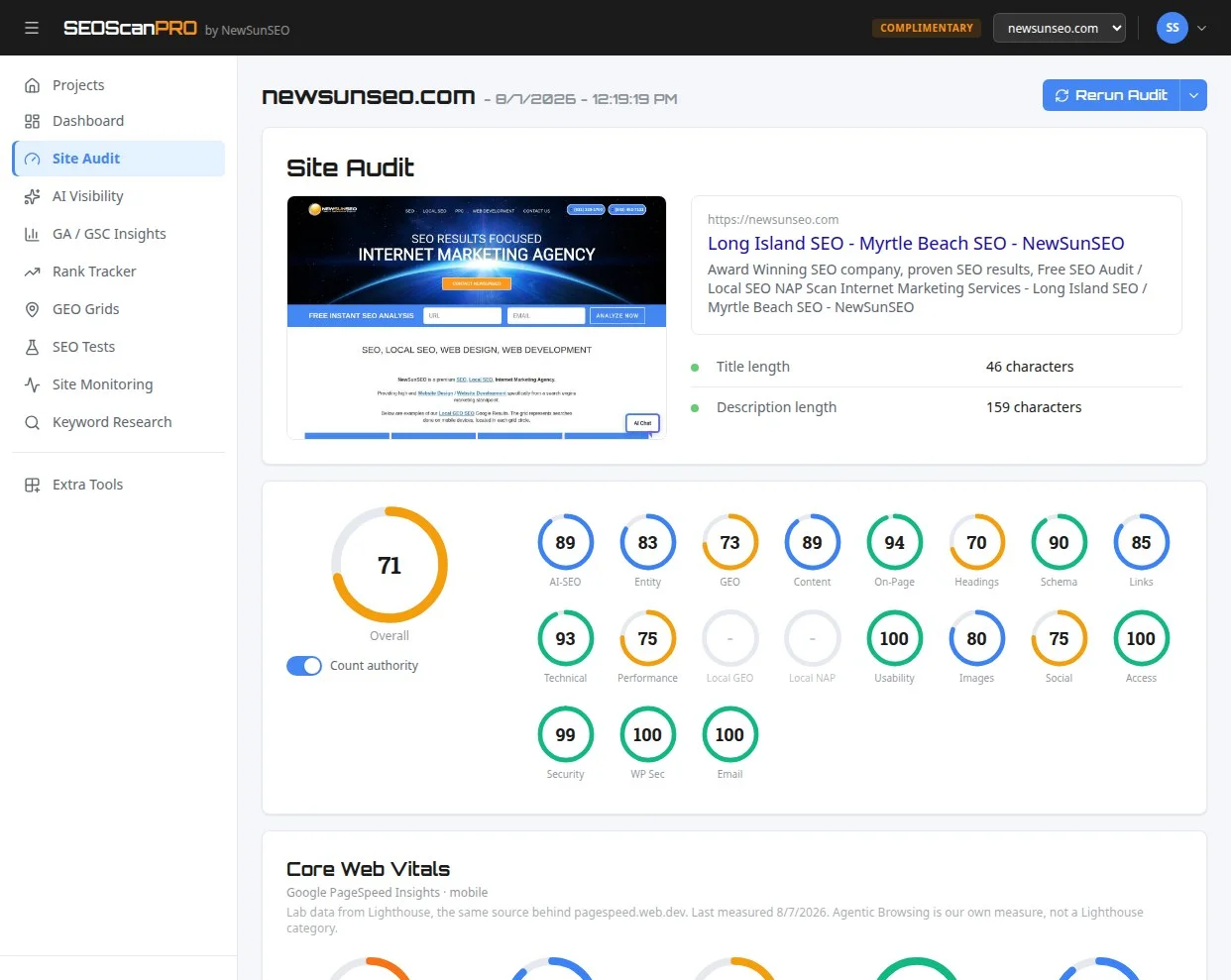
    The SEOScanPro site audit report

    The site audit tool runs a full technical audit of a site and shows the measured result behind every check. Open the site audit tool.


    This article summarizes reporting from semrush.com.

  • Misconfiguring Cloudflare Can Hurt Your SEO Badly

    Misconfiguring Cloudflare Can Hurt Your SEO Badly

    Keeping Googlebot explicitly allowlisted in Cloudflare is what protects your organic traffic, your Google Ads, and your Merchant Center listings, and it takes one setting to confirm. Get it wrong and a single toggle in Cloudflare’s bot and crawl settings can quietly stop Google from crawling a site, dropping rankings, breaking Ads, and pulling product listings within days. The damage is reversible but recovery can take weeks, as two recent cases posted on LinkedIn show.

    Both examples trace back to firewall or crawl control rules that were tightened to stop unwanted bots, then switched off traffic from the crawlers the site actually needed, including Googlebot. Because the misconfiguration looked like an algorithm penalty or a core update at first glance, it took site owners time to find the real cause.

    What happened in the first case

    A site’s managed IT provider turned on Cloudflare’s crawl control feature, which is designed to stop bots from hitting a site. The setting blocked all bots by default, including Googlebot. The site’s organic Google traffic disappeared, Google Ads kept serving on a site that Google could no longer crawl, and all Merchant Center listings were removed.

    Organic traffic was gone for roughly two weeks before the issue was caught and fixed, and the site was only starting to recover once the settings were corrected.

    What happened in the second case

    At an online marketplace, bot traffic was hitting the servers hard enough to threaten uptime. The team added bot access restrictions at the firewall level to keep the site available to real users. The same rules kept Google from crawling key product pages, and search visibility dropped sharply. From the outside the chart could pass for a core update or a spam update, but the cause was configuration, not algorithm.

    Why this is more common than people think

    Cloudflare exposes many toggles and rule sets aimed at AI bots, scrapers, and unwanted crawlers. Read out of context, several of those settings will block Googlebot as a side effect. Once that happens, three things tend to break at once:

    • Organic Google traffic drops as pages fall out of the index or stop ranking.
    • Google Ads keep spending against landing pages Google can no longer fetch.
    • Merchant Center listings are removed because the product feed destination returns crawl errors.

    How to tell configuration from an algorithm update

    A sudden loss of crawl activity in server logs, a flat Search Console crawl rate, or crawl errors spiking after a Cloudflare or firewall change are strong signals the cause is technical. A real algorithm or spam update shows ranking shifts without a matching drop in crawl volume. When organic traffic falls on the same day a bot, crawl, or WAF rule was changed, the configuration change is the first place to look.

    Cloudflare settings to audit before they ship

    • Crawl control and bot fight mode confirm Googlebot and other verified bots are allowlisted.
    • Security rules and WAF custom rules exempt known user agents and verified search bots.
    • Rate limiting rules target the URLs and paths that need protection rather than the whole property.
    • Super Bot Fight Mode’s verified bots setting is on, since this is what keeps Googlebot and Bingbot working.
    • New firewall or access rules are tested against real user agents before being pushed to production.

    Audit these rules any time someone other than the SEO owner changes Cloudflare or hosting settings, since managed IT providers and hosting migrations are a common trigger.

    How to recover after a misconfiguration

    1. Reallow verified Googlebot, Bingbot, and any AI crawlers the site actually wants to allow.
    2. Confirm Google can fetch key URLs with a server header check or the URL Inspection tool in Search Console.
    3. Resubmit affected sitemaps and request indexing for priority pages.
    4. Check Merchant Center and Google Ads for diagnostic changes once crawling resumes.
    5. Watch rankings, indexing, and crawl stats daily for the next several weeks since recovery is rarely instant.

    This is not new. Misconfigured robots.txt files and Apache rules blocked engines for years. The risk is higher now because Cloudflare, WAFs, and bot management tools expose more toggles, more providers touch these settings, and the blast radius includes ads and Merchant Center, not just organic search.

    FAQ

    Can Cloudflare block Google from crawling a site?

    Yes. Bot management, crawl control, and firewall rules can all be configured to block Googlebot, which stops indexing and can remove Google Ads and Merchant Center listings.

    How long does it take to recover from a Cloudflare misconfiguration?

    Recovery depends on how long the misconfiguration was live. In one case, organic traffic was gone for about two weeks and took additional weeks to return.

    How is a configuration issue different from a Google algorithm update?

    An algorithm update shifts rankings while crawl rate stays normal. A Cloudflare or firewall misconfiguration drops crawl traffic at the same time rankings fall, and shows up in server logs and Search Console crawl stats.


    This article summarizes reporting from seroundtable.com.

  • Anthropic’s Claude for Small Business: What Site Owners Should Audit When AI Agents Sit Inside SaaS Stacks

    Anthropic’s Claude for Small Business: What Site Owners Should Audit When AI Agents Sit Inside SaaS Stacks

    Anthropic launched Claude for Small Business on May 13, 2026, packaging agentic workflows and pre-built connectors for Intuit QuickBooks, PayPal, HubSpot, Canva, Docusign, Google Workspace, and Microsoft 365 inside its Claude Cowork interface. The product ships with 15 agentic workflows and 15 skills covering finance, operations, sales, marketing, HR, and customer service, and Anthropic framed the launch as part of its public benefit mission to give smaller companies AI tooling that has historically been built for the enterprise. For site owners and SEO teams, the launch signals a near-future in which AI agents routinely read from and write to the SaaS systems that drive revenue, which changes what needs to be checked on the technical audit checklist.

    Why an AI agent product launch matters to a technical SEO audit

    When an AI agent can pull a deal record from HubSpot, generate a campaign asset in Canva, and queue an invoice reminder through QuickBooks in a single flow, the SaaS stack stops being a passive backend. It becomes a content surface that AI reads from, generates against, and posts into. Technical SEO work has long focused on crawl, rendering, structured data, and page speed. A product like Claude for Small Business adds new audit questions about what the agents can see, what they can publish, and what URLs or assets those actions produce.

    The connector model changes how data flows into your pages

    Anthropic said the connectors plug into QuickBooks for payroll planning, the monthly close, cash-flow work, tax-season prep, and reconciliation; PayPal for settlements, invoicing, disputes, and refunds; HubSpot for lead triage, customer pulse, and campaign attribution; Canva for design, publishing, and performance tracking; and Docusign for sending contracts and filing the executed copy back. Each connector is a read-and-write pathway between Claude and a system of record. If your marketing site relies on any of these systems as a source of truth, audit teams should map every pathway an AI agent could use to publish or modify content.

    What to check on pages and assets the agents touch

    The workflows Anthropic highlighted include building a 30-day forecast, drafting a plain-English profit and loss statement, surfacing cash position and sales trends on one page, and finding slow revenue stretches in HubSpot before generating campaign assets in Canva. The named skills include an invoice chaser, margin analyzer, month-end prepper, tax-season organizer, contract reviewer, lead triager, and content strategist. Several of those skills produce pages, summaries, or assets that live on a public or internal domain, which means they have a URL, a render path, and an indexing profile whether anyone planned for it or not.

    Pages and dashboards worth auditing

    Start with the assets Claude is most likely to publish: the one-page cash-and-sales summary, the plain-English P&L, the campaign assets generated in Canva, and the contract status pages surfaced from Docusign. Confirm that each has a canonical URL, a robots policy that matches its visibility intent, structured data where appropriate, and no stray parameters that could create duplicate indexable paths. If the AI generates the summary on demand and serves it as a transient page, verify that the URL either returns a noindex header or is excluded from the sitemap.

    API and integration endpoints

    Each connector talks to a SaaS vendor through an API. If your site or your agency setup exposes any of those APIs to an AI agent, the audit should cover authentication, scope, and rate limits. A connector that can publish to Canva or file a Docusign contract has at least the same authority as a logged-in marketing user. Confirm that tokens are scoped to the lowest privilege needed, and that the audit log inside each SaaS tool captures agent-initiated actions separately from human actions.

    Permissions, approvals, and data handling

    Anthropic stated that every task and workflow is initiated by the user, that the user approves the plan first or can let it run end-to-end, and that existing permissions hold so an employee cannot see more through Claude than they can in QuickBooks or Drive today. The company also said it does not train on customer data by default on its Team and Enterprise plans, with full details in its Trust Center. Anthropic added that a survey it ran with small business owners found half named data security as their single biggest hesitation about AI.

    From an audit standpoint, the permission claim is the most important to verify in your own environment. If a junior marketer cannot see executive compensation in QuickBooks today, they should not be able to surface it through a Claude prompt either. Run permission tests for each role that touches the agent, and document the matrix. Where the SaaS tools expose their own audit logs, enable them and route the agent-only events into a separate report so they are easy to review.

    Who is endorsing the integrations

    Anthropic published comments from partners alongside the launch. Joe Preston, VP of Product Management at Intuit QuickBooks, said the integration gives small businesses AI-powered automations to manage finances, accelerate payroll, and generate data-backed insights. Angela DeFranco, GM and VP of Product for HubSpot’s Marketing Hub, said HubSpot partnered with Anthropic to build the first CRM connector for Claude so go-to-market teams can access their HubSpot context wherever they work. Anwar Haneef, GM and Head of Ecosystem at Canva, said the integration lets a business owner go from idea to published, on-brand design in one flow.

    Daniela Amodei, Co-founder and President of Anthropic, said small businesses make up nearly half the American economy but have never had the resources of bigger companies, and that AI is the first technology that can finally close that gap. Customer comments included Brian Ludviksen, COO of Purity Coffee, who said the product problem-solved for him and showed him problems he did not know he had, and Mike Beckham, CEO of Simple Modern, who said hours of looking at stuff that does not matter are gone. Ryan Olson, Technology and Innovation Manager at MidCentral Energy, said it frees up tedious clerical work for more value-add tasks.

    The training layer: AI Fluency for Small Business

    Anthropic partnered with PayPal on AI Fluency for Small Business, a free on-demand course taught by owners who have built AI into their own operations, including Prospect Butcher Co. in Brooklyn and MAKS TIPM Rebuilders in California. Amy Bonitatibus, Chief Corporate Affairs Officer at PayPal, said PayPal is equipping small and medium-sized business owners with the tools, expertise, and trusted infrastructure they need to compete in a rapidly evolving digital economy. The course covers identifying which tasks in a business are right for AI and how to get started.

    The Claude SMB Tour and nonprofit reach

    Starting May 14 in Chicago, Anthropic and partner Tenex.co are running the Claude SMB Tour, a free half-day live AI fluency training and hands-on workshop for 100 local small business leaders per stop. Attendees receive a one-month Claude Max subscription. Spring stops include Chicago, Tulsa, Dallas, Hamilton Township, Baton Rouge, Birmingham, Salt Lake City, Baltimore, San Jose, and Indianapolis, with more cities planned in the fall. Anthropic thanked the Greater Cleveland Partnership and the National Talent Collaborative for piloting the concept in March.

    Anthropic also said it is supporting the Workday Foundation Solopreneurship Accelerator Program with Workday and the Local Initiatives Support Corporation (LISC), which in 2026 will equip an initial cohort of 15 aspiring solopreneurs with seed funding from the Workday Foundation, Claude credits from Anthropic, and an AI-first entrepreneurship curriculum developed by LISC. The company named three Community Development Financial Institutions (CDFIs) it is partnering with: Accion Opportunity Fund, Community Reinvestment Fund USA, and Pacific Community Ventures. Pacific Community Ventures is using Claude to power its Radiant Data Hub to collect and synthesize voice-based feedback from small business clients and their workers.

    Practical audit checklist for site owners

    Use this short list as a starting point the next time you run a technical audit on a site whose stack includes any of the connected SaaS tools:

    • Inventory every page, dashboard, or asset that an AI agent could publish through a connector, and confirm each has a clear canonical URL and indexing policy.
    • Verify that agent-initiated actions are logged in each SaaS vendor’s audit log and that the log is reviewed on a schedule.
    • Test role-based access through the agent against the same role’s permissions in the underlying SaaS tool to confirm no scope creep.
    • Check API tokens used by the agent for the smallest scopes that still let the workflow complete.
    • Add the agent’s on-demand pages to your sitemap or noindex decision list, and document the rule so it survives a re-audit.
    • Confirm that structured data on agent-generated content matches the page’s real purpose and does not mark up content the vendor did not intend to expose.

    Anthropic’s framing of the launch focused on access for smaller companies. For a technical SEO team, the practical takeaway is that AI agents are now first-class actors inside the SaaS stack, and the audit needs to treat them the same way it treats any other integration that can publish to a URL.

    FAQ

    What is Claude for Small Business and which tools does it connect to?

    Claude for Small Business is an Anthropic product introduced on May 13, 2026, that delivers a package of connectors and ready-to-run workflows through Claude Cowork. It connects to Intuit QuickBooks, PayPal, HubSpot, Canva, Docusign, Google Workspace, and Microsoft 365 and ships with 15 agentic workflows and 15 skills across finance, operations, sales, marketing, HR, and customer service.

    How does Claude for Small Business handle data security and approvals?

    According to Anthropic, every task and workflow is initiated by the user, the user approves the plan first or can let it run end-to-end when ready, existing permissions hold so employees cannot see more through Claude than they can in QuickBooks or Drive today, and Anthropic does not train on customer data by default on its Team and Enterprise plans. Anthropic also said a survey it ran with small business owners found half named data security as their single biggest hesitation about AI.

    What is the AI Fluency for Small Business course and the Claude SMB Tour?

    AI Fluency for Small Business is a free online course Anthropic built with PayPal, taught by owners who have integrated AI into their own operations including Prospect Butcher Co. in Brooklyn and MAKS TIPM Rebuilders in California, and is available on-demand starting on the launch date. The Claude SMB Tour is a free half-day live AI fluency training and hands-on workshop for 100 local small business leaders per stop, hosted by Anthropic and Tenex.co beginning May 14 in Chicago, with spring stops in Tulsa, Dallas, Hamilton Township, Baton Rouge, Birmingham, Salt Lake City, Baltimore, San Jose, and Indianapolis.

    Related coverage

  • How Google’s Generative AI Search Guide Changes Your Technical SEO Checklist

    How Google’s Generative AI Search Guide Changes Your Technical SEO Checklist

    Google has folded AI optimization guidance into its Search Central SEO Fundamentals section, alongside the long-standing SEO Starter Guide. The new guide quietly resets several assumptions that have circulated around “AEO” and “GEO” as separate disciplines, and it gives site owners a short list of audit items worth running this week rather than a new playbook to follow.

    For teams running technical audits, the guide is less a how-to and more a diagnostic checklist. It clarifies which settings disqualify a page from AI Overviews, which widely sold tactics have no effect, and what separates content that survives AI synthesis from content that gets replaced by it.

    What the guide actually says about AI Overviews

    AI Overviews are built from pages already in Google’s index. The retrieval process, often called retrieval-augmented generation (RAG), pulls from existing indexed pages and assembles answers. For complex queries, Google runs several related searches at once and merges the results, a pattern referred to as query fan-out. A page does not have to match the exact phrasing of the user’s question. A deep, well-structured page can surface because it answers one of the related sub-questions.

    Two consequences follow. First, the basic SEO inputs, crawling, indexing, ranking, and snippet eligibility, still drive inclusion in generative features. Second, semantic coverage of a topic matters more than exact-match keyword targeting, because the fan-out pulls from related concepts rather than literal strings.

    The eligibility setting most audits miss

    To be cited in an AI Overview, a page must be indexed and eligible to show a featured snippet. The guide draws a clear line: a page carrying a nosnippet tag cannot appear in AI Overviews, even if it ranks well and covers the topic thoroughly.

    Many teams treat nosnippet as a low-stakes setting for controlling SERP snippets. In practice, a misplaced or inherited tag can quietly take a high-value page out of the running for generative answers. Audit action: pull a list of pages with nosnippet directives and review each one against current business priorities. Pages that should be eligible for AI inclusion need that tag removed.

    Tactics the guide dismisses

    Google does not publish mythbusting sections preemptively. When official documentation names and dismisses specific practices, it is acknowledging that those practices have spread far enough to warrant correction. The guide’s “What you don’t need to do” section targets five:

    • llms.txt and machine-readable AI markup. Google treats llms.txt like any other crawlable file. It receives no special weighting, no influence over Googlebot behavior, and no role in AI Mode citations. Crawlers from Anthropic, OpenAI, and Perplexity operate on different principles, so llms.txt may still matter for those systems. For Google specifically, it does not move the needle.
    • Chunking content into short, AI-digestible paragraphs. Google’s systems understand context across multi-topic pages. Pre-segmenting content for machine readers tends to produce a worse experience for human readers without any ranking gain.
    • Rewriting copy for AI comprehension. Synonyms and semantic variants are handled by the retrieval layer. A page about fixing a lawn does not need the literal string “how to fix a lawn full of weeds” to be cited for that query.
    • Planting brand mentions across forums and roundups. The same spam policies that apply to standard search apply to AI Overviews. Manufactured authority does not transfer.
    • Overinvesting in structured data. No special schema.org markup unlocks AI Overview eligibility. Structured data remains useful for rich results, but it is not an AI-specific lever.

    How to read the commodity versus non-commodity distinction

    The guide’s quality recommendations draw a line between two content types using concrete examples. A “7 Tips for First-Time Homebuyers” article counts as commodity content: common knowledge, available from many sources, offering no unique angle. A first-person account titled “Why We Waived the Inspection and Saved Money: A Look Inside the Sewer Line” counts as non-commodity content, because the reasoning and the specific dollar figure could only come from someone who lived through the experience.

    The distinction is about origin, not execution. A polished first-time homebuyer guide can still be commodity content if a generative model could produce an equivalent version from public sources. Conversely, a draft-quality post with original data or lived experience qualifies as non-commodity because no model can fabricate it without the underlying event.

    Audit action: for each top-performing page, ask whether a generative model could synthesize an equally useful answer from publicly available material. If yes, the page sits in the path of AI replacement. Pages that draw on original reporting, first-hand experience, expert commentary, or proprietary data have structural protection.

    What to check on your own site

    A focused audit based on the guide looks like this:

    • nosnippet inventory. Export every URL with a nosnippet meta tag. Confirm each one is still meant to be excluded from generative features. Pages with strong relevance to your monetization keywords should not carry the tag.
    • Indexed and eligible status. Confirm top-priority pages are indexed in Search Console and pass the same eligibility checks required for featured snippets.
    • Content exposure test. For each high-traffic page, run the commodity test. Pages that fail should be considered for a depth upgrade, additional original material, or consolidation with a deeper resource.
    • Thin cluster pages. Many sites accumulated thin, top-of-funnel articles targeting minor variations. Merge them into a single, comprehensive resource that can answer multiple sub-questions during query fan-out.
    • Feeds for e-commerce and local. Product feeds, local business feeds, and review feeds are the substrate AI Overviews pull from. Accuracy here directly affects what gets surfaced.
    • Semantic HTML. Clean heading hierarchy, structured lists, and meaningful markup keep pages legible to retrieval systems and to downstream agents that read on their behalf.
    • Structured data discipline. Keep schema.org markup where it earns rich results. Do not add markup speculatively in hopes of an AI Overview boost.

    The wider signal

    The guide reads as calm advice, but the substance points in one direction: the tactics being marketed as AI-specific optimization mostly do not work, and the durable advantage comes from being indexed, eligible, and substantively harder to synthesize than what a model can produce from public sources. For site owners, that translates into an audit priority list that looks familiar, crawl and index health, snippet eligibility, content depth, structural HTML, and feed accuracy, with a sharper standard applied to content originality than search has asked for before.

    FAQ

    Does Google require llms.txt for AI Overviews?

    No. Google states that llms.txt and other machine-readable AI markup receive no special treatment. The file does not influence how Googlebot crawls a site, how content is weighted in AI Overviews, or whether a page is cited in AI Mode. llms.txt may still matter for crawlers from Anthropic, OpenAI, and Perplexity, which operate on different principles.

    Can a nosnippet page still appear in AI Overviews?

    No. To appear in generative AI features, a page must be indexed and eligible to show a featured snippet. Pages carrying a nosnippet tag cannot appear in AI Overviews, even when the content ranks well. Audit your nosnippet inventory to confirm high-value pages are not silently excluded.

    What counts as non-commodity content for AI Overview purposes?

    Non-commodity content carries a specific, experienced perspective that only someone who went through the subject could write. The guide’s own example is a first-hand account of waiving a home inspection with the reasoning and dollar figures attached. The test is origin-based: could the content have come from anywhere, or only from you? Generic content drawn from the same pool of public information everyone else uses is what AI Overviews are positioned to replace.

    Related coverage

  • What Site Owners Should Audit as Data Center Water Use Climbs Behind AI Workloads

    What Site Owners Should Audit as Data Center Water Use Climbs Behind AI Workloads

    Cooling demands from AI servers have lifted U.S. data center water consumption to roughly one trillion liters per year, according to industry figures cited in recent reporting. Sites that integrate AI features now inherit a measurable share of that load, which makes on-page and infrastructure audits a useful place to flag sustainability claims, performance tradeoffs, and hosting efficiency.

    The shift is structural rather than incremental. Higher power densities on AI accelerators translate into more aggressive cooling cycles, which in turn pull more water through evaporative systems. For site owners, that pipeline ends at the edge of the rack holding the model their product depends on, and it shapes electricity contracts, SLA terms, and carbon disclosures that increasingly show up in vendor reports.

    Why does AI change the water math at the rack level?

    Traditional servers run cooler than AI accelerators. When a site owner shifts a workload to a model that needs GPU-backed inference, the host must manage heat from cards drawing far more power per square foot. The Edison Electric Institute has noted that this added thermal load puts heavier demand on cooling infrastructure, which is where most of the facility-level water draw originates.

    Evaporative cooling systems work by vaporizing water to shed heat. A single large facility can move through millions of liters in a day, and the share attributed to AI workloads is climbing fastest. For site owners reviewing their hosting contracts, the practical question is whether the vendor’s water intensity figures have been updated to reflect AI workloads, or whether they still rely on legacy averages that understated the impact.

    What should an audit look for on AI-heavy pages?

    Pages that embed chat interfaces, retrieval-augmented generation, image generation, or other inference-driven features are the highest-leverage places to start an audit. Three checks tend to surface the most useful findings.

    1. Cache aggressively before you call the model

    Every uncached inference request burns compute, electricity, and cooling. Audit whether pages reuse responses for repeated queries, cache embeddings, or short-circuit common paths with static content. A reduction in live inference calls is also a reduction in incremental water and energy draw at the host.

    2. Right-size the model and the context window

    Routing a simple FAQ to a large model wastes power. Audit routing logic to confirm that only the queries that need a heavyweight model reach it. Trimming context windows and using smaller models for short answers cuts both latency and thermal load.

    3. Verify the vendor’s sustainability disclosures

    Hosting providers and AI vendors publish sustainability reports that should be checked against the workload they actually run for you. Google’s mid-2026 sustainability report showed a 25 percent increase in total emissions, and Amazon reported a 16 percent increase, with both companies tying the rise to AI demand. If your vendor’s report shows a similar trajectory, the audit should flag it and prompt a conversation about regional hosting, renewables matching, or water-positive commitments.

    Where is regional strain showing up first?

    Water stress is uneven across the United States, and a number of proposed or built facilities are clustered in regions that have already pushed back. Texas alone has roughly 84 data center projects in the pipeline, and local officials have raised concerns about competing demand for water. Opposition has surfaced in Pennsylvania and California as well, where projects have been restricted or blocked entirely.

    Some communities have reported that water resources are being drawn without permits or meters, reducing pressure for nearby residents. Mayors in multiple states have warned that AI capacity is pushing local grids toward blackouts and shortages. For site owners, this matters because hosting a model in a water-stressed region can become a reputational risk that surfaces in press, in user complaints, and eventually in compliance reviews.

    Is industry transparency improving?

    Partially. A pledge signed with the Trump administration, called the Rate Payer Protection Pledge, commits AI data center operators to supplying their own power so ratepayers are not stuck subsidizing new demand. Water use, however, was not directly addressed in that agreement.

    Nvidia chief sustainability officer Josh Parker claimed in a press release that the water consumption challenge for data centers is largely solved, citing a warm-water cooling system. Critics have noted that such systems address on-site use only and leave out the water embedded in electricity generation and hardware manufacturing. Independent analysis has argued the bigger problem is peak demand during hot spells or training runs, when municipal systems can be pushed past capacity.

    What reporting rules exist today?

    United Nations Secretary-General António Guterres has urged AI companies to disclose environmental impacts and commit to renewable power for data centers as part of a seven-point plan. Compliance with those calls remains voluntary in most jurisdictions.

    A 2023 Texas law requires data centers to report water usage, but the state’s water supply planning director, Temple McKinnon, told lawmakers the agency lacks enforcement power to compel companies to respond. State Rep. Cody Harris said during a hearing that transparency around resource use shouldn’t be optional. Until enforcement arrives, reported figures will continue to undercount actual draw.

    What can site owners document right now?

    Few teams have the leverage to choose where their AI vendor builds, but most can document, in writing, the assumptions baked into vendor sustainability reports. Audit pages should record the region the inference runs in, the model size used for each feature, the cache hit rate, and the vendor’s most recent emissions and water figures. Those four data points give a reviewer something to compare against next year’s report, and they create a paper trail if regulators tighten disclosure rules later.

    The companies that win trust over the next decade will be the ones that can show their inference pipeline cooling load has dropped, not the ones whose vendor brochures still quote pre-AI averages. An SEO and performance audit is a reasonable place to start collecting that evidence.

    FAQ

    How much water do U.S. data centers use because of AI?

    Industry reports put U.S. data center water consumption near one trillion liters per year, with cooling demand from AI workloads driving much of the recent increase.

    Why do AI servers need more water than traditional servers?

    AI accelerators run at higher power densities and generate more heat, which raises the cooling load. The Edison Electric Institute has said that added thermal load increases demand on local water infrastructure.

    Are data centers required to report their water use?

    A 2023 Texas law requires reporting, but Temple McKinnon, the state’s water supply planning director, told lawmakers the agency lacks enforcement power, and compliance has been largely ignored. Federal disclosure remains voluntary.

    Related coverage

  • AI Search and Long-Term SEO: What to Audit on Your Site Now

    AI Search and Long-Term SEO: What to Audit on Your Site Now

    AI answers are pulling from the same indexed web as traditional results, which means the technical and editorial work site owners have done for years is now being judged under a more demanding microscope. Crawlability, entity clarity, and sourceable claims are no longer background hygiene; they decide whether a page gets cited, summarized, or ignored by generative systems. For anyone running technical SEO audits, the practical question is which existing checks now carry more weight, and which shortcuts quietly erode the asset a site is actually building.

    Why an AI-shaped index raises the cost of sloppy SEO

    Generative search interfaces do not invent facts. They assemble them from pages that have been crawled, parsed, and judged trustworthy enough to quote. When that pipeline is the product, every weakness in the upstream site becomes more visible. A page with a broken heading hierarchy, missing schema, or unsourced statistics is harder for a model to attribute, and easier to skip in favor of a cleaner competitor. The fundamentals still pay; they just compound faster, and the penalties for skipping them compound faster too.

    Audit checklist: what to verify on every priority page

    For pages that matter to your business, run through the following checks. None of them are new, but their impact under AI-driven discovery is sharper than it was two years ago.

    Crawlability and rendering

    Confirm that crawlers can reach the page without depending on a chain of JavaScript execution. Log file analysis should show Googlebot and any AI-specific crawlers (when disclosed) hitting the URLs you care about, with a healthy response code distribution. A page that is not consistently fetched cannot be cited, regardless of how well it is written.

    Entity clarity in copy and markup

    Read each priority page and ask: is the primary subject obvious within the first paragraph? Are the people, products, and organizations on the page named consistently with how they appear elsewhere on the web? Author markup, Organization markup, and sameAs links to authoritative profiles help search systems connect the page to a recognized entity. Vague references, inconsistent naming, or missing author attribution make a page harder to attach to a real source.

    Structured data accuracy

    Schema markup is most useful when it matches what a human reader actually sees. Run your priority URLs through a schema validator and confirm that Article, Organization, Person, Product, and FAQ types are present only where they apply, and that required properties are populated. Markup that contradicts on-page content is a negative signal, not a neutral one.

    Sourceability of claims

    For every statistic, quotation, or factual assertion on a priority page, ask whether a reader (or a model) could trace it back to a primary source. Inline citations, linked references, and clearly dated data points make a page attractive to cite. Unsourced claims, even accurate ones, are easier for a generative system to paraphrase into a generic answer and then drop your URL from.

    Topical cluster coverage

    Open your site map and look at how your priority topic is covered. A single strong article surrounded by thin or unrelated content is a weaker signal than a tight cluster of interlinked pages that address the subject from multiple angles. Identify the gaps where a supporting page is needed and treat the cluster as one asset, not a collection of independent posts.

    Content maintenance signals

    Check the publish and last-updated dates on your priority pages. Outdated statistics, broken examples, and stale screenshots all reduce the chance a page is pulled into a current answer. A documented refresh schedule, even a lightweight one, is a more reliable long-term advantage than chasing the next announced ranking factor.

    Which old habits are now net negatives

    Several practices that were tolerable in a traditional search environment quietly work against a site when AI answers become a primary discovery surface.

    • Volume without substance. When generative tools can produce passable text cheaply, low-effort human content loses its edge fast. Large numbers of shallow posts dilute the authority of the pages that actually matter and create more surfaces to maintain.
    • Treating AI as a separate channel. AI-driven discovery draws from the same indexed web. Splitting optimization efforts between a “traditional SEO” bucket and an “AI SEO” bucket usually means neither gets done well, and obscures which technical fixes matter most.
    • Reacting to every announced signal. The pace of new ranking factors and AI features generates noise. A small set of well-understood fundamentals, executed consistently, outperforms a long list of half-implemented experiments that get abandoned after a quarter.

    Which metrics actually track the asset you are building

    Quarterly ranking reports tell less of the story than they used to. The measures that track a durable asset under AI-driven search are slower, but they line up with what is actually being built.

    • Citation frequency in AI answers. Periodically query the AI surfaces relevant to your topic and note which URLs are being cited. Over time, this becomes a leading indicator of which clusters are earning trust.
    • Branded search demand. Growth in searches for your brand or product names signals that the entity associated with your site is strengthening, independent of any single ranking position.
    • Share of priority pages earning external mentions. Track how many of your cluster pages attract links, citations, or unlinked mentions from sources outside your domain. A high ratio suggests the cluster is recognized as a coherent reference.
    • Internal coverage depth. Measure how completely your priority topics are covered by your own pages, including the supporting angles that turn a single article into a cluster. Coverage depth is one of the more reliable proxies for topical authority.

    What an audit usually surfaces

    Most sites that have not been audited recently show the same pattern: a handful of well-written cornerstone pages surrounded by inconsistent markup, thin supporting content, and a maintenance cadence that has slipped. None of these issues are dramatic on their own. Together, they are exactly the profile that AI-driven search systems pass over in favor of a cleaner, better-organized competitor. The work to fix them is unglamorous, and it is also the work that compounds.

    SEO has always been a multi-year practice. AI search has not changed that; it has just made the cost of treating it as a campaign more visible, and the payoff of disciplined fundamentals more visible too.

    FAQ

    Which technical SEO checks matter most for AI-driven search?

    Crawlability, rendering, accurate structured data, entity clarity, and sourceable claims carry the most weight, because AI systems select and cite pages from the same indexed web that traditional crawlers use.

    How do I know if my pages are being cited by AI answers?

    Run a recurring set of representative queries against the AI surfaces relevant to your topics and record which URLs appear as citations. Tracking this over time reveals which clusters are earning trust and which are being skipped.

    What is the most common weakness you find in SEO audits right now?

    Strong cornerstone pages surrounded by inconsistent markup, thin supporting content, and slipped maintenance schedules, the exact profile that causes AI-driven systems to favor better-organized competitors.

    Related coverage

  • Setting Up Claude Tag in Slack Safely: A Technical Setup Checklist

    Setting Up Claude Tag in Slack Safely: A Technical Setup Checklist

    Claude Tag is Anthropic’s Slack integration that turns the assistant into a channel participant. Mention @Claude in a connected channel and it runs tasks in an Anthropic-hosted sandbox, posts progress back to the thread, accepts mid-task steering from anyone present, and returns finished work to the conversation. Setup is straightforward in principle but requires careful choices around channel scope, connected tools, model selection, and spend limits before the integration is safe to leave running.

    What an admin needs before installation

    Claude Tag is not available on Free, Pro, or Max individual plans. It requires a Claude Team or Claude Enterprise plan, Slack workspace admin permissions, and the ability to install Slack apps in the workspace. Admins also need access to the Claude Tag settings at claude.ai/admin-settings/claude-tag as an organization Owner or Admin, funded usage credits on the Team plan, and a dedicated test channel that does not touch live client or production data.

    Two policy decisions should be made before the first install: which tools Claude is allowed to reach, and what employees may or may not delegate to it. These choices shape every later step.

    How should the Slack install and account pairing actually work?

    Install begins at claude.com/claude-for-slack. After clicking Add to Slack and confirming the correct workspace, most workspaces require an admin to approve the app, so admin permissions are effectively mandatory. An earlier “Claude in Slack” app existed before Claude Tag, so confirm the team is installing the current product.

    Inside Slack, open the Claude app and then open the Claude Tag admin settings in a browser. Connect only the tools the team plans to delegate work through. There are more than twenty pre-built connectors, including Google Drive, Gmail, Google Calendar, Notion, Confluence, GitHub, GitLab, BigQuery, Snowflake, Linear, Asana, Jira, HubSpot, Salesforce, Datadog, and Sentry, plus custom tools and custom MCP servers via the “Connect another tool” option. Slack channel history, web search, and sandboxed code execution need no extra credentials.

    Pairing happens from inside the Slack workspace. An admin posts @Claude connect as a top-level message in the target channel. Claude replies with a single-use pairing code that expires in 15 minutes. Paste that code into the Set up wizard at claude.ai/admin-settings/claude-tag.

    The wizard asks for three things. First, a channel scope: Whole workspace or Specific channels. Specific channels with a single test channel is the safer starting point. Second, an access bundle: a named set of tool credentials attached to that scope, so an engineering channel can have GitHub access while a marketing channel only sees documents. Third, a spend limit for the scope. Click Launch to finish.

    One rule applies to all later changes: configuration updates such as new tools or settings only affect new threads. An existing thread keeps the connections it started with, which is why testing changes in a fresh thread matters.

    Which model should be the default, and how is spend controlled?

    Under Customize at claude.ai/admin-settings/claude-tag, set the default model for the scope. Sonnet is a sensible default for summaries, drafts, research, and internal documentation, and it costs meaningfully less per token than Opus. Reserve Opus for high-stakes or genuinely complex work. Users can still switch models inside a thread by asking, for example @Claude use Sonnet for this. The reply footer shows which model answered, which makes per-thread auditing straightforward.

    Three habits keep the bill predictable. Use a dedicated test channel so early experiments do not consume credits meant for production. Expand from one channel to more channels slowly, and set a spend limit before launch, not after the first surprise. Review token spend after the first few runs at claude.ai/admin-settings/usage/claude-tag, which resets each billing period. Work done in channels bills to the organization’s shared usage credit balance, while direct messages with Claude bill to the sender’s own seat.

    What should a test run actually verify?

    Tag @Claude with a simple, real task in the dedicated test channel. A reliable first prompt: @Claude please summarize this thread, identify the open questions, and create a short action list for the team. Confirm four things during the run: Claude responds, it uses the right context, it touches only the tools expected for that task, and it produces output a human would actually use. Only after that review should access expand to more channels.

    After the first few tasks, check three things in the admin pages. Token spend per channel on the usage page. Which connected tools were actually used, and drop the ones that are not pulling their weight, tightening the access bundle if Claude is reaching into systems that were not expected. The memory Claude has saved, because Claude Tag keeps persistent, channel-scoped memory. Memory from public channels is shared across the workspace, while memory from private channels stays in that channel. Anyone in the channel can ask @Claude what do you remember about this channel? and can correct or remove entries by talking to Claude. Organization Owners can edit or delete a scope’s memory in admin settings, and Admins can view it. If multiple teams use Claude Tag, schedule a regular memory review.

    How should safety and permissions be configured?

    Start with limited channel access and expand slowly. Avoid connecting sensitive tools first, especially anything that writes to production systems. Do not give Claude access to private client data without an approved internal policy. Write simple rules for what employees may delegate and which channels Claude is allowed in. Keep a human in the loop on any output that reaches a customer or affects revenue. Monitor usage and costs weekly at first, then monthly once the spend pattern is clear.

    Two guest-related behaviors are worth flagging. Slack channels shared across multiple workspaces are not supported. In channels that include guests, Claude stays silent unless the admin enables Allow Claude to respond to guests.

    Which use cases fit Claude Tag best?

    The integration fits work that already happens in Slack threads: summarizing long threads into decisions and action items, capturing meeting follow-ups, drafting client updates from internal discussions, turning open conversations into structured task lists, researching internal questions across Drive, Notion, Confluence, and the web, creating SOPs from Slack conversations, producing first drafts of blog posts, emails, and reports, running project status reviews across connected tools, preparing sales or support responses from prior context, and organizing team knowledge into searchable documentation.

    Practical prompts that copy and paste cleanly into a thread include: @Claude summarize this thread and list the decisions made. @Claude create a task list from this conversation and group it by owner. @Claude turn this discussion into a client-friendly update. @Claude review this idea and identify risks or missing details. @Claude draft an SOP based on the process described in this thread. @Claude create a blog outline from the points above. @Claude compare the options discussed here and recommend the best one. @Claude find the open questions we still need to answer. @Claude rewrite this into a professional email. @Claude create a concise executive summary of this thread.

    What are the common setup failures and their fixes?

    Most issues fall into a small set of causes. If Claude does not respond, the app may not be installed or approved, the channel may be outside the scope, Claude Tag may be switched off for that scope, or guests in the channel may be blocking the reply. A pairing code that expired or was already used means re-posting @Claude connect and pasting the new code promptly. Only admins can run @Claude connect, which is by design. Usage credits must be funded on Team plans before Claude Tag will run. New tool connections only apply to new threads, so test new settings in a fresh thread. A “Still waiting for available capacity” message is transient and resolves by retrying in the same thread. Higher-than-expected costs point to the default model and the per-channel spend page. Tools being used beyond expectations mean tightening the access bundle for that scope. Memory that needs review or deletion can be edited by Owners in admin settings or corrected by channel members by talking to Claude.

    FAQ

    What plan is required to install Claude Tag in Slack?

    Claude Tag requires a Claude Team or Claude Enterprise plan. It is not available on Free, Pro, or Max individual plans, and the organization must fund usage credits before Claude Tag will run.

    How is Claude Tag paired with a Slack channel?

    An admin posts @Claude connect as a new top-level message in the target channel. Claude replies with a single-use pairing code that expires in 15 minutes. The code is pasted into the Set up wizard at claude.ai/admin-settings/claude-tag, where the admin selects a channel scope, an access bundle, and a spend limit before clicking Launch.

    Where can admins review Claude Tag spend and memory?

    Token spend per channel lives at claude.ai/admin-settings/usage/claude-tag and resets each billing period. Channel-scoped memory can be inspected by Admins in admin settings and edited or deleted by Organization Owners, while channel members can correct or remove entries by talking to Claude.

  • AI Data Centers and Water Use: What Site Owners Should Audit Now

    AI Data Centers and Water Use: What Site Owners Should Audit Now

    The hidden utility bill behind every AI feature on your site

    Generative search, answer engines, and AI-powered assistants do not float in the cloud; they run on GPU racks that need constant cooling and steady power. Amazon’s latest sustainability filing shows its AI campuses pulled roughly 2.5 billion gallons of water in a single twelve-month window, a figure that has reframed AI from a software conversation into an industrial one. For anyone running technical SEO audits, that shift matters because latency, uptime, model availability, and even pricing now trace back to physical infrastructure with real resource limits.

    Why cooling became a first-order constraint

    Traditional server rooms handled around 10 kW per rack. Modern AI racks push past 30 kW, and air handling alone cannot pull that heat out fast enough. Direct-to-chip liquid loops and immersion baths have moved from R&D to standard practice. NVIDIA’s reference designs for the B200 generation, for example, treat liquid cooling as the default rather than an upgrade. The side effect: every facility has to source, treat, recycle, or evaporate water at volumes that strain local utilities.

    That strain shows up in two places a site owner can feel:

    • Latency and uptime. When a region hits drought restrictions or grid stress, a hyperscaler can throttle a region or defer new capacity. Inference endpoints slow down, batch jobs queue, and downstream tools that depend on them (content generation, embeddings, retrieval) start missing SLAs.
    • Pricing and roadmap risk. Water-positive pledges, recycling retrofits, and renewable siting all add capex. Those costs pass through API pricing, enterprise seat fees, and minimum commitments. A vendor exposed to high-cost regions is more likely to raise rates or change terms mid-contract.

    The numbers worth writing down

    Anchor figures you can cite in an audit report or stakeholder memo:

    • Global data center electricity demand tracked around 460 TWh in 2022 and could approach 1,000 TWh by 2026, per the International Energy Agency.
    • U.S. data centers already draw roughly 2.5% of national electricity, with projections ranging from 6% to 9% by 2030.
    • Mid-sized facilities use 300,000 to 500,000 gallons per day for cooling during summer peaks, according to the U.S. Department of Energy’s Lawrence Berkeley National Laboratory.
    • Training a GPT-3-class model can indirectly consume around 700,000 liters of water (about 185,000 gallons) at the least efficient sites, based on a 2023 analysis in Communications of the ACM by Li, Ren, and colleagues.
    • A hyperscale AI training campus can burn through 1 to 5 million gallons per day, year-round.

    What this changes inside a technical SEO audit

    Most audit checklists cover crawl budget, Core Web Vitals, structured data, and indexability. Infrastructure risk has been an afterthought. It belongs in scope now, especially when a site’s visibility depends on AI-driven channels.

    Check the AI services in your rendering stack

    Map every endpoint that touches a user-visible page: chat widgets, on-page summarizers, retrieval-augmented generation layers, AI-generated meta descriptions, automated image alt text. For each one, identify the underlying model provider and the region it serves. A single hosted inference call in a drought-restricted zone can degrade your page experience when that region is throttled.

    Audit model provider concentration

    If every AI feature on your site routes through one provider in one region, you have a single point of physical failure. Look for multi-region failover, model-agnostic abstraction layers, and documented degradation behavior when a region is constrained.

    Read the sustainability report before the SLA

    Major hyperscalers publish water use efficiency figures and forward-looking commitments. AWS has set a water-positive target for 2030. Google publishes fleet-wide WUE and discloses site-level non-potable sourcing. A vendor whose infrastructure story is thin or whose regions sit in stressed watersheds is a latent risk that will not show up in a speed test.

    Add a sustainability and resilience column to vendor scorecards

    For each AI vendor in your stack, capture:

    • Primary and failover regions, and whether those regions are in water-stressed basins.
    • Published water and power efficiency metrics, or the absence of them.
    • Documented behavior during prior drought, heatwave, or grid events.
    • Pricing terms that allow migration if a region becomes uneconomic.

    This is the kind of information your legal and procurement teams will ask for once Scope 3 reporting tightens, and it is information you can collect during an audit rather than scrambling for later.

    The regulation curve is bending toward disclosure

    The European Union’s Energy Efficiency Directive already requires data center operators above 500 kW to report energy and water performance. In the United States, the SEC’s climate disclosure rules push public companies toward standardized environmental reporting, though water metrics still lag carbon metrics. Virginia and Arizona have both opened water-impact studies for new data center builds, and several states are reworking tax incentives to reflect resource cost. Vendors that lag on disclosure today will be forced to catch up, and the lag often shows up first in opaque API contracts.

    How site owners should respond

    Three practical moves fit inside an existing audit cycle:

    1. Inventory every AI call path on your site and tag the region and provider.
    2. Add infrastructure resilience to your vendor review template, with water and power posture as named criteria.
    3. Pressure test your fallback. If your primary AI region went dark for a week, would your pages still render, index, and convert?

    None of this requires buying new tooling. It requires treating the data center as part of your technical stack, which it always was, even when the marketing copy forgot to mention it.

    FAQ

    Why are AI data centers so water-intensive?

    GPU clusters generate far more heat per rack than traditional servers, so facilities rely on evaporative cooling towers and indirect cooling loops that consume large volumes of water. On top of that, most electricity still comes from thermal power plants, which use water themselves, so each kilowatt-hour carries an embedded water cost.

    How much water does training one large AI model actually use?

    A 2023 analysis published in Communications of the ACM found that training a GPT-3-scale model can indirectly consume around 700,000 liters (about 185,000 gallons) at the least efficient facilities. The exact figure swings with regional power mix and on-site cooling efficiency.

    What should a technical SEO audit add to cover AI infrastructure risk?

    Map every AI-powered feature on the site to its model provider and region, flag any single-region concentration, review vendor sustainability disclosures, and verify that pages still function if a primary AI region degrades or goes offline.

    Related coverage

  • Google AI Studio’s App Builder: What SEO Auditors Should Know About Prompt-to-App

    Google AI Studio’s App Builder: What SEO Auditors Should Know About Prompt-to-App

    Google AI Studio’s App Builder generates a working Next.js web app, including a React frontend, serverless API routes, Firebase authentication, and Firestore, from a single natural-language prompt, completing the build in under five minutes. The feature runs inside the Project IDX cloud workspace, which provides a live preview environment and one-click deployment to Firebase Hosting. Gemini 2.5 Pro handles the code generation, and the output is modular and Git-friendly rather than a single monolithic file. For anyone responsible for what gets published on a website, this shift changes the shape of the QA checklist.

    What App Builder actually produces

    p>A prompt such as “build a customer feedback tool with a form, an email notification backend, and a simple dashboard” returns a full-stack application: data schema, UI components, routing, API handlers, and a live preview URL. Early demos show branching user flows, form validation, and simple role-based access responding to multi-paragraph prompts. Android generation via Flutter appears in early previews but is not yet stable. According to Google’s AI Studio documentation, mobile output and built-in test generation are on the roadmap.

    Why technical SEO auditors should care

    p>The most common outcome of prompt-to-app tools is not a replacement for professional engineering. It is a flood of new, minimally reviewed pages shipping to production. A custom booking tool that loads fast but ships with noindex defaults, or a directory page with client-side rendering and no server-rendered fallback, will quietly disappear from search. When a non-developer uses App Builder to spin up an internal tool, then publishes it on a real domain, the SEO surface area expands without anyone trained to evaluate it.

    The risk profile for an audit changes when the page being audited was written by a model in seconds. Three areas deserve a closer look.

    Render and indexing behavior

    p>Next.js apps can be configured in several modes: static export, server-side rendering on each request, or client-side rendering where JavaScript builds the document in the browser. App Builder’s defaults and any later tweaks determine which one applies. Crawl your staging URL and the live deployment with a tool that fetches the rendered DOM, not just the raw HTML response. If the meaningful content only appears after JavaScript execution, confirm that Google can render it and that the internal links are present in the rendered output.

    Metadata, structured data, and canonicals

    p>AI-generated templates tend to ship with reasonable defaults for title and description tags, but they rarely include JSON-LD, Open Graph tags tailored to the page’s purpose, or a sensible canonical strategy. Before a generated app goes public, check that each route has a unique title and meta description, that canonical URLs match the deployed path, and that any structured data reflects the actual content rather than placeholder values from a template.

    Performance budgets and Core Web Vitals

    p>A freshly generated app that imports the full Firebase SDK, a charting library, and several utility packages on every route can pass a functional test and still fail Largest Contentful Paint on mobile. Run Lighthouse on representative pages, including a route that loads Firestore data, and watch the bundle size in the Next.js build output. Trim or lazy-load anything that is not needed for the initial paint.

    The shared limits and the security gap

    p>Google positions App Builder for prototyping and internal tools. The documentation warns that generated code needs security review and testing before production. In practice, prompt-to-app output frequently contains overly permissive Firestore security rules, missing input validation on API routes, and authentication flows that look complete but skip edge cases. Any app that accepts payments, stores personal data, or writes to a database that holds customer records needs a human review pass before it goes live.

    For an auditor, the practical question is: who owns the post-deployment review? When a small business owner builds a tool with no engineering background, the answer is often nobody. Flag that gap in any audit deliverable, and recommend at minimum a signed-off security review for any app that handles user-submitted data.

    How this fits the current AI coding landscape

    p>Google is not the only company working on prompt-to-app, and AI-assisted coding tools have been available for some time. What sets App Builder apart is the direct connection from a natural-language prompt to a deployed preview environment with staging URLs, rather than to a code suggestion inside an editor. A 2024 Stack Overflow survey reported that developers spend roughly 35% of their time on setup, configuration, and boilerplate before writing meaningful application logic, and App Builder targets exactly that overhead.

    Gemini 2.5 Pro was selected for long-context reasoning and multilingual code fluency. The pipeline runs on Gemini’s API, which means similar flows can be built on top of it by third parties, though Google retains an advantage through the Project IDX workspace that handles UI planning, incremental revision, and deployment in one place.

    What to add to your audit checklist now

    p>When a client shows you a site or app that looks like it was generated quickly, treat it as unverified by default and verify the following before signing off.

    • Crawl the live URL with a JavaScript-enabled renderer and confirm the rendered DOM contains the content, internal links, and metadata that the raw HTML suggests.
    • Check the Next.js rendering mode for each route and confirm that search engines can index the version users will actually see.
    • Verify that title tags, meta descriptions, canonical URLs, and structured data are present, unique, and accurate for every public route.
    • Run Lighthouse on a representative route and compare the results against a documented performance budget; flag any unused or oversized dependencies.
    • Review Firestore security rules, API route input validation, and authentication flows before any app handling user data goes to production.
    • Confirm that any app intended to attract organic traffic has a discoverability plan, since a working tool that search engines cannot parse does not bring in customers.

    What to watch next

    p>Google’s stated roadmap includes Android and iOS via Flutter, built-in test generation that produces unit and end-to-end tests alongside the code, and deeper integration with Google Cloud services such as Calendar, Gmail, and Maps so that prompts can request apps that schedule meetings or trigger email workflows. Each of those expansions increases the volume of AI-built apps reaching production, which increases the value of a thorough audit pass before launch.

    FAQ

    What does Google AI Studio’s App Builder actually generate?

    It generates a runnable Next.js web application from a natural-language prompt, including a React frontend, serverless API routes, Firebase authentication, and Firestore integration. The output appears in a live preview inside Project IDX and can be deployed to Firebase Hosting with one click.

    Is App Builder output safe to use in production as-is?

    No. Google positions App Builder as a rapid prototyping tool and states that the generated code should be reviewed for security, performance, and edge-case handling before production deployment. Common issues include overly permissive Firestore rules and missing input validation.

    What SEO issues should auditors expect on AI-built apps?

    Watch for JavaScript-only rendering with no server-side fallback, missing or generic metadata, absent structured data, default or incorrect canonical URLs, and oversized client bundles that hurt Core Web Vitals. Any of these can keep a working app invisible to search engines even when the app itself functions correctly.

  • What Manus Cloud Computer Means for Auditing Sites AI Agents Read on Your Behalf

    What Manus Cloud Computer Means for Auditing Sites AI Agents Read on Your Behalf

    Manus Cloud Computer hands AI agents a persistent Linux sandbox where they browse the web, fill spreadsheets, and run multi-step jobs for hours or days without a human watching. The platform, described in coverage dated June 16, 2026, marks a practical shift from one-shot prompts to background digital workers that retrieve and act on public information about businesses. For anyone running technical SEO audits, the implication is immediate: the next visitor to your pages may not be human, and the bot may be acting on what it reads.

    Why persistent agents change the audit checklist

    Until recently, crawlers in your logs looked mostly like Googlebot, Bingbot, or a scraping script. A new category is emerging: long-running agents that arrive, open a browser tab inside their container, navigate like a person, copy structured data into a CSV, and move on. McKinsey’s 2025 State of AI survey found 65% of organizations regularly use generative AI and nearly half are already exploring autonomous agent capabilities, which means agent traffic will grow alongside human and search-engine traffic.

    That shift turns a few standard SEO checks into urgent ones. If an agent is researching a vendor, enriching a CRM record, or building a market map on behalf of a buyer, the data it pulls from your site is the data a sale may depend on. Audit the surfaces an agent will read the way you would audit a snippet Google might surface.

    Pages and markup agents will actually read

    Manus’s sandbox gives an agent a real browser, file storage, and tool integrations, with long-running execution and the ability to pause and resume. Early users describe workflows that would take a human assistant hours finishing in under 30 minutes, including research across dozens of sites in parallel. That browser is doing what a person would do: landing on the homepage, clicking into product pages, and scraping the result.

    Run the same audit you would for a new human visitor:

    • Server-rendered key content: confirm that pricing, integrations, team size, and category descriptions render without JavaScript, since headless browsers are common but not universal.
    • Structured data: keep Organization, Product, FAQ, and BreadcrumbList schema complete and current. Agents building vendor lists rely heavily on what is in the markup.
    • robots.txt and meta robots: decide deliberately which agent signatures you want to allow, block, or rate-limit, and document the policy.
    • Public APIs and sitemaps: if you expose a developer API or a machine-readable feed, agents will find it; make sure it agrees with what humans see.
    • Rate limiting and WAF rules: long-running sessions can hammer endpoints; configure thresholds that absorb agent bursts without false positives on real users.

    Permissions, safety, and the trust question

    The platform isolates each agent in a sandboxed Linux container, requires user-approved credentials for API and SaaS access, and logs activity. Permissions are explicit, and the agent cannot reach resources the user has not granted. That design is what makes autonomous action viable, and it is the same pattern enterprise deployments will demand.

    From an audit standpoint, treat any agent visiting your site as an authenticated user with a narrow scope. Check that your logs can distinguish agent user agents from search bots, that consent and privacy banners behave correctly for non-human visitors, and that any data exposed to a logged-in agent is data you would be comfortable sharing with a stranger who walked into your office.

    What the metrics already tell us

    The adoption signal from McKinsey is the part to anchor on: regular generative AI use is mainstream, and autonomous exploration is close behind. Coverage of Manus notes parallel sub-tasking, end-to-end automation chains from data collection to CSV exports, and queue management for recurring jobs. Once those capabilities land in sales, marketing, and operations tooling, your pages will be read by agents acting on a buyer’s behalf more often than by the buyer themselves.

    Where to focus the next crawl

    If you run audits for clients or for your own site, three checks rise to the top:

    1. Snapshot your server-rendered HTML for the ten pages a buyer would hit first, and confirm structured data, contact details, and category language match what an agent would extract into a comparison sheet.
    2. Review your access logs for unfamiliar headless-browser user agents, separate them from named crawlers, and decide a policy.
    3. Document a public data policy: which feeds, schemas, and APIs you expose, and how an agent should attribute what it pulls.

    Agentic platforms will keep moving toward deeper integrations with CRM, accounting, and HR tools, with regulatory pressure for activity logs, human oversight triggers, and explainability. Multi-agent teams that divide a research goal across specialists are already on the roadmap. The sooner your public surfaces are clean enough for an autonomous reader, the sooner the agents acting on a buyer’s behalf will pick the right things up about you.

    FAQ

    What does Manus Cloud Computer actually run?

    It runs AI agents inside a sandboxed Linux container with a browser, file storage, and approved tool integrations, allowing tasks to continue for hours or days and to pause and resume when interrupted.

    How is an autonomous agent different from a regular chatbot for SEO purposes?

    A chatbot answers a single prompt with text. An autonomous agent retains context across long tasks, uses browsers and APIs to take real actions, and finishes a multi-step job such as compiling a vendor list without further prompts.

    Should site owners block AI agent traffic?

    Coverage indicates agents operate inside isolated environments with explicit user permissions and activity logs, so blocking is a deliberate policy choice rather than a default. Audit which agents visit, separate them from named crawlers in logs, and make sure any data an authenticated agent can read is data you are comfortable exposing.