
Category: Content Marketing

  • Topic Clusters: A Five-Step Guide to Building Topical Authority

    Topic Clusters: A Five-Step Guide to Building Topical Authority

    A topic cluster is a group of interconnected pages on a website organized around a single broad subject, and building them is one of the clearest paths to earning visibility in both traditional search results and AI-generated answers. Ranking algorithms and AI answer engines reward proven depth with more keyword reach, more citations, and a clearer site structure for readers and crawlers alike. This guide walks through the five-step process for creating and monitoring your own.

    What is a topic cluster?

    A topic cluster is a set of thematically related pages that work together to prove depth on a subject. Every cluster has one pillar page that provides a broad overview of the topic, plus several cluster pages (sometimes called subpages) that cover the associated subtopics in detail. The pages are tied together with internal links.

    Restaurant team management platform 7Shifts illustrates the model. Its guide to restaurant costs acts as a pillar page, linking out to articles on restaurant bookkeeping, accounting, and labor costs. Each linked subpage goes deeper on one slice of the broader topic while the pillar keeps the high-level view.

    What are the benefits of topic clusters?

    Topic clusters build topical authority, and topical authority is what lets a site compete for more keywords in search and appear in more prompts on AI search platforms like ChatGPT and Google AI Overviews. A site with a pillar page on apartment decoration, supported by cluster pages on kitchen decor, living room furniture, and bedding, signals to search systems that it knows the subject well. Authoritative pages get displayed in results, and AI platforms cite them in answers.

    Clusters also handle query fan-out, the process where an AI search platform expands a user’s question into several related sub-queries before composing an answer. A well-built cluster already addresses those sub-queries, which raises the chance of being mentioned and cited inside AI systems.

    Clusters create a cleaner site structure by linking related pages to a pillar page, which helps search engines, AI platforms, and human readers locate content, gauge the pillar’s importance, and recognize semantic relationships between pages. A site organized this way also makes it easier to attract and convert the specific audiences a brand wants to reach.

    How to create topic clusters and monitor their performance

    A topic cluster that drives organic traffic, boosts visibility on AI search platforms, and lifts user engagement comes from a repeatable five-step process. To make each step concrete, the steps below follow a fictional pet supply business building a cluster around dog toys.

    1. Choose a core topic

    Start with a focused brainstorming session and ask: which topics are relevant and important to the brand, which topics have worked in the past, what content already exists, what does the target audience care about, and what do competitors cover. The chosen topic should be broad enough to support several pieces of content, but not so broad that the cluster becomes oversized and unfocused. For new sites, prioritizing authority around a single topic or service line tends to produce faster results. The pet supply example picks dog toys as its core topic.

    2. Research your topic

    Look for keywords with the right intent and a reasonable difficulty score for the site. The goal is to pick topics where earning visibility is realistic. Search for the core topic, then evaluate the following metrics for each candidate term:

    • Intent: Navigational, informational, commercial, or transactional. Pick based on what the cluster is meant to do; a cluster aimed at driving sales leans commercial or transactional.
    • Personal Keyword Difficulty (PKD %): A score out of 100 estimating how hard it will be to rank in Google’s top 10 organic results for that term, given the site’s current authority. Higher numbers mean tougher competition.

    For the pet supply example, a starting keyword like “dog toys for aggressive chewers” works because the difficulty is manageable.

    3. Identify pillar pages and subpages

    An AI-powered Keyword Strategy Builder can generate pillar page and subpage ideas from the starting keyword. For a deeper walkthrough of how the tool groups ideas, see a guide to clustering with the Keyword Strategy Builder.

    Once the tool finishes, the pet supply example surfaces one topic, interactive toys for aggressive chewers, whose pillar page targets “interactive dog toys” and whose subpages cover tug toys for dogs, sensory chew, and toys for high energy dogs. Both pillar and subpages contain a keyword cluster, which is a group of search terms sharing the same intent. Mapping each cluster cleanly to a single page lets a site rank for more search terms and removes the guesswork that happens when two pages compete for the same terms, a problem known as keyword cannibalization.

    A strong pillar page should be the most complete resource on the core topic, target the broad head term rather than a narrow variation, and map its H2s and H3s to the subtopics the subpages cover. Prioritize pillar and subpage ideas by intent, search volume, and difficulty, and use keyword mapping to track which cluster is assigned to which page. Mixing highly specific queries with popular ones helps a cluster gain visibility faster.

    4. Create quality content

    Useful, authoritative, accurate, and relevant content is what earns visibility. Start with the pillar page, since it is the foundation of the cluster and should be structured around the subtopics that will live on their own cluster pages. That structure makes it easy to link out as each subpage is published. After the pillar goes live, cluster pages can be added at a sustainable pace, though publishing sooner means results sooner.

    Internal links should run both ways, from the pillar to its cluster pages and from each cluster page back to the pillar. When adding links, anchor text that includes the target keyword helps Google understand what each linked page is about. An AI-powered Content Toolkit can speed up the writing process by analyzing competing pieces, generating an optimized draft, and producing a Content Optimizer score with prioritized fixes for both search rankings and AI-generated answers. Apply those fixes to lift the score and improve visibility.

    Three principles keep the content strong. Write for people first, so genuine value drives rankings and engagement. Be clear and concise, and structure content so readers can find what they need quickly. Build internal links between cluster pages so navigation is easy and the cluster reads as a connected unit.

    5. Measure your cluster’s performance

    Tracking performance tells a site what to expand, what to fix, and where the strategy needs to adjust. Three measures capture whether a cluster is functioning as a connected unit or just a set of loosely related pages: organic traffic to the pillar page compared with its subpages, how often visitors click between cluster pages, and how much of the cluster’s target keyword set the site actually ranks for.

    AI visibility belongs on that dashboard too. A well-built cluster gives an AI system a clear, authoritative page to point to for each sub-query inside the topic, which lifts appearances in AI Overviews and similar answer experiences. Tracking target terms with a Position Tracking tool surfaces Google rankings, including AI Overviews, and tracks positions in ChatGPT for the same terms. Tags can group related keywords so each page in the cluster can be monitored as a whole.

    Finally, treat the cluster as a living structure. Keep the pillar evergreen as the topic evolves, and add new subpages when fresh subtopics earn their place in the cluster.

    Real topic cluster examples

    Healthline’s allergy content cluster

    The Everything You Need to Know About Allergies article serves as the pillar for an allergy cluster, overviews of symptoms, causes, and treatments, with each subtopic living on its own subpage for deeper coverage. The pillar links out to those subpages, and each subpage drills into one slice while the pillar preserves the overview.

    Petcube’s puppy care content cluster

    Pet technology company Petcube uses a Puppy Care 101 guide as its pillar, covering the basics first-time puppy owners need and linking out at the ends of many sections to subpages on raising a puppy, adopting from a shelter, puppy-proofing, puppy supplies, and crate training.

    Wistia’s video marketing guide

    Video marketing platform Wistia’s video marketing guide is the pillar for a cluster that includes subpages on funnel stages, examples, promotion, and more. Unlike an overview-style pillar, Wistia structures the guide as sequential chapters, a format that works when subtopics build on each other, and it embeds instructional videos throughout to add to its topical authority.

    FAQ

    What is a topic cluster in SEO?

    A topic cluster is a group of thematically related pages on a website built around one pillar page that provides a broad overview, with multiple cluster pages covering subtopics in detail. Internal links connect the pillar to its cluster pages and the cluster pages back to the pillar.

    Why are topic clusters important for AI search?

    Topic clusters help a site appear in AI-generated answers because they address the sub-queries that AI platforms produce through query fan-out. A clear, authoritative page for each sub-topic makes it easier for AI systems to cite the site in answers like Google AI Overviews and ChatGPT responses.

    How do you measure topic cluster performance?

    The core measures are organic traffic to the pillar page versus its subpages, click-throughs between cluster pages, and how much of the cluster’s target keyword set is actually ranking. Tracking AI visibility in Google AI Overviews and ChatGPT for the same target terms gives a fuller picture of how the cluster is performing.

    Try the AI visibility report
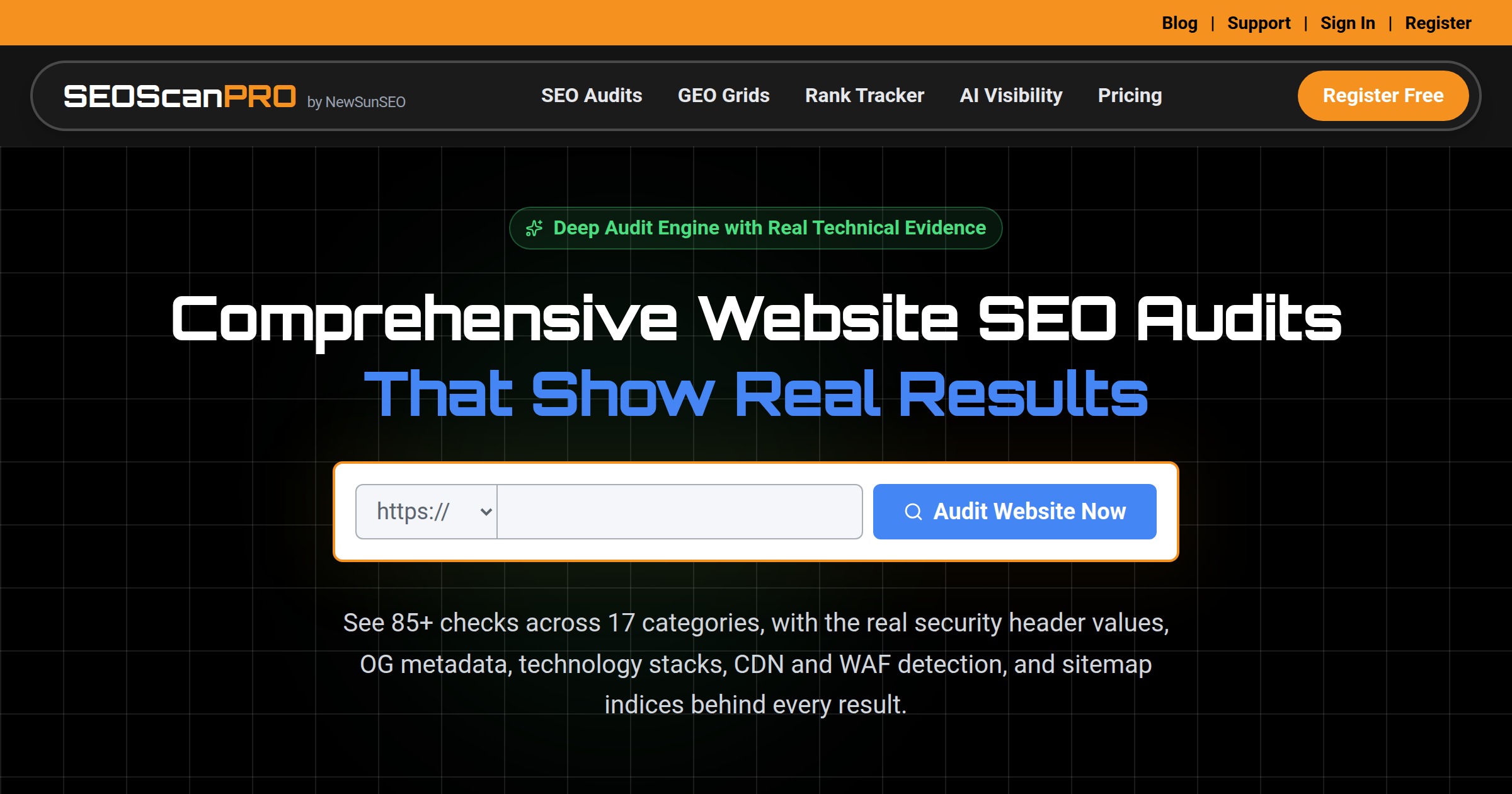
    SEOScanPro, which includes the AI visibility report

    The AI visibility report runs a full technical audit of a site and shows the measured result behind every check. Open the AI visibility report.


    This article summarizes reporting from semrush.com.

  • How to Do SEO for a New Website in the Right Order

    How to Do SEO for a New Website in the Right Order

    SEO for a new website turns search into an asset that keeps sending you buyers long after each page goes live, and you get that result from doing a few of the right things in the right order rather than tackling a 40-item list at once. Early structural decisions cost nothing to get right before you publish, while reversing them after content and links pile up means redirects, lost equity, and time you cannot recover. Doing the work in sequence can be the difference between an afternoon of setup and months of cleanup.

    Why order beats effort on a new site

    For a brand-new website, the sequence is the strategy. Choosing your URL structure before you publish costs nothing; changing it after 80 pages are indexed and linked means redirects and lost link equity. Picking keywords you can realistically win before you write saves you from a library of well-crafted pages that never rank.

    This matters more than it would for an established site because a new domain has no authority buffer to absorb mistakes. An older site can publish out of order and still rank on domain strength. A site launched last month cannot, so getting the foundation right first is what lets it compound.

    What early SEO gives a new website

    Search sends strangers who are actively looking for what you offer, and unlike paid ads that traffic does not stop when you stop paying. A page that ranks keeps working for months or years after you publish it, which is why starting early builds a compounding asset instead of a rescue project.

    Two payoffs stand out for a new site. First, it builds authority you cannot buy overnight, so the sites that start sooner are further ahead when a buyer finally searches. Second, it positions you for AI-driven discovery, because the same signals that help you rank also help AI systems find and cite you. ChatGPT alone reached 900 million weekly active users in early 2026, and a growing share of people now discover brands they have never heard of inside AI answers.

    How search engines and AI answers work

    Search engines find your pages by crawling, store them by indexing, and order them by ranking. Crawling is when a bot such as Googlebot follows links to discover pages. Indexing is when the engine stores and understands those pages so they can be served later. Ranking is when it decides, for a given search, which indexed pages appear and in what order.

    If a page is not crawled, it cannot be indexed, and if it is not indexed, it cannot rank. That is why the first thing to confirm on a new site is that search engines can reach and index your pages, not whether a title tag is optimized.

    AI systems add a fourth step: generating a response. Tools like ChatGPT, Perplexity, and Google’s AI Overviews pull passages from sources they trust and synthesize an answer, sometimes citing you by name. Earning a place in those answers is an extension of SEO, known as generative engine optimization (GEO) or answer engine optimization (AEO). These tools draw on two sources, often blended in one answer: training data, the frozen snapshot of text they learned from, which does not include anything published after the model’s cutoff and does not reliably attribute facts; and live web results, which they retrieve in real time and often cite by name. That live retrieval is where a new site can realistically show up.

    Your new website SEO checklist: before and after launch

    The cheapest wins happen before launch, so lock the structural decisions first and treat everything after launch as ongoing work. The same sequence applies to any new site, from a local service business to a SaaS product.

    Before you launch

    • Technical foundation: choose HTTPS, a mobile-friendly build, and a fast host, and plan your robots.txt.
    • Site architecture: decide your URL structure and how pages nest, such as /blog/, /product/, or topic folders.
    • Keywords: map a few winnable target keywords to your core pages and set a roadmap for future content.
    • Content: draft your core money pages and outline your first topic cluster.
    • Authority: claim your brand name, profiles, and key directories.
    • AI visibility: write clear, extractable, entity-rich pages from day one.
    • Measurement: set up Google Analytics 4 and Google Search Console.

    After you launch

    • Verify indexing in Google Search Console, submit your sitemap, and fix crawl issues.
    • Add new pages into the existing structure and avoid ad hoc URLs.
    • Expand into new keywords and questions as you publish more.
    • Publish supporting content on a steady cadence and refresh it regularly.
    • Earn backlinks and brand mentions through PR, guest posts, and communities.
    • Monitor AI mentions and build presence in the sources AI systems cite.
    • Track rankings and AI visibility, and watch indexing before rankings.

    The sequence to follow, step by step

    Work top to bottom, since each step assumes the one before it is done. The early steps are decisions and setup; the later steps are ongoing work.

    1. Set up the technical essentials

    Make sure search engines can crawl and index your site before anything else, because no keyword or content work matters if your pages cannot be found. Indexing is what experienced practitioners check first. Create a robots.txt file to tell crawlers which pages to access, set up Google Search Console to see how Google crawls and ranks your pages, submit an XML sitemap through it so engines have a complete list of pages to index, and connect Google Analytics 4 to track visitor behavior. On a new site the data fills in slowly, so set these up early and let them populate. Running a site audit, such as a scan with SEOScan Pro, surfaces indexability problems like noindex tags and blocked resources first, and it flags whether every page is served over HTTPS, whether the mobile version is sound (Google indexes the mobile version first), and whether Largest Contentful Paint stays under 2.5 seconds.

    2. Lock your architecture and URLs

    Decide how pages are organized and how URLs are structured before you publish, since this is easy today and slow to reverse later. Most new sites need a homepage, an about page, core product or service pages, a contact page, and a blog, each with room to expand into subpages. Set your slugs now: keep them short, descriptive, and keyword-focused, and avoid numbers and special characters. Once a URL is indexed and linked, changing it means redirects, and every redirect taxes equity and invites errors.

    3. Choose keywords and prompts you can win

    Keyword research tells you what your audience types so you can build pages around terms worth ranking for. The goal for a new site is not the highest volume, it is terms you can realistically win that lead to revenue. A useful rule of thumb on a brand-new domain is to target keywords with a personal difficulty score under 20 and 100 or more monthly searches, and to open question-style, long-tail queries, which are more specific and less contested. Prioritize by intent and potential revenue, starting with commercial, lower-funnel terms closest to a purchase, then expanding into informational topics through your blog. Then find the prompts buyers type into AI tools, which are longer and more conversational than keywords, and map both keywords and prompts to their target pages.

    4. Create content people and AI systems want to cite

    Content earns rankings and AI citations the same way: by being useful, organized into topics you cover in depth, and structured so a specific passage can be lifted out. Start with topic clusters, a pillar page on a broad topic plus internally linked supporting pages, and build one topic out fully before moving to the next. The biggest differentiator for a new site is original input: your own data, tests, or first-hand experience. Even small experiments or surveys give both Google and AI systems a reason to recommend you over a larger competitor who only summarizes. Then tighten on-page SEO: write a clear title tag under about 550 pixels that includes the target keyword, a meta description that earns the click, descriptive H2s and H3s that answer real questions from your research, and alt text that describes each image.

    5 and 6. Build authority and AI visibility

    Once content is live, earn backlinks and brand mentions through PR, guest posts, and community participation, and build presence in the sources AI answer engines pull from. Monitor whether your brand appears across ChatGPT, Gemini, Perplexity, and Google AI Overviews so you are measuring AI discovery from the start.

    Roughly how the first 90 days map out

    • Before launch: lock the technical foundation, architecture, and URLs; research keywords and prompts; draft core pages.
    • Launch week: set up Search Console and GA4, submit your sitemap, run a site audit, and confirm pages are getting indexed.
    • First 30 days: publish your first content cluster, start a steady cadence, and fix crawl issues as they surface.
    • Days 30 to 90: build authority through backlinks and brand mentions, work on AI visibility, and watch for early ranking signals.

    FAQ

    What should you set up first when starting SEO on a new website?

    Confirm that search engines can crawl and index your pages before anything else. Create a robots.txt file, set up Google Search Console, submit an XML sitemap, and connect Google Analytics 4. A page that is not indexed cannot rank, so indexing is the first thing to verify.

    How do you choose keywords for a brand-new website?

    Target terms you can realistically win rather than the highest-volume ones. On a new domain, a useful rule of thumb is a personal keyword difficulty under 20 and 100 or more monthly searches, prioritized by search intent and revenue potential. Long-tail, question-style queries are usually easier to rank for because they are more specific.

    How can a new website show up in AI answers like ChatGPT?

    Write clear, extractable, entity-rich pages, organize them into topic clusters, and add original data or first-hand experience. AI tools such as ChatGPT, Perplexity, and Google’s AI Overviews retrieve live web results and often cite the pages they use by name, which is where a new site can appear.


    This article summarizes reporting from semrush.com.

  • How to Create SEO Content That Ranks and Gets Cited by AI

    How to Create SEO Content That Ranks and Gets Cited by AI

    SEO content is content built to be found: pages designed to rank in search engines like Google and get cited by AI systems like ChatGPT and Perplexity. Earning that visibility means satisfying three audiences at once, each of which judges a page a little differently: users who want answers, search engines that decide what to rank, and AI systems that decide what to cite. This guide covers five steps to create SEO content that holds up across all three.

    What is SEO content?

    SEO content can be a product page, a blog post, a video, or an image. What makes it SEO content is that it is optimized to rank in search engines and get cited by AI systems the moment someone searches for what you offer. When you search "what are the best walking shoes for plantar fasciitis," running brand RunRepeat’s guide is cited five times in the Google AI Overview and ranks first in the organic results. The page was built to rank.

    Which format fits your topic?

    SEO content is not one format. The right one depends on what the searcher wants to do: learn something, compare options, or take action. Match the format to that intent and the page has a far better chance of ranking and getting cited.

    • Blog posts and guides: answering a question or teaching something.
    • Product and service pages: helping someone evaluate what you sell.
    • Comparison pages: helping people choose between options.
    • Landing pages: getting someone to take one specific action.
    • Pillar pages and topic clusters: covering a whole subject, with supporting pages linked to it.
    • Images and infographics: ranking in image search and earning citations when other sites embed them.
    • Video: demonstrating something and ranking on YouTube as well as in Google.

    Start from the search intent behind your keyword. The search results page will usually show you the format Google already rewards for that query.

    Why SEO content keeps earning rankings and AI citations

    SEO content keeps working long after you publish it. A page that ranks for a relevant term keeps pulling in organic traffic for months or years. The tradeoff is time: a social post spreads immediately and an ad drives traffic within hours, while SEO content builds more slowly and lasts far longer. The RunRepeat guide draws about 15,000 monthly visitors in the U.S., all from organic search, and ranks for about 1,600 keyword variations, almost all commercial. It is also mentioned or cited in Google AI Overviews across 629 prompts.

    1. Target the right keyword and understand search intent

    Pick topics that have demand and a clear connection to your business, so the visibility reaches people likely to buy or sign up. A keyword research tool shows how many people search for a query each month and how hard it will be to rank. In Semrush’s Keyword Overview, "best walking shoes for plantar fasciitis" returns 3,600 U.S. searches a month and a keyword difficulty of 21%. Enough people are looking, and ranking is realistic.

    If your topic is bigger than one page, cramming everything onto a single page makes each part thin. The fix is a topic cluster: one main page, several supporting pages, all linked so readers and search engines can move between them.

    How do you read search intent?

    Google.com is your best tool for analyzing intent. Type your keyword and autosuggest shows what else people look for, such as variations by gender, foot type, and brand. Ads at the top mean the term is commercially valuable enough for brands to pay for it, a sign the searcher is close to buying. The AI Overview for the walking-shoe query lists features to look for and specific shoe recommendations, so searchers want both education and product options. Put it together and the results page tells you a good answer needs well-researched shoe options, sorted by different needs, backed by credible information.

    Your location, search history, and login status can skew what Google shows you. Use a VPN set to the location you are targeting, in a private window, logged out. You can also open a clean results preview in Semrush by entering your keyword and location into Keyword Overview, scrolling to the SERP Analysis section, and clicking View SERP.

    2. Add original information

    Original information is what is on your page that is not on the other pages: your own data, a test you ran, or what you discovered by doing the work yourself. When several sources repeat the same thing, that confirms what a reader was starting to believe, but repetition alone gives no reason to choose your content. Originality does, and it builds trust by showing you know the subject beyond what is already out there. AI systems can already write the answer everyone else gives, so repeating it gives them no reason to reference you.

    Google holds a patent called information gain that describes scoring a page by how much it adds to what the reader has already seen. Google has not confirmed whether it uses this, but a page that copies the ones above it tends to be harder to rank. Decide what you are adding before you draft: original data, first-hand experience, expert input, a repeatable framework, or custom visuals and tools.

    3. Prove your credibility with E-E-A-T

    Users, search engines, and AI systems all have to decide whether to believe you, and none of them can check everything you claim. How much proof a reader needs depends on what they stand to lose: a failed recipe costs an afternoon, failed tax advice could cost thousands. Google’s guidelines for this are called E-E-A-T: experience, expertise, authoritativeness, and trustworthiness. Trust carries the most weight, and it matters most on money and health topics, where a bad answer can do real harm.

    AI systems make more of that decision themselves. A results page lists links and lets the user choose; an AI answer gives one response and cites the sources behind it, so the system has already decided which sources were worth using. That is why AI often looks for the same claim across sources with no connection to you. Proof falls into three groups by how hard each is to fake:

    • Claim: anyone can type "we’re the best," so it counts for almost nothing.
    • Show: a photo, a screenshot, or footage of you doing the work costs something to produce, so it carries more weight.
    • Confirm: a review you did not write, a certification you had to pass, or a client who will go on record with real numbers. You cannot produce those yourself, so they are worth the most. A Clutch or G2 profile fits here.

    RunRepeat does most of this at once. They publish the exact method they use to test shoes, down to wearing every pair in the same size, their reviewers have real experience and specialties, and they criticize shoes they earn commissions on.

    4. Make your content extractable

    Search engines and AI systems interpret your content using natural language processing. They split text into words and sentences (tokenization), pick out the words that name real things like people, products, and places (entity recognition), and work out what a passage means from context (semantic analysis). Google announced in 2020 that it ranks individual passages, not just whole pages, and AI systems retrieve passages too. A comprehensive guide gives you more sections that can surface on their own, as long as each one stands up by itself. For the RunRepeat guide, no single search sends it more than about 4% of its traffic; the rest is spread across hundreds of variations, many ranking first.

    Put the most important information first

    Work out the most important thing on the page, then lead with it: on a blog post, the answer to the question in the title; on a product page, what the product is and what it costs; on a landing page, the benefit you offer. In 2006, the Nielsen Norman Group tracked the eyes of 232 people reading web pages and found the F-pattern, where readers scan across the top, drop down, scan a shorter line, then trail off down the left edge. Lead with what matters and they read more of it. Search engines and AI systems also tend to pull from the first part of a page, so a main point buried halfway down may not get extracted at all.

    Label sections for exactly what they answer

    Search engines and AI systems match your heading against what someone searched, and the closer your heading is to the question, the easier that match is. "Common Mistakes When Choosing a Primary Keyword" works better than "Common Mistakes."

    Name things specifically

    Say the actual product, service, or brand instead of "this feature" or "the company," because entity recognition depends on working out what your words refer to. "Omnisend’s SMS automation integrates with Shopify’s abandoned cart data to trigger personalized recovery messages within two hours of cart abandonment" gives it far more to work with than "our automation features help ecommerce businesses increase revenue."

    5. Get the on-page mechanics right

    On-page elements are attributes search engines and AI systems read to work out what a page covers, and people read them too, usually in the results. Include your primary keyword in the title tag, the H1, the URL slug, the first paragraph, and at least one H2. Stop there, because Google treats keyword stuffing as spam. Use secondary keywords in your subheadings and body copy where they fit naturally. Your title tag and meta description are what someone sees in the results, so be clear about what the page covers. Give every image a descriptive filename and alt text, which screen readers read aloud and search engines use to work out what the picture shows.

    FAQ

    What is SEO content?

    SEO content is any content, a product page, blog post, video, or image, that is optimized to rank in search engines like Google and get cited by AI systems like ChatGPT and Perplexity. It is designed to be found the moment someone searches for what you offer.

    Where should I place my primary keyword on the page?

    Include your primary keyword in the title tag, the H1, the URL slug, the first paragraph, and at least one H2. Do not go further than that, since Google treats keyword stuffing as spam. Use secondary keywords in subheadings and body copy where they fit naturally.

    How long does SEO content take to earn traffic?

    SEO content builds more slowly than a social post or an ad, but it lasts far longer. A page that ranks keeps pulling organic traffic for months or years. One cited walking-shoe guide draws about 15,000 monthly U.S. visitors and ranks for around 1,600 keyword variations.

    Related coverage


    This article summarizes reporting from semrush.com.
  • Claude AI Watermarks Are Rolling Out: What Content Teams Need to Know

    Claude AI Watermarks Are Rolling Out: What Content Teams Need to Know

    Anthropic has begun embedding invisible watermarks in text generated by Claude models released on or after August 2, 2026, and is attaching signed provenance metadata to supported file types, per the company’s own support documentation. The change follows the company’s signing of the EU AI Act’s Article 50(2) Code of Practice on Transparency of AI-Generated Content, and the marking applies globally across Claude apps, Claude Code, Claude Cowork, Claude Tag, the API, and Claude accessed through AWS, Google Cloud, or Microsoft Foundry. Watermarks do not change search rankings directly, but they do shift how content teams should think about disclosure, workflow documentation, and what “AI-assisted” actually means when a machine can flag it.

    What Changed With Claude’s AI-Generated Content?

    Anthropic is both a provider of generative AI models and generative AI systems, which gave it obligations under Article 50 of the EU AI Act. It met those obligations by signing onto the EU’s Code of Practice on Transparency of AI-Generated Content, the same code that roughly 190 companies, including Google, Meta, Microsoft, Mistral, and OpenAI, had signed onto by the end of July. The practical result is that Claude models launched on or after August 2, 2026 now weave an imperceptible watermark into the text they generate and attach signed provenance metadata to supported file types. Anthropic says it is also working to bring marking support to models released before August 2, 2026, with no confirmed timeline yet.

    If a content team uses Claude to draft product descriptions, blog outlines, or on-page copy, raw Claude output now carries a detectable marker. Light edits usually preserve the mark. Heavy rewrites, paraphrasing, or translation can weaken it or remove it entirely.

    What Actually Carries a Claude Watermark

    • Text generated by a supported Claude model carries an embedded, invisible watermark that survives copy-paste and some editing.
    • Files Claude generates in supported formats (.svg, .png, .jpg) carry C2PA-standard signed provenance metadata that records how the file was created and flags whether it has been tampered with.
    • Human-written text that Claude only edited, translated, or summarized can also pick up a mark, even though Claude was not the original author.

    That third point is the one most people miss. A writer who drafts their own copy and runs it through Claude for a proofread ends up with marked text. So does a translator working from someone else’s article. A detected watermark tells you Claude touched the content somewhere in the chain, not who actually wrote it.

    Document AI-Assisted Workflows for Compliance

    Teams that use Claude for blog outlines, drafts, or edits should document which stage used AI, what human editing followed, and who signed off on the final version. That paper trail protects the team regardless of whether a watermark survives, and it is the kind of record that helps if disclosure requirements tighten later.

    Why Anthropic Is Marking Claude Outputs

    Anthropic is marking Claude’s output to meet its EU AI Act Article 50 commitments, and the company is applying the marking globally rather than building a separate EU-only version. That gives businesses a consistent provenance signal no matter where their content or their audience sits. For content workflows, the practical move is getting ahead of EU disclosure rules, building an internal audit trail, and being ready if platforms start asking for provenance data down the line. The mark works more like a digital signature sitting quietly in the content supply chain than a public disclaimer.

    Prepare for EU AI Act Compliance

    Article 50 requires machine-readable identification of AI-generated content, with exemptions worth tracking. Content that undergoes genuine human editorial review, where someone holds editorial responsibility for the final version, can fall outside the disclosure requirement even if it carries a Claude mark. A watermark showing up on copy does not automatically create a labeling obligation. It depends on how much editorial control was actually exercised.

    Streamline Compliance Documentation

    Logging Claude’s role in the content workflow, even briefly, cuts down legal review time later, makes platform compliance easier to demonstrate, and gives a reusable template for every piece produced with AI assistance.

    How Claude’s AI Watermark Works

    Claude uses two techniques: an embedded watermark woven into generated text, and signed provenance metadata attached to supported files. The text watermark does not change the meaning, quality, or readability of what Claude writes. Readers and writers will not see it. Because it is embedded in the text itself, it travels when the content is copied and pasted and can persist through light editing. It is applied at the model level, so the mark shows up no matter which Claude product generated the text.

    File metadata works differently. When Claude generates a .svg, .png, or .jpg, it attaches metadata following the C2PA (Coalition for Content Provenance and Authenticity) standard, the same open standard used across the industry for content provenance. That metadata records how the file was created and flags whether it has been altered since.

    Text vs. File Marking: Key Differences

    Text watermarks embed during generation and degrade with heavy editing. File metadata attaches after generation and persists unless it is actively stripped through re-saving, format conversion, or screenshotting. Neither method produces a guarantee. Both are signals, not proof.

    Detection Challenges in Real-World Use

    Anthropic has not published its detection mechanism yet, so third-party tools cannot verify Claude’s marks directly. Only Claude’s own eventual detection tooling will be able to confirm them. Independent researchers have already argued that watermarks in general can be weakened through intense paraphrasing, and that older models, very short passages, or stripped file metadata may never carry a detectable signal in the first place. Treat a watermark hit, or the absence of one, as a signal, not a verdict.

    Can Claude’s Watermark Be Detected or Removed?

    The watermark itself does not affect rankings. Publishing unedited AI content at scale still risks running into Google’s quality guidelines, watermark or no watermark. The fix is not trying to strip the mark. The fix is making the content genuinely better. A practical workflow: run AI-assisted research first, have a human write from that research and an outline, and finish with expert fact-checking. That produces original work while using AI responsibly, and it happens to be the same workflow that survives a watermark check either way.

    Google’s AI Content Evaluation Criteria

    Google evaluates helpfulness, originality, and expertise. Watermark detection is not part of that equation. How the content was created matters far less than whether it is actually useful once someone reads it.

    Reduce AI Content Risk with Quality Steps

    • Limit how much raw AI output goes out untouched.
    • Add original research or data competitors don’t have.
    • Run subject-matter expert reviews.
    • Document the workflow.
    • Keep building E-E-A-T signals: experience, expertise, authoritativeness, and trust.

    Does Claude’s AI Watermark Affect SEO?

    Not directly. Provenance tracking is becoming standard practice across the industry, not just something Anthropic is doing. Getting documentation habits in order now means adapting faster as platforms start asking for this kind of transparency more broadly, whether that turns into disclosure norms for AI search results or something Google folds directly into its quality guidelines.

    Future Provenance and Ranking Scenarios

    It is reasonable to expect platforms to eventually highlight verified human content more prominently, for search to start filtering undisclosed bulk AI content, and for E-E-A-T scoring to factor in provenance signals over time. None of it is confirmed yet, but the direction is worth watching.

    Original Research Still Wins

    Unique data, original testing, and real analysis outperform generic content regardless of what tool drafted it. The Claude AI watermark doesn’t change that.

    What SEOs and Content Teams Should Do Going Forward

    Build a workflow that combines Claude’s speed with actual human expertise, and be able to show the work if anyone asks. In practice, that could look like: Claude drafts the first pass of product descriptions or blog outlines, a subject-matter expert adds details a model couldn’t know, and someone logs which parts used AI and which review happened before publication.

    AI Content Workflow for SEO Teams

    AI-assisted research, human drafting and enhancement, expert review, and provenance documentation, in that order, keep content quality intact while keeping teams ready for whatever disclosure requirements come next.

    Balance Automation with Expertise

    Claude’s speed is real. So is the fact that a model can’t fact-check itself, add a genuine opinion, or verify something happened the way it says it did. Pairing the two is still the whole game.

    What This Could Mean for the Future of AI Content

    Claude’s watermark system is one piece of a broader shift toward standardized AI content disclosure. Google, Meta, Microsoft, Mistral, and OpenAI are all moving in the same direction under the same EU code. Some Claude users have pushed back publicly, arguing that a watermark on lightly-edited or heavily-directed work misrepresents how much of the creative labor was actually theirs. Anthropic’s own limitations documentation backs part of that concern: proofreading, translation, and summarization can all trigger a mark on work that was never Claude’s to begin with.

    The practical move stays the same regardless of where that debate lands: disclose AI assistance where it matters, lead with actual human expertise, and keep fact-checking rigorous. That’s what builds trust with readers and with search platforms as disclosure norms keep evolving.

    Key Takeaway

    Claude’s AI watermark does not change the fundamentals. Google evaluates content quality, not the tool that produced it. A detected mark signals Claude may have processed the content, not that Claude wrote it or that a human didn’t edit it afterward. Original insight and expert review still matter more than stripping a watermark out.

    FAQ

    Does Claude’s AI watermark affect Google rankings?

    No. According to Anthropic’s support documentation, the watermark does not directly influence search rankings. Google evaluates content quality, originality, and helpfulness, not the tool that produced it. Scaled, low-value AI content remains the real risk, watermark or not.

    Can Claude AI watermarks be removed?

    Yes, in many cases. Heavy paraphrasing, translation, or mixing Claude output with significant human writing can weaken or remove text watermarks. File-based C2PA metadata can be stripped through re-saving, format conversion, or screenshotting. Neither method produces a guaranteed result; both act as signals rather than proof.

    Should I disclose Claude use in my content?

    It depends on the level of editorial review. Under EU AI Act Article 50, content that undergoes genuine human editorial review, where someone holds editorial responsibility for the final version, can fall outside disclosure requirements even if a watermark is present. Logging Claude’s role at each workflow stage keeps documentation ready if disclosure rules tighten further.


    This article summarizes reporting from seo-hacker.com.

  • Survey: 60% of U.S. Consumers Find AI in Brand Messaging a Turnoff

    Survey: 60% of U.S. Consumers Find AI in Brand Messaging a Turnoff

    Six in 10 U.S. consumers say the term AI in a brand’s messaging is a turnoff, and 86% still want to check the original source before trusting what an answer engine tells them. Those are the headline numbers from a new field study of 2,000 U.S. adults and business leaders, run in April 2026, and they carry direct implications for anyone auditing a site for AI search visibility.

    The contradiction is sharp: 60% of enterprise respondents reported that traffic from AI search platforms has climbed over the past year, and 74% now call AI discoverability a main or significant priority. At the same time, the same share of consumers (60%) read AI labels in marketing copy as a signal to disengage. Brands chasing citations are running headlong into audiences that distrust the very word they are leaning on.

    What the study measured

    The April 2026 survey split its 2,000 respondents into 1,200 general consumers and 800 enterprise CMOs and decision-makers. The dual sample lets the report compare what buyers want against what publishers are investing in, and the gap is the story. Enterprises are betting budget on being cited by AI; consumers are paying more attention, not less, to whether a real person stands behind a page.

    Brian Alvey, CTO of WordPress VIP, framed the tension in the report: brands must now build sites that are legible to AI agents acting on behalf of people, and still feel trustworthy to the small slice of users who actually click through past the answer box. Failing either side means losing either the citation or the repeat visitor.

    The trust signals that actually move the needle

    The survey asked consumers what makes an AI-mediated page feel credible. The answers were concrete and actionable for site owners:

    • 33% rank clicking through to the original source as their top trust signal, ahead of known brand reputation.
    • 86% do not fully trust AI-generated answers and want to verify primary sources themselves.
    • 42% rank unattributed AI responses as less trustworthy than airline fees, confusing privacy policies, or a medical bill.
    • 73% feel the internet is less human than it was a decade ago.
    • 80% believe web information should stay openly accessible, rather than sitting behind a small number of walled platforms.

    Each of those numbers maps to something a technical SEO audit can check. Original-source visibility, attribution markup, open access, and the human voice in copy are all reviewable on a page-by-page basis.

    What to audit on your own pages

    Site owners can use the survey results as a checklist for content that needs to earn both a citation and a click.

    Source attribution on every claim

    If a third of consumers treat the outbound source link as their primary trust check, that link needs to be visible, descriptive, and loadable by crawlers. Audit body content for inline citations, anchor text that names the source, and any claims that lack a verifiable reference. Pages with statistics, quotes, or product claims should link to a primary document, not a roundup post.

    Structured data for authorship and provenance

    Schema markup for author, organization, and datePublished helps answer engines connect a claim to a real entity. Run a crawl and confirm that author markup is present on editorial content, that the author entity resolves to a real profile page, and that the same author name is consistent across posts. Inconsistent or missing authorship is a quiet trust leak that the 33% figure makes expensive.

    Open access for high-value pages

    80% of respondents want information to stay freely accessible, and AI agents will follow that preference. Pages blocked by paywalls, login walls, or aggressive consent interstitials can be parsed less reliably and cited less often. Audit your top cited URLs to confirm they render fully for unauthenticated crawlers and do not require a click-through before content loads.

    The AI label problem in copy

    60% of consumers are put off by the word AI in marketing language. That means a page lead or product page that opens with AI-powered, AI-driven, or intelligent automation as the headline framing may lose engagement before the value prop lands. Run a content scan for the label across landing pages, hero copy, meta descriptions, and social bios. Replace AI-first framing with benefit-first framing, and reserve technical AI references for product documentation where buyers expect them.

    Human voice in the body text

    73% of consumers say the web feels less human than a decade ago. That is partly a writing problem, not a tooling problem. Audit recent posts for signs of templated boilerplate: generic intros, repeated transition phrases, listicles with no original analysis. Pages that read like model output will underperform on the trust side of the AI search equation even if they rank.

    What enterprise teams are signaling

    On the publisher side, 60% of enterprise respondents saw AI-referred traffic grow over the past year, and 74% treat AI discoverability as a main or significant priority. That gap between buyer skepticism and publisher investment is the engine driving the next round of changes: provenance labels, verified-source badges, and richer attribution formats similar to the credit lines already common in voice assistants. Sites that invest in clean bylines, original research, and open citation practices now will be the easiest for platforms to label as trustworthy later.

    The bigger signal

    The 2025 Edelman Trust Barometer special report on AI put global trust in artificial intelligence at 33%, and the WordPress VIP numbers suggest U.S. consumer sentiment has hardened further since. For SEO and content teams, the practical lesson is to stop treating AI optimization and human credibility as separate workstreams. Citation-ready content, transparent sourcing, and a clear human voice are the same checklist. Pages that pass it will earn both the answer-engine mention and the click that follows.

    FAQ

    Why are consumers turned off by the word AI in brand messaging?

    The April 2026 survey of 2,000 U.S. adults found 60% say the label AI in a brand’s messaging is a turnoff, while 86% do not fully trust AI-generated answers and 73% feel the internet is less human than it was ten years ago. The label reads as automation without accountability, and buyers are responding by discounting it.

    How much do consumers trust AI-generated answers without source attribution?

    42% of respondents rank unattributed AI answers as less trustworthy than airline fees, confusing privacy policies, or a medical bill. 86% want to verify primary sources themselves, and 33% point to clicking through to the original source as their single strongest trust signal.

    Can brands use AI for content without losing audience trust?

    The survey does not penalize AI used behind the scenes. It shows consumers react to AI being marketed to them as a feature. Brands that use AI for research or drafting, keep human review in the loop, and publish with visible authorship and source links can stay efficient without triggering the 60% turnoff response.