
SEO Audit Tool
An SEO audit tool that reads your website the way search engines and AI assistants do, runs 85+ checks, and shows the measured value behind every result.
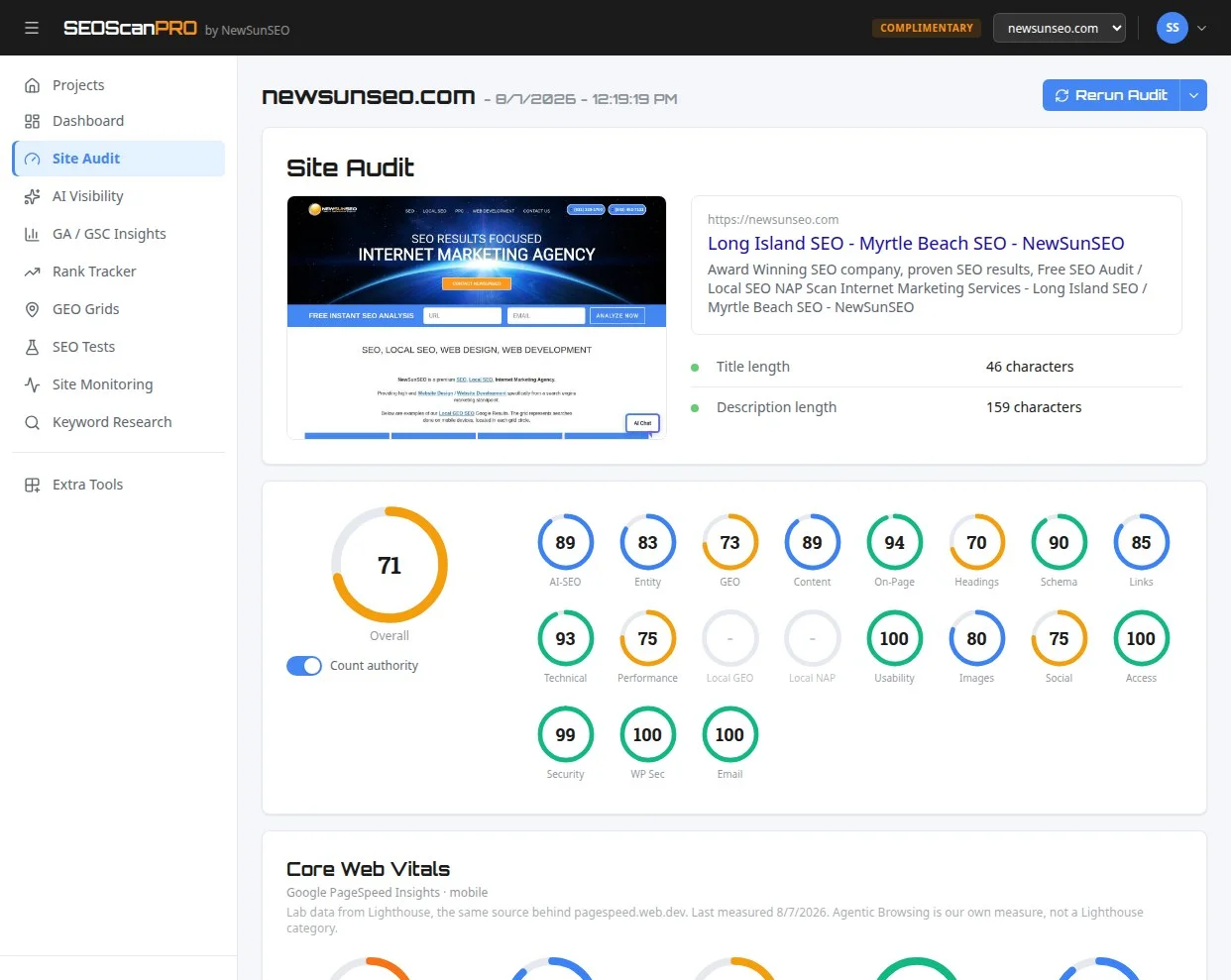
What the audit gives you
One report covering the technical ground that decides how search engines and AI assistants read your site.
The evidence behind every score
Each check shows the value we measured. A security header is reported as the header string your server returned, so you can hand the report to a developer and they know exactly what to change.
Your page as a visitor sees it
The report opens with a capture of the page fully loaded, beside a preview of how your listing appears in search results, so you can see both at once.
A clear order to work in
Findings are ranked so you always know what to improve next, with the effort and the likely impact stated rather than left for you to guess.
Built for AI search too
The audit checks whether AI crawlers are permitted, whether the structured data assistants look for is present, and whether your site publishes the files those systems now read.
What every audit covers
One report, 85+ checks across 17 scored categories. Every check shows the value we measured, so the report reads as evidence you can hand to a developer rather than a number you have to take on trust.
On-page SEO
Title tags, meta descriptions, canonical tags and URL structure.
Performance
Core Web Vitals measured from Lighthouse, the same source behind PageSpeed Insights.
Usability
Viewport scaling, tap target sizing and how the page behaves on a phone.
Links
Internal link health, redirect chains and nofollow distribution.
Social and sharing
OpenGraph and card metadata used whenever your page is shared.
Security
The raw header values your server returns, reported as the header string itself.
AI visibility
How ChatGPT, Perplexity and Google AI Overviews read this site.
Crawlability
Whether a crawler can reach your pages by following links.
Canonical and duplication
Which URL you are telling search engines is the real one.
Content quality
Depth, readability and how much of the page is actually text.
Heading structure
How the page is outlined for readers and crawlers.
Structured data
The machine-readable description search engines and assistants read.
Link detail
Internal and external linking, and anything broken.
Server and delivery
What the site is served by, and how.
Certificate, cookies and mail
Trust signals beyond the security headers.
Fonts, sharing image and technology
What the page loads and what it is built with.
The 17 scores on your report
Each one carries its own ring and its own check list, so you can see where a score came from instead of guessing at it.
- AI-SEO
- Entity
- GEO
- Content
- On-Site
- Headings
- Schema
- Links
- Technical
- Performance
- Usability
- Images
- Social
- Access
- Security
- WP Sec
Seventeen categories, more than eighty-five checks
The audit covers on-page SEO, Core Web Vitals and performance, usability, links and architecture, social and sharing, security headers and certificates, crawlability, canonical and duplication, content quality, heading structure, structured data, server and delivery, email security, and AI visibility.
- Every category carries its own score ring and its own check list
- Core Web Vitals measured from Lighthouse, the same source behind PageSpeed Insights
- Certificate, cookie and mail security reported with the actual configuration found
- Technology, CDN and WAF detection so you know what is actually serving your site
What an SEO audit tool does for your site
An SEO audit tool tests your pages for the problems that stop search engines and AI assistants from reaching, reading or trusting them: a blocked crawler, a missing title, a slow load, a certificate error. Each result names the check, the page and the value found.
SEOScanPro audits one page in depth, then crawls the rest of the site behind it. The in-depth audit loads the page in a real browser, measures its speed with Lighthouse, reads the headers your server sends back, and runs it through 85+ checks. The crawl then walks the site page by page. A problem that repeats across a template shows up as a count of affected pages.
Each result carries the value that was measured. You see the title tag that was found, the header string that came back, the load time that was recorded. That is what makes a website audit something a developer can work from.
Technical SEO: can search engines reach and read your pages
Technical SEO comes first. If a crawler cannot reach a page, or is told to skip it, nothing else on that page counts.
- robots.txt rules and the XML sitemap
- Canonical tags and duplicate URLs
- Status codes, redirect chains and broken links
- HTTPS certificate, mixed content and security headers
- Core Web Vitals and page speed, measured with Lighthouse
- Mobile usability: viewport scaling and tap target sizes
- The server, CDN and firewall in front of your site
On-page SEO: what each page says and how it is built
On-page SEO covers what you write and how each page is structured. Much of it lives in your templates, so one template fix reaches every page built from it.
- Title tags and meta descriptions
- Heading structure, including a missing or repeated H1
- Content depth and readability
- Image alt text
- Structured data that describes your business
- Social cards used when the page is shared
- Internal and external links
A site audit that covers every page
Most SEO errors repeat. A template missing its H1 is missing it on every page built from that template. One page can show you the pattern. The crawl shows you how far it goes.
When an audit finishes, SEOScanPro starts a crawl of the site on its own. It follows links from your home page, stays on your domain, and honors your robots.txt. How many pages it covers depends on your plan.
The results fill the Top Pages table on your dashboard, one row per page. Issues are counted across the site, so you can read "pages with no H1" as a number and see which pages they are.
- Status code, and whether the page can be indexed, with the reason when it cannot
- Canonical URL
- Title and meta description
- H1 count and word count
- Images missing alt text
- Internal links and click depth from the home page
- Load time and a score for the page
Where to start when the audit finds errors
Fix what stops a page being found before you fix how it reads. Work down this list.
- Anything that stops a page being found: a noindex tag, a robots.txt block, a 404, or a canonical that points somewhere else
- Anything that affects every page at once: a slow template, a missing security header, a sitemap that is out of date
- Page-level fixes on the pages that matter most: titles, descriptions, headings and alt text
- The rest: social cards, font loading and smaller speed gains
AI search is part of the same audit
People now ask AI assistants the questions they used to type into a search box. Those assistants read your site with their own crawlers, and they lean on structured data to work out who you are.
So the audit checks whether your robots.txt lets AI crawlers in, whether your site publishes an llms.txt file, and whether your structured data names your business clearly. The AI-SEO, Entity and GEO scores sit on the same report as your technical results. The AI visibility page covers the rest.
Running your first audit
Setup takes as long as it takes to add a website.
- Create a free account and confirm your email with the code we send
- Add your website
- Run the audit. The report for your page comes back in about a minute
- Send the share link to whoever makes the changes. They can open it without an account
- Make the fixes, run the audit again, and compare it with the last one
How often to run a website audit
Run one whenever the site changes: a redesign, a new template, a plugin or theme update, a move to a new host, or a batch of new pages. Those are the moments new errors appear.
Between changes, a regular audit catches slow drift, such as a page that got heavier or a sitemap that fell behind the site.
The Free plan includes one audit a day on one website. Paid plans raise that limit or remove it. The pricing page lists the amounts.
Honest about what a measurement is
The accessibility checks are automated. They catch what a machine can catch, and they are not a WCAG conformance audit or an opinion on legal compliance.
The security checks look at what is visible from outside your site. They are not a penetration test, and they say nothing about your application code or your server.
A score is a health check rather than a prediction. Fixing what a report flags makes a site technically better, which generally helps, and we will not promise you a ranking that nobody outside a search engine can promise.
Keep the history
Every audit is kept, so a score means something against the ones before it. Run it again after a change and you can see exactly what moved and what did not.
SEO audit tool questions
What is an SEO audit tool?
An SEO audit tool checks a website for the problems that affect how search engines and AI assistants find, read and rank it. SEOScanPro runs 85+ checks across 17 scored categories and shows the value it measured for each one, so you know exactly what to change.
Is the SEOScanPro SEO audit tool free?
Yes, on one website. The Free plan runs the full audit, all 85+ checks, once a day with no card required. Paid plans add more websites and audits, plus GEO grids, rank tracking and the Content Writer. Start with a free SEO audit.
Does the audit crawl my whole website?
The audit reads one page in depth. As soon as it finishes, a crawl of the site starts on its own and records the main SEO fields for each page it reaches. How many pages it covers depends on your plan.
How long does an SEO audit take?
The report for the page you chose comes back in about a minute. The site crawl runs after that. On a large or slow site it takes a few minutes, and the Top Pages table fills in as it goes.
What is the difference between technical SEO and on-page SEO?
Technical SEO is whether search engines can reach, load and trust your pages: crawl rules, status codes, speed, HTTPS and canonical tags. On-page SEO is what each page says and how it is built: titles, descriptions, headings, content and structured data. The audit covers both.
Can I share an audit report with my developer?
Yes. Every report has a share link that opens without a login. Each finding shows the value measured on your site, such as the exact header your server returned, so a developer can act on it directly.
Does the audit check AI search readiness?
Yes. Every audit checks whether AI crawlers are allowed in, whether the site publishes an llms.txt file, and whether your structured data tells assistants who you are. Those results sit in the same report as the technical ones.
Will fixing the findings improve my rankings?
Fixing what an audit flags makes a site technically better, which generally helps. Nobody outside a search engine can promise a ranking, and we do not. Your audit history shows what changed on the site after each round of fixes.
The rest of the toolset
Free SEO Tools
Every free tool in one place: the site audit, the local SEO audit and the audit checklist.
Local SEO Audit
Your map positions measured across your service area, with the site checks that affect them.
GEO Grids
Your position measured from dozens of points across your service area.
Plans and Pricing
Every plan runs the full check set. Plans differ by how many sites you track.
Audit your site in about a minute
Enter an address and the full report comes back. You can also start from the home page and see a full report first.
Run a free audit