Category: SEO News

  • SEO best practices can lose traffic: what controlled testing on enterprise sites reveals

    SEO best practices can lose traffic: what controlled testing on enterprise sites reveals

    Controlled SEO A/B testing on large ecommerce and travel sites has shown that many long-standing best-practice recommendations can swing traffic in either direction, including negative ones. The lesson from years of split tests is straightforward: experience should generate hypotheses, not certainty.

    That is the working premise behind the SearchPilot platform, which was spun out of the search agency Distilled in 2019 and now focuses exclusively on running controlled SEO experiments for enterprise teams.

    Why SEO best practice is not the same as SEO proof

    Enterprise SEO work is full of high-confidence recommendations that behave differently once they are tested. A technical audit finds missing markup. A title tag looks under-optimised. A template could include more keywords. The recommendation feels sensible, so it goes onto the roadmap. The missing step is evidence.

    Once a change is tested at page-group level, some recommendations win, some lose, and some do nothing. The outcome often depends on the site, template, vertical, competitors, SERP layout, user behaviour, and timing. The point of a testing programme is not to make SEO expertise redundant. It is to turn that expertise into testable hypotheses with a clean mechanism and a measurable expectation.

    How SearchPilot came out of Distilled

    SearchPilot did not start as a standalone software company. It began as internal tooling inside Distilled, a global search agency that grew to roughly 60 employees with offices in London, Seattle, and New York, plus the SearchLove conference series, DistilledU training, and a content publishing operation.

    Around the early 2010s the agency hit its first real growth wall, with revenue falling year over year for the first time. Out of that pressure came a sharper R&D push. The team, including the current CTO, built what became known as DistilledODN, a software-enabled capability for SEO consulting.

    In 2019, during acquisition conversations with Brainlabs, the agency and software sides split. Brainlabs took the agency business. The software team spun out into a standalone company. The spin-out happened shortly before the pandemic hit in 2020, which forced an early question: what does the new company do better than anyone else? The answer became controlled SEO experimentation for large websites.

    Why focus became the real business lesson

    Running an agency and running a software company are not the same job. Distilled had juggled consulting, conferences, training, publishing, R&D, international expansion, and software at once, which was both exciting and chaotic. The spin-out narrowed the mission to a single core capability: helping enterprise teams run SEO tests at scale.

    That focus shapes everything downstream. The platform is built for large ecommerce, retail, marketplace, and travel sites with enough pages, enough traffic, and enough commercial value to make controlled testing worthwhile. The same lesson applies to a testing programme: prioritising a small number of strong hypotheses matters more than generating a long backlog, and building clean variants with enough traffic sensitivity gives the business something it can act on.

    How SEO A/B testing actually works

    SEO A/B testing is structurally different from traditional CRO testing. In CRO, users are split between a control and a variant experience, and behaviour is measured. In SEO, the search engine crawler is part of the system, so users cannot be bucketed without creating cloaking risk or breaking the test.

    The fix is to split pages, not users. A statistically balanced group of pages is chosen as the control. A comparable group is chosen as the variant. The change is applied server-side on variant pages only, so it is visible to users, to Googlebot, and to LLM-related crawlers alike. There is no separate crawler-only version. The page experience is identical for every visitor to that page.

    That page-level approach is why large ecommerce and travel catalogues, with many pages receiving meaningful organic traffic, are such a strong fit for the model.

    What makes a site testable

    Two ingredients matter: traffic and pages. A rough rule of thumb is around 30,000 organic sessions per month, or about 1,000 per day, distributed across a useful number of pages. Two pages are not enough. Dozens can sometimes work. Hundreds or thousands are better.

    Conversions matter to the business, but they are often too noisy to be the primary metric for a test. Revenue is affected by discounts, competitor pricing, promotions, seasonality, and macro conditions. Organic traffic is usually a cleaner primary metric for detecting the effect of a page change. The business can then translate the expected traffic lift into revenue using its own commercial models.

    What makes a strong SEO hypothesis

    An idea is not a hypothesis. Adding FAQ content to category pages is an idea. The hypothesis is the mechanism and the expected effect: adding concise FAQ content will help category pages rank for additional long-tail queries and improve relevance for existing ones, increasing organic sessions to the tested page group.

    Weak hypotheses produce weak tests. Some failures are not because the idea was wrong but because the change was too small to produce a measurable result, or because the expected mechanism was unclear. There is even a working concept of an underpowered-idea detector: a way to flag test ideas that are unlikely to move the needle before engineering time is spent on them.

    Alt attributes are a useful example. Adding alt attributes to images is good practice for accessibility, usability, compliance, and sometimes image search. Controlled tests have not produced evidence that changing alt attributes moves standard organic SEO traffic in either direction. That does not make alt attributes unimportant. It makes them a weak candidate for a traffic-focused SEO A/B test.

    Why test backlogs grow faster than teams can run them

    Large SEO teams rarely run out of test ideas. Ideas come from in-house SEOs, agencies, product teams, content teams, merchandising teams, technical audits, competitor analysis, internal politics, and old recommendations that have been waiting for engineering resource. The challenge is not generation. It is prioritisation.

    Helpers usually judge ideas on two axes: how likely they are to move the needle, and how easy they are to build. The goal is the overlap, meaning changes that are both commercially meaningful and practical to implement.

    The larger blocker is often organisational. Some teams cannot test above-the-fold on product pages because product owns that space. Some cannot change templates because engineering capacity is scarce. Some cannot touch certain content modules because brand or merchandising controls them. When test velocity is low or win rates disappoint, the problem is not always the quality of the SEO ideas. It may be that the team is only allowed to test low-impact parts of the page. Enterprise SEO experimentation is as much an operating model as a tool.

    Why title tags are still dangerous to change

    Title tag tests are among the most likely to produce very large positive results and among the most likely to produce very large negative results. Title tags affect two things at once: rankings and click-through rate. Google rewrites some titles, but not all of them, so the wording still often contributes to the search snippet and therefore to whether the result is clicked.

    Old recommendations to load title tags with target keywords now look higher-variance than many SEOs treated them at the time. Paid search analysts have long known that one advert can dramatically outperform another because the copy is better, not because it contains a different number of keywords. Organic snippets work the same way, as the test in the section above showed.

    One title tag test produced an initial decline of more than 20% in organic traffic. The team iterated on the same underlying idea and found a version that produced a large positive result. The lesson was not that title tags work or do not work. It was that implementation matters.

    What a breadcrumb schema test taught the team

    A breadcrumb schema fix that reduced traffic is one of the more memorable test results. SEOs usually ship breadcrumb markup fixes without much hesitation. The change is technical housekeeping. The test produced a negative result.

    The lesson is not that breadcrumb schema is bad. It is that search result changes can affect user behaviour in ways that are hard to predict. Structured data changes how a result appears, and a technically cleaner search result is not always a more clickable one; in the breadcrumb test, the rich result shifted user expectations in a way that reduced clicks.

    What this means for SEO teams today

    Controlled testing reframes the role of SEO expertise. Pattern recognition and experience still matter, but they feed a prioritised experiment queue rather than a fixed list of changes. Best-practice recommendations become hypotheses with a stated mechanism, a measured effect size, and a clear go or no-go signal.

    For enterprises with enough traffic and template depth, the upside is faster learning and fewer quiet losses. For smaller sites, the same discipline still applies, even if the testing infrastructure has to be lighter: form a hypothesis, define a primary metric, build a clean control, and read the result rather than the assumption.

    FAQ

    What is SEO A/B testing?

    SEO A/B testing is a controlled experiment where a statistically balanced group of pages is held as a control while a comparable group receives a change. The change is applied server-side so every visitor, including Googlebot and LLM crawlers, sees the same variant page. Results are compared between the groups over the test window.

    Why can standard SEO best practices lose traffic?

    Recommendations that look obvious, such as fixing breadcrumb schema or rewriting a title tag, can change ranking signals, snippet appearance, and click-through rate at the same time. A technically cleaner result is not always a more clickable one. Controlled tests have shown both large positive and large negative outcomes from the same type of change.

    What does a site need to run controlled SEO tests?

    Enough organic traffic and enough pages to form meaningful control and variant groups. A rough rule of thumb is around 30,000 organic sessions per month distributed across dozens to thousands of pages, which is why large ecommerce, retail, marketplace, and travel sites are the strongest fit.

    Try the site audit tool
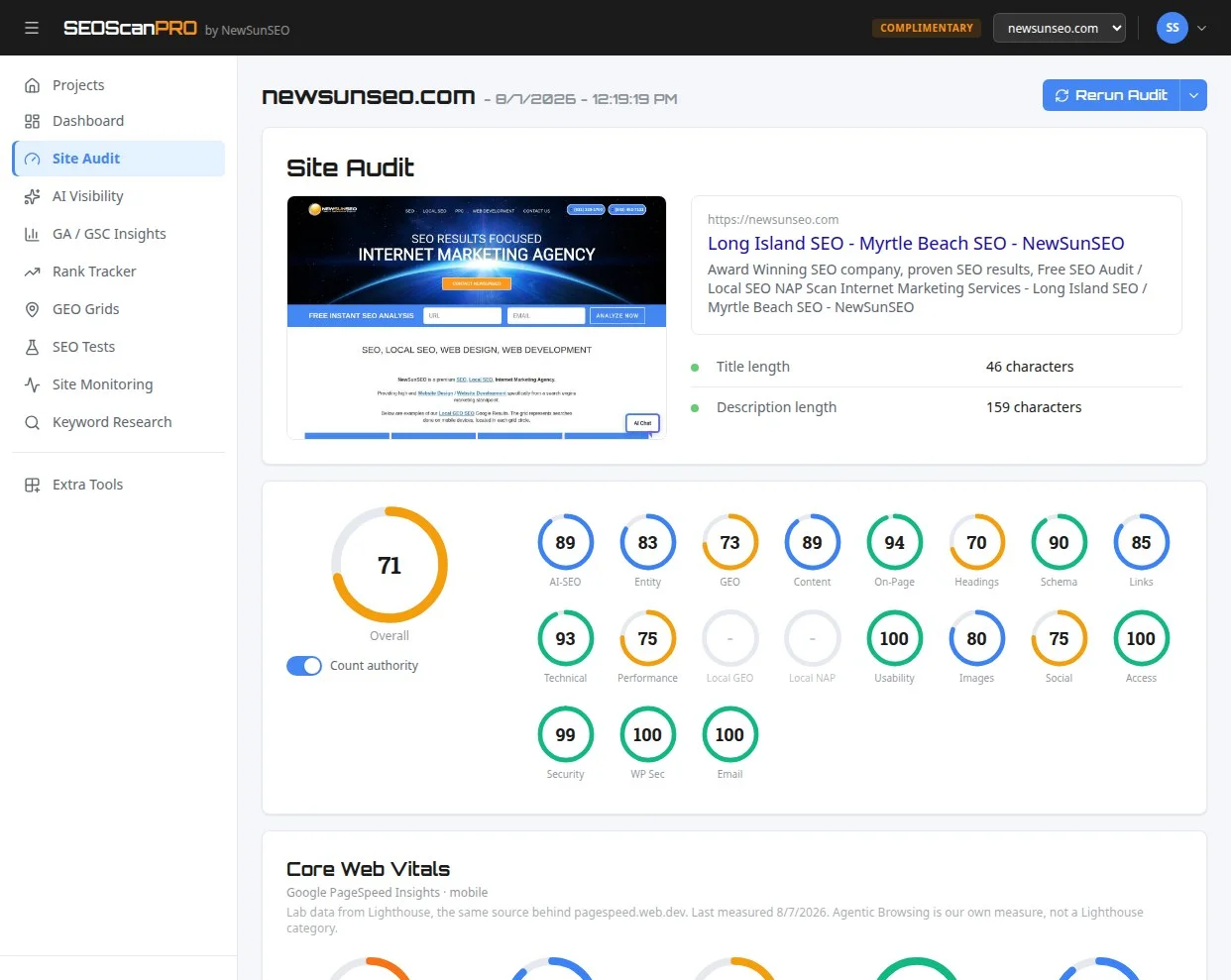
    The SEOScanPro site audit report

    The site audit tool runs a full technical audit of a site and shows the measured result behind every check. Open the site audit tool.


    This article summarizes reporting from searchpilot.com.
  • Google Confirms It Does Not Penalize Sites for Old Outbound Links That Later Host Shady Content

    Google Confirms It Does Not Penalize Sites for Old Outbound Links That Later Host Shady Content

    A site is not penalized by Google for old outbound links that point to a domain that later changes ownership and starts hosting low-quality content. Google’s search relations team answered the question directly: the web is full of turmoil, and a handful of legacy links is not treated as a ranking issue. The clarification gives site owners a clear, long-standing answer to a worry that comes up every time a previously trusted outbound target goes bad.

    What Google Said About Old Links to a Domain That Went Bad

    The question came from a site owner running a lodging site who had linked to a real business years ago. That business lost its domain, and the domain now serves shady content. The owner wanted to know whether those old backlinks would drag their own site’s rankings down.

    Google’s response on the forum thread was short and unambiguous. No penalty applies for old links to a domain that has since turned shady. The advice was to keep content fresh overall, while noting that the web is full of turmoil and a few legacy links are not the kind of problem that affects rankings on their own. The follow-up added that if an entire site’s value has become obsolete, that is a different situation, separate from a handful of broken or outdated links.

    Why This Matters for Site Owners

    Outbound links age. The page you cited in 2018 as a reliable source may have been sold, parked, or repurposed by 2026. For sites with years of content, that means hundreds or thousands of outbound links spread across archives, resource pages, and blog posts. Auditing every one of them is unrealistic, and the answer from Google removes the urgency.

    The underlying principle is that Google works to ignore link cruft rather than treat it as a negative signal. Link cruft is the name for old, spammy, or irrelevant links that accumulate naturally as the web shifts. Google has held this position consistently: noisy or low-quality links are not converted into a ranking penalty against the linking site.

    When an Old Outbound Link Becomes a Real Problem

    Not every situation is covered by the “ignore it” stance. The clarification distinguishes between a handful of outdated outbound links and a site whose overall value has gone stale. If a site’s content has stopped being useful, accurate, or current, that is an editorial and quality issue, not a link issue. Outdated outbound links inside otherwise useful content do not trigger a penalty on their own.

    There is also a practical reason to refresh outbound links when the opportunity comes up. Linking to working, relevant, and trustworthy sources improves the reader’s experience and supports the site’s credibility. Keeping things fresh is a quality habit, not a penalty-avoidance task.

    How to Think About Outbound Link Maintenance

    Site owners do not need to chase down every old link the moment a target domain changes hands. A practical approach focuses on high-traffic pages and cornerstone content first, since those drive the most visible signal. Spot-checking outbound links on those pages once or twice a year is enough to catch the cases where a linked source has truly become inappropriate.

    For everything else, the default is to leave the link in place. Google’s ranking systems are designed to handle the natural churn of the web, including domains that change ownership and content that drifts in quality. A backlink from 2019 to a domain that started hosting shady content in 2026 is the textbook case of link cruft, and link cruft is what Google’s systems are built to discount rather than punish.

    The Bigger Picture on Link Signals

    Google has said for years that it works to ignore unhelpful link signals rather than convert them into negative ranking weight. That position has been consistent across many discussions of link quality. The latest confirmation reinforces the same message: a noisy link profile, full of links that no longer reflect the original linking intent, is not the kind of problem that gets a site demoted.

    The implication for anyone running a long-lived site is straightforward. Editorial standards for outbound links should focus on what readers see when they click, not on what might happen to rankings if a target domain turns bad later. That is the right level to maintain, and it matches what Google’s systems are designed to handle.

    FAQ

    Does Google penalize a site for old outbound links that now point to shady content?

    No. Google does not penalize a site for old outbound links to a domain that later changed ownership and started hosting low-quality content. Google’s stance is that it ignores such link cruft rather than converting it into a negative ranking signal.

    What did Google’s search relations team say about these old links?

    Google’s search relations team answered the question directly on a forum thread, saying no penalty applies and that “the web is full of turmoil.” The advice was to keep content fresh overall, while making clear that a handful of outdated links is not a ranking problem on its own.

    Should site owners audit every old outbound link?

    No full audit is required. Outdated links inside otherwise useful content do not trigger a penalty, and Google’s systems are designed to handle this kind of natural link churn. Spot-checking outbound links on high-traffic and cornerstone pages once or twice a year is enough to catch genuinely inappropriate targets.

    Try the rank tracker

    SEOScanPro, which includes the rank tracker

    The rank tracker runs a full technical audit of a site and shows the measured result behind every check. Open the rank tracker.


    This article summarizes reporting from seroundtable.com.

  • Google’s Gemini can now call businesses on your behalf

    Google’s Gemini can now call businesses on your behalf

    Pixel 11 owners can now ask Gemini to call a business for them, placing orders, booking appointments, making reservations, and checking stock on the user’s behalf. The assistant navigates phone menus, waits on hold, and produces a live text transcript that the user can read while the call is in progress, with the option to jump in and take over at any moment.

    This is Google’s second attempt at automated calling, and the new version gives users far more visibility and control than the earlier effort. What remains uncertain is how the businesses on the receiving end of those calls will react.

    What the new Gemini calling feature can do

    Users can send Gemini to a business to handle a defined task: place an order, schedule an appointment, make a reservation, or confirm whether a product is in stock. The assistant works through automated customer service menus on its own, then waits on hold until a person picks up.

    Google describes this as an early experiment limited to Pixel 11 testers. Three details set the new feature apart from Google’s earlier work in the same space:

    • Gemini identifies itself as an AI at the start of every call.
    • A real-time text transcript runs alongside the conversation, so the user can follow along without listening.
    • The user can take over the call at any point, mid-conversation.

    That last point is the most concrete change from the “Call for me” feature Google showed last year, which did not give users an in-call takeover option.

    How it compares with Google’s earlier calling tools

    Google has been working on pieces of this problem for years. The new Gemini capability sits alongside two existing tools that handle parts of the phone call experience:

    • Direct My Call transcribes the automated menu so the user can read the options and pick the right one without memorising a spoken list. The human stays in charge of the call.
    • Talk to a Live Representative, introduced in 2024, lets the user step away while an AI assistant waits on hold. Once a person picks up, the AI hands the call back to the user.

    The new Gemini feature goes further by handling the full task end to end, not just a single step in the call.

    Why businesses may push back

    The reaction from the businesses receiving these calls is the open question. Meta is running a comparable test on a wider range of devices and has already run into friction.

    Businesses began hanging up on Meta’s calls once they realised they were speaking to an AI assistant called Muse. Meta’s response was to route some of those calls through human contractors. That workaround also failed, both because of privacy concerns and because some call centre operators rejected the arrangement.

    Meta has a relevant history here. Facebook M, a project the company positioned as an AI-driven assistant, turned out to rely heavily on human operators behind the scenes.

    Google has not described any plan to hire human contractors to fill the gaps the way Meta did.

    Where automatic call handling has worked so far

    Call screening is a separate category from outbound calling, and it has had a smoother run. Pixel phones have offered AI-generated responses to incoming calls for years, and Apple introduced automatic call screening on its phones only last year. Both features filter calls on the device owner’s behalf rather than reaching out to a business, which sidesteps the consent question that outbound AI calls raise.

    What is still unknown

    Google has not said when, or whether, the new Gemini calling feature will move beyond the Pixel 11 test group. Meta is testing a similar capability across more devices, but the two companies are dealing with the same underlying problem: a business that does not want to spend staff time talking to an AI assistant.

    For now, the feature exists as a controlled experiment on one phone model, with transcripts and a takeover button as the safety valves. Whether those controls are enough to keep businesses on the line is the part that will only become clear once the calls start landing at scale.

    FAQ

    What can Google’s Gemini call businesses to do?

    On Pixel 11, Gemini can place orders, schedule appointments, make reservations, and check whether products are in stock. It also navigates automated phone menus and waits on hold.

    Does Gemini tell businesses it is an AI?

    Yes. Gemini identifies itself as an AI at the start of every call, and it shows a real-time text transcript that the user can read while the call is happening.

    Can a user take over a Gemini call mid-conversation?

    Yes. The user can jump in and take over the call at any point, which is a change from Google’s earlier “Call for me” feature.


    This article summarizes reporting from techspot.com.

  • Guardrail Metrics in SEO Testing: How to Read Beyond a Single Primary Metric

    Guardrail Metrics in SEO Testing: How to Read Beyond a Single Primary Metric

    A single primary metric decides whether an SEO test wins. Guardrail metrics do everything else. They give early signals that move before traffic does, add qualitative context when a number is too sparse to test on its own, and confirm that one improvement has not quietly damaged another part of the funnel.

    Why one primary metric is not enough

    Every rigorous SEO test needs a single primary metric. For most teams, that is organic sessions to the tested pages, because the volume is high enough to reach statistical confidence and close enough to the business to matter. The trade-off is that one number cannot cover the full picture. It will not show the impact on visibility and impressions, whether the change helped conversions, or whether it hurt something else the team cares about.

    Guardrail metrics fill those gaps. They are secondary metrics chosen before the test starts, and each one has a defined job.

    What guardrail metrics actually do

    Three jobs cover most cases:

    • Lead metrics give an early signal. Impressions move before sessions, because a change in rankings or in the range of queries a page appears for shows up in impression data first. Volumes are also higher, which tightens confidence intervals sooner. Lead metrics do not always make good primaries, because they are too disconnected from business impact, but they help interpret why a winning test won.
    • Sparse or noisy metrics provide qualitative data. Some metrics that matter, such as LLM referrals at the time of writing, or conversions and revenue per session on many sites, are too thin to power a test on their own. A practical approach is to power the test on total organic traffic and read the sparse metric alongside it. If a test wins on sessions and LLM referrals point the same direction, that is useful learning, even if the referral data would not stand alone.
    • Additional metrics guard against unexpected harm. Guardrails keep a winning test from breaking something else. SEO changes aimed at important pages and sections often raise concerns from product and design teams about user experience, conversion rate, or average order value. Guardrails give those teams a way to watch for damage in real numbers.

    How guardrails fit with the primary metric in practice

    Guardrails are usually sparser than the primary metric (there are fewer conversions than visits, for example), so reaching statistical confidence on them is uncommon. Many teams replace the usual threshold with a simple rule set:

    • Primary metric improves and guardrail shows no negative impact: declare a win.
    • Primary metric improves and guardrail significantly declines: iterate on the experiment design.
    • Primary metric improves and guardrail declines within the margin of error: run a standalone, higher-powered conversion rate test.

    This setup is what lets cautious enterprise teams approve bolder tests, because the guardrail makes the test safe to run. It is also how SEO testing bridges into AI discovery. As LLM referral volumes grow, some of today’s sparse metrics will graduate to primary status, and the teams already tracking them will have a head start.

    Decide in advance: the part most teams skip

    The difference between guardrail metrics and metric soup is committing up front to what each metric is for. One primary metric decides the result. A small set of guardrails each does one of the three jobs above. That pre-commitment is what keeps results trustworthy after the test ends, when the temptation is strongest to reinterpret the numbers to fit the outcome.

    Tracking multiple metrics inside a single test

    Connecting multiple data sources and attaching several metrics to one test is now standard practice in testing platforms, which means a team can watch its primary and guardrails in the same view. For SEO work, this matters because a single metric almost never tells the whole story, and the gap between organic search and AI discovery makes that gap wider.

    For teams that want to see how their pages perform across both traditional search results and AI answers, an AI visibility audit can show where a site is being cited and where it is invisible. That view is a useful complement to a guardrail-focused test setup, because it adds the AI referral dimension to the same conversation.

    FAQ

    What is a guardrail metric in SEO testing?

    A guardrail metric is a secondary metric chosen before a test starts to do one of three jobs: give an early signal that moves before the primary metric, add qualitative context when a number is too sparse to test on its own, or confirm that an improvement has not damaged another part of the funnel.

    Why not just use one primary metric for every SEO test?

    One primary metric cannot cover the full impact of a change. It does not show the effect on impressions, conversions, or other business outcomes. Guardrail metrics fill those gaps and keep results honest.

    How do you decide whether a guardrail metric matters?

    Commit before the test starts. Assign each guardrail one of the three jobs, decide the rule for a win, an iterate, or a standalone follow-up test, and stick to that rule regardless of how the results read at the end.

    Try the AI visibility report

    SEOScanPro, which includes the AI visibility report

    The AI visibility report runs a full technical audit of a site and shows the measured result behind every check. Open the AI visibility report.


    This article summarizes reporting from searchpilot.com.
  • Sometimes There Is No Absolute Right Answer For SEO

    Sometimes There Is No Absolute Right Answer For SEO

    Readers looking for a single, definitive answer to common SEO questions will find a useful mindset shift in a recent Google response: sometimes there is no absolute right answer, but a path can be chosen and made the right one through execution. The framing comes from a Search Advocate at Google, posted on LinkedIn, and it speaks directly to a recurring decision point in content strategy: whether to expand an existing page to cover a subtopic or split the subtopic into a separate supporting article.

    What sparked the response

    The question centered on an article that clearly needed expansion, yet contained a sub-intent that could stand on its own. The choice was either to fold the subtopic into the main article or create a new page and link them together. Both approaches are common in content work, and both have valid arguments behind them. That ambiguity is exactly what the Google response addressed.

    The Google response in plain terms

    On LinkedIn, the Search Advocate responded with: “Sometimes there is no absolute right answer, but you can choose one, and make it the right answer.” The point is not that any option is equally good in a vacuum. It is that, once a choice is made, the execution behind that choice is what turns it into the right call for that specific site, audience, and structure.

    Why this fits a wider pattern in Google guidance

    This is consistent with prior Google messaging on SEO decision-making. A well-known phrase from the same Search Advocate is “it depends,” which has become shorthand for the reality that ranking factors interact differently across sites. Related public guidance has emphasized that no SEO setup is perfect, that an awesome site tends to outperform a perfectly optimized one, and that there is no single formula that guarantees rankings. The throughline is the same: SEO rewards judgment and follow-through, not a checklist.

    How to apply this when you face a similar choice

    For a site owner weighing whether to expand a page or split it, the practical move is to stop looking for the universally correct answer and start evaluating trade-offs. A single, deep page can consolidate authority around one keyword cluster and serve readers who want everything in one place. Separate pages can target distinct intents more precisely and give internal linking a clearer path. Either path works if it is executed with intention: the chosen structure should be supported by matching on-page signals, internal links, and content that actually satisfies the reader’s query.

    Teams that want to see how a site measures up before committing to a structural change can run a technical audit first. A tool like SEOScanPro’s comprehensive website audit surfaces the on-page and technical signals that influence how a page is read, so the chosen path starts from a known baseline rather than guesswork.

    The bigger takeaway

    SEO is full of decisions where the data points in two directions and no public guidance names a winner. The productive response is to pick, build it well, and revisit if the results say to. Waiting for a definitive answer often costs more time than a confident, well-executed choice.

    FAQ

    Is there ever one right answer for an SEO decision?

    Often there is not. Google’s Search Advocate has said directly that sometimes there is no absolute right answer, and the practical step is to pick an approach and make it the right one through execution.

    Should I expand an existing page or create a new article for a subtopic?

    Either approach can work. A single deep page consolidates topical authority, while a separate page targets a distinct intent more precisely. The right choice depends on the site’s structure, the audience, and how well the chosen path is executed.

    Why does Google say “it depends” so often?

    Because ranking factors interact differently across sites. What works well for one site, niche, or audience may not work the same way for another, which is why Google guidance tends to focus on principles rather than fixed rules.

    Try the rank tracker

    SEOScanPro, which includes the rank tracker

    The rank tracker runs a full technical audit of a site and shows the measured result behind every check. Open the rank tracker.


    This article summarizes reporting from seroundtable.com.

  • Keyword Seed Selection for International SEO: A Practical Framework

    Keyword Seed Selection for International SEO: A Practical Framework

    Readers who build international keyword lists from translated source terms gain a research base that reflects how people in each target market actually search, which raises organic visibility in every country the site serves.

    The wrong approach, copying English keywords through machine translation and shipping them to every market, ships a list that does not match local search behavior and quietly caps growth in every region it touches. This guide walks through the practical choices behind building keyword seeds for international SEO: what to research first, what to keep out, and how to expand from a small set of confirmed terms into a market-ready list.

    What a keyword seed actually is

    A keyword seed is a small, verified list of search terms that represent the core topic of a page or section of a site. From those confirmed seeds, keyword research tools expand outward into the full set of queries a market uses. The seed is the foundation: if the seed terms do not match real local search behavior, the expanded list inherits the same problem at scale.

    For international SEO, every market needs its own seed list. The English list cannot be the seed for French, German, Japanese, or Brazilian Portuguese content, because the way people phrase searches in each language is shaped by local habits, vocabulary, and search engine interfaces.

    Why translation is not enough

    Direct translation of an English keyword list produces terms that may be grammatically correct but functionally wrong. Search volume patterns, common modifiers, and the exact words users type differ across markets even when the underlying product or topic is identical.

    Three common failure modes show up repeatedly:

    • Search engines in some markets favor compound or different word order than English, so a literal translation misrepresents intent.
    • Local competitors bid on and optimize for terms that do not appear in a translated list at all.
    • User modifiers such as price qualifiers, location indicators, and question phrases follow language-specific patterns that translation drops.

    Because of this, a research process that starts from each market, rather than from English and out, produces seeds that reflect what users in that market already type.

    Start with the site’s existing language versions

    Before going wider, the practical first step is to look at what each existing market version of the site already ranks for. Where data is available, the terms a market’s pages already receive impressions and clicks for are the strongest possible starting seeds, because those are confirmed local queries from real users.

    From there, two productive directions open up:

    • Expand outward within that market using a keyword tool, keeping the seed list as the anchor for relevance.
    • Compare the seed across markets to find shared intent and gaps where one market has demand another does not yet capture.

    This market-first approach keeps the seed grounded in real search data for that region, not in assumptions carried over from English.

    Competitor and market signals to fold in

    Local competitor pages, market-specific forums, and the autocomplete and “People also ask” panels on regional search engines expose terms that no translated list will surface. Reviewing competitors that already rank in each market gives a second source of seed candidates beyond the site’s own data.

    Practical places to look include:

    • Top-ranking local competitor pages and their visible headings, titles, and frequently asked sections.
    • Regional search engine autocomplete for the core topics the site covers.
    • Industry or community forums in each target language.
    • Question-based queries pulled from People also ask and equivalent panels.

    Each of these sources returns terms that are already in use, which is the defining property a good seed needs.

    Volume versus relevance as the seed filter

    Search volume data by language and country is patchier than English volume data, and exact-match numbers for smaller markets can be unreliable. Treating raw volume as the primary filter during seed selection tends to drop terms that are actually valuable and inflate terms that look large but contain weak intent.

    A more useful filter is a relevance threshold first, then volume. The seed should include terms that clearly match the product, service, or topic the page covers, even when reported volume is modest. From that relevance-confirmed base, the keyword tool can expand into related and longer-tail variants for the content brief.

    Building the list: a repeatable order of operations

    A practical sequence for assembling an international keyword seed looks like this:

    1. Pull existing query data from each language version of the site where available.
    2. Audit top-ranking local competitors in each market for repeated term patterns.
    3. Add terms surfaced by regional autocomplete and People also ask panels.
    4. Layer in industry and community sources in each target language.
    5. Apply a relevance filter, keeping only terms that genuinely match the page or section.
    6. Hand the filtered seed to the keyword tool for full expansion and grouping.

    This order keeps each market’s seed grounded in confirmed local behavior rather than in translation, and gives the keyword tool a clean base to expand from.

    What this looks like for a multi-market site

    A site with English, French, German, and Japanese versions faces four separate seed lists, none of them derived from each other. The English list seeds English pages. The French, German, and Japanese lists each come from their own data sources and their own competitor landscape. The same product can have four completely different keyword profiles, one per market, and that is the desired outcome.

    Across markets, comparing the finished seeds reveals patterns worth acting on. A term that performs well in one market but is missing from another is often an opportunity to expand, while a term that appears everywhere may be a candidate for a central resource rather than a market-specific page.

    Common pitfalls to avoid

    Three pitfalls show up often enough to name directly:

    • Using one market’s seed to seed another market’s content brief.
    • Picking seeds purely on reported search volume, especially in smaller markets where volume data is thin.
    • Skipping the existing-site data step and starting from a blank translated list.

    Avoiding all three keeps the research aligned with how each market actually searches, which is the entire point of international keyword research.

    Tools that handle the heavy lifting

    Across the practice of international SEO, the value of a per-market seed list is consistent: it gives every downstream tool, from rank trackers to AI-search visibility checks, a query set that reflects each market’s real demand. A keyword tool fed a clean, market-specific seed returns a much more usable expansion than one fed a translated English list.

    FAQ

    What is a keyword seed in international SEO?

    A keyword seed is a small, verified list of search terms that represent a page or site’s core topic in a specific market. From those confirmed terms, keyword research tools expand into the full set of queries users in that market actually type. Each target market needs its own seed list because search behavior differs by language and country.

    Why can’t I just translate my English keyword list for other markets?

    Direct translation often produces grammatically correct but functionally wrong terms. Local search habits, word order, modifiers, and competitor targets differ across markets, so a translated list misses queries that real users in that market actually search. Building each market’s seed from its own data sources produces terms that match local behavior.

    Where should international keyword seeds come from?

    Effective seeds come from a mix of sources: existing query data from each language version of the site, top-ranking local competitor pages, regional search engine autocomplete, People also ask panels, and industry or community forums in each target language. Those sources return terms already in use, which is the defining property a good seed needs.

    Try the rank tracker

    SEOScanPro, which includes the rank tracker

    The rank tracker runs a full technical audit of a site and shows the measured result behind every check. Open the rank tracker.


    This article summarizes reporting from searchengineland.com.

  • Why Is SEO Important? 11 Reasons It Still Matters in 2026

    Why Is SEO Important? 11 Reasons It Still Matters in 2026

    SEO remains one of the highest-return investments in digital marketing because rankings compound: the content optimized today keeps earning clicks months and years later, while AI search grows on top of the same foundation. This guide covers what SEO is, how it works, and 11 concrete reasons it still matters in a search landscape that now includes AI Overviews, AI Mode, and ChatGPT.

    What Is SEO?

    Search engine optimization is the process of improving a website’s content, structure, and overall online presence to earn greater organic, unpaid visibility in search engine results pages. Done well, SEO earns visibility in Google, including in AI Overviews and AI Mode, and in organic rankings.

    SEO is one of two main pillars of search engine marketing. The other is pay-per-click marketing, where a business pays to appear as a sponsored result.

    How Does SEO Work?

    SEO works by helping search engines understand what a page is about so it can rank for appropriate queries. Google wants to rank pages that satisfy search intent, demonstrate experience, expertise, authoritativeness, and trustworthiness (E-E-A-T), load quickly, and are easy to navigate. These same signals help AI systems decide which results to surface, so SEO work also builds visibility in AI-generated answers.

    The most common SEO tactics include keyword research, content creation, link building, and technical SEO.

    Why Is SEO Important?

    SEO matters because it improves organic visibility in the search results, which translates into more brand awareness, website traffic, and ultimately more sales. The 11 reasons below explain each benefit in detail.

    1. Search Engines Generate Massive Traffic

    Google processes roughly 16.4 billion searches per day, and organic search generated over one trillion visits in 2025, more than any other channel. AI traffic grew 66% that year but from a much smaller base, under one billion visits per month, against tens of billions from organic search. Capturing the available organic clicks in a niche is what separates winning brands from invisible ones.

    2. SEO Can Be Highly Cost Effective

    SEO is more cost-effective than paid channels because a well-ranking page can keep earning visibility for months or years without ongoing ad spend. The main costs are content creation, updates over time, and site maintenance. A digital agency helped one B2B services firm grow organic monthly traffic from roughly 4.1K to 12.4K visits between 2025 and 2026, with organic keyword visibility up more than 103%. Traffic has kept climbing since.

    3. Search Visibility Builds Brand Awareness and Authority

    Brands that frequently appear in the search results accumulate awareness simply through repeated exposure. A language-learning platform that ranks for thousands of topical keywords becomes the first name searchers think of, even when they never click. Repeated presence is what makes a brand feel authoritative and trustworthy, increasing the chance that searchers engage later.

    4. Competitors Are (Probably) Doing It

    If competitors are using SEO, they are capturing the visibility a business should be competing for. If they are not, that is a clear opening to dominate the niche. Comparing rankings against competitors across thousands of shared keywords shows exactly which terms others own and where the gaps are.

    5. SEO Complements Google Ads

    Appearing in both organic and paid positions gives a brand the best of both worlds. PPC ads usually sit at the top of the page and get strong visibility, but a meta-analysis found the top five organic results receive significantly more clicks overall than paid ads for the same queries. Owning both placements doubles the real estate on the results page.

    6. Reach Prospects Throughout the Buying Journey

    People turn to search at every stage, from early research to final purchase. A mattress brand’s size-comparison guide attracts roughly 164.6K organic visits per month, with keywords spanning informational and commercial intent. Ranking for informational, commercial, navigational, and transactional keywords captures demand from research all the way through to checkout.

    7. Optimization Efforts Improve the User Experience

    Many core SEO tactics are really website best practices in disguise. Google weights Core Web Vitals, including Largest Contentful Paint (LCP), Cumulative Layout Shift (CLS), and Interaction to Next Paint (INP), all metrics that measure how usable a page feels. Improving them lifts rankings and lifts the conversion rate at the same time.

    8. Keyword Research Lets You Monitor Market Trends

    Search volume data is a real-time feed of what audiences want. Search interest in ballet sneakers has climbed over recent months, a signal that footwear retailers can act on by stocking the style, publishing comparison content, or both. The same data points to rising demand in nearly every category.

    9. SEO Results Are Quantifiable

    Organic rankings, traffic, and conversions are all measurable, which makes it possible to gauge performance and prove ROI. A position-tracking tool with a visibility score running from 0% (ranking outside the top 100 for all tracked keywords) to 100% (holding the top organic spot for every tracked keyword) puts the trend in a single graph. Google Analytics 4 layers on organic traffic and organic conversions to close the loop.

    10. SEO Helps You Protect Your Brand

    Controlling what appears when people search for a brand is a defensive moat. Without SEO, a negative article or review can rank prominently in branded results and damage relationships with prospective customers before the relationship ever starts.

    11. SEO Is the Foundation for AI Search Visibility

    The work that earns rankings is the same work that earns citations in AI answers. The evaluator has shifted from a human clicking a link to an AI composing an answer, but the fundamentals have not: structured content, authoritative sourcing, and clear signals about what a page is actually about. Optimizing for AI answers, sometimes called answer engine optimization (AEO), shares those fundamentals with SEO. A few things work differently:

    • Direct answers matter more. AI systems tend to pull from content that answers a question plainly and early, rather than building up to the point.
    • Writing for query fan-out beats writing for a single keyword. AI systems often break a single prompt into multiple related sub-queries behind the scenes to build an answer, so a page optimized around one exact-match keyword can miss the broader set of questions the AI is actually trying to answer.
    • Category entry points (CEPs) anchor the strategy. CEPs start from the real-world situations that make someone think of a category in the first place. Using keywords and CEPs together gives AI systems and search engines more ways to recognize and cite the content.

    Tracking citations, mentions, visibility, and prompts in an AI visibility report closes the loop and shows what is actually being surfaced.

    Start Building an SEO Strategy

    Rankings compound, content keeps earning visibility long after publication, and AI search now reads off the same foundation. The brands that invest in SEO now are the ones that will own the results, both human and AI, for years to come.

    FAQ

    What is SEO and why is it important?

    SEO, or search engine optimization, is the process of improving a website’s content, structure, and online presence to earn greater organic visibility in search engine results. It is important because it drives sustainable, compounding traffic, builds brand awareness and authority, and now forms the foundation for being cited in AI-generated answers from systems like Google AI Overviews and ChatGPT.

    Is SEO still worth it in 2026?

    Yes. Organic search generated over one trillion visits in 2025, more than any other channel, and AI traffic grew 66% that year on top of that base. Well-ranked pages can keep earning clicks for months or years without ongoing ad spend, which makes SEO one of the highest-return investments in digital marketing.

    How does SEO help with AI search visibility?

    The same SEO work that earns rankings, including structured content, authoritative sourcing, and clear topical signals, also earns citations in AI answers. AI systems tend to pull from content that answers a question plainly and early, and they often break a single prompt into multiple related sub-queries. Writing for query fan-out and category entry points, not just one exact-match keyword, gives AI more ways to surface a page.

    Try the AI visibility report

    SEOScanPro, which includes the AI visibility report

    The AI visibility report runs a full technical audit of a site and shows the measured result behind every check. Open the AI visibility report.


    This article summarizes reporting from semrush.com.

  • Semrush MCP Use Cases for SEO Research in AI Assistants

    Semrush MCP Use Cases for SEO Research in AI Assistants

    The Semrush MCP server connects Semrush data directly to AI assistants such as Claude and ChatGPT, so SEO research can be run in plain language. Built on the Model Context Protocol, an open standard from Anthropic that gives AI models a universal way to connect to external data sources, files, and tools, the server turns Semrush metrics into answers an assistant can return inside a conversation. This guide groups sixteen Semrush MCP use cases by workflow: keyword strategy, competitive intelligence, content optimization, and diagnostics, with copy-paste prompts ready to adapt.

    How do you set up the Semrush MCP?

    Setup takes four steps. First, check the plan: MCP access comes with Semrush One Starter, Semrush One Pro+, SEO Classic Pro, and SEO Classic Guru, each including 50,000 API units. Traffic Market reports need a separate Trends API subscription, which matters when the Traffic Analytics prompts come up.

    Second, connect from inside the AI client. In Claude, go to Settings, then Connectors, click Add, then Browse Connectors, search for Semrush MCP, and approve the permissions. In ChatGPT, go to Settings, then Apps, find Semrush, and click Connect. Both clients use OAuth, so there is no key to paste.

    Third, use the endpoint for other clients. Cursor, VS Code, Gemini, Perplexity, and custom agents connect to https://mcp.semrush.com/v2/mcp with an API key in the Authorization header. The developer docs list the config for each one. For terminal work, Claude Code with Semrush applies the same idea with more automation on top.

    Fourth, confirm the connection by asking something cheap, like the Semrush Rank for a domain in the US database. If a number comes back, the connection is live. If there is an error, ask the AI to walk through fixing it.

    Every prompt below sits in the Semrush MCP prompt library, where each use case is a workflow of three or four chained prompts. The first prompt in each workflow is featured here because it pulls the data; the full workflow link covers the follow-ups. To use one, paste it, swap in the relevant domain, country, and keywords inside the brackets, run it, and read the output before acting on it.

    The MCP pulls live Semrush data on demand and does not monitor anything or send alerts. Anything that needs watching over time, such as rank tracking or competitor alerts, gets set up inside Semrush itself. The MCP is also read-only, so it retrieves data but never changes it.

    What keyword strategy workflows does the Semrush MCP unlock?

    These search-demand and keyword-strategy prompts uncover where demand in a niche actually sits, which keywords competitors own that a site does not, and which gaps deserve effort first.

    Spot shifts in search demand

    This prompt maps the niche’s biggest keyword clusters by combined volume before the full workflow layers rising, declining, and SERP-opportunity views on top. Use it when planning a quarter and need to know where demand lives before deciding what to build.

    Using Semrush keyword data for {country}: Identify the top 8 keyword clusters for {niche} by combined monthly search volume. Return ONE table: Columns: cluster_name, combined_monthly_volume, example_keywords (up to 5). Limit: 8 clusters exactly.

    The output is a table of eight clusters ranked by combined volume. The workflow’s trend prompts then show which clusters are growing.

    Turn keyword gaps into roadmaps

    This prompt finds keywords competitors rank for that the site does not, plus the ones where the site ranks far behind. The full workflow then clusters them and plans pages. Reach for it when traffic is going to competitors but not through obvious doors.

    If {competitor-domains} are provided, use them directly (up to 5). If not, first find {your-domain.com}’s top organic search competitors (limit 5); exclude domains with Competitor Relevance = 0.00 and organic traffic above 10M (e.g., YouTube, Reddit, Wikipedia). Use Semrush data for {country} to analyze {your-domain.com} against its top organic competitors. Find and prioritize two opportunity types: Missing keywords (competitors rank, but {your-domain.com} does not) and Weak shared keywords (both rank, but {your-domain.com} ranks much lower than the strongest competitor). Prioritize low-hanging fruit that look actionable through content or on-page improvements. Return ONE table (up to 50 rows): Columns: keyword, opportunity_type, monthly_volume, intent, top_competitor_domain, competitor_rank, your_rank, rank_gap, recommended_action, rationale.

    The result is a 50-row table splitting gaps into missing and weak shared, with a recommended action per row. The workflow’s next prompts cluster the list into themes.

    Prioritize gaps by demand and intent

    This prompt estimates the search intent mix inside each gap cluster so gaps can be sequenced by business value rather than raw volume. The full workflow carries it through competitor difficulty checks into a six-week sprint plan. Run it as a follow-up once a gap list exists.

    Using Semrush keyword data for {country}: For the 8 gap clusters, estimate intent distribution. If gap clusters already exist in this conversation, use them. If no gap clusters are available, first identify keyword gaps for {your-domain.com} against up to 5 competitor domains, then cluster them into exactly 8 themes. Return ONE table: Columns: cluster_name, informational_share_pct (est), commercial_share_pct (est), transactional_share_pct (est), top_intent_keywords (up to 5). Limit: 8 rows. If intent labels are unavailable, infer from SERP/page types and label as estimate.

    The output is an eight-row table of estimated intent shares per cluster. Spot-check a SERP or two before trusting the roadmap, since the intent figures are model-generated estimates.

    How does the Semrush MCP support competitive intelligence?

    These competitive-intelligence prompts identify who a site actually competes with in search, how traffic splits, who is growing, and how to watch them without living in dashboards.

    Identify true search competitors

    This prompt ranks the domains sharing keywords by Semrush’s Competitor Relevance score rather than by assumed competitors. The full workflow maps overlap clusters and SERP feature wins next.

    Using Semrush data for {country}: Identify the top 10 organic competitors of {your-domain.com}, excluding high-traffic generic domains (Competitor Relevance = 0.00 or organic traffic above 10M, e.g., YouTube, Reddit, Wikipedia). Return ONE table: Columns: competitor_domain, estimated_organic_traffic, ranking_keywords, keyword_overlap_with_{your-domain.com}, overlap_pct (if available). Limit: top 10 competitors.

    The output is a 10-row table with traffic, keyword counts, and overlap per domain. Those names feed the next four prompts.

    Prioritize strengths, gaps, and attacks

    This prompt finds clusters where the site is strong and competitors are weak, so the focus is on defending strengths before chasing new ones. The full workflow ends in a defend-versus-attack map.

    Using Semrush data for {country}: Identify keyword clusters where {your-domain.com} has relatively strong visibility but the top 5 competitors have weaker presence. If a previous competitor focus or cluster analysis exists in this conversation, use it as a starting point. Return ONE table: Columns: unique_cluster, why_unique (1 sentence), example_keywords (up to 5), suggested_defense_action. Limit: 8 clusters.

    The output lists up to eight clusters where the site leads, each with a defense action. The workflow’s next prompts then show where competitors outrank the site.

    Size traffic share across competitors

    This prompt pulls each domain’s traffic and engagement and computes market share. It calls Traffic Analytics, which needs a Trends API subscription; the full workflow continues into channel and geography splits.

    For each competitor domain ({competitor-domains}) in {country}, use Semrush Traffic Analytics to retrieve each domain’s overall traffic summary (visits, unique visitors, engagement). It accepts multiple domains per request. If {competitor-domains} are not provided, use competitor domains identified earlier in this use case as top organic/search competitors, market competitors, or strongest keyword-overlap competitors. Combine, dedupe, and limit to 5. Request columns: target, rank, visits, users, pages_per_visit, bounce_rate, time_on_site. Build a single comparison table: Domain, Rank, Visits, Unique Visitors, Pages/Visit, Bounce Rate, Avg Duration (s), Traffic Share %. Derive: total_market_traffic (sum of all visits), market_leader (domain with highest visits), traffic_concentration (combined traffic share of top 2).

    The result is a share-of-market table with total market traffic, the market leader, and top-two concentration. On a plan without the Trends API, the MCP reports the gap and falls back to organic estimates, so a low_data engagement column usually means the plan, not a broken prompt.

    Find competitors gaining organic traffic

    This prompt pulls 12 months of traffic history per competitor and ranks them by absolute growth. The full workflow turns the winners’ patterns into playbooks.

    Using Semrush data for {country} over the last 12 months, identify the top 10 competitors of {your-domain.com} by organic traffic growth. Process: find the top organic competitors, select top 10 by keyword overlap or competitive relevance (exclude domains with Competitor Relevance = 0.00 and Organic Traffic above 10M). For each competitor, pull its organic traffic trend over time. Extract traffic_12m_ago and traffic_now. Compute traffic_change_abs and traffic_change_pct. Flag any competitor where traffic_12m_ago is below 100 as low_data, since percentage growth from a tiny base is misleading. Determine the top_growth_cluster driving traffic growth. Return ONE table: Columns: competitor_domain, traffic_change_abs, traffic_change_pct, top_growth_cluster. Limit: top 10 by traffic_change_abs.

    The output is a growth leaderboard with the cluster driving each gain. The low_data flag matters, because percentage growth from a tiny base will otherwise top the table.

    Track competitor visibility shifts

    To track visibility shifts, set the watch list first. This prompt builds a monitoring table of the 10 most relevant competitors and the cluster each competes on. The full workflow establishes the baseline that shifts are measured against.

    Using Semrush data for {country}: Identify the top 10 organic competitors of {your-domain.com} to monitor. Sort by competitor relevance (Cr) descending. Return ONE table: Columns: competitor_domain, estimated_organic_traffic, keyword_overlap (if available), primary_competing_cluster. Limit: 10 competitors.

    The result is a compact watch list. Regenerate the list monthly and hand it to the alerts prompt below.

    Build alerts and response plays

    This prompt produces alerts for when a competitor gains rankings or when the site loses them. The MCP writes the rules but cannot create alerts; the output goes into Semrush, for example as Position Tracking campaigns. The full workflow adds response playbooks.

    Create a competitor monitoring alert ruleset for {your-domain.com} in {country}. Do NOT generate alerts for {your-domain.com} gains; the purpose is early warning, not reporting success. Cover two signal categories: competitor_gain (a monitored competitor gains organic traffic, rankings, or visibility above threshold in clusters overlapping with {your-domain.com}) and own_loss ({your-domain.com} drops in rankings, traffic share, or keyword visibility in a monitored cluster). Return ONE table: Columns: alert_name, signal_type (competitor_gain / own_loss), metric, threshold, cadence, action_owner_role, what_to_investigate. Include at least 8 alert rules: minimum 5 of type competitor_gain, minimum 2 of type own_loss.

    The result is a rules table with thresholds, cadences, and owners. If the prompt runs in the same conversation as the earlier competitive prompts, the AI calibrates against real baselines in the conversation and every threshold carries both a percentage and an absolute floor instead of a generic number. Backtest it against a prior year’s data before accepting the output.

    FAQ

    What is the Semrush MCP server?

    The Semrush MCP server connects Semrush data directly to AI assistants such as Claude and ChatGPT, so users can run real SEO research in plain language through the Model Context Protocol (MCP), an open standard created by Anthropic that lets AI models connect to external data sources, files, and tools.

    Which Semrush plans include MCP access?

    MCP access comes with Semrush One Starter, Semrush One Pro+, SEO Classic Pro, and SEO Classic Guru, each including 50,000 API units. Traffic Market reports need a separate Trends API subscription.

    Which AI clients support the Semrush MCP endpoint?

    Claude and ChatGPT connect through their built-in connectors using OAuth. Cursor, VS Code, Gemini, Perplexity, and custom agents connect to https://mcp.semrush.com/v2/mcp with an API key in the Authorization header.

    Does the Semrush MCP monitor or send alerts?

    No. The MCP pulls live Semrush data on demand and does not monitor anything or send alerts. Anything that needs watching over time, such as rank tracking or competitor alerts, must be set up inside Semrush itself.

    Try the rank tracker

    SEOScanPro, which includes the rank tracker

    The rank tracker runs a full technical audit of a site and shows the measured result behind every check. Open the rank tracker.


    This article summarizes reporting from semrush.com.

  • What 25 Years of SEO Teach About Getting Found in AI Search

    What 25 Years of SEO Teach About Getting Found in AI Search

    SEOScanPro is built by NewSunSEO, which has been doing SEO in one form or another since 2001. Twenty-five years is long enough to watch search change shape many times, and each change taught the same lesson from a new angle: the sites that keep winning are the ones search engines can read, trust and quote without effort. AI search is the newest version of that lesson. It rewards the same foundations, and it asks for more work on top of them.

    The foundations that have held since 2001

    Every era of search has come down to the same sequence. A crawler finds the page, renders it, understands it, and decides whether it answers the question. The tools and the ranking signals changed constantly. That sequence did not.

    A site that loads quickly, states clearly what each page is about, links its pages together sensibly and keeps its technical house in order has had an advantage in every version of search we have worked in. Those same qualities are what let an AI assistant read a page and lift an accurate answer from it.

    What AI search adds on top

    Traditional search ranks pages. AI assistants assemble answers, and they name only a handful of sources in each one. That changes what visibility means in three practical ways.

    • Access comes first. Each assistant crawls with its own named agent, and a robots.txt file can allow one while blocking another. A site can rank well in Google and still be invisible to an assistant it has turned away without realizing it.
    • Clarity earns the quote. Assistants quote pages that state things plainly, with a clear question and a direct answer underneath it. Structured data that says what a business is, where it operates and what it offers gives them facts they do not have to guess at.
    • Consistency across the web counts for more. An assistant cross-checks what your site says against what other sources say about you. Business details that agree everywhere make you easier to identify and easier to recommend.

    Why AI visibility is a whole-business effort

    This is the part that has changed the most. For most of search history, SEO could deliver results largely on its own: fix the site, publish better pages, earn links. AI visibility draws on work that sits with other people in the business.

    Developers control whether pages render cleanly and load quickly. Whoever manages listings controls whether your name, address and phone number agree across directories. Content owners control whether pages answer real questions in the words customers use. Customer service shapes the reviews an assistant reads. The businesses that do best in AI answers are the ones where all of these people work from the same picture of what needs fixing.

    That shared picture is the real value of an audit. It turns a broad goal like “show up in AI answers” into a specific list that each person can act on.

    Measure what AI search actually uses

    A single average rank hides most of what matters now. The measurements that show where you really stand are more specific:

    • Which AI crawlers your robots.txt lets in, and which rule decides each one.
    • Whether your structured data is complete, or missing properties that cause it to be ignored.
    • How quotable your key pages are, based on how they are built.
    • How visible you are across your whole service area, not just at one address.

    SEOScanPro runs more than 85 checks across 17 scored categories and shows the measured value behind each one, so every finding comes with the evidence you need to act on it. The free AI Crawlability Test, Schema Markup Checker and AI Overview Readiness check each answer one of those questions on its own.

    FAQ

    Does traditional SEO still matter for AI search?

    Yes. AI assistants rely on the same things search engines always have: pages they can reach, render and understand. Strong technical foundations remain the starting point, and AI visibility builds on top of them.

    What is the first thing to check for AI visibility?

    Check whether AI crawlers are allowed to read your site at all. Each assistant uses its own named agent, and a single robots.txt rule can block one without affecting the others.

    Why does AI visibility involve more than the SEO team?

    Assistants weigh page speed and rendering, consistent business details across the web, clear answers in your content and what reviews say about you. Those sit with developers, listing managers, content owners and customer service, so the best results come when everyone works from one list of fixes.

    Try the site audit tool

    The SEOScanPro site audit report

    The SEOScanPro site audit runs a full technical audit of a site and shows the measured result behind every check. Open the site audit tool.

  • 20 SEO Questions, 20 Sharp Answers: A Practitioner Q&A

    20 SEO Questions, 20 Sharp Answers: A Practitioner Q&A

    Twenty focused questions produce twenty concrete answers about where SEO is heading, what changed when AI search engines entered the picture, and how practitioners are reorganizing their work in response. The exchange covers site migrations, link building, brand mentions, analytics, and the practical overlap between traditional search optimization and getting cited by AI assistants.

    What did the interview actually cover?

    The format was deliberately tight: twenty questions, twenty answers, no filler. The interviewer pushed for specifics on technique, measurement, and prioritization, and the answers stayed grounded in what practitioners see in day-to-day work rather than abstract trend pieces.

    Several threads ran through the conversation. One was how classic SEO fundamentals (crawl efficiency, internal links, clean redirects, accurate analytics) have become more important now that AI systems are pulling from the open web to build their answers. Another was how teams are deciding where to spend their limited bandwidth, especially when a single visibility report no longer captures the full picture.

    How is AI search changing SEO priorities?

    The clearest theme across the answers was a shift from a single ranking position to a broader concept of visibility. When a user asks an AI assistant a question, the assistant picks from sources it has indexed and synthesizes an answer. Showing up in that synthesized response is a different goal from ranking first in a list of blue links, and the answers described practitioners layering that goal on top of their existing work rather than replacing it.

    Brand mentions, even without hyperlinks, came up as a signal worth tracking. So did the structure of content: clear answers to clear questions, factual claims that can be lifted cleanly into a generated response, and on-site markup that helps machines identify what a page is actually about.

    What about site migrations and analytics?

    Migrations came up as one of the highest-risk moments for organic traffic, and the answers emphasized pre-migration baselines, mapping every redirect, and watching log files rather than trusting dashboards alone in the weeks after launch. Analytics hygiene showed up repeatedly: clean filters, correct hostname settings, and a working grasp of which queries and pages actually drove results before any change.

    How are teams approaching link building now?

    The answers treated link building as still relevant but repositioned around relationships, original data, and genuinely useful tools or research that other sites want to reference. Cold outreach for the sake of a link was described as a poor use of time. Digital PR, original surveys, and free tools were named as the kinds of assets that earn coverage organically.

    What practical advice came out of it?

    Several answers converged on the same practical point: measurement has to catch up with where users actually see a brand. A traditional rank tracker still has value, but visibility now also includes whether a brand is cited by AI systems, whether its pages are being pulled into AI overviews, and whether its name appears in the sources an assistant draws from. Tools that report a position on a service-area grid map the real-world picture more accurately than a single city-wide average, and SEOScanPro’s GEO Grids do exactly that kind of local rank mapping for businesses that need to see which towns and suburbs they are invisible in.

    Why does the format matter?

    Twenty short questions force short, specific answers. That format cuts through the broad trend pieces and leaves readers with a checklist of concrete shifts they can apply to their own work, from how they structure a piece of content to how they measure whether it landed.

    FAQ

    What changed in SEO because of AI search?

    Visibility now extends beyond a single ranking position. Practitioners track whether a brand is cited in AI-generated answers, whether its pages are pulled into AI overviews, and whether its name appears in the sources an assistant draws from, layering this on top of traditional ranking work.

    Are link building and brand mentions still important?

    Yes. Links from credible sources still matter, and brand mentions without hyperlinks are treated as a separate signal worth tracking. The strongest results come from original research, useful tools, and digital PR rather than cold outreach.

    What is the highest-risk moment for organic traffic?

    Site migrations. The answers stressed pre-migration baselines, full redirect mapping, and watching log files in the weeks after launch rather than relying on dashboards alone.

    Try the AI visibility report

    SEOScanPro, which includes the AI visibility report

    The AI visibility report runs a full technical audit of a site and shows the measured result behind every check. Open the AI visibility report.


    This article summarizes reporting from searchengineland.com.

  • Google Chrome Adds New Metrics to Measure Ad-Heavy Websites

    Google Chrome Adds New Metrics to Measure Ad-Heavy Websites

    Site owners and developers now have new measurement data in Google Chrome that shows how advertising affects the browsing experience on ad-heavy websites. The browser introduced these metrics so teams can quantify the load that ads place on a page and connect that load to how the page performs for real visitors. For anyone who runs an ad-supported site, the change turns a vague concern about clutter into something concrete you can track.

    What did Google Chrome introduce?

    Chrome added new metrics focused on measuring pages that carry heavy advertising. The purpose is to give the people who build and maintain websites a clearer view of how ad content contributes to the overall experience, rather than leaving ad impact buried inside general performance numbers. With dedicated measurement, a team can look at ad load as its own signal and see how it moves alongside the rest of a page.

    Why does measuring ad load matter?

    Advertising pays for a large share of the open web, and the amount of ad content on a page has a direct relationship to how fast and stable that page feels. Heavier ad delivery can compete for the same resources that render the content a visitor came to read. By exposing measurement built specifically for ad-heavy pages, Chrome gives publishers a way to weigh the revenue value of their ad placements against the experience those placements create.

    Who benefits from the new metrics?

    The clearest audience is publishers and developers who depend on display advertising and want to keep both revenue and page experience healthy. With measurement aimed at ad-heavy pages, these teams can identify which templates or placements carry the most weight and decide where adjustments are worth making. The data supports a practical trade-off: keep the advertising that funds the site while protecting the speed and stability that keep readers coming back.

    How does this fit with page experience work?

    Google has spent years pushing site owners toward measurable page experience, and metrics built around ad load extend that same idea to the part of a page that is often the hardest to see clearly. Instead of guessing whether ads are the reason a page feels slow, a team can point to a number. That makes conversations between ad operations, editorial, and engineering easier, because everyone is looking at the same evidence.

    What should site owners do next?

    Start by reviewing your most ad-heavy templates against the measurement Chrome now provides, and treat the numbers as a baseline you can improve over time. Compare heavy pages with lighter ones to see how much of the difference traces back to advertising. From there, you can test placement and delivery changes and watch whether the metric moves, keeping the ad inventory that matters while trimming the load that hurts the reader. A regular technical review of how ads affect your pages keeps this work from slipping, and it is the kind of ongoing check a site audit is built to handle.

    FAQ

    What are Google Chrome’s new metrics for ad-heavy websites?

    They are new measurements in Chrome that let site owners and developers see how advertising contributes to a page’s experience, giving ad load its own signal instead of leaving it inside general performance numbers.

    Who should pay attention to these metrics?

    Publishers and developers who run ad-supported sites benefit most, because the data helps them balance the revenue from ad placements against the speed and stability those placements affect.

    Why did Google add measurement for ad-heavy pages?

    The amount of advertising on a page influences how it performs, so dedicated measurement gives teams a concrete way to track ad impact and make informed decisions about their placements.

    Related coverage


    This article summarizes reporting from searchengineland.com.

  • SEO and PPC Are Sitting on Each Other’s Best Insights

    SEO and PPC Are Sitting on Each Other’s Best Insights

    Search teams get more from the same budget when SEO and PPC share what each already knows. Paid search reports show which queries convert and where costs are climbing, while organic data shows where a site already earns visibility for free. When those two streams inform each other, paid spend concentrates on gaps organic has not reached, and strong rankings reduce the need to keep paying for established terms.

    Running both channels is not the same as running a search strategy. It is two channel strategies, and the space between them is where budget gets wasted and opportunities slip past. In many businesses the SEO team and the PPC team work separately, each hitting its own targets and reporting on its own metrics, with no one looking across both at once.

    Where the separation comes from

    SEO and PPC are genuinely different jobs. The skills, the tools, and the way success is measured all differ, so they often sit in separate teams, sometimes with separate budget holders or even separate agencies. That works up to a point. It becomes a problem when the split turns into the default and no one reviews both channels together.

    Measurement reinforces the divide. An SEO team is judged on rankings and organic traffic. A PPC team is judged on cost per click, conversion rate, and return on ad spend. Neither is set up to track what the other does. Sometimes teams simply do not know enough about the other channel to ask the right questions, and sometimes there is reluctance to share data in case it shifts budget away from a channel. Both reactions are understandable, and both cost the business.

    What sharing data saves

    The clearest saving is cutting spend on clicks for terms a site already ranks well for. If a page holds position one, there is a strong case for not bidding on that keyword at all. When the PPC team has no view of organic rankings, that spend keeps running.

    A subtler gain comes from reading shifts in paid performance. When costs per click rise on certain terms and returns fall, those terms become stronger candidates for organic investment, either through new content or by improving pages that are already close to ranking. Paid data on which keywords convert should feed organic content priorities directly. Organic data on which terms already rank strongly should guide where paid budget gets focused and where it gets pulled back. Without that flow, both channels decide from an incomplete picture.

    There is also a brand consistency gain that rarely gets discussed. When the two channels operate apart, they can send different messages to the same audience: an organic result leading to an informational page while a paid ad for the same query drives to a promotional landing page. That inconsistency reduces trust and lowers the chance of a conversion whichever channel brought the visitor in. Shared decisions keep the experience coherent and make better use of the marketing budget.

    What good collaboration looks like in practice

    None of this needs a major restructure. Three practical changes make the biggest difference.

    Start with shared keyword research

    Keyword research works best as a joint task, with both teams working from the same list from the start. SEO takes the long view of what people search for over time and what informational content is needed. PPC adds commercial validation: what is converting now and what current demand looks like. Working from the same data, the teams make decisions together instead of pulling in different directions.

    Avoid duplicate landing pages

    Duplicate landing pages are a common and avoidable problem, and they usually trace back to one team not knowing what the other has built. The PPC team requests a page for a campaign, and no one checks whether SEO already targets the same intent. The result is two pages chasing the same goal, splitting authority and confusing Google about which one to rank. Weeks later the SEO team may spot the new page in Google Search Console and spend time working out whether it is cannibalizing an existing page, whether a canonical tag is needed, or whether a noindex tag would keep it out of organic search. A short check before any new campaign page gets built prevents that work. More often than not, improving a page that already exists serves both channels better than starting from scratch.

    Hold joint planning calls

    Putting both teams on the same monthly call is simple and effective. Everyone hears the same objectives, commercial priorities, and campaign updates at once. If PPC is planning a new landing page or shifting keyword priorities, SEO knows in advance, which lets teams prevent problems rather than fix them. It also presents the account as one strategy rather than two separate efforts, which builds client confidence.

    Which data each team can share

    PPC search term reports show which queries drive paid conversions, which are expensive without converting, and where costs per click are trending. That feeds organic keyword prioritization, content planning, and identifying gaps where SEO is not yet competing.

    Organic ranking data points the other way. A page in position one is a signal to reduce or pause ad spend on that keyword and move budget elsewhere. Pages ranking between positions four and 10 can benefit from a targeted paid push that lifts total visibility while organic continues to improve.

    SEO content research also supplies negative keywords for paid campaigns. When the SEO team knows which informational queries bring organic traffic that does not convert, that list can feed straight into PPC negative keyword exclusions, so the business stops paying for clicks that consistently fail to convert. Finally, both teams benefit from reporting on the same outcomes. Revenue, leads, and conversions matter more than channel-specific metrics, and shared commercial results make budget allocation straightforward.

    The fix is a communication one

    The gap between SEO and PPC is not technical. It is a communication issue, which makes it one of the easiest to fix once someone decides to. The two functions do not need to become a single team. They need to share the data that helps each make better decisions, so paid insights shape organic priorities and organic data shapes paid spend.

    FAQ

    Should you bid on keywords you already rank for organically?

    If a page holds position one, there is a reasonable case for not bidding on that keyword and moving the budget elsewhere. When PPC has no view of organic rankings, that spend continues unnoticed. Pages ranking between positions four and 10 can be worth a targeted paid push to increase total visibility while organic improves.

    How do SEO and PPC teams avoid duplicate landing pages?

    Check what already exists before building a new page for a paid campaign. Duplicate pages targeting the same intent split authority and confuse Google about which one to rank. A short conversation between the teams, or improving an existing page instead of creating a new one, prevents the cleanup work of canonical or noindex tags later.

    What data should SEO and PPC teams share?

    PPC search term reports show converting queries, expensive non-converting queries, and cost per click trends, which guide organic content planning. Organic ranking data shows where a site is already visible so paid budget can be pulled back. SEO also supplies non-converting informational queries as negative keywords for paid campaigns, and both teams should report on revenue, leads, and conversions.


    This article summarizes reporting from searchengineland.com.

  • Evolving SEO for 2027: What Still Needs to Change

    Evolving SEO for 2027: What Still Needs to Change

    SEO gains more reach and resilience when it adapts to how search actually works today, especially as Google leans further into entity understanding, AI Overviews, and generative answers. The work that still needs to change in 2027 spans how content is structured, how success is measured, and how publishers relate to the platforms that surface their work.

    Why SEO still has to evolve for 2027

    Search has moved past ten blue links into a landscape shaped by Google AI Overviews, conversational follow-ups, and AI assistants that synthesize answers from many sources at once. Content marketing success, by one recent survey, has fallen to a 12-year low, a signal that the old production playbook is producing diminishing returns. The opportunity now sits in aligning content with how Google actually understands entities and queries, and in proving visibility inside AI-driven results, not just traditional rankings.

    Entity-first content: aligning pages with Google’s Knowledge Graph

    Google has spent years building out the Knowledge Graph, and entity-first SEO treats that layer as the foundation rather than an afterthought. In practice, this means structuring pages so the people, products, organizations, and concepts on them are unambiguous and connected to authoritative sources the Knowledge Graph already recognizes. When the underlying entities are clear, Google can match content to more queries, including the conversational follow-ups that drive AI Mode and AI Overviews.

    Two research threads make the case for this shift. A survey of 131 SEO professionals ranked Google’s top ranking factors, and entity clarity keeps climbing. Two separate GEO experiments also challenged conventional AI visibility advice, suggesting that the levers marketers have long trusted, such as keyword density and backlink volume, matter less than how well a source establishes itself as a trusted entity that AI systems want to cite.

    The follow-up query: rethinking SEO for conversational search

    AI Mode turns search into a conversation. A single query becomes a thread of follow-ups, each one narrowing or pivoting on the last. Optimizing only for the first query leaves most of the session on the table. Pages that win in conversational search tend to cover an entity deeply enough to answer the second, third, and fourth question without forcing the user to leave the AI interface.

    This is where what happens before search matters as much as the search itself. The research on pre-search behavior shows that the decision often forms before a query is typed, shaped by prior reading, social context, and earlier AI conversations. SEO that ignores this upstream moment cedes influence to whatever already shaped the user’s frame of reference.

    Measuring success in an AI-first SERP

    Rank tracking and click-through rates tell less of the story when AI Overviews absorb the answer above the organic results. Two tools are gaining ground:

    • AI visibility tracking. Whether and how often a brand is cited inside AI Overviews, AI Mode, and Gemini responses. Recent tests in which Google has begun paying publishers for content used in AI Mode, AI Overviews, and Gemini hint at how seriously the platform is treating attribution and sourcing.
    • Entity coverage. How thoroughly a site covers the entities in its topic space, measured against the connections in the Knowledge Graph rather than a keyword list.

    Google Analytics has also moved in this direction with customizable dashboards, giving teams room to define what visibility means for their own brand instead of relying on off-the-shelf templates built for a pre-AI SERP.

    What content still needs to fix

    Production volume is no longer a moat. The future of content is thinking, which means original analysis, proprietary data, and a clear point of view that AI systems can attribute and cite. A few practical shifts make a real difference:

    • Images have a new job in AI search. Visual content is parsed and re-described by AI systems, so alt text, surrounding context, and entity markup now feed the answer engines directly.
    • AI watermarking is a content signal. If visible AI watermarks on your work would alarm your audience, the underlying content strategy is the real problem, not the watermark.
    • Pre-search influence. Content that shapes the user’s thinking before they query earns more downstream visibility than content that only competes for the query itself.

    Where this leaves SEO practitioners

    The core SEO skill set, technical health, crawlability, and link authority, still matters, but it now sits underneath a layer of entity modeling, AI visibility measurement, and content strategy built around original thinking. Teams that treat SEO as a content production line will keep falling behind. Teams that treat it as a system for becoming the most authoritative, clearly defined source on a topic will find that AI-driven search amplifies rather than dilutes their reach.

    FAQ

    What does entity-first SEO actually mean?

    Entity-first SEO means structuring pages so the people, products, organizations, and concepts they cover are unambiguous and linked to authoritative sources Google already recognizes in its Knowledge Graph, which improves matching across queries including AI Overviews and conversational follow-ups.

    Why is conversational search changing SEO strategy?

    AI Mode turns a single query into a thread of follow-up questions. To win visibility across the whole session, pages need to cover an entity deeply enough to answer the second, third, and fourth question without forcing the user to leave the AI interface.

    How should SEO success be measured in 2027?

    Traditional rank and click tracking cover less of the picture in an AI-first SERP. The leading indicators are AI visibility (how often a brand is cited in AI Overviews, AI Mode, and Gemini) and entity coverage (how thoroughly a site covers its topic space relative to the Knowledge Graph).


    This article summarizes reporting from searchengineland.com.

  • 18 SEO KPIs for organic and AI search: how to pick the few that matter

    18 SEO KPIs for organic and AI search: how to pick the few that matter

    Choosing three or four well-chosen SEO KPIs gives a clearer read on progress than tracking a dozen numbers that don’t connect to your goal. With AI answers now sitting ahead of traditional search results, the set of metrics worth watching has grown beyond rankings and clicks to include AI visibility, mentions, and citations. This guide covers 18 SEO KPIs across organic and AI search, organized by what they measure, so you can pick the few that ladder up to your business goal.

    Why a small set of KPIs beats a long dashboard

    Search performance produces a flood of data points. Rankings, impressions, AI citations, mentions, and referral visits each capture something real, but tracking all of them at once splits your attention across numbers that don’t necessarily relate to your goal. Monitoring a select few hand-picked SEO KPIs keeps you focused on whether your effort is moving the outcome you care about.

    The right KPIs depend on what you’re trying to achieve. A brand chasing awareness watches different numbers than one chasing conversions, so the skill is deciding which KPIs actually matter for your goal.

    What are SEO KPIs?

    SEO KPIs are the most important metrics across organic search and AI-generated answers that you measure to evaluate whether you’re on track to meet your SEO and business goals. Common examples include search engine visibility, keyword rankings, AI citations, organic click-through rate, and conversions.

    Monitoring these KPIs helps you track performance, make data-driven decisions about where to invest next, and demonstrate return on investment to stakeholders. The specific KPIs you track depend on your website and your goals.

    Search visibility KPIs

    Search visibility KPIs measure your brand’s presence across organic and AI search.

    1. Search engine visibility

    Search engine visibility measures how prominently your website appears in search engine results for target keywords. It covers multiple SERP features, including People Also Ask and featured snippets, to give a broader view of presence across queries. Tracking it shows whether SEO efforts succeed beyond individual rankings.

    To track search engine visibility, open Google Search Console, click “Performance” in the left-hand menu, then “Search results.” Check the box next to “Total impressions” to see how many times your site appeared in search results over a specific period. GSC’s total impressions include queries beyond your target keyword list. For visibility on a specific target keyword set, use Semrush’s Position Tracking tool: enter your target keywords when you set up the project, click “Start Tracking,” and review the trend graph on the “Overview” tab.

    2. Keyword rankings

    Keyword rankings show where your site appears in organic search results for specific terms, which affects visibility and the potential to drive clicks. Tracking rankings helps find drops, spot high-performing pages, and discover new keyword opportunities.

    3. AI visibility

    AI visibility measures how often your brand appears in AI-generated answers across relevant topics compared to competitors. Semrush’s AI Visibility score reflects your AI visibility on a 0 to 100 scale. Visibility Overview shows the trend over time and the comparison against competitors across AI platforms. Semrush’s Enterprise AIO offers broader platform coverage and more granular monitoring for larger organizations.

    4. AI mentions

    AI mentions are brand name appearances in AI-generated answers. Visibility Overview tracks mentions over time, broken down by platform and country, and benchmarks performance against competitors.

    5. AI citations

    AI citations are instances when AI-generated answers cite your domain as a source, whether or not you’re mentioned. Visibility Overview shows your total number of citations and the total number of cited pages. Clicking the number under “Cited Pages” identifies which pages earn the most AI citations.

    Traffic KPIs

    Traffic KPIs show how often search visibility leads to clicks and visits.

    6. Organic click-through rate

    Organic click-through rate is the percentage of impressions in unpaid search results that result in clicks to your website. A higher CTR often signals relevant and compelling content. Calculate it as (organic clicks / SERP impressions) multiplied by 100. View it in GSC under “Search results” by checking “Average CTR.” The “Pages” tab breaks CTR down per page.

    7. Organic traffic

    Organic traffic refers to visits to your site from organic search results. Monitoring it shows which pages attract the most visits and whether the number is growing or shrinking. View it in Google Analytics 4 by clicking “Reports,” then “Acquisition,” then “Traffic acquisition.” The “Organic Search” row shows the session count for the selected period.

    GA4 includes traffic from Google AI Overviews and AI Mode in the Organic Search channel, so the sessions reported here include some AI search experiences. Semrush’s Organic Search dashboard in the Traffic Market Toolkit separates any domain’s traffic into Organic Search and Google AI Mode, so you can see how much comes from each.

    8. Non-branded organic traffic

    Non-branded organic traffic is search engine traffic from queries that don’t contain your brand name. An increase shows you’re growing awareness and getting visits from people who don’t know your brand yet. Semrush’s Organic Rankings tool shows estimated non-branded traffic at the top of the “Overview” tab.

    9. AI referral traffic

    AI referral traffic is website traffic from AI platforms such as ChatGPT, Perplexity, Gemini, and Claude. Semrush research found the average AI search visitor was 4.4 times as valuable as a traditional organic search visitor, based on conversion rate, which matters because AI-generated answers don’t generally drive much traffic to other websites. AI referral traffic appears in GA4’s Traffic acquisition report under the AI Assistant channel. Semrush’s AI Traffic dashboard in the Traffic Market Toolkit breaks AI referral traffic down by platform and benchmarks it against competitors over time. Larger organizations can use Benchmark Intelligence in Semrush Enterprise AIO for cross-platform comparison.

    Authority KPIs

    Authority KPIs measure when other websites validate your brand.

    10. Backlinks

    Backlinks are links on external webpages that point to your site, which signal that your content is valuable and trustworthy. Search engines treat links from authoritative, trustworthy sites as a stronger credibility signal, so one link from a reputable source can outweigh many from lower-quality ones. The same holds in AI search: Semrush’s backlinks study, which analyzed 1,000 domains, found that domains with stronger backlink authority are mentioned more often in AI-generated answers.

    11. Brand mentions

    Brand mentions are references to your brand across the web and can be linked or unlinked. Linked mentions can support SEO through backlinks, while unlinked mentions reveal context that helps search engines and AI systems understand what your brand is known for. Track mentions with the Brand Monitoring app by creating a new query for your brand name and selecting “Brand” from the drop-down. Under “Main Filters,” add your website under “Track backlinks” so linked mentions are flagged. The “Analytics” tab then shows total mentions and how many are also linked.

    User engagement metrics

    User engagement metrics show how visitors interact with your site.

    12. Bounce rate

    Bounce rate is the percentage of unengaged sessions, meaning the session lasted 10 seconds or fewer, didn’t involve a key event, or included fewer than two page or screen views. A high bounce rate may mean the page content is irrelevant or that the site has usability or technical issues. Google has never specified bounce rate as a direct ranking factor, but leaked documents and testimony at Google’s antitrust trial indicate that user experience metrics like bounce rate do affect rankings. Track bounce rate in GA4 by going to “Reports,” clicking “Engagement,” and selecting “Pages and screens.” Customize the report to add “Bounce rate” as a metric, then save the changes.

    13. Average engagement time

    Average engagement time measures the average amount of time users spend actively viewing your website or app. In GA4, it only counts the time when a webpage is in focus in the browser or when the app is open in the foreground. High engagement signals that content is useful and meets user expectations, which helps build trust with audiences and supports overall search performance. Find it in GA4’s “Engagement overview” report under “Average engagement time per active user.”

    Business impact KPIs

    Business impact KPIs show how search performance translates to tangible value.

    14. Conversions from organic and AI search

    A conversion occurs when visitors from organic or AI search complete a desired action, such as completing a purchase, signing up for a newsletter, or downloading a resource. Effectively, conversions from organic and AI search reveal how well your traffic from those sources contributes to business results. In GA4, conversions are tracked as key events that you specify. Mark the actions that matter most by going to “Admin,” “Data display,” “Events,” and selecting the star next to each event you want logged as a key event. The Traffic acquisition report then shows total key events and Session key event rate for the Organic Search and AI Assistant rows. Note that GA4’s AI Assistant channel group doesn’t include traffic from AI Overviews or AI Mode.

    15. Return on investment

    SEO ROI is the profit you gain from SEO compared to what you spend on it. A positive ROI is the ultimate goal of every SEO strategy. Calculate it as: SEO ROI = ((Revenue from SEO minus cost of SEO) / cost of SEO) multiplied by 100. For example, spending $9,000 on SEO and generating $16,000 in revenue gives an ROI of 77.8%.

    16. Customer lifetime value

    Customer lifetime value (CLV) estimates the total revenue generated by customers during their entire relationship with your business. Tracking CLV for SEO shows whether those customers purchase once or continue to create value over time. Calculate it as: CLV = (Average purchase value) multiplied by (average purchase frequency) multiplied by (average customer lifespan). An average customer who spends $100 per order, makes three orders per year, and stays for five years produces a CLV of $1,500.

    17. Cost per acquisition

    Cost per acquisition (CPA) from SEO measures how much it costs to acquire one new customer through organic and AI search. SEO costs that affect CPA include team salaries, agency fees, SEO tool costs, content creation, and link building. A dropping CPA indicates your SEO strategy is becoming more cost-effective; a rising CPA may signal problems. Calculate it as: SEO CPA = Total SEO costs / Total number of customers acquired through organic and AI search. Spending $4,000 on in-house SEO and $1,000 on an agency and gaining 100 new customers gives a CPA of $50.

    18. Local visibility

    Local visibility KPIs measure how customers find your business in location-based searches. These typically include Google Business Profile views, direction requests, phone calls, and local pack rankings, which surface for queries with geographic intent.

    How to pick the KPIs that matter for your goal

    Start with the business outcome you’re chasing, then work backward to the search signal that most directly predicts it. A brand chasing awareness pairs non-branded organic traffic with brand mentions. A brand chasing revenue pairs conversions from organic and AI search with SEO ROI or cost per acquisition. Keep the list short, revisit it when your goal shifts, and resist the pull to track everything just because the data is available.

    FAQ

    What are SEO KPIs?

    SEO KPIs are the most important metrics across organic search and AI-generated answers that you measure to evaluate whether you’re on track to meet your SEO and business goals. Common examples include search engine visibility, keyword rankings, AI citations, organic click-through rate, and conversions.

    How many SEO KPIs should you track?

    Tracking a small set of hand-picked SEO KPIs tied to one goal gives a clearer read on progress than tracking a dozen unrelated numbers. The right KPIs depend on what you’re trying to achieve, so awareness, traffic, and revenue goals each call for different selections.

    Which KPIs matter for AI search?

    For AI search, the most useful KPIs are AI visibility, AI mentions, AI citations, AI referral traffic, and conversions from the AI Assistant channel. Authority signals such as backlinks and brand mentions also influence how often AI-generated answers surface your domain.

    Related coverage


    This article summarizes reporting from semrush.com.

  • Google Search Ranking Volatility Continues After August Spam Update

    Google Search Ranking Volatility Continues After August Spam Update

    Google Search results have stayed turbulent since the August 2026 spam update finished rolling out on August 21, and third-party tracking tools continue to register significant ranking movement more than a week later. The SEO community is documenting fresh volatility that looks like an unconfirmed ranking update rather than spam cleanup alone.

    What happened with the August 2026 spam update?

    The August 2026 spam update began on August 18 and concluded on August 21. It was the latest in a string of spam-related actions Google has taken, with the previous confirmed spam update being the June 2026 spam update that ran from June 14 through June 26. Before that, Google pushed out the May 2026 core update, which started on May 21 and completed on June 2.

    Why is volatility still happening after the spam update ended?

    Ranking volatility has not settled since the spam update wrapped. Independent tracking tools continue to show wide swings in the aggregate score, and SEOs are reporting major shuffling in niches that had been stable for months. The pattern looks consistent with Google pushing out an additional, unannounced ranking change on top of the spam cleanup. It is unclear whether the turbulence relates to a separate PDF-related issue in Google Search.

    This continues a busy stretch of unconfirmed updates. Since late July, observers noted volatility on July 24, around August 1 to 3, around August 5, on August 13, and during the 18th and 19th, with movement carrying through that week. The turbulence that began after August 21 sits at the tail of this run.

    What are the tracking tools showing?

    Multiple third-party SERP trackers picked up elevated volatility during the period, and the aggregate of those tools reflects ongoing turbulence rather than a return to baseline. The tools listed in the underlying tracking data include AccuRanker, Algoroo, AWR (Advanced Web Ranking), CognitiveSEO, DataForSEO, Mangools, Mozcast, SEMRush Sensor, Serpstat, SimilarWeb, Sistrix, Wincher, Wireboard, and Zutrix. The aggregate reading combines these individual signals into a single composite view of Google Search volatility.

    What are SEOs seeing in the search results?

    Chatter in the SEO community, both in the comments section of the original coverage and on WebmasterWorld, points to real-world ranking shifts that line up with what the tools show. Practitioners reported major shuffling in niches that had been stable for months, noting that Googlebot activity picked up overnight before the changes appeared.

    One commenter observed a 100% increase in AI Overview mentions alongside the turbulence. Others described the unpredictability as a business problem, saying it is hard to build on rankings that reshuffle every few weeks. Several publishers reported that indexing has been disrupted even for sites that follow Google’s policies and publish human-written content, while spam sites appear unaffected. Some reported traffic and Discover drops, along with Google sending visitors to 404 pages for around two weeks.

    How does this fit the broader update timeline?

    The August spam update is the most recent confirmed action. The list of recent confirmed and unconfirmed events includes:

    • June 2026 spam update: June 14 to June 26 (confirmed)
    • May 2026 core update: May 21 to June 2 (confirmed)
    • Unconfirmed volatility on the 18th and 19th of the prior month
    • Unconfirmed volatility around July 24
    • Unconfirmed volatility around August 1 to 3
    • Unconfirmed volatility around August 5
    • Unconfirmed volatility on August 13
    • August 2026 spam update: August 18 to August 21 (confirmed)
    • Post-spam turbulence from August 22 onward (unconfirmed)

    The pattern is a long stretch of confirmed and unconfirmed updates stacked closely together, leaving little calm window for sites to recover before the next shift.

    What should site owners watch for?

    Site owners can use the same third-party trackers Google monitors to spot whether their rankings are caught in this current turbulence. The aggregate score is the fastest way to see whether volatility is high across the board, and individual signals from tools like Sistrix, Mozcast, Semrush Sensor, and Algoroo help confirm whether the shift is broad or limited to specific niches.

    For sites that have seen indexing issues or sudden drops in Discover traffic during this window, the practical move is to compare changes against the timeline above. If rankings moved on or after August 21 in a niche that has been volatile for several weeks, the shift is more likely tied to the cluster of recent unconfirmed updates than to a single cause.

    FAQ

    What was the Google August 2026 spam update?

    The August 2026 spam update was a confirmed spam-related ranking change that began on August 18, 2026 and concluded on August 21, 2026.

    Is Google Search still volatile after the August 2026 spam update?

    Yes. Third-party tracking tools and SEOs continue to register significant ranking volatility in the days after the August 2026 spam update wrapped, suggesting an additional unconfirmed update is in progress.

    Which tools track Google Search ranking volatility?

    Common third-party trackers include AccuRanker, Algoroo, AWR, CognitiveSEO, DataForSEO, Mangools, Mozcast, SEMRush Sensor, Serpstat, SimilarWeb, Sistrix, Wincher, Wireboard, and Zutrix. Aggregating these tools gives a composite view of Google Search turbulence.

    Related coverage


    This article summarizes reporting from seroundtable.com.