Quick Answer
According to Claroc, a share link from Grok Build, the vibe-coding agent from SpaceXSI, could be found by anyone who ran a passive DNS search for hostnames ending in grok.me, and clicking it usually opened the app and everything it stored. Claroc, a security research firm, tried 43,551 Grok app addresses and found 37,571 still online, of which 35,578 (94.7%) opened for anyone with no sign-in. Among the exposed material were a sales territory map covering 594 accounts, employee names and ID numbers, medical exam results, and an auto transport quote desk holding roughly 4,000 orders with prices and margins.
Consider how a shared app URL can become discoverable and review its access settings. The research points to DNS records and search indexes as places to check when auditing your own domain.
How Did Grok Build Links Become Discoverable?
Grok Build users can input speech or text and may have a working app ready for internal testing within minutes, while the links are designed to give developers a way to get the app in front of authorized users quickly. The very left of the URLs contain two or more "dice words," meaning randomly generated phrases such as "failing chassis traders," although users can modify them. The rightmost portion of the link is grok.me. The scheme is intended to prevent links from being easily guessable. When done correctly, a phrase comprising three dice words has roughly 38 bits of entropy, amounting to billions of possible combinations. A three-phrase example from the research looks like https://cinder-crane-sand-frost.grok.me
The randomness sat to the left of the domain rather than in the path, which is where Google Docs-style links put it. Passive DNS services monitor DNS lookups and place newly observed hostnames in searchable databases, so a search for grok.me hostnames enumerated tens of thousands of live project links. Asaf Aprozper, co-founder and CTO of Claroc, said his tests over the previous week showed that Grok Build used the "Anyone with the link" setting by default, with "invited users" and "only you" available as alternatives.
A representative with Cursor, the AI coding service SpaceXSI recently acquired, said Grok Build "apps are private by default and nothing goes public unless the creator chooses to share it." Aprozper’s tests contradict that statement. In Aprozper’s tests, Grok Build required users to change anyone with the link to one of the other two options.
What Did the Links Expose?
Claroc identified exposed material from several organizations and data categories, including a Peruvian construction company’s occupational-health dashboard with 3,784 worker medical exams, a Tesla service-center scorecard naming 22 technicians with productivity and bonus status, a US Navy ship engineering contractor roster of 108 people on a Navy logistics support contract, a luxury cruise company galley checklist listing crew by full name and employee ID, a healthcare company roster of about 3,565 hospital employees by name and ID, and a confidential proposal to a large retail customer that included a hardware bill of materials. The list continued with a Norwegian-Finnish aerospace and defense group load board and loading procedure for an explosives building plus its HSE training matrix, a US home construction company callsheet with about 583 home-buyer prospects with budgets and financing notes, a Malaysian holding company monitor for 37 developments with profit and sales figures, an auto transport quote desk with about 4,000 orders, prices and margins, and a confidential IP transit proposal from a US data center colocation and hosting service to a European carrier. Some affected organizations were Fortune 500 companies or a defense contractor.
After speaking to the CISO of the luxury cruise company, it "pulled in their whole security team as soon as we shared the findings and are already working to contain the Grok exposure."
What SpaceXSI Itself Exposed
Claroc found 24 live Grok Build apps containing SpaceXSI material. A sampled document was an onboarding plan marked confidential for a new enterprise sales team member. Other exposed files included a sales territory map covering 594 accounts, internal addresses for sales tools, and advertising proposals. Claroc notified SpaceXSI on Sunday and later tagged Elon Musk and Grok Manager Matt Palmer on X after receiving no response, according to Claroc. The 24 SpaceXSI apps exposed their information on Monday evening, and SpaceXSI began removing the links within a few hours of Ars Technica sending an email with questions. At the time that report went live, links for all 24 apps returned an "app not found" error. The Cursor representative did not answer follow-up questions about whether SpaceXSI intentionally exposed its proprietary information, why the company removed the data after the report was submitted, or whether it planned to notify customers who had exposed similar material.
What the Access Controls Did on Two Test Apps
Claroc tested two apps built in Grok’s own Build mode, where a person describes an app in the chat and Grok writes it. In the account used, clicking Publish on a Grok-built app proposed Anyone with the link as the access setting, with the panel offering Anyone with the link, Invited users and Only you, and Anyone with the link already selected. The first app, a contact list, got a database and no sign-in, so from an incognito window the researchers added a row that the next visitor saw. The second, a customer list "for my company’s sales team of 4 people," drew sign-in on its own through "Continue with Google" and "Continue with X." Claroc’s report states that "The code Grok wrote adds whoever signs in to the team before it checks whether they are on it, so the check always passes. A Google account that was not the owner’s and had never been invited signed in, saw every customer, changed one record and deleted another." The researchers noted they tested this only on their own app. Switching to Only you made the first app answer 401 to a stranger on both the page and its data function, and unpublishing the second took its address offline within seconds. In the account used, Claroc said the settings were not the default and nothing prompted the builder to use them.
Why Link Placement Matters for Website Owners
Capability-based access control treats possession of a secret URL as authorization, and a Grok Build URL puts the random host component in front of the domain, which can expose that secret through passive DNS indexing. Aprozper said competing coding agents from ChatGPT, Lovable, Bolt and Replit also give each app its own web address, so the same DNS records expose them, and that "Grok is where we found by far the most sensitive company data." AI platforms that place the secret randomness in the path include Claude’s published artifacts at claude.ai/public/artifacts/, ChatGPT’s shared conversations at chatgpt.com/share/ and Gemini at gemini.google.com/share/.
Path placement is not a complete answer on its own. Claroc’s research notes that in August 2025 more than 370,000 shared Grok conversations on grok.com/share/ links turned up in Google search, because search engines could index the pages. Moving the secret into the path keeps it out of DNS, while search indexing and link scanners can still expose it.
Android AI Apps Secrets Leak (2026)
A separate line of research looked at AI apps rather than shared web links. Cybernews analyzed 1.8 million Android apps on the Google Play Store and found that most AI apps leaked an average of five secrets. Seventy-two percent of the analyzed apps contained at least one hardcoded secret. The average AI app leaked 5.1 secrets, and 81.14% of the detected secrets were related to Google Cloud Project identifiers, endpoints and API keys. Leaky Firebase and Google Cloud Storage instances had exposed more than 200 million files, totaling nearly 730TB of user data. Researchers found hundreds of AI Android apps with hardcoded secrets had already been breached by automated exploits.
What to Do Now
- List every app you have shared through a Grok Build link.
- Review the access setting on each shared app.
- Review the information in any publicly shared app.
- Review indexed DNS records for hostnames ending in grok.me.
- Review search results for your own share links and domain paths.
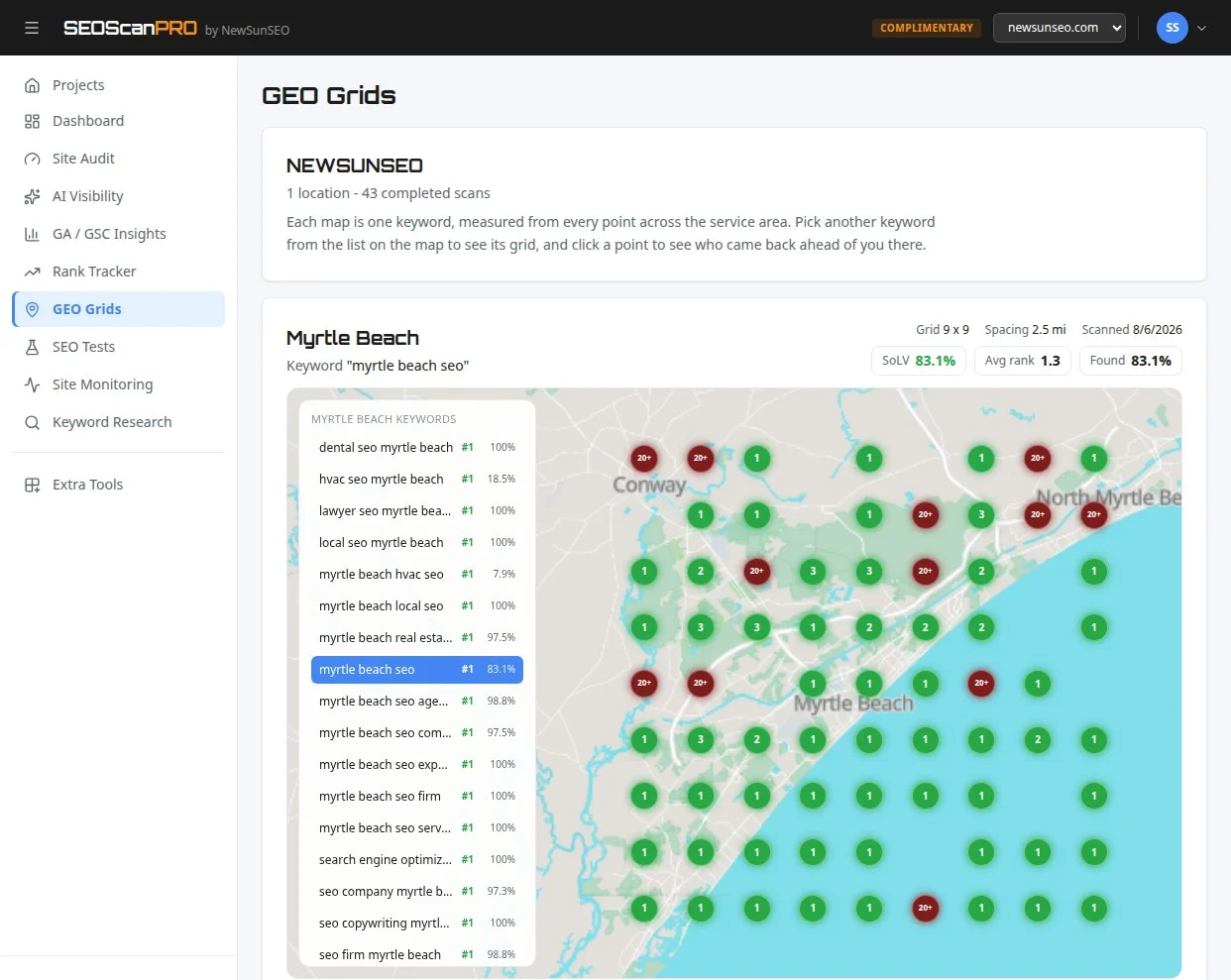
Rank position across a service area is what a geo grid report shows, and SEOScanPro‘s GEO Grids map rank position across a whole service area so you can see which towns and suburbs your domain is invisible in, rather than one city-wide average.
Key Considerations
- The default access setting matters more than the URL pattern alone, since switching to Only you made a test app return 401 to a stranger.
- Moving a secret into the URL path keeps it out of passive DNS but not out of search indexes, as the August 2025 grok.com/share/ case shows.
- Most open apps in the research were games, landing pages and calculators, and about 1 in 10 held sensitive material, with roughly 2% rated high or critical severity by the researchers’ estimate.
- Only 1,993 of the 37,571 online apps tested answered with HTTP 401, the error an app set to Only you or Invited users returns.
- SpaceXSI’s 24 apps were taken down after the report, and the company did not answer follow-up questions about customer notification.
FAQ
Why Were Grok Build Links Easy to Find?
Grok Build placed its random secret before the grok.me domain. Passive DNS services recorded newly observed hostnames in searchable databases, allowing researchers to enumerate live project links.
What Should Grok Build Users Set?
Users who do not intend to make an app widely available should select the "invited users" option rather than "Anyone with the link." Users can also select "only you."
How Many Grok Build Apps Were Open?
Claroc tried 43,551 Grok app addresses. Of the 37,571 still online, 35,578 (94.7%) opened for anyone with no sign-in.
Was SpaceXSI Material Exposed?
Yes. Claroc found 24 live Grok Build apps containing SpaceXSI material, including a confidential onboarding plan and a sales territory map of 594 accounts. SpaceXSI removed the links within a few hours of Ars Technica emailing the company, and all 24 returned an "app not found" error when that report went live.
Are Other AI Coding Platforms Affected?
Aprozper said app builders including Lovable, Bolt and Replit "also give each app its own web address, so the same DNS records expose them, too. However, Grok is where we found by far the most sensitive company data."
Try the geo grid tool