
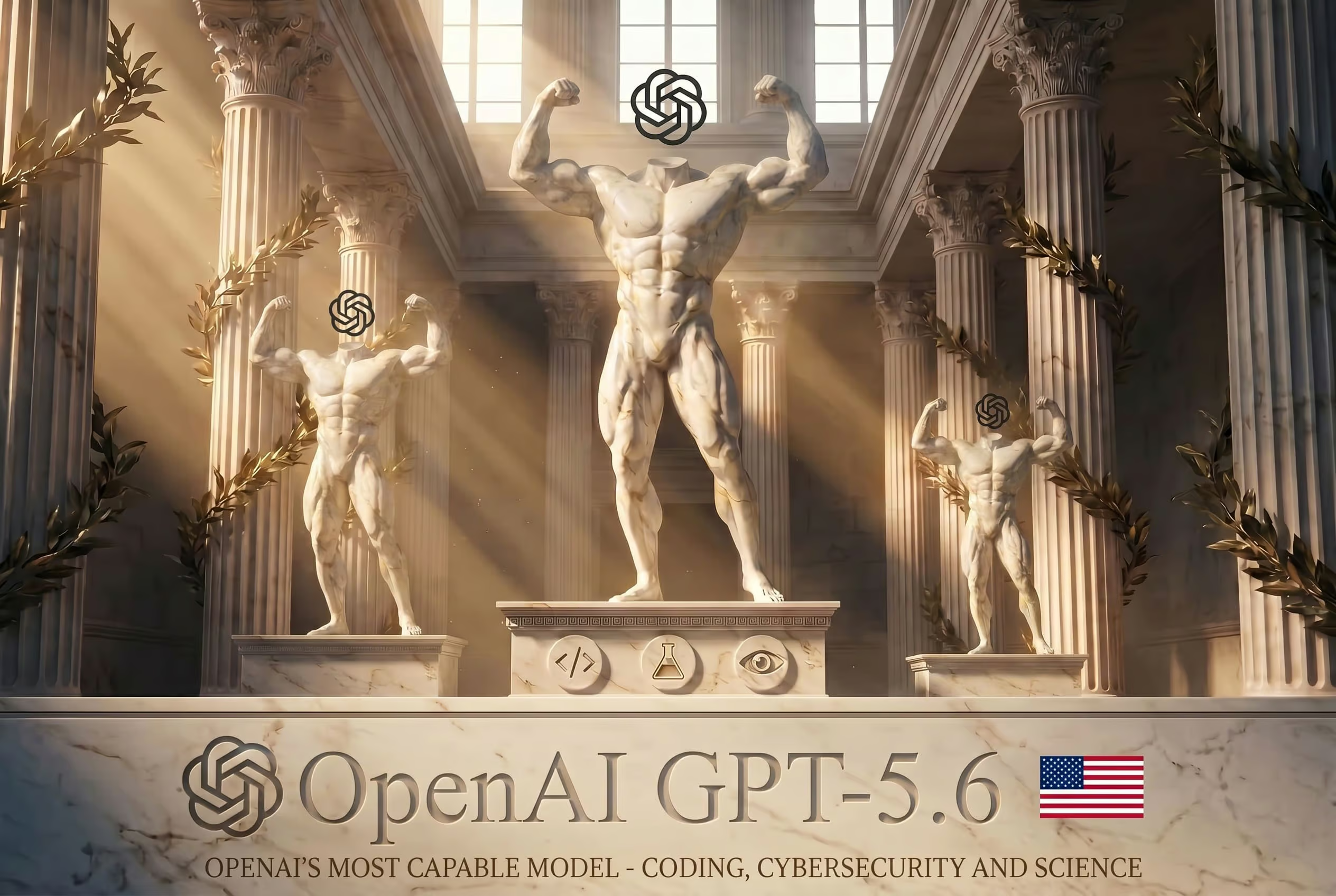
OpenAI is moving its GPT-5.6 model family to general availability on Thursday, July 9, 2026, following a closed preview that started in late June with a small group of partners and U.S. government coordination. The release ships three named tiers: Sol as the flagship, Terra as a balanced everyday model, and Luna as a low-cost fast option. Pricing, benchmark results, and a Cerebras-powered Sol deployment land on the same date.
What changes for a technical audit when OpenAI renames its tiers?
OpenAI has split the version number from the capability name. The 5.6 label marks the generation; Sol, Terra, and Luna mark durable tiers that can improve between releases. For anyone tracking model behavior on a site, that distinction matters more than it sounds. A page audited against Sol today will need re-checking when Sol upgrades in place, even if the next release still carries the 5.6 label.
Audit checklist: stable model targets vs. moving ones
- Record which tier you tested against, not just the version string.
- When documenting content policies or output behavior, cite the tier name (Sol, Terra, Luna) rather than the generation.
- Plan to re-run validation when a tier upgrades, since behavior can shift without a version bump.
What new reasoning controls ship with GPT-5.6?
Two new effort settings land alongside the family. A max reasoning effort setting gives Sol extended thinking time before producing output. An ultra mode goes past a single agent and coordinates subagents to push complex jobs faster. Both give developers a knob to trade latency for depth, which changes what you measure during an audit. Latency is no longer a single number per query; it depends on the effort setting.
Audit checklist: measuring reasoning effort
- Capture both p50 and p95 response time at each effort level you ship to production.
- Compare depth (token count, subagent calls) against wall-clock time to spot when ultra mode pays for itself.
- For pages where response length matters, test under max and under the previous default to confirm no regression.
How do the three tiers perform on coding, biology, and security benchmarks?
OpenAI positions Sol as state of the art on Terminal-Bench 2.1, a command-line workflow benchmark covering planning, iteration, and tool use. On GeneBench v1, a long-horizon genomics and quantitative-biology benchmark, Sol outperforms GPT-5.5 with fewer tokens. On ExploitBench, Sol stays competitive with Mythos Preview while using about one third of the output tokens. On ExploitGym, a benchmark built by UC Berkeley researchers with OpenAI and other frontier labs, all three tiers improve as reasoning effort rises.
On safety, OpenAI states Sol helps users find and fix vulnerabilities more than it carries out end-to-end attacks, and that it does not cross the Cyber Critical threshold in OpenAI’s Preparedness Framework. In Chromium and Firefox evaluations, Sol identified bugs and exploitation primitives but did not autonomously produce a functional full-chain exploit under the tested conditions.
Audit checklist: when your site touches these workloads
- If you run agentic coding pipelines, re-run your Terminal-Bench 2.1-style suite under max and ultra.
- Token efficiency on Sol may cut cost-per-task; refactor pricing assumptions before the next billing cycle.
- Security tooling that relied on the older model for triage should be re-tested; refusal behavior and classification strength have changed.
What does the GPT-5.6 safety stack look like?
OpenAI is calling GPT-5.6 its most extensive safety stack so far, configured per tier:
- Refusal training designed to hold up under jailbreak and disguised-intent attempts.
- Real-time cyber and biology misuse classifiers that evaluate output as it streams and can pause generation for review by a larger reasoning model on higher-risk content.
- Account-level review triggered by flagged activity.
- Differentiated access matched to each tier’s capability.
- Automated red-teaming with over 700,000 A100-equivalent GPU hours targeting universal jailbreaks, plus ongoing third-party human red-teaming through the preview.
OpenAI has warned that users may see blocks or refusals during the preview window and is collecting feedback to trim unnecessary blocks before wider release.
Audit checklist: false-positive rate on refusals
- If your site pipes model output through downstream filters, count how often the safety stack rejects legitimate queries.
- Log refusals with the prompt category to spot systematic over-blocking.
- Track changes across preview and GA; the company has signaled the refusal surface will move.
How is GPT-5.6 priced per million tokens?
Pricing splits across the three tiers:
- Sol: $5 input, $30 output per million tokens.
- Terra: $2.50 input, $15 output per million tokens.
- Luna: $1 input, $6 output per million tokens.
Terra is positioned to match GPT-5.5 while costing roughly half as much. Luna sets a new floor for frontier-tier pricing. Prompt caching is more predictable this round: explicit cache breakpoints, a 30-minute minimum cache life, cache writes billed at 1.25x the uncached input rate, and cache reads continuing at the existing 90% discount.
Audit checklist: cost modeling on the new tiers
- Recalculate cost-per-task at each tier using your real prompt and completion token counts.
- For workloads where Terra matches older performance, switch and capture the savings.
- Update caching math: writes are now 1.25x, reads still 0.10x of the uncached input rate.
- Confirm your 30-minute cache life assumption still holds for long-tail prompts.
What is the Cerebras Sol deployment, and who gets it first?
OpenAI is bringing GPT-5.6 Sol to Cerebras hardware at up to 750 tokens per second in July. Initial access is limited to select customers. The target use cases are latency-bound workloads such as high-throughput coding agents and real-time analysis.
Audit checklist: latency-sensitive pages
- If a page depends on sub-second responses, model the 750 tokens-per-second ceiling against your largest expected prompt.
- Confirm Cerebras-region availability lines up with your user’s geography before promising the speed.
- Prepare a fallback path for the period when access is invite-only.
What should you test on day one?
From July 9, API and Codex access opens across all three tiers, with ChatGPT rolling out more broadly afterward. Teams already running GPT-5.5 in production should benchmark Terra first for cost parity, then run Sol through Terminal-Bench 2.1-style agentic tasks to measure gains from the new max and ultra modes. Budget-sensitive flows should set Luna as the new floor for what frontier capability costs.
FAQ
When does GPT-5.6 reach general availability?
GPT-5.6 reaches general availability on Thursday, July 9, 2026, after a limited preview that started in late June with a small partner group in coordination with the U.S. government.
What do the Sol, Terra, and Luna names mean?
Sol is the flagship tier, Terra is a balanced everyday tier, and Luna is a fast, low-cost tier. The 5.6 number marks the generation; Sol, Terra, and Luna mark tiers that can advance without a version bump.
How much does GPT-5.6 cost per million tokens?
Sol is $5 input and $30 output, Terra is $2.50 input and $15 output, and Luna is $1 input and $6 output per million tokens. Cache writes are billed at 1.25x the uncached input rate with a 30-minute minimum cache life, and cache reads still receive a 90% discount.