
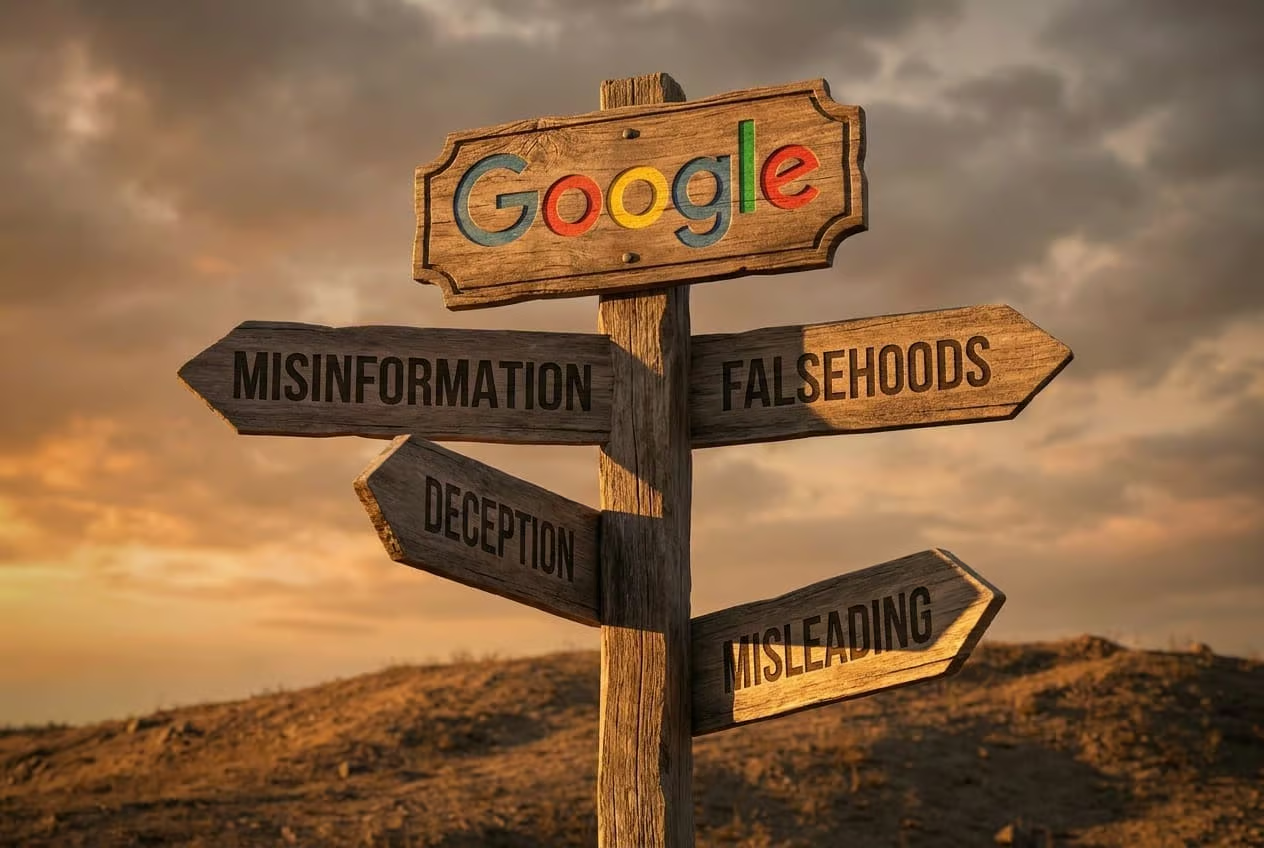
A Munich Regional Court issued a preliminary injunction in June 2026 ordering Google to correct fabricated statements that AI Overviews produced about two German publishers. The ruling treats those AI-generated summaries as Google’s own commercial speech, not as neutral pointers to third-party pages, which opens Google to liability for defamation whenever its models invent claims.
For anyone running a website, the practical question is immediate: what do AI search surfaces actually say about your brand, your hours, your pricing, and your reputation, and what should you check today to find and fix the errors?
Why this ruling changes the audit checklist
Earlier platform liability arguments leaned on the idea that a search engine only lists links, so it is not the speaker. The Munich judges drew a sharp line. They said traditional search results are third-party content indexed for retrieval, while AI Overviews generate “independent, new, and substantive statements” that no external publisher wrote. Once the model invents a sentence like “Yes, [the publisher] is known for dubious business practices,” the platform that surfaces it becomes the responsible party.
The court also dismissed the defense that users should already assume AI output is unreliable. A tool whose usefulness depends on trust, the judges reasoned, cannot be marketed as helpful while disclaiming all accuracy. The court added that AI Overviews sit on top of search as an optional commercial layer, one users can ignore, so the liability that comes with publishing that layer is real.
The numbers behind the risk
A 2024 Pew Research Center survey found that 61% of Americans who regularly use AI-powered search rarely or never click through to source links. A May 2025 independent analysis by The New York Times reported that 9% of AI Overviews contained factual errors and 56% included inaccurate source attributions. Stanford’s 2025 AI Index Report put the hallucination rate for general-purpose models between 3% and 10%, with higher error rates in niche and local queries. None of those figures are edge cases. They describe a system that routinely invents details about real businesses.
p>
That blend of high error rate and low click-through means a hallucination about your company is often the only answer a searcher ever sees, and you may not know it exists.
What a site owner should audit right now
Start by treating AI surfaces the way you treat a directory you cannot edit. Run the exact queries your customers would type: brand name plus “hours,” plus “pricing,” plus “reviews,” plus “scam” or “complaints,” plus the city you serve. Capture screenshots and dates for every answer across Google AI Overviews, Google AI Mode if you have access, Microsoft Copilot summaries, Perplexity, and ChatGPT search. Store the prompts, the responses, and the cited URLs so you have evidence if a false claim sticks.
Then walk a structured data and entity audit, because AI Overviews pull heavily from sources they trust. Confirm your schema markup on the official site: Organization, LocalBusiness, FAQ, Product, and Service schemas should be present, valid in Rich Results Test, and free of conflicting data. Check your Google Business Profile, Bing Places, Apple Business Connect, Yelp, Facebook, LinkedIn, and the top three or four industry directories in your vertical. Look for mismatches in name, address, phone, hours, service descriptions, and founder names. Inconsistent signals are exactly where AI models start inventing.
Finally, audit your reputation footprint. Pull every AI answer that mentions your brand and tag each as accurate, outdated, or fabricated. Outdated answers (old hours, old pricing) usually trace back to a stale page or a stale listing, and fixing the source often clears the AI summary. Fabricated answers (claims that never existed on your site) require a documented correction request to the platform, and now, a legal pathway in jurisdictions that follow the Munich reasoning.
What changes operationally after the ruling
The injunction is preliminary and Google has said it is reviewing the decision, so expect an appeal. Even so, the legal framing travels fast. Cases built on the same theory are being prepared in other European jurisdictions, and U.S. courts have been arguing about Section 230 and AI-generated statements for years. A single plaintiff who wins on this logic in one major market can reset how every AI search vendor handles takedowns, opt-outs, and proactive monitoring.
The likely downstream effect is a formal “AI correction” workflow, modeled loosely on DMCA takedowns but aimed at defamatory or factually wrong AI outputs. Expect faster complaint intake, required response windows, and stronger source verification for high-stakes verticals such as health, finance, and local business reputation. For well-prepared sites, that is good news: accurate, well-structured entity data becomes the trusted input that AI systems reach for first.
The bigger shift for technical SEO
For years, the discipline of technical SEO has chased blue-link rankings. The Munich ruling underlines that the next frontier is answer-layer accuracy. Crawl logs, log file analysis, and structured data validation matter as much as ever, because they control what the model can cite, but they no longer tell the full story. You also need a separate monitoring layer that watches what AI surfaces actually publish about your brand and flags drift between the source page and the generated answer.
The court put it plainly, in a translated ruling excerpt: AI Overviews are “an additional function without which users are perfectly capable of finding results.” Translation for site owners: the AI layer is optional for users and now legally exposed for the company that runs it. Build your site, your schema, and your listings so the AI has nothing worth inventing, and you turn a new liability regime into a competitive advantage.
FAQ
What did the Munich court actually decide about Google AI Overviews?
The Munich Regional Court issued a preliminary injunction in June 2026 holding Google liable for false and defamatory statements its AI Overviews generated about two German publishers. The court treated the AI summaries as independent statements authored by the platform, not as passive listings of third-party content, and ordered Google to correct them.
How often do AI Overviews get facts wrong?
A May 2025 independent analysis by The New York Times found that 9% of AI Overviews contained factual errors and 56% included inaccurate source links. Stanford’s 2025 AI Index Report placed general-purpose model hallucination rates between 3% and 10%, with higher rates on niche and local queries.
What should a site owner check first to find AI errors about their business?
Run the queries your customers would run, capture the AI answers across Google AI Overviews, Microsoft Copilot, Perplexity, and ChatGPT search, and screenshot the responses. Then validate your schema markup, your Google Business Profile, and your top directory listings for consistent name, address, phone, hours, and service data, since AI models often invent details where sources conflict.