
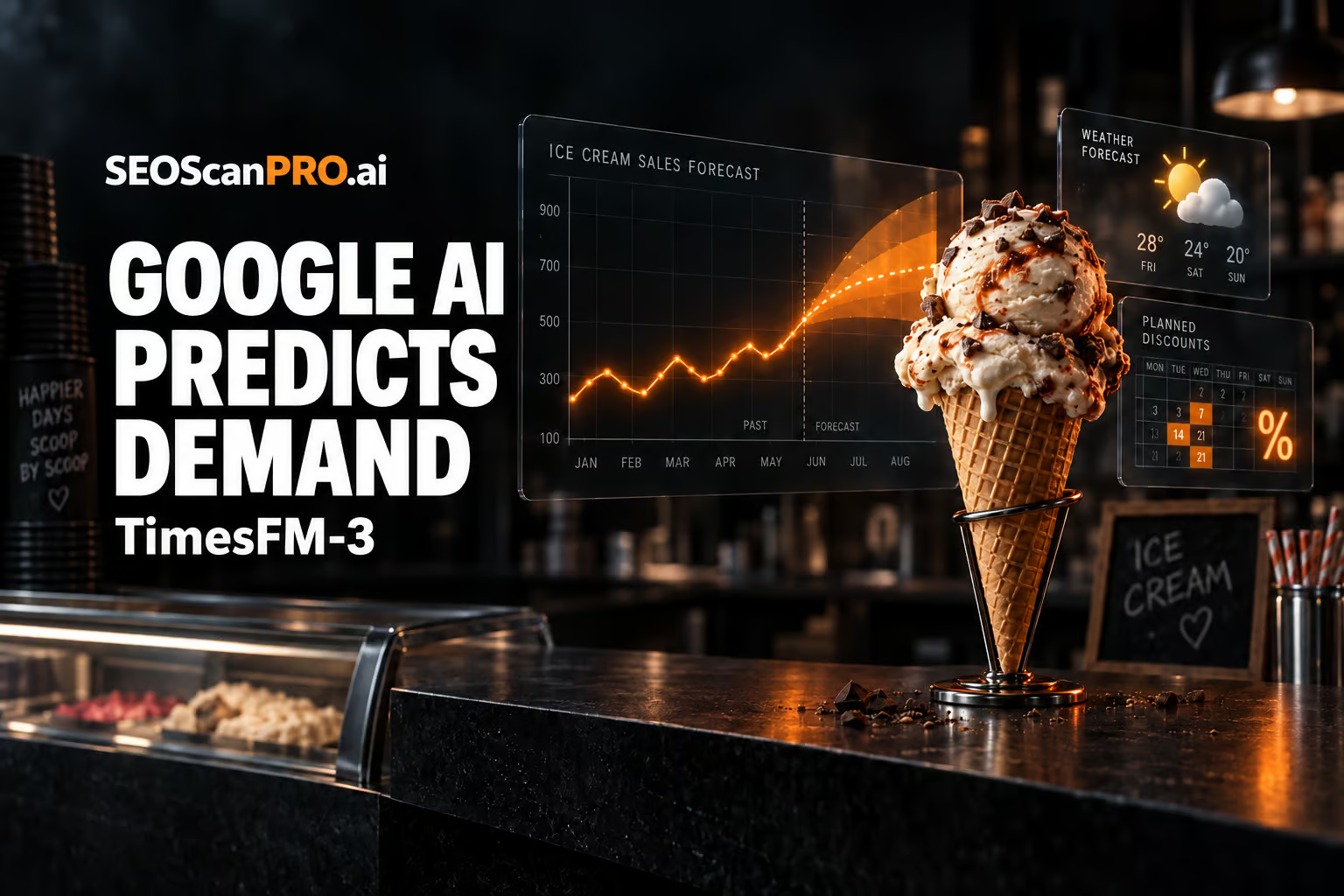
Google Research has released TimesFM-3, an AI model that forecasts the future from time series like daily sales figures, drawing on related data and known upcoming events to improve its predictions.
Google Research released TimesFM-3 on September 12, 2026. It reads time series alongside known future events and ranks first among pretrained forecasting models on Google’s three chosen benchmarks, though newer work shows that benchmark position does not settle every forecasting question.
How TimesFM-3 Uses More Than a Sales Series
Google illustrates the model with a retail chain forecasting ice cream sales. A practical forecast can include related products such as waffle cones and syrup, along with historical foot traffic, weather, discount campaigns, and holidays.
TimesFM-3 handles three types of supplementary data:
- Multiple related variables, such as different ice cream flavors, predicted together.
- Factors known only from the past, such as historical foot traffic.
- Known future events, such as planned discounts and weather forecasts.
Instead of returning one number for each time step, the model outputs nine values to show the range and uncertainty around a prediction.
What One-Shot Forecasting Changes
Earlier versions in the TimesFM family predicted the future one block at a time. Google says that method was slow, compute-heavy, and allowed errors to compound as each prediction built on the previous one.
TimesFM-3 marks future time steps as blanks and fills them in a single pass. In Google’s ice cream example, a model that knows only past sales continues the usual weekly pattern and misses planned promotions. According to Google, with the discount schedule supplied, TimesFM-3 can learn from history how promotions affect demand and may expect roughly 20 percent more units on each promotion day.
For website teams, that points to a concrete audit question. Are campaign dates, seasonal offers, and weather conditions represented as structured inputs, or does the business expect a forecast tool to infer them from a sales chart?
How the Model Processes Data
TimesFM-3 uses a Transformer architecture, the same base design as earlier versions. It groups 32 consecutive data points into one patch and normalizes each series to a common scale, allowing measurements with very different magnitudes to be compared.
The model then works in two directions. Along the time axis, it identifies patterns within a series and draws only on past values, which prevents future information from leaking into the forecast. Across series, it compares variables at the same point in time and learns their relationships, such as how a discount on one product affects demand for another.
Google reports that the model has 330 million parameters and was trained on real and synthetic time series totaling more than one trillion data points. According to Google, it operates zero-shot, so no extra training may be required for a new task.
Where the Benchmark Lead Has Changed
According to Google, TimesFM-3 ranks first among pretrained forecasting models on Gift-Eval, FEV-Bench, and Time in both point accuracy and uncertainty calibration. The comparison set includes Amazon’s Chronos-2, the Toto-2.0 family, and Google’s TimesFM-2.5. Google says the model matches or beats the field with only one variable, while adding more data widens the gap.
That result now has two important qualifiers. Mistral AI says its 209M model has a different advantage: “Our 209M model beats TimesFM-3 and Falcon-2.0 with fewer parameters.” Mistral’s Timestral family includes 5M, 28M, 123M, and 209M parameter versions. Mistral reports that all four sit on the Pareto front for accuracy against model size and that the family does not need a GPU for inference.
An independent study led by Ebrahim Khaled Ebrahim, Somaia Mohamed Ali, and Ahmed El-Kotory also found a setting where a classical method wins. Across 7,200 generated series, a pre-registered protocol, and a 12-step horizon, neither family dominated every scenario. The researchers found: “With four or more cycles automatic ARIMA is 21-24% more accurate than TimesFM-3 on seasonal ARIMA data.”
The study also reported that TimesFM-3’s error was never more than 1.31 times the best method in a scenario, while every classical method was at least 2.2 times worse somewhere. On intermittent demand, TimesFM-3 showed no advantage over simple history-based benchmarks. The result applies to the short horizon tested, since at steps 25 to 48 the three foundation models tested forecast a decline on a saturating process whose level stays flat.
What This Means for Website Forecasts
All versions through TimesFM-2.5, released in September 2025, could only process one data series at a time, making TimesFM-3’s multivariate support a major step forward.
A model that leads on general public benchmarks may still lose to automatic ARIMA on strongly seasonal data with four or more cycles. According to Mistral AI, the smaller models in its Timestral family are faster and cheaper.
For marketers working with search performance data, the same data discipline applies. Check the timestamps and definitions used across the records before combining them.
Where TimesFM-3 Is Available
TimesFM-3 is available on GitHub and Hugging Face. According to Google, it may be added to BigQuery in the coming weeks. TimesFM-2.5 currently handles single-variable forecasting in BigQuery through the AI.FORECAST command.
Since the family launched in 2024, Google says it has been deployed across retail, finance, manufacturing, healthcare, and the sciences. Versions through TimesFM-2.5, released in September 2025, processed only one data series at a time, making multivariate support the main advance in TimesFM-3.
Google is also developing forecasting systems outside the time series family. According to the-decoder.com, in early August Google DeepMind released WeatherNext Cyclones, an open-source system for tropical cyclones that predicts storm tracks and intensity about a day further out than leading operational models.
What to Do Now
- List the variables your forecast depends on. Write down sales, related product data, historical traffic, campaign dates, holidays, and weather sources before choosing a model.
- Check that each source shares matching time periods. Review how the records are dated and whether promotional, seasonal, and traffic data can be joined to the sales series.
- Record known future events separately. Make scheduled discounts and weather inputs explicit so the forecasting process can use them instead of only extending past patterns.
- Compare models on your own seasonal pattern. Evaluate TimesFM-3 against a classical method such as automatic ARIMA, especially if the data contains four or more seasonal cycles.
- Track both accuracy and uncertainty. Review the range of forecast values and the error metrics relevant to your decisions rather than relying on a single point estimate.
FAQ
What Is Google TimesFM-3?
TimesFM-3 is a time series forecasting model from Google Research that predicts future values such as daily sales from past data. It uses related products, factors known only from the past such as historical foot traffic, and known future events such as planned discounts and weather forecasts. According to the-decoder.com, it has 330 million parameters, was trained on real and synthetic time series totaling more than one trillion data points, and works zero-shot.
How Is TimesFM-3 Different From Earlier Versions?
Every version through TimesFM-2.5 could process only one data series at a time. TimesFM-3 adds multivariate support, so it can forecast several related variables together and use supplementary past and future data. It also replaces block-by-block prediction with a one-shot method that marks future steps as blanks and fills them in a single pass, which Google says reduces the compounding errors of the older approach.
Where Can I Access TimesFM-3?
According to Google, TimesFM-3 is available on GitHub and Hugging Face, and may be added to BigQuery in the coming weeks. In BigQuery, TimesFM-2.5 currently handles single-variable forecasting through the AI.FORECAST command.