

Site owners can now use a fixed September 24 through October 8 window to assess the Google September 2026 spam update. Google confirmed that the worldwide rollout ended on October 8, but the available evidence does not identify what the update targeted or establish that it caused every ranking change reported during the period.
The update took 13 days and 16 hours to finish, longer than the three earlier spam updates Google ran in 2026. Google calls a spam update a notable improvement to its automated systems for detecting spam, according to its update report.
What the completed rollout means for site owners
Google launched the update on September 24, applying it globally and to all languages. The Google Search Status Dashboard recorded completion on October 8 at 1:00 a.m. PDT. The source article describes the rollout as taking nearly the full two-week window Google allowed.
That gives owners a useful comparison period. Use Google Search Console to compare performance before, during and after the rollout as more data becomes available. A dip during the rollout does not establish that the spam update caused it.
Early research also requires caution. Diib analyzed 32,569 websites with connected Google Analytics and found that the median share of visits from unpaid Google search fell from 34% to 31% between September 24 and 26. Ten percent of the sites saw that share drop by half or more, compared with 5% in the preceding comparison period. Diib called the findings an early read, not a verdict, and said the data did not reveal which sites Google classified as spam.
What are manual actions and algorithmic demotions?
The source article reports a possible increase in Google manual action penalties after the update, but it does not identify the observer or provide an official Google count. Site owners should distinguish that observation from the confirmed completion of the spam update.
Review any manual action notice in Google Search Console, including the affected URLs and the stated issue, and compare it with Google’s spam policies.
What to check in your site audit
A site audit should record evidence that helps distinguish a policy problem from ordinary ranking volatility. The audit does not need to assign a cause to a ranking change. It should show what changed, where it changed and whether the evidence persists across Search Console, indexing data and country-level reporting.
- Manual action notices: Check Google Search Console for a manual action and record its date, affected URLs, stated issue and the response requested by Google. Escalate the finding if a notice is unresolved or if changes do not resolve the stated problem.
- Country-level visibility and traffic changes: Compare impressions, clicks, traffic and affected queries before September 24, during the rollout and after October 8. Record whether the change appears across those data sets or only in one report.
- Indexing and canonical consistency: Review the pages that changed status or visibility, including their index status, canonical selection and whether Google selected the intended URL.
- Thin or templated pages: Compare the affected pages with the purpose of their sections. Record repeated content, missing information and whether large groups of URLs share the same structure without enough distinct content.
- Author and credential claims: Check whether named authors, biographies, photos and qualifications are accurate and supported by the visible page. Escalate unsupported claims to the person responsible for editorial or page content.
- Structured and visible author data: Compare author information in visible page content, metadata and structured data. Record mismatches rather than assuming the search engine will ignore them.
SEOScanPro provides comprehensive website SEO audits, including a local SEO audit and on-page analysis.
What publishers using AI content should review
Google told publishers to manually fact-check AI-generated content for accuracy before publication. The source article also says Google expanded its guidance on how main content is defined and how quality raters review pages. Review the page’s main content and the accuracy of its factual claims.
Google warned against deceptive authorship information. Compare visible bylines, author photographs and credentials with the supporting records.
Google also said its spam-update systems use AI to detect AI-generated spam at scale. Review Google’s spam policies and the qualities the source describes for the targeted content.
How advertisers should assess the product and ad changes
Google Ads added AI Max columns for brand inclusion, commission tracking and locations of interest optimized targeting. It also introduced self-service conversion-lift management. Automated promotions for Search and Performance Max campaigns are planned, while an AI-powered campaign-localization tool entered beta.
Google Merchant Center added a UCP integration hub. OpenAI was also testing richer product labels inside ChatGPT results and a visual ad format inside AI image generation.
Search Console and Search feature changes
Google Search Console added multi-select country filters to the Performance report. Its Search Generative AI control page also added top-level domain details.
According to Google, review snippets were removed for healthcare web pages.
Crawl-management documentation now covers the Retry-After HTTP header, which allows a server to ask crawlers to slow down when it is under heavy load. Google also introduced a UGC fresh-data program.
Nano Banana 2.1 became available in Google AI Mode. Search profiles expanded to India and Canada, with Brazil coming soon, and Google local panels tested a WhatsApp button.
What to do now
- Create a dated comparison. Compare impressions and clicks in Google Search Console before, during and after the rollout.
- Check manual actions directly. Open the manual actions section of Google Search Console. Record any notice, affected URLs and stated issue, then resolve the documented problem before changing unrelated parts of the site.
- Review affected content. Look for thin, templated or mass-produced pages that lost visibility. Compare each affected page with its intended main content and Google’s spam policies.
- Verify authorship. Confirm that visible bylines, author profiles, photos and credentials match supporting records. Compare structured author information with the visible page and record any mismatch.
- Validate AI-assisted pages. Fact-check AI-generated factual claims before publication and revise content that lacks original information or a clear purpose for the reader.
FAQ
When did the Google September 2026 spam update finish?
Google confirmed that the worldwide rollout ended on October 8, 2026. It started on September 24 and took 13 days and 16 hours, according to Google’s ranking update history.
Did the September 2026 spam update cause every ranking drop during the rollout?
No. The available early data did not establish causation or identify which sites Google classified as spam. Search Console changes that persist across several days and appear in impressions and clicks carry more evidence than a short fluctuation in a third-party rank chart.
What should a site owner check after a spam update?
Check Google Search Console for manual actions, compare performance before and after the rollout, review indexing and canonical consistency, and inspect affected pages for thin or templated content. Also verify author information, credentials and any mismatch between visible and structured authorship data.
Try the site audit tool
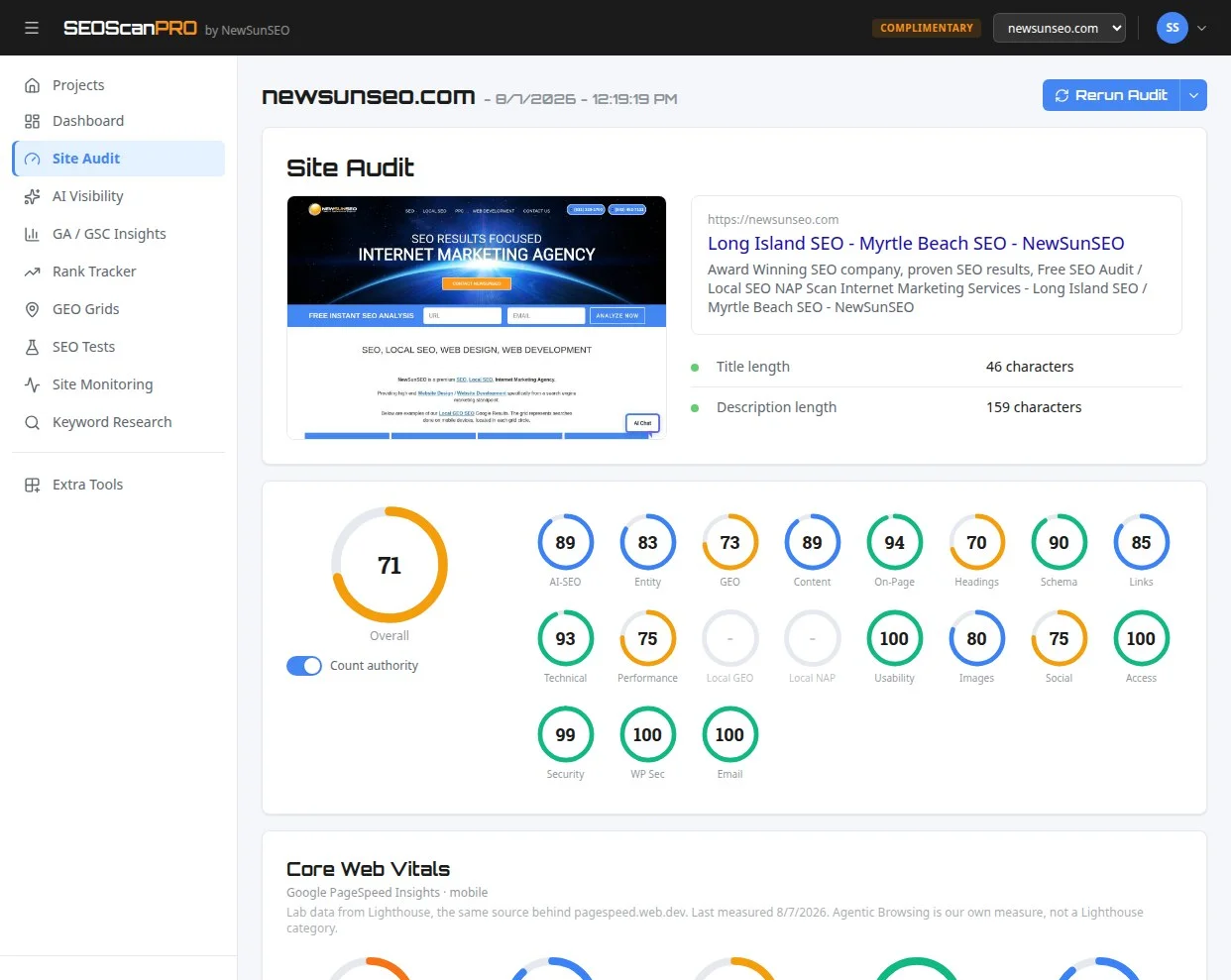
SEOScanPro runs a full technical audit of a site and shows the measured result behind every check. Open the site audit tool.
Sources
- Search News Buzz Video Recap: Google Spam Update Done, Penalties Rise, Factcheck AI, Content Quality, Fake Authors, Ads & So Much More, seroundtable.com, Oct 9, 2026
- searchenginejournal.com
- coalitiontechnologies.com
- Google September 2026 Spam Update Has Finished Rolling Out, seroundtable.com, Oct 8, 2026