
Free SEO tools can give website owners a practical way to check AI visibility, research keywords, audit technical issues, and monitor rankings without spending money. Choosing the right tools helps you understand what search engines and AI platforms can see and decide which improvements to address first.
Each tool covers a different part of the workflow, and the amount of useful free access varies. Some provide daily searches, others allow limited pages or keywords, and some focus on a single task. Understanding those limits helps you choose where to start and what an audit should flag.
What free SEO tools can measure
Search and AI visibility depend on relevant content, site health, and authority. A free tool may help you examine one of those areas in greater detail than another.
- AI visibility: Check whether a domain appears in AI search platforms and which topics or brands appear in those results.
- Keywords: Use keywords to generate ideas, compare search demand and difficulty, and find questions that match search behavior.
- Technical health: Audit pages, check speed metrics, identify indexing problems, and connect warnings to potential improvements.
- Authority and backlinks: Review referring domains, backlink volume, anchor text, and lost links.
- Performance: Track keyword positions, search queries, top pages, and changes in visibility over time.
For a broader technical review, SEOScanPro runs a full site audit and shows the measured result behind each check, including on-page analysis and a local SEO audit.
How the seven tools compare
- Semrush: Covers AI visibility, site audits, keyword ideas, backlinks, domain authority, keyword rank checks, and position tracking.
- Google Search Console: Shows search performance, indexing coverage and errors, top pages, and top queries.
- Google PageSpeed Insights: Measures performance metrics such as Largest Contentful Paint and Cumulative Layout Shift, then lists speed and usability issues.
- Ubersuggest: Generates keyword ideas and metrics, filters for volume and difficulty, and includes a First Page Potential score.
- Google Keyword Planner: Produces keyword ideas from a seed term or URL, with average monthly search ranges and advertiser competition levels.
- AnswerThePublic: Uses Google autocomplete data to reveal related questions and long-tail ideas, with CSV export.
- AlsoAsked: Maps related questions visually and groups them into topic clusters.
Which free SEO tools include AI visibility checks?
Semrush includes an AI Visibility Tool for checking a domain across AI search platforms such as ChatGPT and Google AI Overviews. It reports overall AI visibility, brand mentions, and performance relative to competitors. A topic breakdown shows the subjects where the brand appears, including areas where coverage is missing.
The free allowance provides three checks per day. Other Semrush features use a shared allowance of 10 analytics requests per day, while some tools have their own limits.
What can a free site audit report?
Semrush Site Audit scans a website for technical SEO issues and organizes findings into errors, warnings, and notices. The setup takes less than two minutes: enter a domain, choose crawl settings, and start the audit. The free plan covers 100 webpages per month.
Google PageSpeed Insights takes a different approach. It analyzes a webpage in a few seconds and reports metrics including Largest Contentful Paint, which measures loading performance, and Cumulative Layout Shift, which measures visual stability. It also lists issues affecting speed and links each issue to an estimated impact, such as milliseconds saved or kibibytes reduced. Its remediation guidance is limited, so implementation may require additional research or help from a developer.
Google Search Console provides the search-side view. Its reports cover indexing coverage and errors, which can reveal pages Google is not indexing and why. Performance data lags by 24 to 48 hours, so the reports do not reflect ranking changes immediately.
Which tools help with keyword research?
Semrush Keyword Magic Tool and Keyword Overview
Keyword Magic Tool generates keyword ideas from a seed term and lets users filter by search volume and difficulty. Its Questions tab surfaces question-based keywords for FAQ sections and AI search coverage. The source testing found that one search produced more than 30,000 keyword ideas in under a minute, while the Questions tab returned more than 30,000 question-based keywords in one click.
A Personal Difficulty Score estimates how difficult a keyword may be for the entered domain, which gives more context than a generic difficulty score. Keyword Overview adds information about search volume, intent, difficulty, and the types of pages appearing in search results, such as informational articles or product pages. Both tools use the shared daily request allowance.
Ubersuggest
Ubersuggest can generate thousands of keyword ideas from a seed keyword. Full metrics are limited to a small number of keywords, and the free version permits three searches per day. Its First Page Potential score estimates whether a website can rank for a keyword on the first page, which helps prioritize a shortlist.
Google Keyword Planner
Google Keyword Planner generates ideas from a seed term or URL. It provides average monthly search ranges and advertiser competition levels, giving advertisers an early view of demand inside Google Ads.
AnswerThePublic and AlsoAsked
AnswerThePublic draws on Google autocomplete data to expose related questions and long-tail ideas, then exports a keyword list as CSV. AlsoAsked presents related questions visually and expands topics into clusters, making it useful for planning FAQs and topic clusters.
How do the remaining tools support tracking and research?
Semrush Position Tracking monitors keyword positions in search results, including Google AI Overviews. The free plan tracks 10 keywords. Its Overview report makes gains, drops, and lost visibility easier to spot, while the Summary section shows recent performance.
Keyword Rank Checker shows a domain’s position for a chosen keyword and the keywords where that domain ranks highest. Three checks per day are available. Website Authority Checker provides a domain’s Authority Score, a Semrush metric based on signals including backlinks, referring domains, organic traffic, and spam factors. Three checks per day are included.
The Backlinks tool analyzes which pages earn links, highlights lost backlinks, and reports anchor text usage. A full analysis can run in under a minute, with 10 shared analyses available per day. Bulk Analysis, which can examine up to 100 keywords at once, is not included in the free plan.
What to do now
- Start with what Google already shows. Use Google Search Console to review indexing coverage, errors, top pages, and search queries. Account for the 24-to-48-hour reporting delay when comparing changes.
- Check the site’s technical condition. Run a site audit and examine errors, warnings, and notices. For page speed, review LCP, CLS, and the estimated impact of each flagged issue.
- Build a focused keyword list. Generate ideas with Keyword Magic Tool, Ubersuggest, Google Keyword Planner, or AnswerThePublic. Filter by search volume and difficulty, then use question data to guide FAQ sections and topic clusters.
- Measure AI visibility. Check the domain’s mentions and topic coverage across AI search platforms, then use the topic breakdown to identify visible subjects and gaps.
- Track a small set of priorities. Monitor rankings for 10 keywords with Position Tracking, and review backlink and authority reports for signs of lost visibility or changing domain strength.
FAQ
Which free SEO tool can check AI visibility?
Semrush offers a free AI Visibility Tool that checks a domain across AI search platforms such as ChatGPT and Google AI Overviews. It shows overall AI visibility, brand mentions, competitor comparisons, and a topic breakdown, with three checks available per day.
How many pages can I audit with a free Semrush plan?
The free Semrush plan allows audits covering 100 webpages per month. Site Audit organizes technical issues into errors, warnings, and notices.
Can I track keyword rankings for free?
Yes. Semrush Position Tracking includes 10 keywords on the free plan and monitors positions in search results, including Google AI Overviews. Keyword Rank Checker also provides three checks per day for a chosen keyword and domain.
Related coverage
- Free SEO Tools | SEOScanPro
- Free SEO Checker | SEOScanPro
- SEOScanPro | Website SEO Audits That Show Real Results
Try the AI visibility report
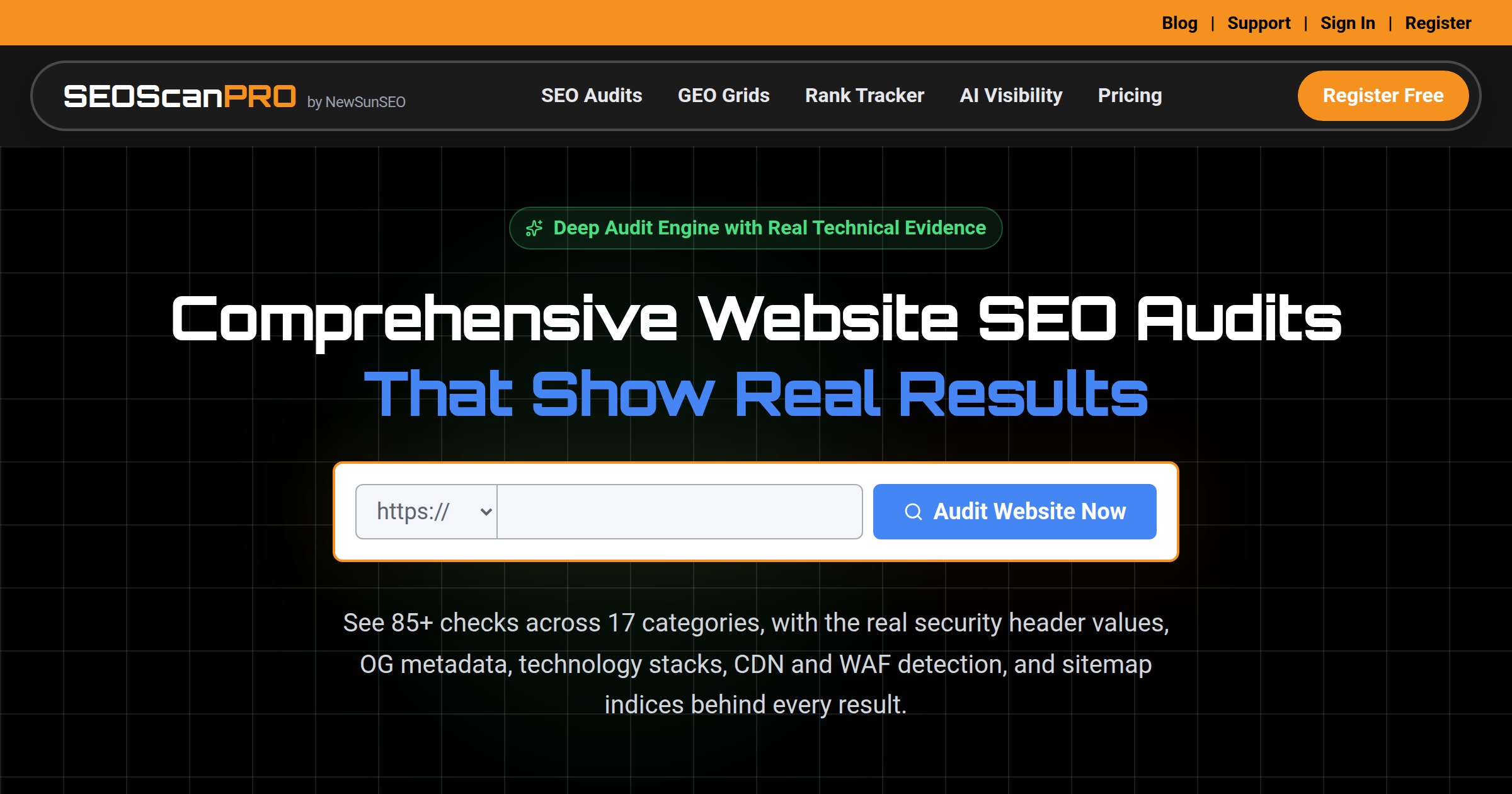
SEOScanPro runs a full technical audit of a site and shows the measured result behind every check. Open the AI visibility report.