

Google has published internal numbers showing how long each stage of search takes in practice, from first discovery of a URL to recovery after a core update. The data, shared at a Google Search Central Live Deep Dive event in Europe, gives site owners a clearer view of what to expect at the crawling, indexing, and serving stages, and where delays tend to stack up.
The figures come from a presentation that broke each process into a fastest time, a typical time, and a slowest time, based on Google’s internal analysis. A useful caveat from the presenter: many of these processes are linked, so a page cannot be indexed until it has been crawled, and a delay in one stage pushes back everything that follows.
What the crawling stage looks like in practice
Discovery of a new URL typically takes around 20 hours, but the slowest cases can run from weeks to never, often because of quality issues. Refreshing a known URL is a longer cycle, averaging about 30 days in the typical case, with the slowest examples stretching to weeks or never. Sitemap processing usually clears in about 24 hours, though low-quality sitemaps can take up to 14 days or never finish. A robots.txt update generally settles within 24 hours, with the slowest cases around 25 hours.
Crawl capacity updates span a wide range, from 4 hours on the fast end to 1 to 2 weeks in the typical case, and 1 to 3 weeks during recovery. Crawl demand updates average around 20 hours, with the slowest cases running from weeks to months. One operational note: crawl capacity can drop in seconds when Google backs off, for example when a server struggles under load.
Indexing timelines and where the slowdowns happen
Rendering usually takes seconds per page, though pages can sit in the queue for hours. The slowest cases run from days to weeks. Meta annotations typically resolve in 45 to 90 minutes, with worst cases at 1 to 4 days. Link annotations are far more variable, ranging from minutes to 1 to 3 weeks typically, and stretching to months in the slowest cases. End-to-end indexing averages about 1.5 hours in the best cases, but quality issues can stretch it to months or leave a page never indexed at all.
Removal requests typically take 1 to 3 weeks, with some running into months. A canonicalization change also takes 1 to 3 weeks normally, and longer when signals conflict. A site move is one of the heavier lifts: 1 to 3 months in the typical case, and 6 months to over a year in the slowest cases. A small site move, however, can wrap up in a few weeks.
Structured data updates range from hours to 1 to 2 weeks typically, and weeks to never when quality is an issue. Image processing runs from hours to days in the typical case, and weeks to months at the slow end. Video processing follows a similar shape, with hours to days typical and weeks to months for deep analysis.
The end-to-end timing reflects when all critical processes finish successfully, which is why the slowest numbers stretch from weeks to months compared with the typical hours to 2 weeks. A site that is healthy at every checkpoint moves through stages such as crawl, rendering, indexing and serving in hours to days; a site that triggers a quality flag at one stage can wait weeks to months for the same result.
Serving timelines, from snippet changes to core updates
Removal in Search Console by the site owner typically takes about 2 hours, with a worst case of 24 hours. Snippet updates and title updates each take 1 to 2 days in the typical case, and several weeks to months in the slowest. Text result image updates run 1 to 2 weeks typically, with the slowest cases stretching to several weeks or months.
Manual action removal typically takes 1 to 2 weeks, with worst cases of 4 to 6 weeks, and much longer for dormant sites. Recovery after a core update is the longest serving timeline in the data: 3 to 6 months to recover in the typical case, and 6 months to a year waiting for the next core update. Spam update changes are faster, at 1 to 2 weeks continuously, with the slowest cases running into months during batch refreshes. Core updates take 2 to 4 weeks to roll out, while spam updates roll out in 1 to 2 days.
Why the spread between typical and slowest is so wide
Across the three stages, the gap between typical and slowest times is driven by a small set of recurring factors: quality flags, server issues, conflicting signals, and the sequential nature of the pipeline. A page that fails a quality check at indexing can sit unresolved for months, even if the crawling stage ran on time. A site move that introduces conflicting canonical signals can delay the move by half a year. A server that struggles under load can cause crawl capacity to drop in seconds, restarting the clock on discovery.
The data also makes clear that serving is not the same as indexing. A page can be indexed quickly and still take weeks or months to surface with the right title or snippet, or to recover from a core update. For site owners, the practical takeaway is that the slowest numbers in the table are the ones to plan around, since the typical case only holds when the underlying signals are clean.
For anyone tracking how visible a site is across a service area, rank position can vary sharply from one town to the next. A geo grid report shows that spread directly, and SEOScanPro’s GEO Grids map rank position across a whole service area so a business can see which locations it is invisible in rather than reading off a single city-wide average.
FAQ
How long does Google Search take to crawl a new URL?
Discovery of a new URL typically takes around 20 hours. The slowest cases run from weeks to never, often when quality issues block the page from being picked up.
How long does indexing take end to end?
End-to-end indexing averages about 1.5 hours in the best cases. Quality issues can stretch the timeline to months or leave a page never indexed at all.
How long does it take to recover from a Google core update?
Recovery after a core update typically takes 3 to 6 months. The slowest cases run 6 months to a year while waiting for the next core update to roll out.
Try the site audit tool
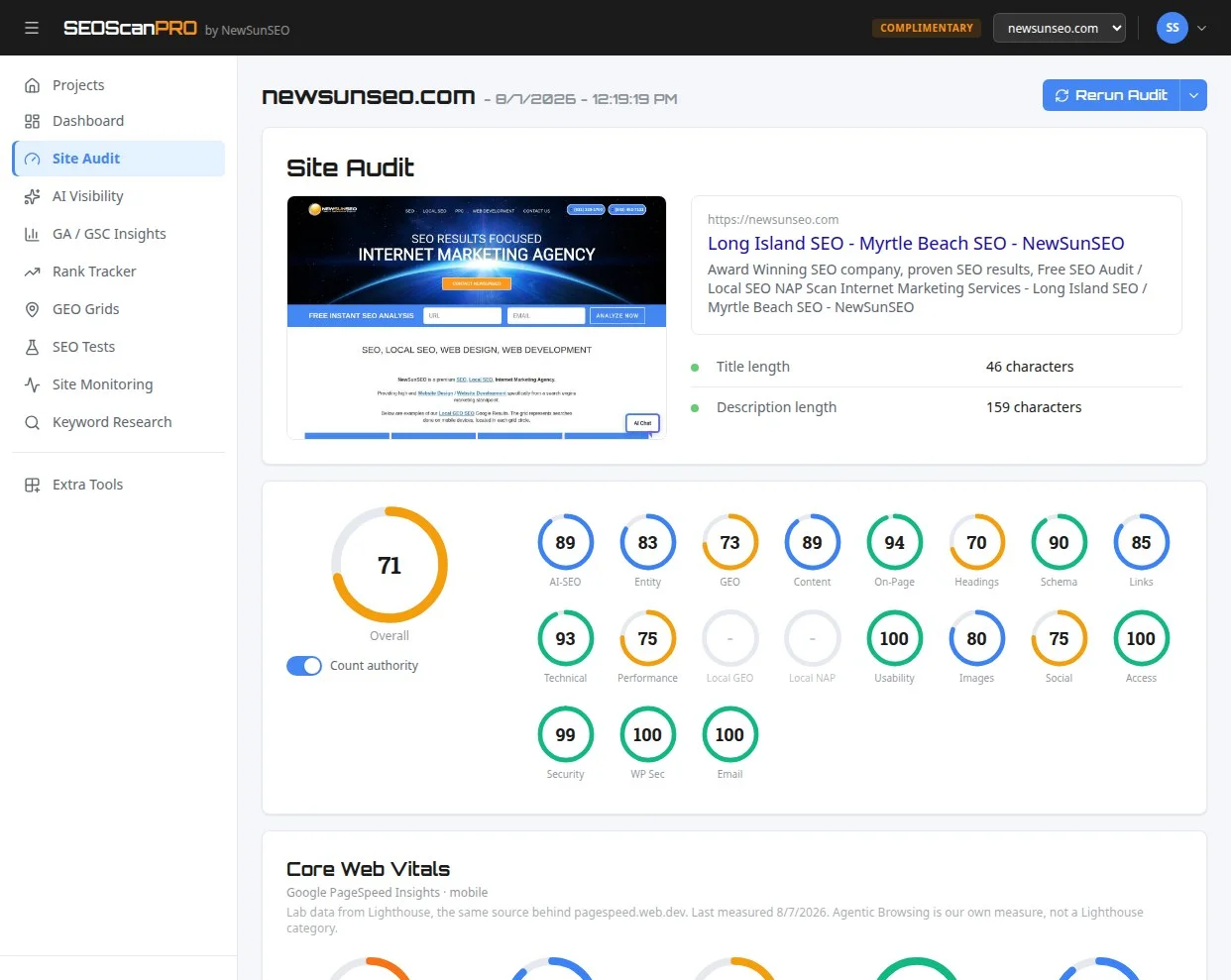
The site audit tool runs a full technical audit of a site and shows the measured result behind every check. Open the site audit tool.
This article summarizes reporting from seroundtable.com.