
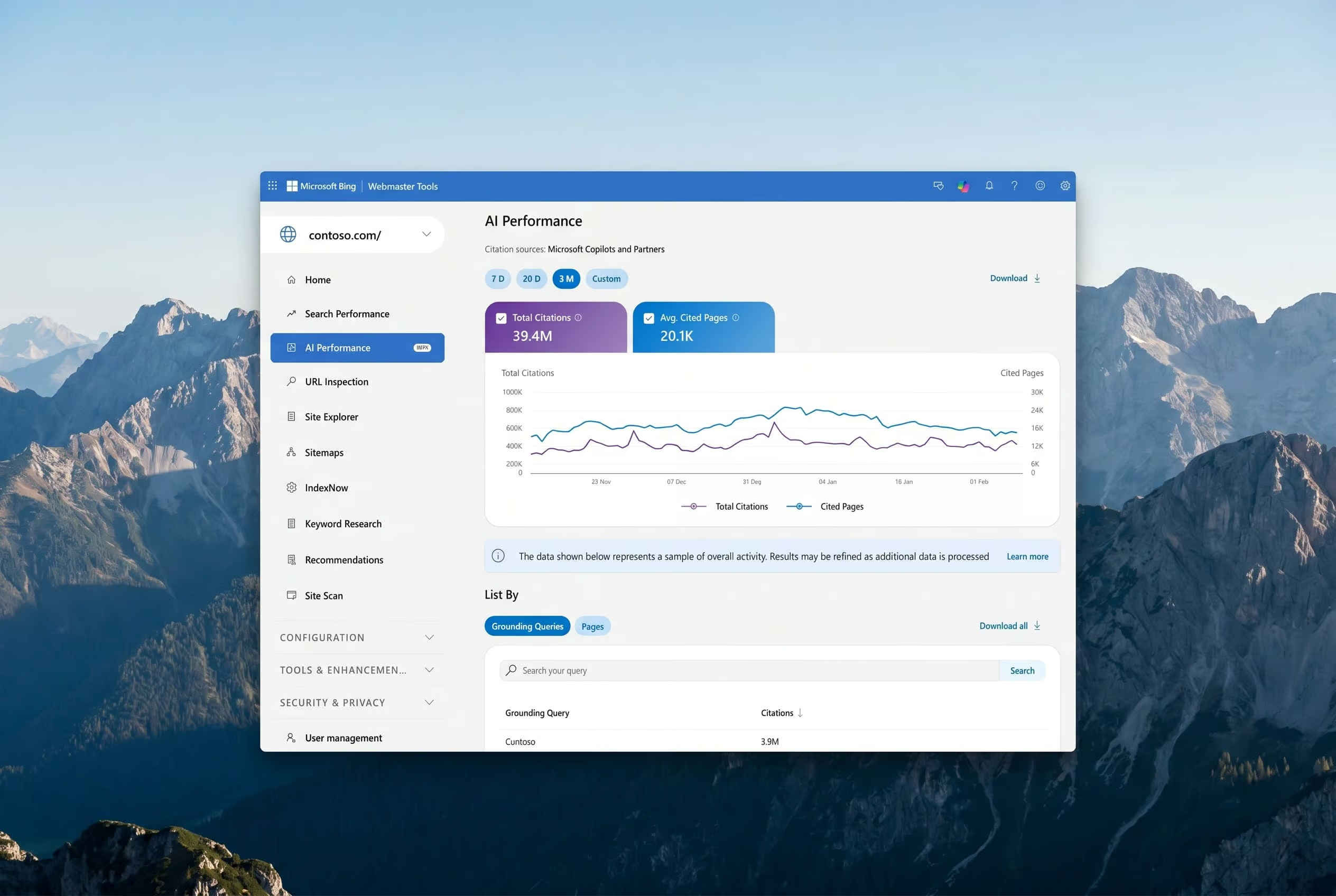
Microsoft has rolled out a public preview of AI Performance inside Bing Webmaster Tools, giving site owners a dedicated reporting section for tracking how their pages get cited inside AI-generated answers across Microsoft Copilot, Bing’s AI summaries, and partner integrations. For technical SEO teams, the release fills a long-standing reporting gap: traditional crawl and index data did not show whether content was being referenced, or ignored, by generative systems.
Below is a practical breakdown of each metric in the new dashboard and the audit checks that pair with it.
Why AI citation data belongs in your audit workflow
Search performance reports have always answered one question: how do my pages rank in blue links? Generative answers raise a second question: does my content show up at all when an AI system assembles a response? The two are not the same. A page can rank well and still never be cited, or be cited without ever holding a top organic position. Treating AI visibility as an extension of rank tracking misses that distinction, which is why a separate report category makes sense.
For publishers running regular technical audits, the new section creates a new class of issues to check: pages that are indexed, eligible, and crawlable, yet absent from AI citations, or the reverse, pages cited frequently with thin supporting content that may need reinforcement.
What the AI Performance dashboard actually measures
Microsoft’s preview surfaces five core data points, all centered on citation frequency rather than ranking position.
- Total Citations: A count of every instance the site is shown as a source in an AI-generated answer during the selected window. Each appearance counts once; the metric does not weight placement inside a response.
- Average Cited Pages: The daily mean of distinct URLs surfaced as sources, aggregated across supported AI experiences. This is breadth, not authority per page.
- Grounding Queries: Representative phrases that AI systems used when retrieving content that became a citation. Microsoft flags these as a sample of overall activity that will be refined as data accumulates.
- Page-level citation activity: A URL-by-URL breakdown so publishers can see which pages are referenced most often. Again, frequency only, not prominence.
- Visibility trends over time: A timeline view of citation activity across supported AI surfaces, useful for spotting directional shifts.
Throughout, the dashboard honors content owner preferences expressed via robots.txt and other supported control mechanisms, so excluded pages stay excluded.
How should publishers act on the data?
The metrics are descriptive, not prescriptive, so the value comes from the audit work they trigger. A useful starting routine:
- Validate current citations. Cross-check the URLs in the page-level report against the queries they appear for. Confirm the cited content actually answers the grounding query; mismatches are a signal to rewrite, not to delete.
- Flag frequent references for reinforcement. Pages that appear often across AI responses are doing structural work for you. Audit them for outdated statistics, broken examples, or thin source citations, then update.
- Find the silent majority. Indexed, crawlable, canonical pages with near-zero citations deserve a second look at clarity, heading hierarchy, and the presence of extractable definitions or tables.
- Treat grounding queries as a content map. The phrases listed are a direct sample of what AI systems considered when pulling from your site. If a phrase is present but the page that should answer it is not cited, that gap is worth closing with a dedicated section.
Structural improvements that show up in the report over time
Several changes tend to improve the odds of being cited, and they are the same patterns technical SEO audits already look for:
- Clear headings, tables, and FAQ blocks. Generative systems pull extractable facts. Pages with explicit question-and-answer markup make that extraction cleaner.
- Supported claims. Original data, named sources, and concrete examples give an AI system something concrete to reuse, and reduce the chance of a confident misquote.
- Topical depth. Pages cited for specific grounding phrases usually have a clear subject focus. Expanding adjacent subtopics on the same URL tends to widen the set of queries that page can answer.
- Freshness. Outdated pages get cited less often. Regular updates keep the canonical version aligned with what an AI system should retrieve.
- Format consistency. When text, images, and video describe the same entities the same way, AI systems are less likely to mix signals or pull from the wrong asset.
Microsoft points publishers to its guide on optimizing content for inclusion in AI search answers for a deeper structural checklist, and that document is worth treating as an extension of your existing on-page audit template.
Where IndexNow fits into the workflow
Microsoft ties AI Performance directly to IndexNow, the protocol that notifies participating search engines when a URL is added, updated, or removed. The pitch is straightforward: if you want AI systems to cite the current version of a page, the crawler needs to know the page changed. Sites that have not enabled IndexNow can sign up at indexnow.org, and the activation step is small enough to fold into any audit deliverable. After enabling, watch whether newly updated pages appear faster in both Total Citations and page-level activity, which gives you a feedback loop for content refreshes.
Local businesses: the extra check that matters
For businesses with a physical presence, the audit scope widens. AI experiences increasingly answer location-based queries, and inaccurate business data is a common reason a site is not cited even when the content is strong. Microsoft recommends registering with Bing Places for Business alongside using Webmaster Tools, so address, hours, and contact details stay current and eligible for inclusion in AI responses. The same check applies to schema markup: confirm local business structured data on the page matches the listing.
What to expect as the preview evolves
Microsoft frames AI Performance as a step toward broader transparency between generative systems and the open web. The team behind the preview, Krishna Madhavan, Meenaz Merchant, Fabrice Canel, and Saral Nigam at Microsoft AI, is actively inviting publisher feedback, which means the metric definitions, especially around Grounding Queries, are likely to be adjusted. For audit purposes, treat the current numbers as directional rather than absolute, and revisit the dashboard after each round of refinements.
The near-term takeaway for technical SEO work is straightforward. AI citation data is now a first-class signal inside Bing Webmaster Tools, and it deserves its own section in any audit report, alongside crawl, index, and classic search performance.
FAQ
What is AI Performance in Bing Webmaster Tools?
AI Performance is a new reporting section inside Bing Webmaster Tools, opened by Microsoft as a public preview. It tracks how a publisher’s pages are cited as sources in AI-generated answers across Microsoft Copilot, Bing’s AI summaries, and select partner integrations.
Which metrics does the AI Performance report include?
The dashboard reports Total Citations, Average Cited Pages, Grounding Queries, page-level citation activity broken down by URL, and visibility trends over time across supported AI surfaces. The metrics count citation frequency, not ranking or placement inside any single answer.
Who at Microsoft is building AI Performance?
The feature is being developed by Microsoft AI. The team inviting publisher feedback includes Krishna Madhavan, Meenaz Merchant, Fabrice Canel, and Saral Nigam.