
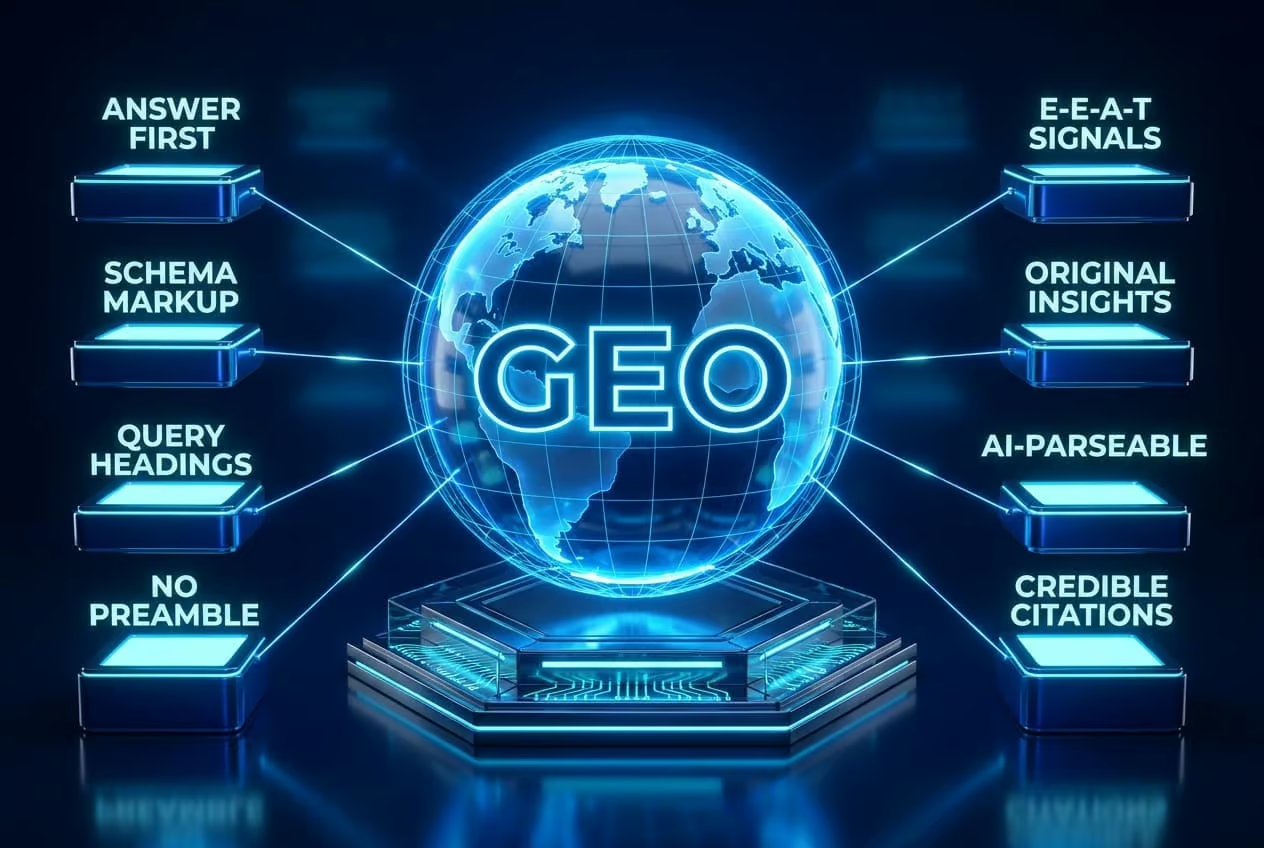
AI search platforms such as Google AI Overviews, ChatGPT Search, and Perplexity do not list ten blue links the way classic search engines once did. They generate a single answer and cite the pages behind it. For anyone running a technical SEO audit in 2026, every URL on a site now carries a binary question: refresh the page so it gets cited, or retire it and build something new. The framework below covers the signals to check, the order to check them in, and the structural fixes that move a page from invisible to cited.
Why refresh beats replacement for most pages
AI search uses Retrieval-Augmented Generation (RAG) to pull live data from search indexes before composing an answer. When an existing URL is updated, RAG reprocesses only the changed content, and the page keeps the backlinks, entity associations, and crawl trust it already earned. A brand-new URL starts at zero on all three counts and often waits weeks or months before it is cited at all. That gap is the central reason an audit should default to refresh before recommending new content.
The default flips only when the existing page is structurally unsalvageable, targets a query cluster the site has never covered, or carries penalties that block indexing regardless of content quality.
AEO versus GEO: what each audit pass measures
Answer Engine Optimization (AEO) and Generative Engine Optimization (GEO) are two layers of the same goal. Separating them during an audit prevents common fixes from being skipped.
- AEO checks focus on extractability. Is there a direct answer inside the first 100 words? Does the page use FAQ or HowTo schema? Do headings mirror the questions real users type, or do they read like internal labels?
- GEO checks focus on citability. Does the page carry original data, named expert contributions, or first-party research? Are claims sourced to credible references an AI model can verify? Is the topic coverage deep enough that the model would pick this page over a competitor when synthesizing a response?
A page can pass AEO and still never get cited because it lacks GEO signals. An audit that scores both layers separately produces clearer fix lists.
Which pages to refresh first during an audit
Not every URL warrants the same effort. Sorting URLs by the signals below produces a ranked worklist the audit can hand to a content team.
- Top priority: URLs ranking in positions 11 through 20 (the bottom of page 1 through the top of page 2) with referring domains above the site’s median. These pages already carry authority and need only structural lift to move into AI citation territory.
- High priority: URLs with steady Search Console impressions but a falling click-through rate. A drop in CTR while impressions hold usually means the title or the opening answer no longer matches intent, which a targeted refresh often reverses in a single cycle.
- High priority: URLs with more than 100 referring domains that return no AI citations when checked in Perplexity, ChatGPT Search, or Google AI Overviews for their target query. The authority exists; the structure is failing.
- Lower priority: thin URLs with no traffic and weak backlink profiles. These are usually better candidates for consolidation into a stronger pillar page than for a standalone refresh.
What to verify on each page before recommending a refresh
A refresh recommendation should not leave the audit stage as a vague instruction. Tie it to specific checks:
- Direct answer present in the first 100 words, phrased as a complete response rather than a question.
- Headings rewritten as real user questions, with each question answered immediately beneath it.
- FAQ or Article schema present, validated, and matching the visible content rather than placeholder copy.
- Statistics and examples updated to the current calendar year, with sources linked inline.
- Internal links refreshed to point at newer pillar content rather than orphaned pages.
- Canonical tag, robots directives, and hreflang still aligned with the live URL.
When a new page is the right audit outcome
Net-new content earns its keep only when at least one of these conditions is true during the audit:
- The topic is absent from the site’s content library and has measurable search demand.
- The existing page targets a fundamentally flawed premise, such as a deprecated product, an outdated regulation, or a query whose intent has shifted entirely.
- The keyword cluster cannot be folded into an existing URL without diluting that page’s primary topic, which would hurt GEO signals.
If none of these conditions apply, the audit should recommend consolidation: merge overlapping posts into a single pillar page, redirect the old URLs, and preserve the referring domains those URLs carry.
How freshness signals feed back into the audit cycle
Google’s own SEO documentation notes that more recent content can be more relevant for queries where freshness matters, and that updating a page can improve its quality. Translated into audit practice, freshness is a relevance signal AI systems read alongside backlinks and entity data. A site that updates its priority pages on a 30 to 90 day cadence builds a record of active maintenance that AI platforms treat as a trust signal, which raises the odds those pages surface in knowledge panels and generated responses.
The practical cadence for most sites:
- Quarterly refresh of top-priority URLs.
- Immediate update of any page affected by a major industry event, product change, or regulatory shift.
- Annual full-site audit with AEO and GEO scoring applied to every indexed URL.
Running the framework against a single page
Take a service page that ranks on page 2 with 45 referring domains and no citations in ChatGPT Search. The audit pass walks the checklist:
- AEO layer: confirm a direct answer sits in the opening paragraph, rewrite headings as questions, add FAQ schema that matches the visible Q&A block.
- GEO layer: add first-party data (a customer count, a measured outcome, a process diagram), cite an industry source by name, and link to a relevant internal pillar piece.
- Structural layer: validate canonical, check Core Web Vitals, confirm the page renders the FAQ block without requiring JavaScript that crawlers may not execute.
If all three layers pass after the refresh, the page returns to monitoring. If the GEO layer cannot be completed because the topic is too thin to support expert claims, the audit recommendation flips to consolidation rather than another refresh cycle.
Common audit findings and their fixes
- Direct answer buried past the 100-word mark: rewrite the opening paragraph so the core claim lands in the first two sentences.
- Headings labeled like internal categories (Services, About, Details): rewrite each as a question the target audience actually searches.
- Schema present but mismatched: regenerate FAQ or Article schema from the live content rather than reusing a template from another page.
- Statistics older than two years: replace with current-year data sourced to a named provider, and update the visible publication date where the content meaningfully changed.
- Multiple URLs targeting the same query cluster: pick the strongest URL, redirect the rest, and confirm the canonical chain is clean.
FAQ
What is the difference between AEO and GEO in an SEO audit?
AEO (Answer Engine Optimization) measures how easily an AI assistant or featured snippet can extract a direct answer from a page, which depends on factors like a concise answer in the first 100 words, FAQ or HowTo schema, and question-form headings. GEO (Generative Engine Optimization) measures whether a page is likely to be chosen as one of the sources an AI model synthesizes when generating a full reply, which depends on authority signals such as original data, named expert contributions, and thorough topic coverage. Both layers need to pass for a page to be cited consistently.
How often should priority pages be refreshed for AI search visibility?
High-impact pages, including URLs ranking in positions 11 to 20 and key product or service pages, benefit from a refresh every 30 to 90 days. Any page affected by a major industry event, a product change, or a regulatory update should be revised as soon as the change is public. A full audit with AEO and GEO scoring across every indexed URL should run at least once a year so structural decay is caught before it costs citations.
Does updating an existing URL produce AI citations faster than publishing a new page?
In most cases, yes. An updated URL keeps the backlinks, entity associations, and crawl trust it already accumulated, which lets Retrieval-Augmented Generation systems incorporate it into generated answers much sooner. A new URL has to be crawled, indexed, and assigned a trust score before it can be cited, and that delay often runs into weeks or months. Net-new pages should be reserved for topics the site has not covered, queries with no existing URL that can serve them, or pages that are too thin to salvage with a refresh.