
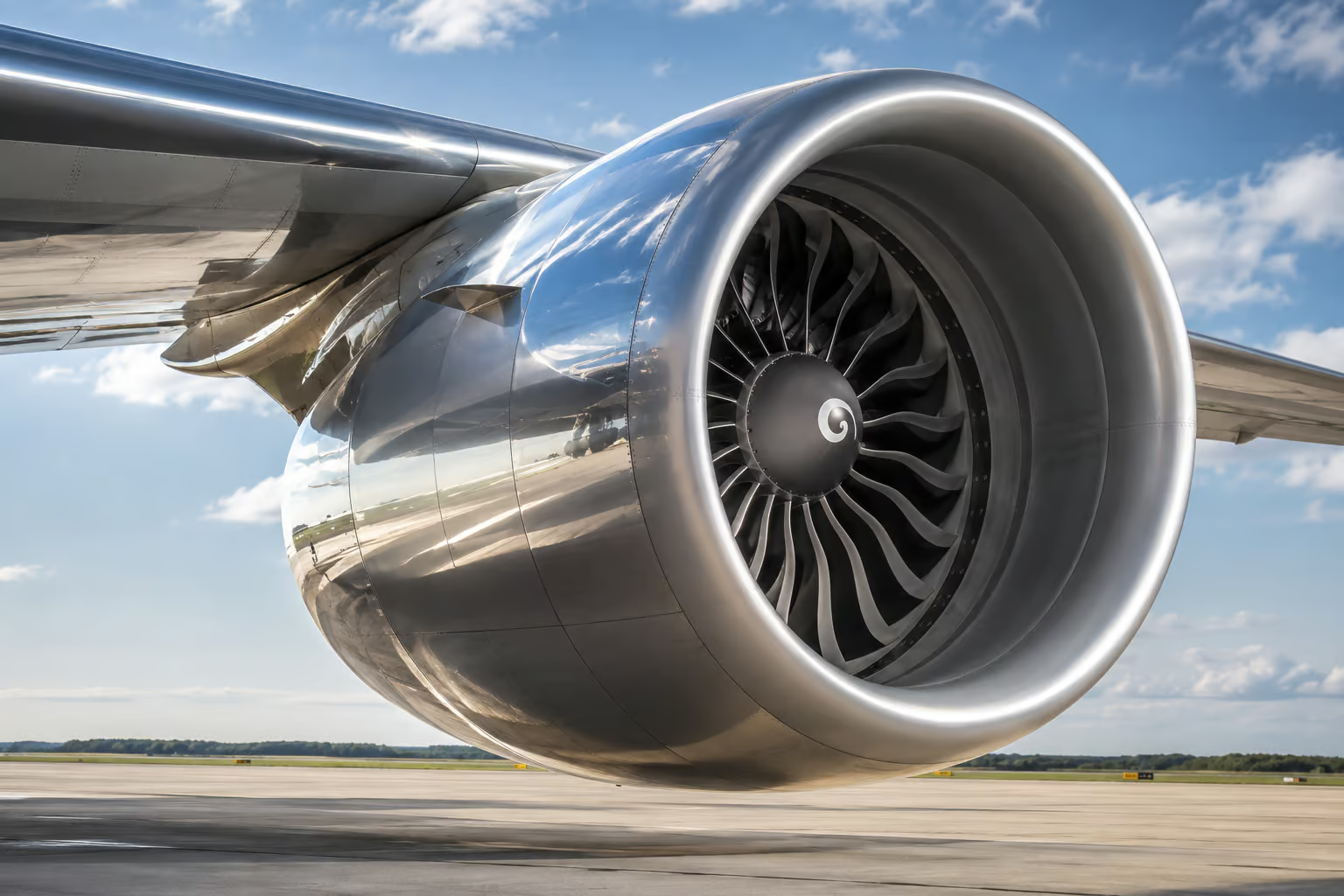
A team at the University of Toronto has produced six new printable nickel-cobalt-chromium alloys through a self-driving laboratory that combines active learning with robotic manufacturing. Two of the compositions performed better than the long-standing benchmark Inconel 625 in targeted high-temperature tests, pointing to a faster pipeline for finding materials that survive inside jet engines and nuclear steam generators.
For technical SEO readers, the story is less about metallurgy than about process compression: a closed loop that turns a multi-year materials hunt into a measured series of weekly iterations, with every result feeding back into the model that picked the next sample.
What the system actually does
The platform pairs a data-lean machine learning model with robots that prepare, print, and test each candidate alloy. Most predictive models demand large training sets, and those sets rarely exist for unexplored metal combinations. The Toronto group tackled that gap with active learning, where the model itself chooses which few samples to manufacture, the robots make and characterize them, and the resulting measurements are fed straight back into the model to pick the next round.
First author Ajay Talbot, in the university’s Department of Materials Science and Engineering, summed up the approach: the models “feel their own way along” by selecting a few samples, testing them, and using the data to decide where to go next, a cycle that “really speeds things up.” The composition space being explored, NiCoCr alloys built from nickel, cobalt, and chromium, can also be processed through laser-based additive manufacturing, which opens the door to complex part geometries that conventional casting cannot reach.
What was found, in numbers
The study, published in npj Advanced Manufacturing on June 23, 2026, reports six printable alloys. The headline comparisons run against equiatomic NiCoCr and against Inconel 625, an industry-standard nickel-based alloy made from more than ten elements.
- Hardness at room temperature: the new alloys reach up to roughly 40% above equiatomic NiCoCr.
- High-temperature hardness: Ni12Co62Cr26 held about 50% higher hardness than equiatomic NiCoCr at 600 °C (about 1,112 °F), the front-of-engine zone, and beat Inconel 625 by 4.5% on hardness in lab tests.
- Oxidation resistance: Ni36Co14Cr50 reduced oxidation mass gain by 85% compared with Inconel 625 at around 1,000 °C (about 1,832 °F), meaning the alloy resists being burned away in the hottest sections of an engine.
- Next target: the team plans to push testing toward roughly 2,192 °F in follow-on work.
Why those numbers matter for auditing your own stack
Materials research and technical SEO look unrelated, but the discovery method is the real payload here. The loop runs on three properties that site owners can map onto their own tooling.
Small sample, fast feedback. Active learning refuses to wait for a big labeled corpus. Each iteration is a request, a result, and an updated prior. Crawl budgets and Search Console data behave the same way: each fix, each re-crawl, each rank check is another sample feeding the next decision. Practitioners running technical audits can borrow the cadence rather than trying to chase every signal at once.
Closed-loop measurement. The robot’s tests write directly back into the model that picked the next sample. Search tooling rarely closes that loop. Audit notes end up in a doc, not in a feature store, so the next audit starts cold. Treating audit findings as a structured record, with versioned schemas for issue type, fix, and result, lets the next run learn from the last.
Constraints over flexibility. The alloy space is narrow on purpose: three elements, printable, tested only for traits that matter downstream. Crawls, log analysis, and Core Web Vitals work the same way. A bounded checklist with a small set of measurable criteria will outperform a sprawling dashboard, because every result is comparable to the one before it.
Who led the work
The corresponding author is Yu Zou, Canada Research Chair in Materials and Manufacturing for Extreme Environments, working with Talbot in the Department of Materials Science and Engineering at the University of Toronto. Funding came from the Natural Sciences and Engineering Research Council of Canada (NSERC), the Canada Foundation for Innovation, the Digital Research Alliance of Canada, and the university’s Acceleration Consortium, which is supported by the Canada First Research Excellence Fund. The paper is open access under a Creative Commons Attribution-NonCommercial-NoDerivatives 4.0 International License.
Where the research goes next
Talbot framed the current NiCoCr work as a proof of the platform rather than a finish line. The plan is to widen the compositional space to ten or twelve elements and run the same closed loop against harder targets, including oxidation behavior past 2,192 °F. Canada Research Chair Zou pointed to the demand side: “There’s enormous demand for materials that can stand up to huge swings of temperature and pressure, such as what you would find inside a jet engine or in the steam generators inside nuclear power plants, anywhere conventional steel just can’t survive.”
FAQ
Who discovered the six new metal alloys?
Researchers at the University of Toronto’s Department of Materials Science and Engineering, led by Canada Research Chair Yu Zou and first author Ajay Talbot, identified six new nickel-cobalt-chromium alloys using an active learning platform coupled to robotic manufacturing. The findings were published in npj Advanced Manufacturing on June 23, 2026.
How do the new alloys compare with Inconel 625?
An alloy of 12% nickel, 62% cobalt and 26% chromium showed 4.5% higher hardness than Inconel 625 at temperatures up to about 1,112 °F. An alloy of 36% nickel, 14% cobalt and 50% chromium showed 85% less oxidation mass gain than Inconel 625 at temperatures reaching about 1,832 °F, according to the published study.
How does the AI system find new alloys?
The system applies active learning, where the model selects a few candidate compositions, robots manufacture and test them, and the experimental data feeds back into the model to guide the next round. The researchers report that this closed-loop design lets them explore new alloy compositions in weeks instead of years, and the resulting alloys are compatible with laser-based 3D metal printing.