

Anthropic’s report, The components of agent memory, published November 6, 2026, examines how Claude writes, retrieves, validates and revises information between sessions.
What Is Agent Memory?
Anthropic defines agent memory as knowledge Claude gains from experience with users or assigned tasks and retains between sessions as context it can read later. The definition excludes changes to model weights, knowledge gained within one conversation and compaction summaries that replace older turns within a continuing context window.
That boundary matters for teams deploying an agent on a website. A note that carries a verified campaign rule into a later session is agent memory. A summary that replaces an earlier exchange in the same conversation is compaction. Consider those cases separately when planning your review.
The report draws on researchers at Letta and UC Berkeley, who proposed sleep-time compute as a way for models to use idle time between interactions to reorganize existing context. Anthropic calls this process dreaming. It can reflect on logs, correct mistakes and produce new notes or representations.
LongMemEval Benchmark (2025)
Review each stage when assessing an agent’s long-term memory.
First, inspect what entered the store. Then trace the query and the items returned. Finally, read the answer and note which retrieved material supported it.
How Memory Notes Are Written
Claude can tag salient events in a session log or write them to a memory store such as a folder of notes. A note may preserve a verified fact, a corrected answer, a strategy or a rule that the agent expects to need in a later session. Anthropic describes memory as a prediction that a recorded pattern will matter again.
The report’s Continual Learning Bench 1.0 database task tested that idea with Claude Managed Agents. Each question started in a fresh session, while a memory directory persisted between sessions. After receiving the correct answer, the agent could write a note intended to help with later questions.
Anthropic reports that Claude Opus 4.7 consolidated its notes into one reference document and marked facts as checked or unconfirmed. Claude Sonnet 5 marked each answer as confirmed after the grader checked it and wrote a correction for a wrong answer. Claude Opus 5 was the first model tested to close the learning loop, with entries that generally included a rule, evidence for the rule, earlier answers and warnings about traps.
Source note: Anthropic, The components of agent memory, published November 6, 2026, Continual Learning Bench 1.0 database task using Claude Managed Agents. The model names and behaviors are directly reported by Anthropic. The report states that Opus 5.5 and Sonnet 5.5 also closed the loop and scored about the same as Opus 5 with memory, while their baselines without memory were slightly higher.
How Memory Notes Are Retrieved and Read
Anthropic’s guidance for frontier Claude models is to create memory notes when a person asks for them or when something is clearly worth remembering, then leave the judgment of salience to Claude. In the CL-Bench database task, simply telling Opus 4.7 and Opus 5 that a memory folder was available gave both a noticeable boost in performance.
When Anthropic set a rule to record only failures, both Opus 5 and Opus 4.7 lost much of the performance boost that memory had provided. For stronger models in this test, Anthropic reports that freedom to judge salience worked better than fixed rules.
Older models benefited from more specific steering. Sonnet 4.6 often did not read files from its memory directory and did not test its theories about a wrong answer. Prompting it to read memory before answering and then test its theories nearly doubled its benchmark score. Without prompting, Sonnet 5 read its memory before answering 9 out of 10 times, while Sonnet 4.6 did so less than half the time.
Source note: Anthropic, The components of agent memory, published November 6, 2026, CL-Bench database task and steering experiments. The 9-out-of-10 reading rate, the less-than-half comparison and the near-doubling of Sonnet 4.6’s score are directly reported figures from one model and one test setting.
Why Selecting Useful Memories Matters
Anthropic used one Pokémon Red run each of Claude Sonnet 3.7 and Claude Fable 5 to compare what each model chose to save around 10,000 steps into the game. Sonnet 3.7 wrote 413 memory files across 225 folders and earned one badge. Fable 5 wrote nine files in two folders, plus one top-level file called global.md, and earned four badges.
Sonnet 3.7 recorded individual battles, items and non-player characters. Because the game’s state changed constantly, its detailed record went out of date. Around step 10,000, it started a fourth folder of master memory files. Over the next 17 steps, it created six files, deleted nine others and took no action in the game.
Fable 5 reserved memory for information the game did not display, such as strategy, plans and tested rules. Its global.md file held the current goal, a plan for tackling gyms and its own rules for using memory. Separate folders held route plans and gameplay strategies. After seven Poké Balls failed in a row to catch a Magikarp, Claude recorded a timing rule based on the successful catch that followed extra wait presses between menu steps.
Source note: Anthropic, The components of agent memory, published November 6, 2026, Pokémon Red evaluation. The file counts, folder counts, badge counts and 17-step sequence are directly reported by Anthropic. The comparison used one run per model, so the figures describe those runs rather than a general ranking of the models.
How Dreaming Corrects Memory
Dreaming gives Claude a way to test notes against original transcripts. In Anthropic’s Pokémon example, Claude incorrectly recorded that a PokéCenter near Mt. Moon was on the east side of the map. It then said, "Mt Moon is behind me," and updated its notes to "Mt Moon DONE."
After crossing a one-way ledge, Claude landed on the route it had come from. Its navigation tool did not show the drop, so it concluded that it had overshot west. With the uncorrected note, it returned to that route three times. After the third failure, it wrote, "I’m going to stop rather than keep looping." The run continued to Pewter City and ended without reaching Cerulean City.
When Anthropic ran dreaming on the folder, Claude checked the note against the session transcript, caught the location error and rewrote it. With the corrected note, Claude went back into Mt. Moon and eventually reached Cerulean City. The report describes this as one positive example in the evaluation.
Source note: Anthropic, The components of agent memory, published November 6, 2026, Pokémon Red evaluation using Claude Managed Agents with a mounted memory directory. The quoted statements and the corrected-versus-uncorrected outcomes are directly reported by Anthropic.
How Dreaming Builds Memory Representations
Anthropic also describes a memory representation called a wiki, a collection of pages written and maintained by Claude that gathers what it knows about one subject and links it to related notes. Anthropic describes these links as a map that can help an agent locate relevant memories as its knowledge base grows.
For a website agent, consider how that representation would fit into your own review process. A team can check whether a note about a landing page, campaign or technical instruction links to supporting material and whether the links still reflect the current site.
What the Neuroscience Research Adds
A 2024 Science study, published March 28, 2024 in volume 383, issue 6690, recorded large-scale neural activity as mice traversed a maze. After some trials, sharp wave ripples occurred during reward consumption, and their spike content replayed the population activity during the maze run on that trial. Later, sharp wave ripples occurred during non-rapid eye movement sleep, and these sleep sharp wave ripples replayed mainly the sequences that were tagged by the waking sharp wave ripples in the maze. Sleep replay focused on trial blocks that had been reactivated frequently during waking sharp wave ripples. The authors described the pattern as a candidate tagging mechanism for selecting experiences that receive long-term consolidation.
The paper also cites research indicating that sleep can preferentially enhance memories relevant to future behavior, emotionally laden information and weaker memories.
These studies describe biological memory. Treat any connection to agent systems in Anthropic’s report as a conceptual comparison.
What Current Systems Research Adds
A 2026 systems study from Shanghai Jiao Tong University and other institutions evaluated 12 representative memory systems and two reference baselines across five benchmark workloads and 11 datasets. The researchers split memory into representation and storage, extraction, retrieval and routing, and maintenance. They found that no single architecture dominated every scenario, and that localized maintenance was more cost-efficient than global reorganization.
Another 2026 paper, Agent Memory: Characterization and System Implications of Stateful Long-Horizon Workloads, characterized ten systems across two benchmark suites and derived 10 system recommendations covering construction scheduling, capability floors, query-volume amortization, freshness and latency trade-offs, and fleet-scale management.
A smaller empirical study called MemoryTax tested four memory methods and three coding agents on one LoCoMo conversation with 419 turns and 152 questions. The authors report that Mem0 beat full context only with GPT-4o-mini, that its build alone cost more than a whole full-context rollout, and that a stronger reader did not recover what a weaker writer left out. The paper states its limits clearly: one conversation, one run per cell and a GPT-4o-mini judge.
Website Agent Memory Audit
Review the report’s write, retrieve, read, validate, correct and maintain stages as a practical audit for a website or marketing team. Review each component against the persistent records an agent can use across sessions.
- Write: Check every persistent note for a source, a date and a confirmation status. Remove records that duplicate information available directly from the current site or task.
- Retrieve: Trace each retrieved note back to the current task. Ask whether it was selected because it applies to that task or only because it shares similar words.
- Read: Ask whether the answer cites the retrieved notes it used. Review whether temporary information was stored alongside durable rules.
- Validate: Confirm that facts about pages, campaigns and search settings carry a checked or unconfirmed label. Ask the developer or content owner to verify uncertain records.
- Correct: Compare important notes with the original transcript or current page. Record corrections and review obsolete campaign or page instructions.
- Maintain: Remove outdated notes, repair broken links and keep the store small enough to use.
What to Do Now
- Mark each item as confirmed or unconfirmed and attach its source.
- Remove records that duplicate information already available directly from the site or current task.
- Trace one recent answer through its retrieved notes and record which notes supported it.
- Assign an owner to review obsolete campaign instructions, page details and linked memories.
FAQ
What Does Dreaming Do in Anthropic’s Report?
Dreaming is Anthropic’s term for reorganizing existing context during idle time between interactions. The process can reflect on logs, test notes against original transcripts, correct mistakes and create new notes or representations.
Try the site audit tool
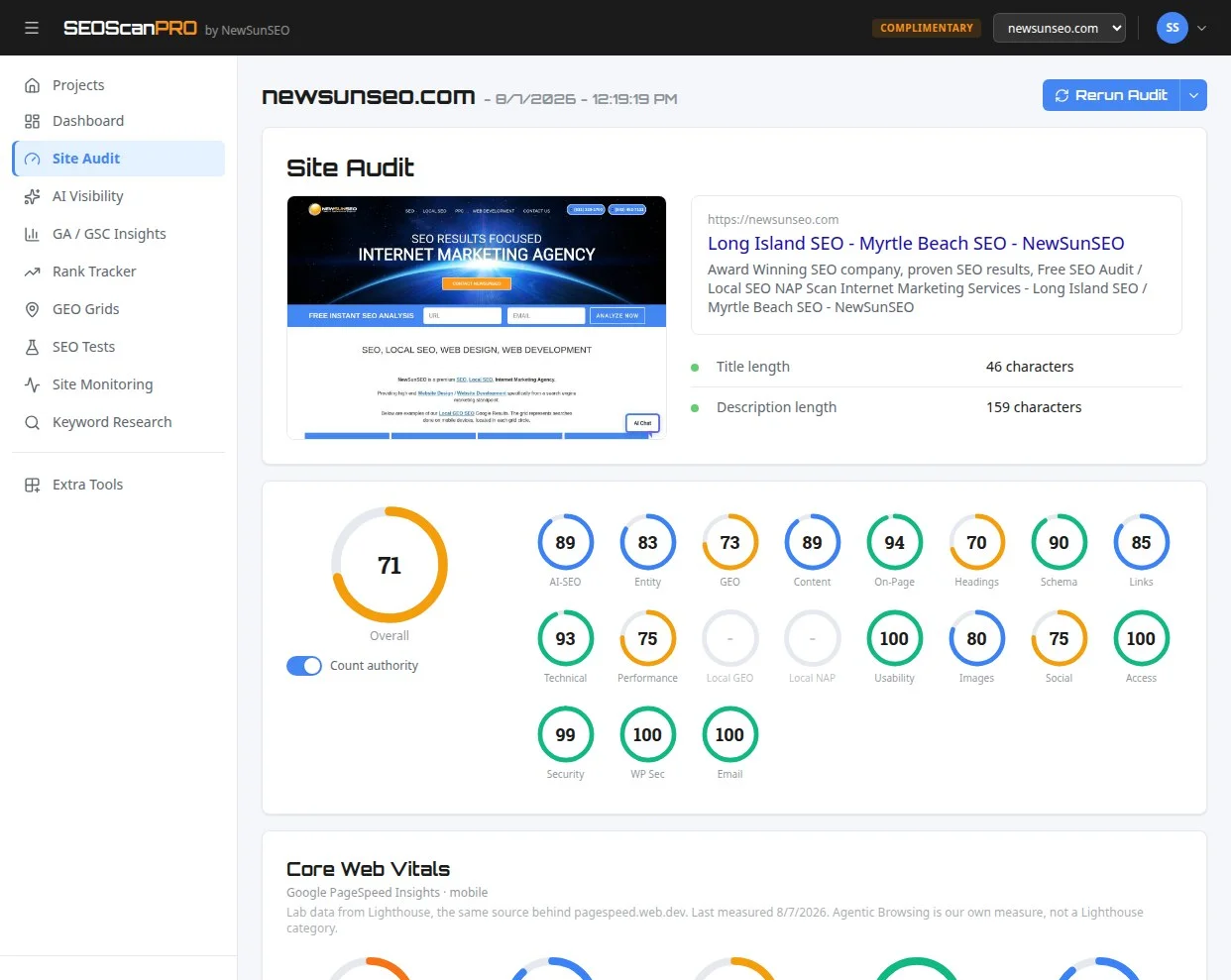
SEOScanPro runs a full technical audit of a site and shows the measured result behind every check. Open the site audit tool.