

You can improve visibility across Google, answer engines and generative AI by answering three connected questions: can crawlers reach the page, does the page answer the reader’s question directly, and does the wider web give AI a credible reason to cite the business. The same foundations still work, but each requires a specific site-level check.
A page can rank well in conventional search and still not appear in AI-generated recommendations. The gap may result from missing answers, stronger third-party brand mentions, different retrieved sources, or technical restrictions that block an AI crawler from accessing the page.
How SEO, AEO and GEO Fit Together
Treat them as one job with three questions, answered in order. A page a crawler cannot reach gains nothing from a better answer, and a clear answer gains little if nothing on the wider web tells an AI system who stands behind it.
| Part | What It Asks | What to Check |
|---|---|---|
| SEO | Can search engines find and index the page? | Crawl access, index status, robots.txt, canonical tags, redirects and broken links |
| AEO | Does the page answer the question clearly? | The answer near the top, descriptive headings, steps and comparison tables |
| GEO | Will an AI system trust the page and name the business? | AI crawler access, structured data that names the business, and relevant mentions and reviews on other sites |
Google’s own guidance on AI features in Search says the established SEO practices still apply to AI Overviews and AI Mode: original, helpful content, pages that can be crawled and indexed, and a good page experience.
Which Seven Practices Still Determine Visibility?
1. Start With Search Intent, Not Just Keywords
Search volume shows what people type, but search intent explains what they need to accomplish. A query asking for the best CRM software and a query asking which CRM suits a small business with five employees and a limited budget require different levels of detail.
Research the intent behind the keyword, the questions people ask before deciding, the comparisons and requirements that influence them, and the gaps in existing content. Add relevant answers to existing pages when they fit instead of creating a separate page for every conversational prompt.
2. Give the Direct Answer First
Readers should not need several paragraphs to reach the answer. Put the answer near the top, then explain why it matters. AI systems can also summarize information found widely online, so useful content needs experience, examples and evidence that go beyond a generic explanation.
For content advice, this means showing how to identify pages that need updating by reviewing historical clicks, impressions, ranking changes and factual accuracy. Firsthand observations, original data, screenshots and real examples can further support the answer. Length alone does not make a page useful.
3. Organize Pages for Readability and Retrieval
Use descriptive H2 and H3 headings, answer important questions early, break complex processes into steps, use tables for comparisons and add schema markup that accurately reflects the page.
Structured data does not guarantee inclusion in AI-generated answers. Google states that special structured data is not required for AI Overviews or AI Mode. Structure should make the content easier for people to understand and for search systems to interpret.
4. Build Topical Authority With Internal Links
Topical authority comes from a connected body of useful content, not the largest possible page count. A site covering AI search can support its main topic with pages about technical SEO, keyword research, search intent, content optimization and AI visibility.
Internal links help readers find related information and show search engines how pages relate to one another. They also reduce overlap when several articles address essentially the same question. In that situation, improving an existing page and its internal links may be more useful than publishing another one.
5. Strengthen Credibility With Sources and Brand Mentions
Accurate information alone does not explain why a reader should trust it. Experience, credible sources, clear authorship and original research all contribute to credibility. Google’s E-E-A-T framework reflects these qualities, although the framework is not itself a single ranking factor.
AI visibility also depends on what other websites say about a brand. Relevant mentions in industry publications, independent reviews and comparison articles can create more opportunities for the business to be discovered and referenced. More mentions do not guarantee a citation, so relevance, credibility and audience trust remain the criteria for earning coverage.
6. Give Search Engines and AI Crawlers Access
Technical access should be checked before a page is rewritten. Important checks include indexability, noindex directives, robots.txt rules, canonical tags, internal links, redirects, broken URLs, rendering problems and AI crawler permissions.
Not every AI crawler has the same function. Some support search experiences, while others collect data for model training, so their access should be assessed separately according to the site’s objectives. If a page cannot be crawled or indexed where required, stronger keywords or revised headings will not fix the underlying problem.
7. Refresh Pages Based on Performance
Age alone is not a reason to rewrite a page. Falling clicks may reflect stronger competing resources, outdated information or a change in search intent, and each cause requires a different response.
Review historical clicks and impressions, keyword movement, current search results, competing content, outdated facts and examples, and changes to internal links or backlinks. A page that remains accurate, relevant and successful may not need an update.
What Does This Look Like in a Website Audit?
An audit should examine one job through three questions. First, check whether the page is available to the crawlers relevant to the site’s objectives. Second, check whether its organization and opening answer make the main response easy to retrieve. Third, assess whether the topic is supported by credible references, internal connections and external brand mentions.
The SEOScanPro site audit covers the first question and part of the second: crawlability, canonical tags, heading structure and structured data, with the measured result behind each check. The AI Visibility check shows which of seven named AI crawlers your robots rules let in, so you can decide on each one separately. Rank Tracker records whether an AI Overview sits on the results for the keywords you track, and Search Console and Analytics shows clicks and impressions against the period before, which is the evidence a refresh decision needs. You can run a free audit to start.
What to Do Now
- Audit reachability. Review indexability, noindex rules, robots.txt, canonicals, redirects, broken URLs and rendering. Check AI crawler permissions separately according to how each crawler is used.
- Check the answer structure. Put the direct response near the top, use descriptive H2 and H3 headings, answer important questions early and confirm that schema accurately describes the page.
- Map search intent. Compare target queries with the decisions, questions and requirements behind them. Add missing information to relevant existing pages before creating new content.
- Review authority signals. Connect related pages with useful internal links, remove overlap, and review credible third-party references and brand mentions relevant to the business.
- Prioritize refreshes by evidence. Use Search Console performance, ranking changes, competing results and factual accuracy to decide which pages need attention. Leave strong, accurate pages alone.
Common SEO, AEO and GEO Mistakes to Avoid
- Building the strategy around keyword volume without understanding intent.
- Making readers search for an answer that could appear immediately.
- Adding FAQs or schema without improving readability.
- Publishing more pages without considering overlap or site structure.
- Assuming brand mentions automatically produce AI citations.
- Rewriting content before checking crawler and index access.
- Refreshing pages based only on publication age.
FAQ
What Is the Difference Between SEO, AEO and GEO?
SEO focuses on organic search visibility, including rankings, crawlability, content relevance and traffic. AEO focuses on direct, accessible answers, while GEO focuses on generative AI visibility through brand mentions, citations, credible references and topical relevance.
Do AEO and GEO Replace SEO?
No. SEO is still the foundation for visibility in AI search. AEO and GEO build on the same work, with extra attention to how AI systems find, understand and cite content.
When Should a Website Page Be Refreshed?
A page should be refreshed when performance or usefulness has changed, such as declining clicks, outdated information, stronger competing content or a shift in search intent. Age alone is not a sufficient reason to update it.
Try the Site Audit Tool
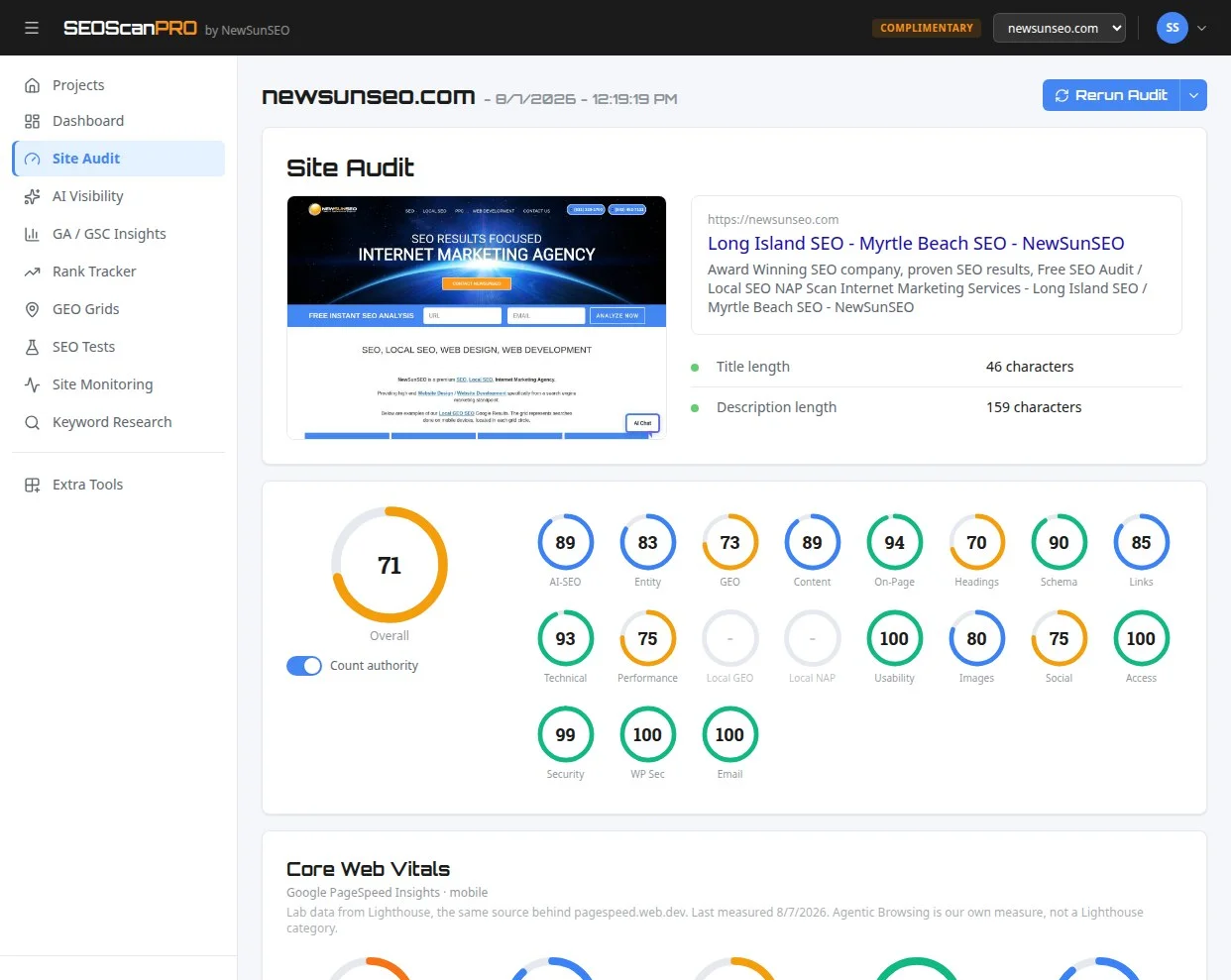
SEOScanPro runs a full technical audit of a site and shows the measured result behind every check. Open the site audit tool.