
Website owners and marketers may want to think about how AI agents could interact with their pages. On October 12, 2026, Meta introduced the Muse Wonder series, Muse Wonder and Muse Wonder Full, which the company says are its "most capable models to date". Both models pair two features Meta calls Active Memory and Active Focus to carry what matters to a user across conversations and keep working toward a goal.
What Muse Wonder means for your site and search visibility
Meta demonstrated Muse Wonder working directly in a browser and across apps: building a running plan from personal preferences, ordering custom items from photos on a personal Instagram profile, and preparing a wedding seating chart from a list of matching requirements. For a site owner, that points to one practical question: can an automated agent reach your pages, read them, and use what it finds?
A site audit can answer that. Check that important information sits in the page HTML rather than behind scripts or interactions an agent may not trigger, that your robots and crawler directives say what you intend, and that pages return clean, parseable markup. Whether an AI agent can actually read and use a site is what an AI Agent Readiness check looks at, and SEOScanPro runs that alongside its AI visibility tracking.
How the Muse Wonder series fits Meta’s scaling work
Meta says it began a ground-up overhaul of its AI efforts fourteen months ago and built the Muse Wonder series on the groundwork it laid with Muse Spark, its earlier release. The models were trained at what Meta calls its gigawatt-scale Prometheus data center and draw on pretraining and reinforcement learning work from teams across the company.
The release is Meta’s first frontier model, according to TechCrunch, and the first since Alexandr Wang, the former Scale AI CEO, restructured the company’s AI efforts last year. WIRED reported that CEO Mark Zuckerberg rebooted Meta’s AI research by funding the Meta Superintelligence Labs and hiring Wang to lead it. Meta’s Llama models were the first frontier open-weight offerings from a large lab, WIRED noted, and the company says it plans to release larger open-weight models in the future.
What Meta reports on benchmarks
Meta reports strong benchmark results for personal and professional agents, memory, and coding, covering four areas: domain expertise, Active Memory, Active Focus, and frontier coding. For domain expertise, its evaluations include tasks in law, finance, and health, such as Harvey’s Legal Agent Benchmark (LAB), which requires a model to work with source documents and follow detailed instructions to produce legal work products.
According to Meta’s testing, presented in the model card and reported by TechCrunch, Muse Wonder and Muse Wonder Full reach comparable benchmark scores to Claude Fable 5.1 and GPT-6 Astra, and Muse Wonder scores higher on the MemoryBench benchmark than Fable, Opus, or Astra. On the independent Artificial Analysis Intelligence Index, Muse Wonder Full scores 56 and ranks fourth of 698 models listed, above a median of 12 and, per WIRED, just below Anthropic’s Claude Opus 5.5.
Many of these figures come from Meta’s own testing, according to TechCrunch. WIRED noted that benchmarks are not always a reliable measure of real-world performance and that Meta did not disclose how the models were built or trained.
What are Active Memory and Active Focus?
Active Memory is the model’s ability to carry important context about a user across conversations and retrieve the details relevant to the current task. Meta highlighted the MemoryBench benchmark, which tests continual learning and memory construction. Research scientist Kavya Kopparapu said in a video accompanying the launch, as reported by TechCrunch, "We put a tremendous amount of effort into making sure your model can remember what’s important to you over days, weeks, months, and beyond."
Active Focus is how the model keeps working toward a goal: trying alternative approaches, working through blockers, and adapting to new information, while asking for clarification when needed and checking in before taking important actions. Meta measures focus through FocusBench and sustained execution through SWE-Marathon, which tests work on long-running software projects.
Do the capabilities generalize beyond training?
Two models can post similar benchmark scores while one handles a wider range of unfamiliar tasks, a gap Meta links to complaints of "benchmaxxing" and praise for "big model smell". Meta compared Muse Spark 1.3 and Muse Wonder Full as it scaled test-time compute and reported that both improve similarly on out-of-distribution tasks, while Muse Wonder Full performs better on unfamiliar tasks than the Muse Spark 1.3 trend would predict. Meta attributes the shift to larger, stronger base models. For anyone relying on an agent to handle real tasks, that breadth matters, because an agent meets combinations of goals, tools, and constraints that were never anticipated during training.
Where Muse Wonder is available
Muse Wonder is available through the Meta Model API and Muse Code, priced at $4 per million input tokens and $20 per million output tokens, according to TechCrunch and Meta’s developer documentation. Muse Wonder Full is available only to Muse Code subscribers and is not served through the API. Meta says Muse Wonder will soon power experiences in its Muse agent, rolling out first to subscribers, and will also power artifact generation.
Safety, alignment, and how earlier claims held up
A personal agent can work across a user’s messages, calendars, and documents, so Meta says it trained the Muse Wonder family to avoid sharing private information without permission, turn down requests to assist in actually harmful acts, and strengthen defenses against cyber attacks. Meta describes Muse Wonder as its "most aligned model to date" and says it offers its strongest safeguards yet against CBRN (chemical, biological, radiological, and nuclear) and cyber misuse, while preserving frontier cyber capabilities for defensive use, per its Meta Superintelligence Scaling Framework. A full report with additional safety evaluations will be available soon.
Meta’s evaluation practices have already been tested in public. In a post addressing a third-party testing misconfiguration involving Muse Spark 1.1, Meta (Meta AI Research blog) said, "Going forward, we are implementing independent verification requirements for test environment isolation and scenario review before evaluations begin and that test scenarios do not reference real companies." WIRED reported that Zuckerberg said on X last month that Meta had delayed the release of its Muse models to work on safety, and that Meta did not disclose whether it has seen agents powered by Muse Wonder misbehave in testing.
What to do now
The steps below are general suggestions for site owners to consider.
- Audit whether your key pages are machine-readable, with core content and structured data available in the page HTML.
- Review your robots and crawler directives so they allow the access you want and block what you do not, then recheck them after any change.
- Watch your server logs for agent and crawler activity so you know which automated clients are reaching your pages and how often.
- For any page drafted or assembled with an AI agent, keep a human review step before publishing, and factcheck claims, figures, and links against a reliable source.
- Label AI-generated or AI-assisted content where disclosure matters, and keep a record of what an agent produced so edits and corrections are easy to trace.
FAQ
What is Muse Wonder?
Muse Wonder is a frontier AI model from Meta, released on October 12, 2026, for personal and professional agentic tasks. It combines Active Memory and Active Focus to track what matters to a user and work toward a goal, and it is available through the Meta Model API and Muse Code.
Does Muse Wonder change how AI agents interact with my website?
Meta demonstrated Muse Wonder working directly in a browser and across apps to complete tasks on a user’s behalf. Making core content machine-readable and reviewing crawler access are general checks a site owner can consider.
What is the difference between Muse Wonder and Muse Wonder Full?
Both belong to the Muse Wonder series. Muse Wonder is available through the Meta Model API and Muse Code at $4 per million input tokens and $20 per million output tokens, while Muse Wonder Full is available only to Muse Code subscribers and is not served through the API.
Try the site audit tool
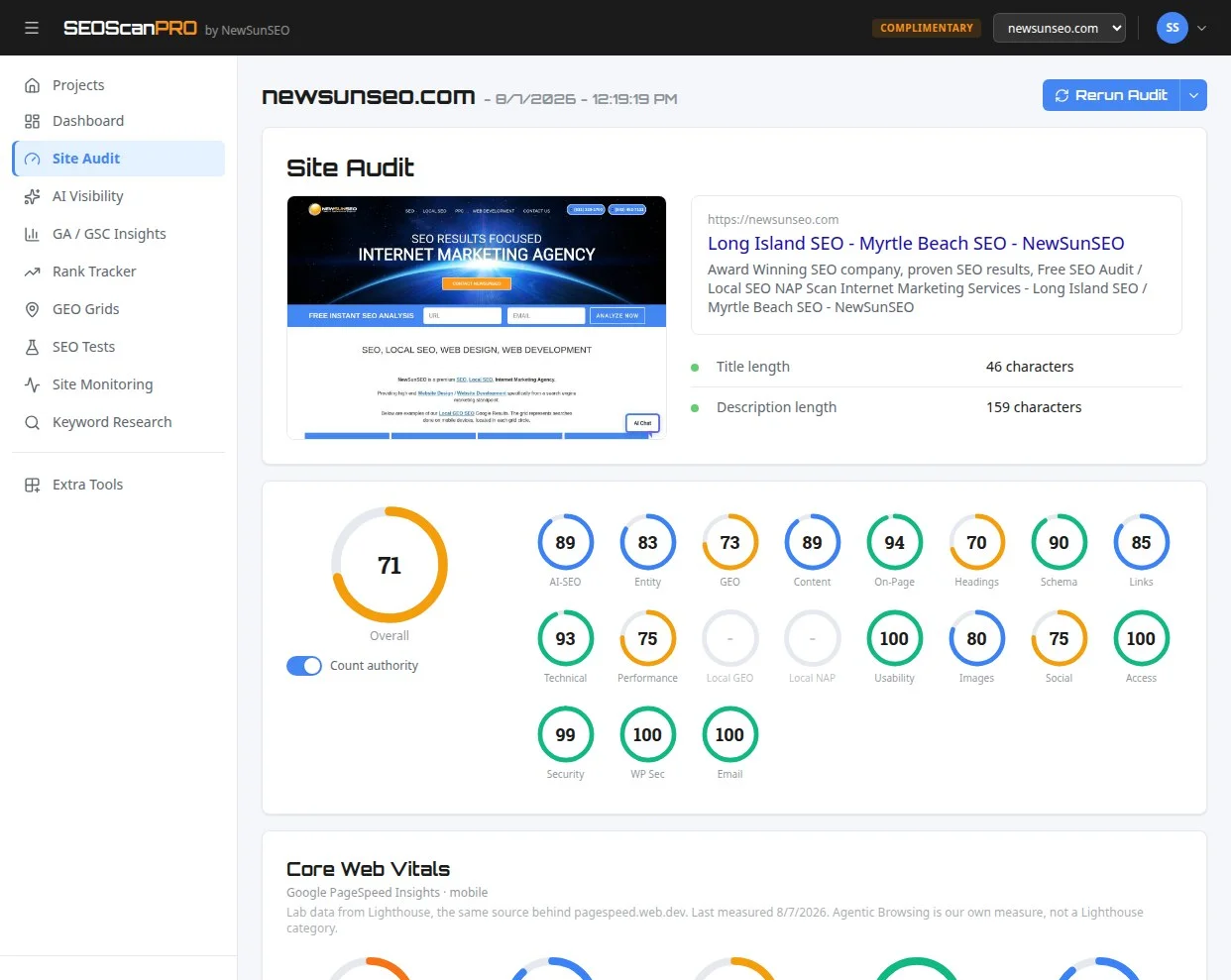
SEOScanPro runs a full technical audit of a site and shows the measured result behind every check. Open the site audit tool.