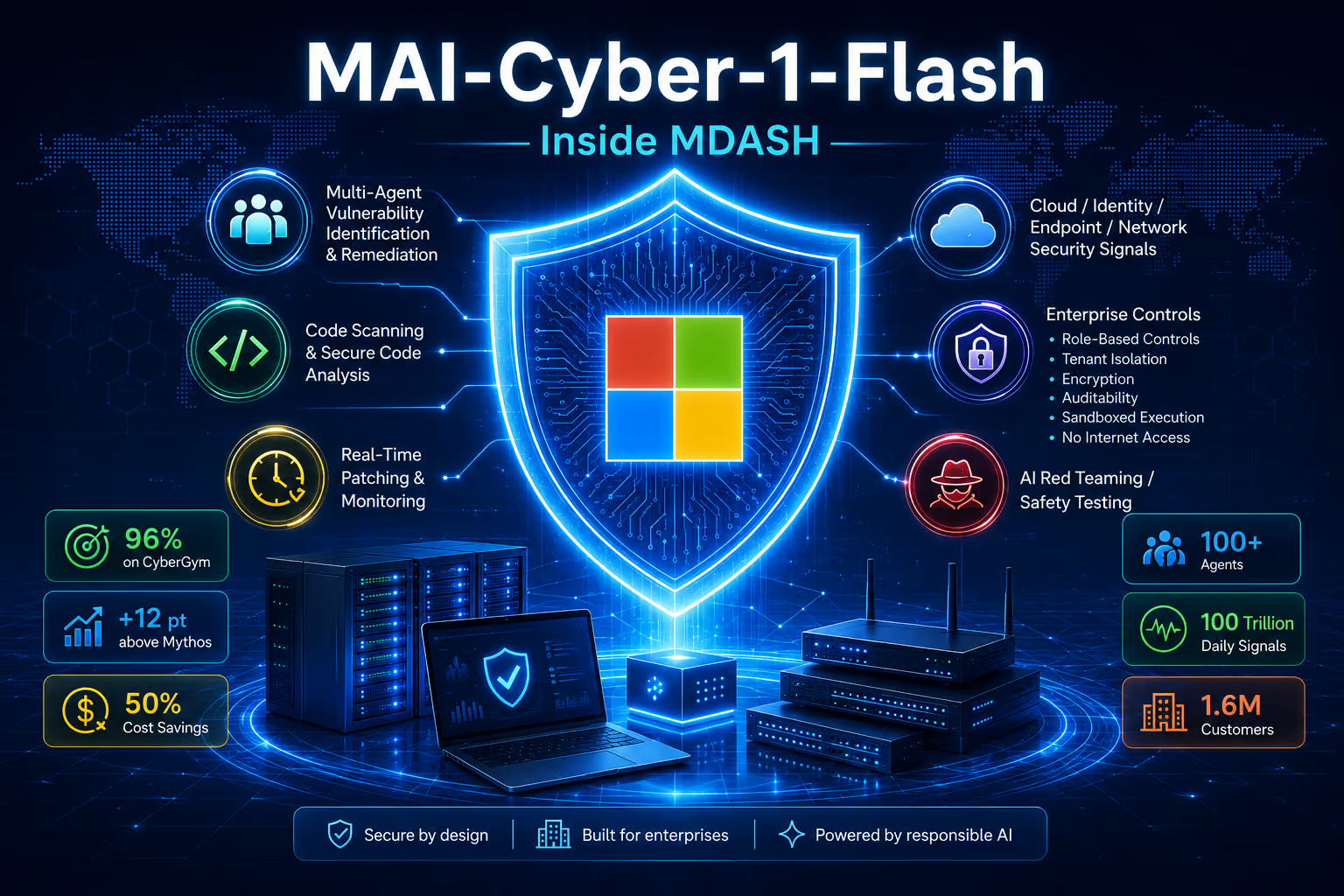
A compact security model from Microsoft AI now runs as the workhorse inside MDASH, Microsoft’s multi-agent harness for finding and fixing software flaws. The model, MAI-Cyber-1-Flash, was built in-house from the MAI-Thinking-1 lineage and is trained on Microsoft’s own high-quality security data. Routing it through MDASH pushes the unified system to a 96% score on CyberGym, a 12-point gain over the Mythos baseline, while cutting the cost of running the harness by about 50% compared with Microsoft’s previous best configuration.
Why a smaller model matters for site owners auditing their own pages
Most readers running technical SEO audits are not deploying Microsoft models directly, but the routing logic behind MDASH still matters. The harness sends roughly 90% of its tasks to MAI-Cyber-1-Flash and reserves larger models, including GPT-5.4, for the remaining 10% of unusually hard cases. Microsoft frames that split as the practical reason for the cost drop: token spend, not raw model strength, is the binding constraint when scanning enormous volumes of code.
For anyone auditing a large site, the takeaway is structural. A scanning pipeline that front-loads cheap, fast models for the long tail of routine checks, then escalates only the suspect findings to a stronger model, can cover more surface area per dollar. If you are stress-testing your own crawlers, log analyzers, or custom vulnerability scripts against a property with thousands of templates, that same routing pattern is worth prototyping rather than sending every request to your most expensive model.
What MAI-Cyber-1-Flash is trained on
Microsoft describes three layers doing the work: the model, the data, and the harness. The model is a compact, code-heavy security model derived from MAI-Thinking-1 and built from scratch in-house. The data layer draws on decades of running security products, including trillions of daily signals across identity, endpoint, cloud, and network, plus a record of real exploits and remediations. The harness layer is MDASH itself, which orchestrates more than 100 expert-tuned agents across multiple leading models to find, validate, and remediate vulnerabilities.
That data advantage is hard to replicate. Microsoft points to more than 100 trillion security signals per day, telemetry from 1.6 million customers, and end-to-end visibility into the defender’s loop: vulnerabilities reported through the Microsoft Security Response Center, attacks and defenses across identity, endpoint, cloud, data, browser, and applications, and the operational record of what worked. Because the company can connect actions to outcomes (what was exploitable, what was contained, what was blocked) the models are positioned to improve continuously. For outside teams, the equivalent is to keep a feedback loop between your scanner output and your production incident data so your tooling actually learns from what your site sees.
Benchmark numbers from CyberGym
CyberGym is the standard benchmark for reasoning over large codebases to surface real flaws. On that benchmark, MDASH with MAI-Cyber-1-Flash scored 96%, a 12-point lift over Mythos. Microsoft also reports that the combined system beats Gemini and GPT on the same test. Against Microsoft’s previous best MDASH setup, which paired GPT-5.4 with 5.4 mini and 5.3 codex, the new configuration cuts cost by 50%.
Two numbers are worth holding separately. The 96% score is a benchmark result and should be read alongside the 12-point gain over the specific Mythos baseline. The 50% cost cut is a comparison against Microsoft’s prior best configuration, not against the open market. Both figures describe the same configuration, but they answer different questions: how well it reasons over code, and how cheaply it does so at the volume MDASH operates at.
How MDASH fits the broader agentic security stack
MDASH is one piece of a larger system. Agentic code scanning inside MDASH feeds Project Perception, a new agentic security system Microsoft is launching in parallel. Perception runs teams of agents that continuously monitor, patch, and close new threat vectors, and it will also begin using MAI-Cyber-1-Flash for security workflows beyond software vulnerability work. The harness now contains more than 100 agents built on multiple leading models, all tuned by Microsoft’s internal security experts.
For practitioners, the relevant pattern is the agent taxonomy: lightweight agents handle the bulk of detection, specialist agents validate findings, and remediation agents close the loop. If you are building or buying a scanner for your own site, ask vendors how their agents split work and how findings are validated before a ticket is opened. A pipeline that funnels everything to a single general-purpose model is the configuration Microsoft is moving away from.
Safety, evaluation, and enterprise controls
MAI-Cyber-1-Flash is Microsoft’s first cyber model, and the company built trust controls into every layer. Training used a security-first calibration, the model was evaluated by Microsoft’s AI Red Team, tested through automated and expert-led adversarial exercises, and independently assessed by a third party. Through MDASH, customers get role-based access, tenant isolation, encryption, auditability, and sandboxed execution environments with no internet access.
For enterprise buyers, the control list is concrete: role-based access control, tenant isolation, encryption, audit logs, and sandboxed execution. If you are evaluating any vendor in this space, those five controls are a reasonable minimum checklist, especially the sandboxed execution with no internet access, since a vulnerability scanner that can reach the public internet from inside your build environment is a different risk profile than one that cannot.
What to watch next
Three things will determine whether the benchmark numbers translate into day-to-day utility. First, how MAI-Cyber-1-Flash performs on codebases outside Microsoft’s training distribution, including open-source projects and older enterprise stacks. Second, how Project Perception’s agent teams handle continuous monitoring without overwhelming security teams with alert volume. Third, whether the cost structure holds as MDASH scales beyond Microsoft’s own customer base, since the 50% cost cut is measured against a specific prior configuration rather than against all competitors.
For site owners and SEO auditors, the practical thread is the routing logic. A small, focused model that handles the routine 90% of checks, paired with a larger model reserved for the hard 10%, is a pattern that maps cleanly onto crawl budget, log triage, and template-level vulnerability scanning across a large property.
FAQ
What is MAI-Cyber-1-Flash?
MAI-Cyber-1-Flash is a compact security model from Microsoft AI, derived from the MAI-Thinking-1 lineage, designed to find vulnerabilities in complex code. It runs inside MDASH and handles up to 90% of scan tasks, with GPT-5.4 reserved for harder cases.
What is MDASH?
MDASH is Microsoft’s multi-agent harness for identifying and remediating vulnerabilities. It coordinates more than 100 expert-tuned agents built on multiple leading models, and it feeds Project Perception, Microsoft’s new continuous-monitoring system.
How does the new configuration perform on CyberGym, and what does it cost?
MDASH with MAI-Cyber-1-Flash scores 96% on CyberGym, a 12-point lift over the Mythos baseline. Compared with Microsoft’s previous best MDASH configuration (GPT-5.4 plus 5.4 mini plus 5.3 codex), the new setup cuts cost by 50%.