
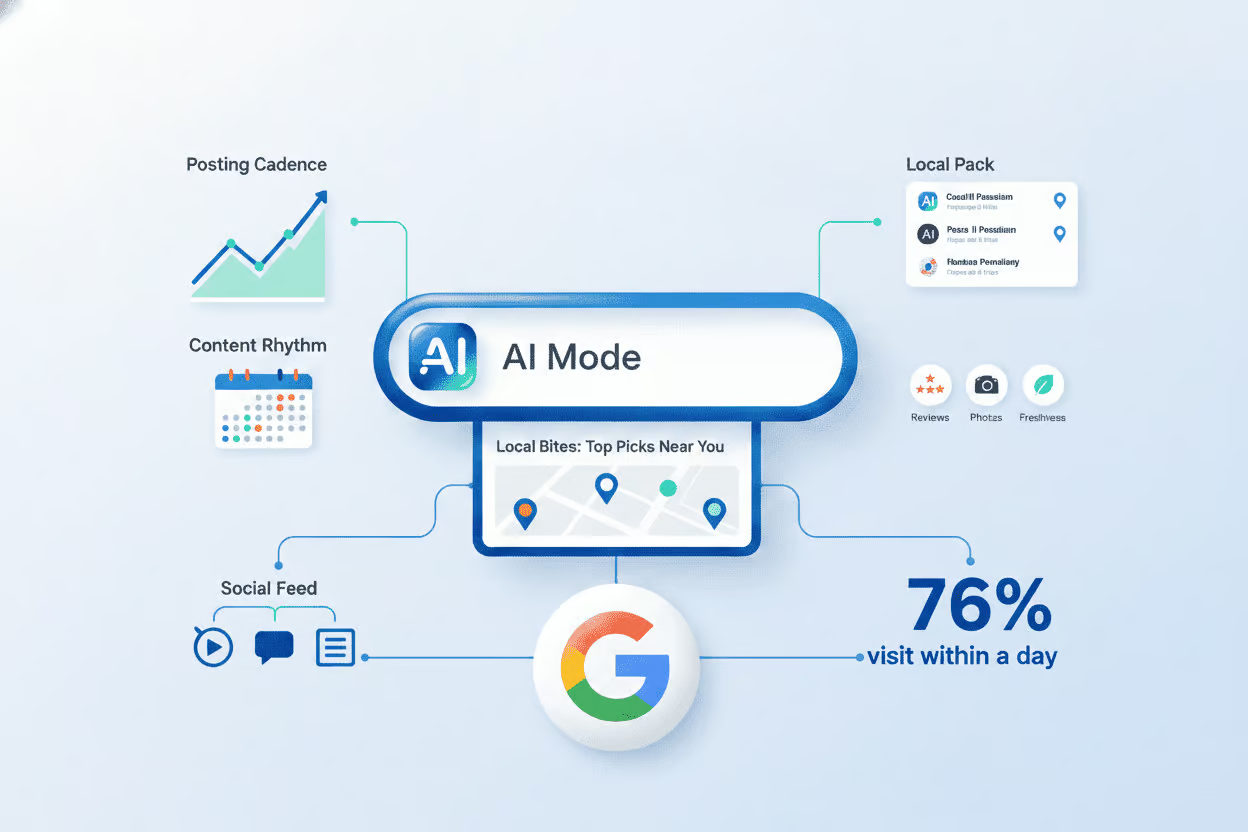
Google has rolled out a redesigned AI-first search input that routes longer, conversational queries directly into AI Mode, bypassing the traditional ten-link results page. Layered on top of expanded local sponsorship inventory inside AI answers and fresh data showing review recency now outweighing raw star count, the change tightens the criteria for which businesses AI surfaces by name. Operators auditing their own pages have roughly a 30-day window to close the structured-data and review-velocity gaps that the new surface reads as disqualifying.
What actually changed on the search results page?
Three shifts are stacking on top of each other, and each one shifts the goalposts for what an audit should look for.
The new AI search input
The redesigned input field treats natural-language queries such as "best brunch spot near me that doesn't take reservations" as the default, then hands them to AI Mode rather than the classic blue-link SERP. The response is typically a synthesized paragraph that names two or three businesses. Selection is driven by review signals, listing completeness, and structured attributes pulled from the Google Business Profile. A thin profile is filtered out before the user ever sees an option list.
Local sponsorship slots are growing, and they are gated by listing quality
Google is testing more paid placements inside the local pack and inside AI answers themselves. Bid is no longer the only gate. Categories, hours, services, photos, and review velocity now feed into whether a paid local slot is eligible to compete. A sparse profile cannot outbid its way into a slot the way it could in 2024.
Review recency is pulling more weight than star count
The review-ROI data point that changed most sharply is the relative weight of recency. A 4.6-star business with 80 reviews in the last 90 days will routinely outrank a 4.9-star business whose last review came in six months ago. Response rate, especially owner responses inside a 24-hour window, now travels with the review as a paired signal.
What should an audit actually verify?
If you run technical SEO or local SEO work for service businesses, the audit checklist needs to track the signals AI Mode reads, not just the signals the classic local pack used to read.
Listing completeness, field by field
Treat empty fields as AI-visible negatives. Audits should confirm that the following are populated and current: a primary category plus every relevant secondary category, every applicable service or product with a description, complete hours including holiday and special hours, photos refreshed at least quarterly, weekly Google Posts, full attributes such as wheelchair access and accepted payment methods, and a website URL whose NAP matches the Business Profile line for line.
Review velocity and response discipline
Pull the last 90 days of reviews and the corresponding owner response timestamps. Anything older than six months without a fresh review is a flag for the auditor to surface. Target a steady cadence, roughly five new reviews per week with a 24-hour response window on every one. The recency and response pattern is what AI reads as authority, not the headline star average.
Citation-graph NAP consistency
Audit the top citation sources for the business's category and confirm name, address, and phone match exactly. Inconsistent NAP across the citation graph is interpreted as ambiguous entity data, which makes AI systems less willing to surface the business by name.
Structured data on the linked website
The Business Profile points at a website. That site needs LocalBusiness or its more specific subtype schema, with the same NAP, hours, services, and aggregate rating properties populated. An AI system that can read the profile but cannot read a matching website gets a weaker confidence signal and may skip the listing.
What do the supporting numbers say?
These are the figures worth pinning inside the audit report so the operator sees what is at stake:
- 76% of users who search for something nearby visit a related business within 24 hours (Think with Google).
- 87% of consumers read online reviews for local businesses in 2025, up from 81% the year before (BrightLocal Local Consumer Review Survey).
- Reviews under 90 days old carry more weight in the local pack's ranking mix than reviews older than a year.
- Analyst forecasts project more than 40% of local queries will surface inside an AI-generated answer by the end of 2026.
- Businesses with complete Google Business Profiles, covering categories, attributes, hours, services, products, and posts, are 2.7x more likely to be selected as a top result inside AI Overviews.
What should change in the next 30 days?
Run a baseline scan against the top three local competitors
Compare category coverage, attribute completeness, post cadence, photo freshness, and review velocity side by side. The competitor with the cleaner profile usually wins the AI answer even when the headline star rating looks worse.
Check whether third-party AI surfaces can find the business by name
Ask ChatGPT, Perplexity, and Gemini directly for "best [category] in [city]" and see whether the business appears. If it does not, the gap is usually structured-data related, and paid spend will not fix it.
Stand up a weekly review and response cadence
Move away from one-off email blasts. Set a weekly floor, five new reviews and a 24-hour owner response on every one. Document the cadence so the auditor can show trend lines in the next report.
Refresh posts, photos, and attributes quarterly
Posts feed the freshness signal directly. Photos older than a year read as stale to both users and AI systems. Attributes that were never set are read by AI as the business not offering that service, not as missing data.
What is still emerging?
Three trends to monitor over the next two quarters:
- AI Mode is expected to default on for more query types, including local intent, which will push more outcomes toward zero-click answers resolved inside the search surface.
- Google will likely add clearer attribution columns in Performance Max and Local Services Ads dashboards as paid local slots multiply inside AI answers.
- Third-party review platforms are under pressure to feed structured data into Google's AI surfaces, while first-party review tools that push directly to a Google Business Profile are gaining emphasis.
The throughline across all three shifts is that local discovery is being rebuilt around AI. Businesses whose listing data is clean enough for an AI to confidently name them will be surfaced; the rest will be filtered out before a user ever sees an options list, and the operator will have no signal that the filter happened.
FAQ
What is Google's new AI search box and how is it different from AI Overviews?
The new AI search box is a redesigned input field that defaults longer, conversational queries into Google's AI Mode rather than the traditional ten-link results page. AI Overviews are the summarized answers that appear at the top of conventional results, while the AI search box is the entry point that increasingly routes users away from that view. For local queries, a single conversational answer may name two or three businesses based on structured listing data, review signals, and recency.
Do recent reviews matter more than overall star rating for local rankings?
Yes. Recency and response rate carry increasing weight in local ranking algorithms, often more than raw star count. A business with a 4.6 average and 80 reviews collected in the last 90 days will frequently outrank a 4.9-rated competitor whose last review came in six months ago. Google rewards a steady, recent stream of authentic reviews paired with timely owner responses, typically within 24 hours.
What belongs in a complete Google Business Profile for AI search?
A profile structured for AI consumption includes a primary and all relevant secondary categories, every applicable service or product with a description, complete hours including holiday and special hours, up-to-date photos refreshed quarterly, weekly Google Posts, full attributes such as wheelchair access and payment methods, a website URL with consistent NAP, and an active review collection and response routine. Empty fields are interpreted by AI systems as the business not offering that service, not as missing data.