
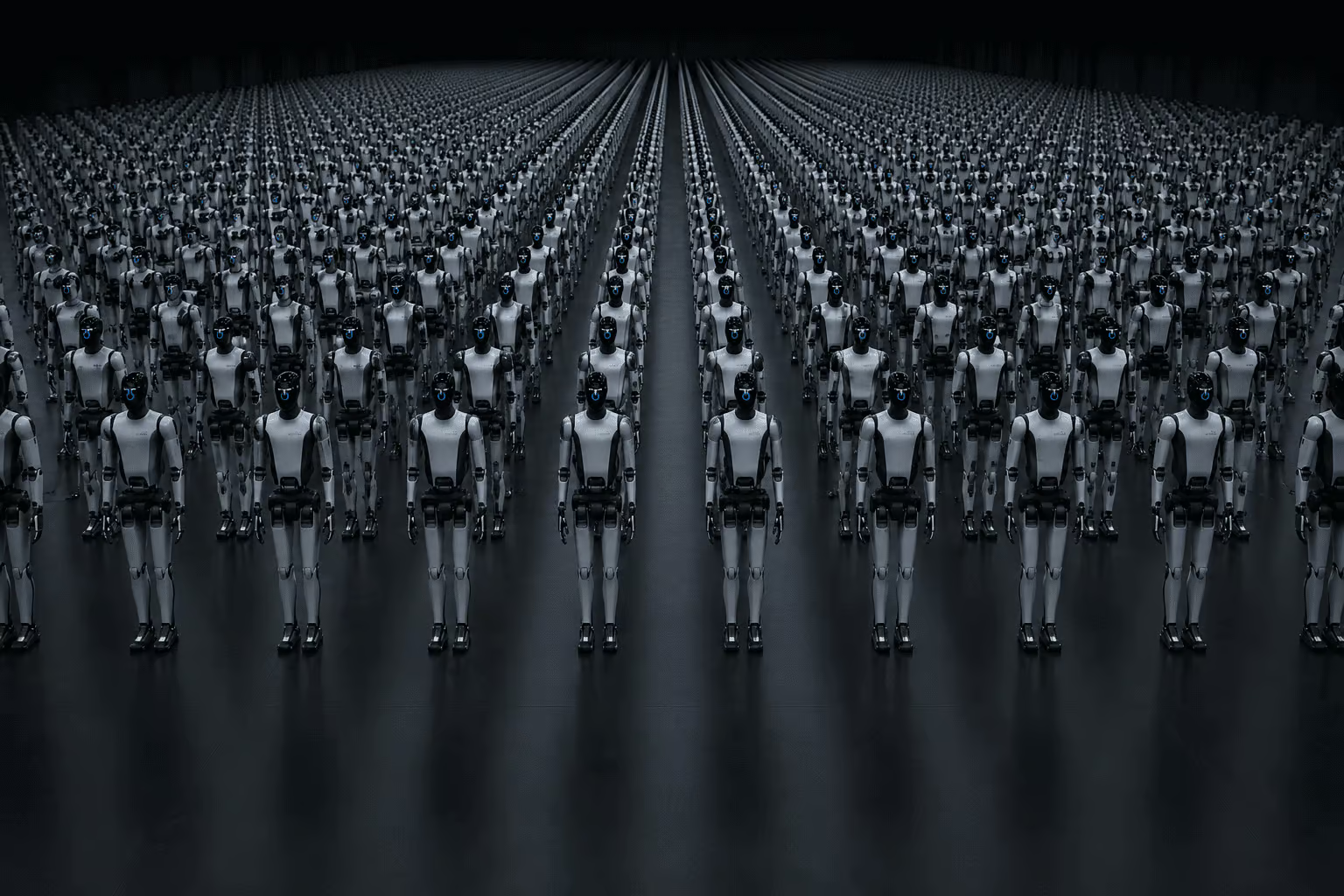
The Federal Communications Commission has barred new imports of foreign-made humanoid robots, quadruped robots, and power inverters, framing the action as a safeguard for U.S. supply chains. The agency described cybersecurity and disruption risks from offshore production as the justification, and the policy is widely read as aimed at Chinese manufacturers. Beijing’s foreign ministry called the move protectionism and warned of countermeasures.
Why the FCC acted now
p
FCC chairperson Brendan Carr said the order was intended to secure critical supply chains. The bans apply to new versions of the covered imports, leaving equipment already in use and previously approved models on the market.
Analysts say the timing adds weight to the decision. With a meeting between President Trump and Chinese leader Xi Jinping expected in September, trade frictions in robotics and adjacent components become another flashpoint before any face-to-face talks. The FCC has previously acted on security grounds against Chinese-made drones, and the new measures extend that pattern into humanoid hardware and grid-adjacent electronics.
What the rule actually covers
Three product categories fall under the restriction:
- Humanoid robots, defined as bipedal machines built for autonomous or remote operation.
- Quadruped robots, the four-legged machines often called robot dogs that are used for security patrols, inspection, and logistics.
- Power inverters, the components that convert direct current electricity into alternating current. They sit inside renewable energy systems, data centers, and a wide range of household appliances.
Because inverters are embedded across the energy and electronics economy, a ban on new imports can ripple through solar installations, backup power, and consumer devices that rely on foreign-made conversion hardware. Existing devices remain in service, and Chinese models already approved by U.S. regulators can still be sold.
China’s grip on humanoid production
Chinese manufacturers hold roughly 85% of the global humanoid robot market, according to the technology research and advisory group Omdia. Around 15,000 humanoid robots shipped globally in 2025, and two Chinese firms, Unitree and AGIBOT, each shipped more than 5,000. U.S. developers such as Tesla and Figure AI each shipped a few hundred or fewer in the same window.
Cost and scale are the structural advantage. Morningstar analyst Kangyuxiao Li said Chinese manufacturers have been scaling production and reducing costs faster than most overseas competitors. Li noted that restricting access to the U.S. removes a future market and shields U.S. developers from price competition, but it will not materially slow China’s overall humanoid development because of the size of its domestic manufacturing base and demand from other export markets.
Morgan Stanley analysts forecast that China’s market for humanoids could reach $15 billion by 2030, a figure that underlines why a ban on U.S. sales is a commercial loss for Chinese vendors even if domestic demand stays strong.
Where this fits in the broader tech trade fight
The inverter and robot bans sit inside a longer sequence of restrictions. The U.S. has already limited imports of Chinese-made drones and tightened export controls on advanced semiconductors and chipmaking tools. Washington is also weighing restrictions on the use of Chinese open-weight artificial intelligence models inside the U.S., a debate that has gained urgency as open-weight systems from Chinese labs have become competitive on common benchmarks.
Samm Sacks, a senior fellow at the New America think tank focused on Chinese technology policies, described the pattern as a steady drumbeat of flashpoints heading into the planned Trump-Xi summit. The Pentagon recently added Unitree and several other Chinese technology companies to a list of firms it says have ties to or aid the Chinese military. Beijing has rejected that characterization.
What it means for collaborations already underway
The rule does not only block finished imports. It also reshapes joint engineering work. Omdia chief analyst Lian Jye Su said the new bans could interfere with collaborations between U.S. and Chinese technology companies. Nvidia’s June humanoid robot reference design, which uses Unitree’s chassis, is the clearest example. A reference design that depends on a now-restricted Chinese-built platform raises questions about whether U.S. developers can keep shipping integrated products or will need to redesign around non-Chinese hardware.
For U.S. robotics labs, the practical effect is a forced reassessment of component sourcing. Any reference architecture, SDK, or starter kit that ships with a restricted chassis embedded now carries distribution risk. Developers who build on top of those kits need a contingency plan, including alternative chassis vendors and a clear audit trail showing where restricted parts enter and leave the build.
China’s response
Chinese foreign ministry spokesperson Mao Ning told reporters in Beijing on Wednesday that protectionism does not make the U.S. more competitive and will only hurt U.S. companies and consumers. The ministry said Washington is overstretching the concept of national security to suppress Chinese companies and that Beijing will take all measures necessary to defend the legitimate rights and interests of Chinese businesses.
Investors are watching for matching Chinese countermeasures. Past rounds of trade friction have produced export controls on rare earths, rare earth processing technology, and specialty chemicals that feed U.S. electronics and clean energy manufacturing. A symmetrical response in rare earths or inverter-grade components would put pressure on the same U.S. sectors the FCC is trying to protect.
What to watch next
Three signals will tell the story in the coming weeks. First, whether the FCC publishes a formal list of restricted model families and chassis, since the line between a humanoid, a quadruped, and an industrial manipulator is not always obvious from a press release. Second, whether Nvidia or other U.S. reference design publishers issue updated guidance for developers using Unitree-based kits. Third, whether Beijing names specific counter-measures ahead of the planned Trump-Xi meeting.
Morningstar analyst Cheng Wang expects pressure on U.S. markets to be limited in the near term, given that existing devices and previously approved models remain usable and saleable. The longer-term picture depends on how fast U.S. developers can close the cost and scale gap with Chinese suppliers, and whether allied manufacturing in Korea, Japan, or Taiwan can fill the gap left by Chinese vendors.
FAQ
What did the FCC actually ban?
The Federal Communications Commission banned new imports of foreign-made humanoid robots, quadruped robots, and power inverters. FCC chairperson Brendan Carr said the order was intended to secure critical supply chains and described cybersecurity and disruption risks from offshore production as the national security rationale.
How dominant is China in humanoid robots?
China holds an estimated 85% of the global humanoid robot market, according to Omdia. Of roughly 15,000 humanoid robots shipped globally in 2025, Chinese firms Unitree and AGIBOT each shipped more than 5,000, while U.S. developers such as Tesla and Figure AI each shipped a few hundred or fewer. Morningstar analyst Kangyuxiao Li said Chinese manufacturers have been scaling production and cutting costs faster than most overseas competitors, and Morgan Stanley analysts forecast China’s humanoid market could reach $15 billion by 2030.
Will the inverter ban affect existing equipment?
Power inverters convert DC electricity into AC electricity and are used in renewable energy systems, data centers, and household appliances. Morningstar analyst Cheng Wang said the ban does not affect continued use of existing devices or sales of models already approved by U.S. regulators, and that near-term pressure on U.S. markets should be limited. The longer-term picture depends on whether U.S. and allied manufacturers can scale inverter production to replace Chinese supply.