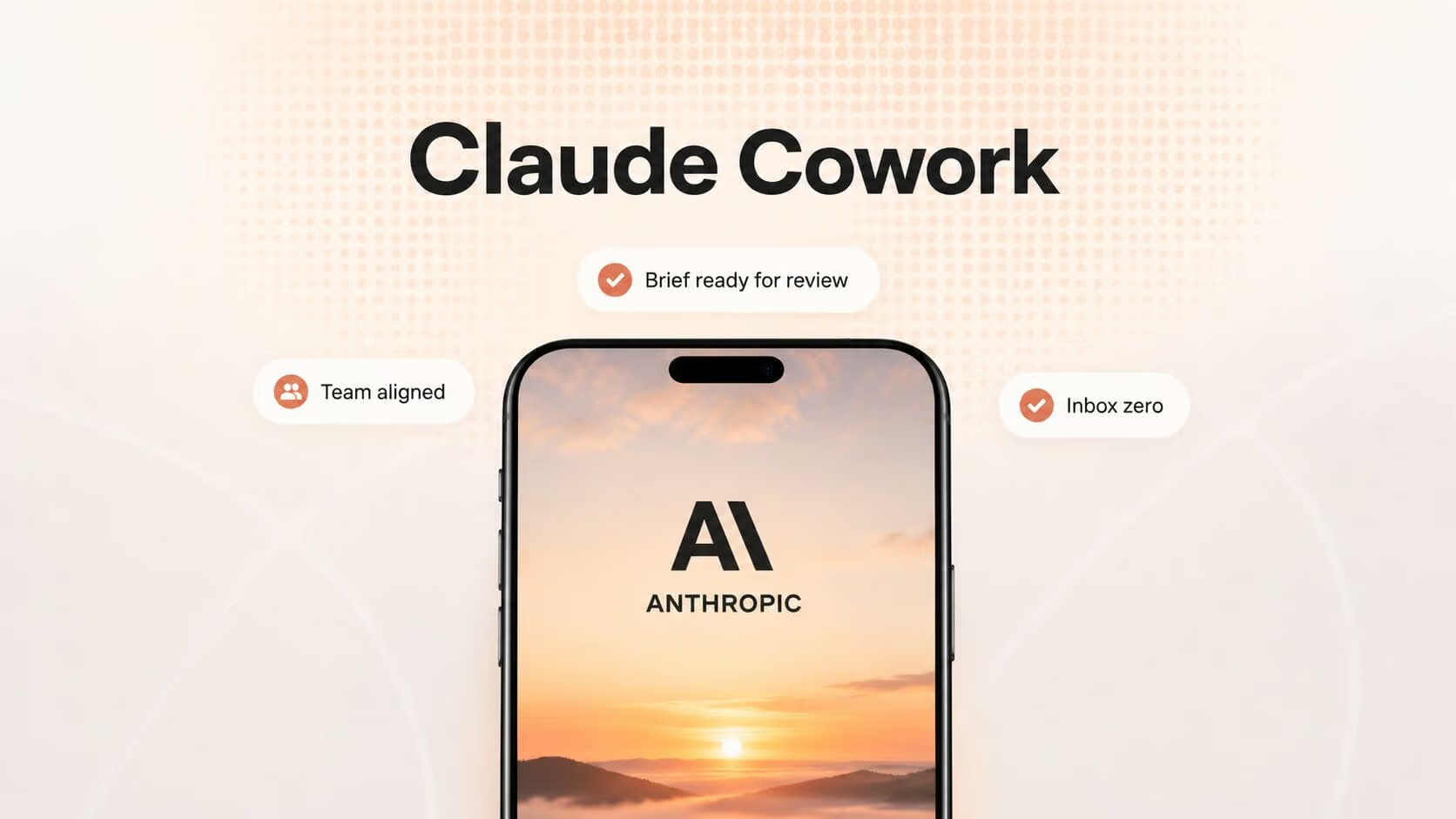
Anthropic has pushed its Cowork agent beyond the desktop, opening a beta on web and mobile to Max subscribers after launching the desktop version in January. Internal usage data covering 1.2 million anonymised sessions from more than 600,000 organisations shows business process work, not software development, accounts for the largest share of activity. The rollout signals where Anthropic thinks the real demand sits, and it raises new questions about how agent-driven automation should be audited, secured, and measured on the sites that depend on it.
For site owners running technical SEO audits, the Cowork expansion matters less as a product announcement and more as a signal that agent-led workflows are leaving the desktop and crossing into phones, browsers, and the apps employees already use.
What changes when Cowork moves off the desktop
The desktop app remains the home base for any task that needs local file access or browser control. Web and mobile add a lighter entry point for people who never installed the app and a way to keep tabs on background work from a phone.
A user can kick off a reconciliation at the office, glance at status on the train home, and pick up the finished output later with the laptop closed. The mobile surface is intentionally thin: it is built to start work and surface results, not to run the heavy steps.
How Dispatch routes requests across engines
A persistent thread carries each task, and Anthropic calls the routing layer Dispatch. Coding requests go to Claude Code, general knowledge work stays in Cowork, and the agent returns the final answer instead of narrating every tool call along the way.
This split is the practical answer to the question many teams ask: which model surface should a request hit? The router decides, and the user sees the outcome.
What 1.2 million Cowork sessions actually show
Anthropic published early statistics drawn from sessions in the last two weeks of May. The breakdown frames where organisations spend agent time:
- Business process work (spreadsheet reconciliation, report building common in finance, HR, and administration): 33.4% of sessions.
- Content creation and copywriting: 16.4%.
- Software development: 8.7%.
The headline figure is the gap between the third category and the first two. Coding is the area that gets the most press coverage, but it is not where the volume of agent sessions is landing. Administrative work is.
Why this matters for site owners and SEO teams
Agent usage is concentrating around the operations that surround a website, rather than around the site itself. Reporting, content drafting, and process automation are the kind of work that produces the inputs an SEO audit eventually consumes: keyword lists, briefs, log summaries, export files, internal reports.
That has a few practical consequences for audits:
- Inputs are increasingly produced by agents, so the audit checklist needs to cover provenance. Where did this keyword list come from, and can the chain be reproduced?
- Mobile access widens the number of people who can trigger background work. Reviewer logs, not just author logs, become relevant evidence.
- Persistent threads mean a single session can touch multiple systems. Audit trails should connect the agent thread to the final artefact that lands on the site.
Treating agent output the same as human output, without a trail, is where risk creeps in. A page that shipped clean can still fail an audit if its source data cannot be traced back.
Where Cowork fits in the wider agent race
Anthropic is not the only lab pushing agents toward non-developer surfaces. OpenAI is widening Codex into a general enterprise platform aimed beyond engineering teams. Google is shipping an agentic assistant under the Gemini umbrella, and Anthropic itself has been threading Claude into Microsoft Word and into large enterprise rollouts such as KPMG giving Claude access to 276,000 staff.
Startups are crowding in too. Viktor raised $75 million to plant an AI coworker inside Slack and Teams. The pattern across incumbents and newcomers is the same: the surface area that matters is the chat client, the office app, and the inbox, not a new tab.
Security considerations when an agent follows your phone
Granting a phone remote control over a desktop agent opens a real attack path. A prompt injection tucked into a document, or a phishing link that reaches the phone, can drive hard-to-reverse actions on the connected machine. Anthropic’s own guidance warns users to connect agents only when they trust every app in the chain.
For audit purposes, that translates into a few checks worth adding:
- Confirm which devices and apps are authorised to drive each agent thread.
- Log the moment a thread is opened, closed, or handed between devices.
- Treat agent-authored files the same way untrusted uploads are treated, until provenance is established.
The caution scales with the trust the agent has been given, and an agent that can move between a desktop and a phone has been given a lot.
FAQ
What is Claude Cowork and where can it be used now?
Claude Cowork is Anthropic’s agent for general knowledge work. It launched as a desktop app in January, and a beta on web and mobile is rolling out to Max subscribers so users can start a task on a desktop and check on it from a phone or browser.
How does Dispatch decide which engine handles a request?
Dispatch keeps one persistent thread open per task. Development work is sent to Claude Code, general knowledge work stays in Cowork, and the system returns the final result rather than walking through each step.
What do the early Cowork usage statistics show?
The figures cover 1.2 million anonymised sessions from more than 600,000 organisations during the last two weeks of May. Business process work made up 33.4% of sessions, content creation and copywriting 16.4%, and software development 8.7%.