
Category: SEO News

  • Why Is SEO Important? 11 Reasons It Still Matters in 2026

    Why Is SEO Important? 11 Reasons It Still Matters in 2026

    Updated October 28, 2026 at 1:13 AM ET

    Its core work, including clear content, sound technical structure and useful site performance, remains relevant as Google expands AI Overviews and AI Mode.

    Google reported that AI Overviews had “over 2.5 billion monthly active users” on May 19, 2026. The same update said AI Mode had “already surpassed 1 billion monthly active users” within its first year.

    Why does SEO still matter in 2026?

    SEO remains a durable way to improve how a website appears in unpaid search results. Google processes approximately 16.4 billion searches per day, while research cited in the source article found that organic search generated more than one trillion visits in 2025, more than any other traffic channel.

    AI traffic grew by 66% that year, but the source reported a much smaller base of under one billion visits per month, compared with tens of billions from organic search. The practical implication for a site owner is straightforward: AI visibility is growing, but organic search remains the larger source of search-driven traffic.

    What is SEO, and how does it work?

    Search engine optimization improves a website’s visibility in search engine results pages. SEO and pay-per-click advertising are the two main pillars of search engine marketing. Paid search buys placement in sponsored results, while SEO earns unpaid visibility.

    Search engines need signals that establish what a page is about and whether it deserves to rank for a query. The source article identifies four requirements:

    • Pages satisfy the searcher’s intent.
    • They demonstrate experience, expertise, authoritativeness and trustworthiness.
    • They load quickly and perform well.
    • They are easy for search engines and visitors to navigate.

    These signals also help AI systems decide which sources to surface. The common SEO work includes keyword research, content creation, link building and technical SEO.

    What can an SEO audit show?

    Review each page’s search intent, content quality, navigation, page performance and Core Web Vitals.

    Core Web Vitals provide specific performance checks:

    • Largest Contentful Paint: how long the largest content element takes to load.
    • Cumulative Layout Shift: how much the layout moves unexpectedly during loading.
    • Interaction to Next Paint: the longest delay before the page visually confirms a successful interaction.

    For site owners who need a consolidated view, SEOScanPro provides comprehensive website SEO audits, including on-page analysis. Google’s PageSpeed Insights is another route for reviewing Core Web Vitals on an individual URL.

    Which 11 benefits of SEO matter most?

    1. Search engines produce substantial traffic

    Ranking well gives a website a share of the billions of searches performed each day. For a site audit, this means checking which queries bring relevant visitors, which pages hold visible positions and where competitors appear for the same terms.

    2. SEO can be cost effective

    A well-ranking page can continue earning visibility for months or years without ongoing placement fees. The costs shift toward content creation, updates and site maintenance.

    3. Search visibility builds awareness and authority

    Frequent appearances in search results expose people to a brand even when they do not click. Duolingo’s rankings across thousands of topical keywords illustrate how repeated visibility can create brand recognition. For an audit, this means checking whether the site has useful, distinct pages for each important topic rather than relying on a single landing page.

    4. Competitors are probably optimizing too

    Compare your rankings against competitors to identify where they hold stronger positions.

    5. SEO complements paid search

    A site can appear in both organic and paid positions, increasing its presence on the results page.

    6. SEO reaches prospects throughout the buying journey

    Search activity changes from early research to product consideration and purchase decisions. An audit should therefore examine whether each page’s intent matches the stage it serves, rather than treating every page as a final conversion page.

    7. Optimization can improve the user experience

    Core Web Vitals connect search performance with practical usability. Slow rendering, unexpected layout movement and delayed interaction feedback can all affect how a page feels. Fixing these issues improves the site for visitors while giving the audit a measurable technical checklist.

    8. Keyword research reveals market trends

    Search data can show where interest is rising. The source article cites Semrush’s Keyword Overview data showing recent growth in searches for ballet sneakers. A footwear retailer could respond by stocking the style, creating comparison content or reviewing the pages that already target the topic.

    9. SEO results are measurable

    Rankings, organic traffic and conversions can all be tracked. The source describes a visibility score ranging from 0%, where a domain ranks outside the top 100 for every tracked keyword, to 100%, where it holds the top organic position for every tracked keyword. You can track organic traffic, organic conversions and many other SEO metrics with a website analytics tool like Google Analytics 4.

    10. SEO helps protect a brand’s search presence

    If a negative article or review ranks prominently, it can affect relationships with prospective customers. A brand audit should check the pages and external mentions that appear when people search for the company name.

    11. SEO provides the foundation for AI search visibility

    The work that supports rankings also supports citations in AI answers. Structured content, authoritative sourcing and clear topical signals remain central. Answer engine optimization, or AEO, shares that foundation but places greater emphasis on direct answers and query fan-out, where a search system breaks a prompt into several related sub-queries.

    Category entry points can also guide content work. They begin with the real-world situations that make someone think of a category, while keywords identify what people type. Combining both gives search and AI systems more ways to recognize a page. A useful audit records citations, mentions, visibility and prompts so teams can see which pages appear in AI results.

    What to do now

    1. Review the pages that already attract organic traffic. Check their search intent, usefulness, headings and internal links. Consider pages with existing visibility when prioritizing updates.
    2. Run a technical and on-page audit. Review crawlability, navigation, page performance and Core Web Vitals. Record each failed check with the affected URL so the owner or developer has a defined repair list.
    3. Compare visibility with competitors. Identify shared keywords where competitors hold stronger positions. Determine whether the gap comes from missing content, weak technical signals or an intent mismatch.
    4. Group content by buyer journey. Make sure informational, commercial, navigational and transactional pages each answer the appropriate need. Check that comparison and product pages are reachable from relevant supporting content.
    5. Track rankings, traffic, conversions and AI citations. Establish a baseline before making changes. Review the same measures over time to compare changes in visibility with changes in site traffic and conversion.

    How does organic search compare with AI traffic?

    Organic search generated more than one trillion visits in 2025, according to the research cited in the source article. AI traffic grew 66%, but remained under one billion visits per month. By May 19, 2026, Google said AI Overviews had more than 2.5 billion monthly active users and AI Mode had passed 1 billion within its first year. These figures describe product reach, while the traffic comparison describes visits. They indicate that optimizing for both search and AI visibility requires the same reliable site foundation.

    FAQ

    Why is SEO important for a website?

    SEO can raise a website’s visibility in unpaid search results and organic traffic, which may increase brand awareness and sales. Technical SEO can improve usability and help pages earn citations in AI-generated answers.

    Does SEO help with AI search visibility?

    SEO and answer engine optimization share fundamentals such as structured content, authoritative sourcing and clear page signals. AI search places added emphasis on direct answers, query fan-out and category entry points.

    What should a website owner check first in an SEO audit?

    Start with search intent, content quality, crawlability, navigation, page performance and Core Web Vitals. Then compare rankings and traffic with competitors to identify gaps and track organic traffic, conversions and AI citations over time.

    Try the AI visibility report
    SEOScanPro, which includes the AI visibility report

    SEOScanPro runs a full technical audit of a site and shows the measured result behind every check. Open the AI visibility report.

    This article reports on publicly available information from the sources listed below. We have no reason to believe it is inaccurate, but we have not independently verified every claim, and details may change as the story develops.

    Sources

    <<{“@context”:”https://schema.org”,”@graph”:[{“@type”:”FAQPage”,”mainEntity”:[{“@type”:”Question”,”name”:”Why is SEO important for a website?”,”acceptedAnswer”:{“@type”:”Answer”,”text”:”SEO can improve a website’s visibility in unpaid search results and increase organic traffic, which may increase brand awareness and sales. SEO can improve technical usability and support citations in AI-generated answers.”}},{“@type”:”Question”,”name”:”Does SEO help with AI search visibility?”,”acceptedAnswer”:{“@type”:”Answer”,”text”:”SEO and answer engine optimization share fundamentals such as structured content, authoritative sourcing and clear page signals. AI search places added emphasis on direct answers, query fan-out and category entry points.”}},{“@type”:”Question”,”name”:”What should a website owner check first in an SEO audit?”,”acceptedAnswer”:{“@type”:”Answer”,”text”:”Start with search intent, content quality, crawlability, navigation, page performance and Core Web Vitals. Then compare rankings and traffic with competitors to identify gaps and track organic traffic, conversions and AI citations over time.”}}]}]}


  • Semrush MCP Use Cases for SEO Research in AI Assistants

    Semrush MCP Use Cases for SEO Research in AI Assistants

    The Semrush MCP server connects Semrush data directly to AI assistants such as Claude and ChatGPT, so SEO research can be run in plain language. Built on the Model Context Protocol, an open standard from Anthropic that gives AI models a universal way to connect to external data sources, files, and tools, the server turns Semrush metrics into answers an assistant can return inside a conversation. This guide groups sixteen Semrush MCP use cases by workflow: keyword strategy, competitive intelligence, content optimization, and diagnostics, with copy-paste prompts ready to adapt.

    How do you set up the Semrush MCP?

    Setup takes four steps. First, check the plan: MCP access comes with Semrush One Starter, Semrush One Pro+, SEO Classic Pro, and SEO Classic Guru, each including 50,000 API units. Traffic Market reports need a separate Trends API subscription, which matters when the Traffic Analytics prompts come up.

    Second, connect from inside the AI client. In Claude, go to Settings, then Connectors, click Add, then Browse Connectors, search for Semrush MCP, and approve the permissions. In ChatGPT, go to Settings, then Apps, find Semrush, and click Connect. Both clients use OAuth, so there is no key to paste.

    Third, use the endpoint for other clients. Cursor, VS Code, Gemini, Perplexity, and custom agents connect to https://mcp.semrush.com/v2/mcp with an API key in the Authorization header. The developer docs list the config for each one. For terminal work, Claude Code with Semrush applies the same idea with more automation on top.

    Fourth, confirm the connection by asking something cheap, like the Semrush Rank for a domain in the US database. If a number comes back, the connection is live. If there is an error, ask the AI to walk through fixing it.

    Every prompt below sits in the Semrush MCP prompt library, where each use case is a workflow of three or four chained prompts. The first prompt in each workflow is featured here because it pulls the data; the full workflow link covers the follow-ups. To use one, paste it, swap in the relevant domain, country, and keywords inside the brackets, run it, and read the output before acting on it.

    The MCP pulls live Semrush data on demand and does not monitor anything or send alerts. Anything that needs watching over time, such as rank tracking or competitor alerts, gets set up inside Semrush itself. The MCP is also read-only, so it retrieves data but never changes it.

    What keyword strategy workflows does the Semrush MCP unlock?

    These search-demand and keyword-strategy prompts show where demand sits in a niche, the keywords competitors rank for that a site does not, and which gaps to address first.

    Spot shifts in search demand

    This prompt maps the niche’s biggest keyword clusters by combined volume before the full workflow layers rising, declining, and SERP-opportunity views on top. Use it when planning a quarter and need to know where demand lives before deciding what to build.

    Using Semrush keyword data for {country}: Identify the top 8 keyword clusters for {niche} by combined monthly search volume. Return ONE table: Columns: cluster_name, combined_monthly_volume, example_keywords (up to 5). Limit: 8 clusters exactly.

    The output is a table of eight clusters ranked by combined volume. The workflow’s trend prompts then show which clusters are growing.

    Turn keyword gaps into roadmaps

    This prompt finds keywords competitors rank for that the site does not, plus the ones where the site ranks far behind. The full workflow then clusters them and plans pages. Reach for it when traffic is going to competitors but not through obvious doors.

    If {competitor-domains} are provided, use them directly (up to 5). If not, first find {your-domain.com}’s top organic search competitors (limit 5); exclude domains with Competitor Relevance = 0.00 and organic traffic above 10M (e.g., YouTube, Reddit, Wikipedia). Use Semrush data for {country} to analyze {your-domain.com} against its top organic competitors. Find and prioritize two opportunity types: Missing keywords (competitors rank, but {your-domain.com} does not) and Weak shared keywords (both rank, but {your-domain.com} ranks much lower than the strongest competitor). Prioritize low-hanging fruit that look actionable through content or on-page improvements. Return ONE table (up to 50 rows): Columns: keyword, opportunity_type, monthly_volume, intent, top_competitor_domain, competitor_rank, your_rank, rank_gap, recommended_action, rationale.

    The result is a 50-row table splitting gaps into missing and weak shared, with a recommended action per row. The workflow’s next prompts cluster the list into themes.

    Prioritize gaps by demand and intent

    This prompt estimates the search intent mix inside each gap cluster so gaps can be sequenced by business value rather than raw volume. The full workflow carries it through competitor difficulty checks into a six-week sprint plan. Run it as a follow-up once a gap list exists.

    Using Semrush keyword data for {country}: For the 8 gap clusters, estimate intent distribution. If gap clusters already exist in this conversation, use them. If no gap clusters are available, first identify keyword gaps for {your-domain.com} against up to 5 competitor domains, then cluster them into exactly 8 themes. Return ONE table: Columns: cluster_name, informational_share_pct (est), commercial_share_pct (est), transactional_share_pct (est), top_intent_keywords (up to 5). Limit: 8 rows. If intent labels are unavailable, infer from SERP/page types and label as estimate.

    The output is an eight-row table of estimated intent shares per cluster. Spot-check a SERP or two before trusting the roadmap, since the intent figures are model-generated estimates.

    How does the Semrush MCP support competitive intelligence?

    These competitive-intelligence prompts identify who a site actually competes with in search, how traffic splits, who is growing, and how to watch them without living in dashboards.

    Identify true search competitors

    This prompt ranks the domains sharing keywords by Semrush’s Competitor Relevance score rather than by assumed competitors. The full workflow maps overlap clusters and SERP feature wins next.

    Using Semrush data for {country}: Identify the top 10 organic competitors of {your-domain.com}, excluding high-traffic generic domains (Competitor Relevance = 0.00 or organic traffic above 10M, e.g., YouTube, Reddit, Wikipedia). Return ONE table: Columns: competitor_domain, estimated_organic_traffic, ranking_keywords, keyword_overlap_with_{your-domain.com}, overlap_pct (if available). Limit: top 10 competitors.

    The output is a 10-row table with traffic, keyword counts, and overlap per domain. Those names feed the next four prompts.

    Prioritize strengths, gaps, and attacks

    This prompt finds clusters where the site is strong and competitors are weak, so the focus is on defending strengths before chasing new ones. The full workflow ends in a defend-versus-attack map.

    Using Semrush data for {country}: Identify keyword clusters where {your-domain.com} has relatively strong visibility but the top 5 competitors have weaker presence. If a previous competitor focus or cluster analysis exists in this conversation, use it as a starting point. Return ONE table: Columns: unique_cluster, why_unique (1 sentence), example_keywords (up to 5), suggested_defense_action. Limit: 8 clusters.

    The output lists up to eight clusters where the site leads, each with a defense action. The workflow’s next prompts then show where competitors outrank the site.

    Size traffic share across competitors

    This prompt pulls each domain’s traffic and engagement and computes market share. It calls Traffic Analytics, which needs a Trends API subscription; the full workflow continues into channel and geography splits.

    For each competitor domain ({competitor-domains}) in {country}, use Semrush Traffic Analytics to retrieve each domain’s overall traffic summary (visits, unique visitors, engagement). It accepts multiple domains per request. If {competitor-domains} are not provided, use competitor domains identified earlier in this use case as top organic/search competitors, market competitors, or strongest keyword-overlap competitors. Combine, dedupe, and limit to 5. Request columns: target, rank, visits, users, pages_per_visit, bounce_rate, time_on_site. Build a single comparison table: Domain, Rank, Visits, Unique Visitors, Pages/Visit, Bounce Rate, Avg Duration (s), Traffic Share %. Derive: total_market_traffic (sum of all visits), market_leader (domain with highest visits), traffic_concentration (combined traffic share of top 2).

    The result is a share-of-market table with total market traffic, the market leader, and top-two concentration. On a plan without the Trends API, the MCP reports the gap and falls back to organic estimates, so a low_data engagement column usually means the plan, not a broken prompt.

    Find competitors gaining organic traffic

    This prompt pulls 12 months of traffic history per competitor and ranks them by absolute growth. The full workflow turns the winners’ patterns into playbooks.

    Using Semrush data for {country} over the last 12 months, identify the top 10 competitors of {your-domain.com} by organic traffic growth. Process: find the top organic competitors, select top 10 by keyword overlap or competitive relevance (exclude domains with Competitor Relevance = 0.00 and Organic Traffic above 10M). For each competitor, pull its organic traffic trend over time. Extract traffic_12m_ago and traffic_now. Compute traffic_change_abs and traffic_change_pct. Flag any competitor where traffic_12m_ago is below 100 as low_data, since percentage growth from a tiny base is misleading. Determine the top_growth_cluster driving traffic growth. Return ONE table: Columns: competitor_domain, traffic_change_abs, traffic_change_pct, top_growth_cluster. Limit: top 10 by traffic_change_abs.

    The output is a growth leaderboard with the cluster driving each gain. The low_data flag matters, because percentage growth from a tiny base will otherwise top the table.

    Track competitor visibility shifts

    To track visibility shifts, set the watch list first. This prompt builds a monitoring table of the 10 most relevant competitors and the cluster each competes on. The full workflow establishes the baseline that shifts are measured against.

    Using Semrush data for {country}: Identify the top 10 organic competitors of {your-domain.com} to monitor. Sort by competitor relevance (Cr) descending. Return ONE table: Columns: competitor_domain, estimated_organic_traffic, keyword_overlap (if available), primary_competing_cluster. Limit: 10 competitors.

    The result is a compact watch list. Regenerate the list monthly and hand it to the alerts prompt below.

    Build alerts and response plays

    This prompt produces alerts for when a competitor gains rankings or when the site loses them. The MCP writes the rules but cannot create alerts; the output goes into Semrush, for example as Position Tracking campaigns. The full workflow adds response playbooks.

    Create a competitor monitoring alert ruleset for {your-domain.com} in {country}. Do NOT generate alerts for {your-domain.com} gains; the purpose is early warning, not reporting success. Cover two signal categories: competitor_gain (a monitored competitor gains organic traffic, rankings, or visibility above threshold in clusters overlapping with {your-domain.com}) and own_loss ({your-domain.com} drops in rankings, traffic share, or keyword visibility in a monitored cluster). Return ONE table: Columns: alert_name, signal_type (competitor_gain / own_loss), metric, threshold, cadence, action_owner_role, what_to_investigate. Include at least 8 alert rules: minimum 5 of type competitor_gain, minimum 2 of type own_loss.

    The result is a rules table with thresholds, cadences, and owners. If the prompt runs in the same conversation as the earlier competitive prompts, the AI calibrates against real baselines in the conversation and every threshold carries both a percentage and an absolute floor instead of a generic number. Backtest it against a prior year’s data before accepting the output.

    FAQ

    What is the Semrush MCP server?

    The Semrush MCP server connects Semrush data directly to AI assistants such as Claude and ChatGPT, so users can run real SEO research in plain language through the Model Context Protocol (MCP), an open standard created by Anthropic that lets AI models connect to external data sources, files, and tools.

    Which Semrush plans include MCP access?

    MCP access comes with Semrush One Starter, Semrush One Pro+, SEO Classic Pro, and SEO Classic Guru, each including 50,000 API units. Traffic Market reports need a separate Trends API subscription.

    Which AI clients support the Semrush MCP endpoint?

    Claude and ChatGPT connect through their built-in connectors using OAuth. Cursor, VS Code, Gemini, Perplexity, and custom agents connect to https://mcp.semrush.com/v2/mcp with an API key in the Authorization header.

    Does the Semrush MCP monitor or send alerts?

    No. The MCP pulls live Semrush data on demand and does not monitor anything or send alerts. Anything that needs watching over time, such as rank tracking or competitor alerts, must be set up inside Semrush itself.

    Try the rank tracker

    SEOScanPro, which includes the rank tracker

    SEOScanPro runs a full technical audit of a site and shows the measured result behind every check. Open the rank tracker.


  • What 25 Years of SEO Teach About Getting Found in AI Search

    What 25 Years of SEO Teach About Getting Found in AI Search

    SEOScanPro is built by NewSunSEO, which has been doing SEO in one form or another since 2001. Twenty-five years is long enough to watch search change shape many times, and each change taught the same lesson from a new angle: the sites that keep winning are the ones search engines can read, trust and quote without effort. AI search is the newest version of that lesson. It rewards the same foundations, and it asks for more work on top of them.

    The foundations that have held since 2001

    Every era of search has come down to the same sequence. A crawler finds the page, renders it, understands it, and decides whether it answers the question. The tools and the ranking signals changed constantly. That sequence did not.

    A site that loads quickly, states clearly what each page is about, links its pages together sensibly and keeps its technical house in order has had an advantage in every version of search we have worked in. Those same qualities are what let an AI assistant read a page and lift an accurate answer from it.

    What AI search adds on top

    Traditional search ranks pages. AI assistants assemble answers, and they name only a handful of sources in each one. That changes what visibility means in three practical ways.

    • Access comes first. Each assistant crawls with its own named agent, and a robots.txt file can allow one while blocking another. A site can rank well in Google and still be invisible to an assistant it has turned away without realizing it.
    • Clarity earns the quote. Assistants quote pages that state things plainly, with a clear question and a direct answer underneath it. Structured data that says what a business is, where it operates and what it offers gives them facts they do not have to guess at.
    • Consistency across the web can matter more than any single claim on your site, because an assistant cross-checks what your site says against what other sources say about you.

    Why AI visibility is a whole-business effort

    For most of search history, this part has changed little. For most of search history, SEO could mostly deliver results on its own by fixing the site, publishing better pages, and earning links. AI visibility depends on work done by people in other parts of the business.

    Developers control whether pages render cleanly and load quickly. Whoever manages listings controls whether your name, address and phone number agree across directories. Content owners control whether pages answer real questions in the words customers use. Customer service shapes the reviews an assistant reads. The businesses that do best in AI answers are the ones where all of these people work from the same picture of what needs fixing.

    It turns the broad goal of showing up in AI answers into a specific list each person can act on.

    Measure what AI search actually uses

    A single average rank hides most of what actually matters.

    • Which AI crawlers your robots.txt lets in, and which rule decides each one.
    • Whether your structured data is complete, or missing properties that cause it to be ignored.
    • No fact to preserve; the sentence is pure scaffolding. [REWRITE_UNAVAILABLE]
    • How visible your business is across the service area you serve, not just at one address.

    SEOScanPro runs more than 85 checks across 17 scored categories and shows the measured value behind each one, so every finding comes with the evidence you need to act on it. The free AI Crawlability Test, Schema Markup Checker and AI Overview Readiness check each answer one of those questions on its own.

    FAQ

    Does traditional SEO still matter for AI search?

    AI assistants rely on the same things search engines have long relied on: pages they can reach, render, and understand.

    What is the first thing to check for AI visibility?

    Check whether AI crawlers are allowed to read your site at all. Each assistant uses its own named agent, and a single robots.txt rule can block one without affecting the others.

    Why does AI visibility involve more than the SEO team?

    Assistants weigh page speed and rendering, consistent business details across the web, clear answers in your content and what reviews say about you. Those sit with developers, listing managers, content owners and customer service, so the best results come when everyone works from one list of fixes.

    Try the site audit tool

    The SEOScanPro site audit report

    The SEOScanPro site audit runs a full technical audit of a site and shows the measured result behind every check. Open the site audit tool.

  • 20 SEO Questions, 20 Sharp Answers: A Practitioner Q&A

    20 SEO Questions, 20 Sharp Answers: A Practitioner Q&A

    Twenty focused questions produce twenty concrete answers about where SEO is heading, what changed when AI search engines entered the picture, and how practitioners are reorganizing their work in response. The exchange covers site migrations, link building, brand mentions, analytics, and the practical overlap between traditional search optimization and getting cited by AI assistants.

    What did the interview actually cover?

    The format was deliberately tight: twenty questions, twenty answers, no filler. The interviewer pushed for specifics on technique, measurement, and prioritization, and the answers stayed grounded in what practitioners see in day-to-day work rather than abstract trend pieces.

    Several threads ran through the conversation. One was how classic SEO fundamentals (crawl efficiency, internal links, clean redirects, accurate analytics) have become more important now that AI systems are pulling from the open web to build their answers. Another was how teams are deciding where to spend their limited bandwidth, especially when a single visibility report no longer captures the full picture.

    How is AI search changing SEO priorities?

    The clearest theme across the answers was a shift from a single ranking position to a broader concept of visibility. The answers instead described practitioners layering that goal on top of their existing work rather than replacing it, since being cited in an AI assistant’s synthesized response is a different goal from ranking first in a list of blue links.

    Brand mentions, even without hyperlinks, came up as a signal worth tracking. So did the structure of content: clear answers to clear questions, factual claims that can be lifted cleanly into a generated response, and on-site markup that helps machines identify what a page is actually about.

    What about site migrations and analytics?

    Migrations came up as one of the highest-risk moments for organic traffic, and the answers emphasized pre-migration baselines, mapping every redirect, and watching log files rather than trusting dashboards alone in the weeks after launch. Analytics hygiene showed up repeatedly: clean filters, correct hostname settings, and a working grasp of which queries and pages actually drove results before any change.

    How are teams approaching link building now?

    The answers treated link building as still relevant but repositioned around relationships, original data, and genuinely useful tools or research that other sites want to reference. Cold outreach for the sake of a link was described as a poor use of time. Digital PR, original surveys, and free tools were named as the kinds of assets that earn coverage organically.

    What practical advice came out of it?

    Several answers converged on the same practical point: measurement has to catch up with where users actually see a brand. A traditional rank tracker still has value, but visibility now also includes whether a brand is cited by AI systems, whether its pages are being pulled into AI overviews, and whether its name appears in the sources an assistant draws from. Tools that report a position on a service-area grid map the real-world picture more accurately than a single city-wide average, and SEOScanPro’s GEO Grids do exactly that kind of local rank mapping for businesses that need to see which towns and suburbs they are invisible in.

    Why does the format matter?

    Twenty short questions force short, specific answers. That format cuts through the broad trend pieces and leaves readers with a checklist of concrete shifts they can apply to their own work, from how they structure a piece of content to how they measure whether it landed.

    FAQ

    What changed in SEO because of AI search?

    Visibility now extends beyond a single ranking position. Practitioners track whether a brand is cited in AI-generated answers, whether its pages are pulled into AI overviews, and whether its name appears in the sources an assistant draws from, layering this on top of traditional ranking work.

    Are link building and brand mentions still important?

    Yes. Links from credible sources still matter, and brand mentions without hyperlinks are treated as a separate signal worth tracking. The strongest results come from original research, useful tools, and digital PR rather than cold outreach.

    What is the highest-risk moment for organic traffic?

    Site migrations. The answers stressed pre-migration baselines, full redirect mapping, and watching log files in the weeks after launch rather than relying on dashboards alone.

    Try the AI visibility report

    SEOScanPro, which includes the AI visibility report

    SEOScanPro runs a full technical audit of a site and shows the measured result behind every check. Open the AI visibility report.


  • Google Chrome Adds New Metrics to Measure Ad-Heavy Websites

    Google Chrome Adds New Metrics to Measure Ad-Heavy Websites

    Site owners and developers now have new measurement data in Google Chrome that shows how advertising affects the browsing experience on ad-heavy websites. The browser introduced these metrics so teams can quantify the load that ads place on a page and connect that load to how the page performs for real visitors. For anyone who runs an ad-supported site, the change turns a vague concern about clutter into something concrete you can track.

    What did Google Chrome introduce?

    Chrome added new metrics focused on measuring pages that carry heavy advertising. The purpose is to give the people who build and maintain websites a clearer view of how ad content contributes to the overall experience, rather than leaving ad impact buried inside general performance numbers. With dedicated measurement, a team can look at ad load as its own signal and see how it moves alongside the rest of a page.

    Why does measuring ad load matter?

    Advertising pays for much of the open web, and the amount of ad content on a page can affect how fast and stable the page feels. When a page delivers more ads, those ads can draw on the same resources the browser uses to render the content a visitor came to read.

    Who benefits from the new metrics?

    The clearest audience is publishers and developers who depend on display advertising and want to keep both revenue and page experience healthy. With measurement aimed at ad-heavy pages, these teams can identify which templates or placements carry the most weight and decide where adjustments are worth making. The data supports a practical trade-off: keep the advertising that funds the site while protecting the speed and stability that keep readers coming back.

    How does this fit with page experience work?

    Google has spent years pushing site owners toward measurable page experience, and metrics built around ad load extend that same idea to the part of a page that is often the hardest to see clearly. A team can cite a specific metric instead of guessing whether ads slow a page.

    What should site owners do next?

    Start by reviewing your most ad-heavy templates against the measurement Chrome now provides, and treat the numbers as a baseline you can improve over time. Compare heavy pages with lighter ones to see how much of the difference traces back to advertising. From there, you can test placement and delivery changes and watch whether the metric moves, keeping the ad inventory that matters while trimming the load that hurts the reader. A regular technical review of how ads affect your pages keeps this work from slipping, and it is the kind of ongoing check a site audit is built to handle.

    FAQ

    What are Google Chrome’s new metrics for ad-heavy websites?

    They are new measurements in Chrome that let site owners and developers see how advertising contributes to a page’s experience, giving ad load its own signal instead of leaving it inside general performance numbers.

    Who should pay attention to these metrics?

    Publishers and developers who run ad-supported sites benefit most, because the data helps them weigh the revenue from ad placements against the speed and stability those placements affect.

    Why did Google add measurement for ad-heavy pages?

    The amount of advertising on a page influences how it performs, and tracking ad impact helps teams decide about their placements.

    Related coverage

  • SEO and PPC Are Sitting on Each Other’s Best Insights

    SEO and PPC Are Sitting on Each Other’s Best Insights

    When SEO and PPC share data, paid spend is directed at keywords organic search has not captured, so pages that already rank well need less ongoing paid promotion.

    Running both channels is not the same as running a search strategy. Running both channels requires two separate channel strategies, and the gap between them is where budget is wasted and opportunities are missed. At many companies, the SEO team and the PPC team operate separately, each meeting its own targets and reporting its own metrics, with no one reviewing both channels together.

    Where the separation comes from

    Their skills, tools, and success metrics differ, so they often sit in separate teams, sometimes with separate budget holders or even separate agencies. That works up to a point. It becomes a problem when the split turns into the default and no one reviews both channels together.

    Measurement reinforces the divide. An SEO team is judged on rankings and organic traffic. A PPC team is judged on cost per click, conversion rate, and return on ad spend. Neither is set up to track what the other does. Sometimes teams simply do not know enough about the other channel to ask the right questions, and sometimes there is reluctance to share data in case it shifts budget away from a channel. Both reactions are understandable, and both cost the business.

    What sharing data saves

    The clearest saving is cutting spend on clicks for terms a site already ranks well for. If a page holds position one, there is a strong case for not bidding on that keyword at all. When the PPC team has no view of organic rankings, that spend keeps running.

    A subtler gain comes from reading shifts in paid performance. When costs per click rise on certain terms and returns fall, those terms become stronger candidates for organic investment, either through new content or by improving pages that are already close to ranking. Paid data on which keywords convert should feed organic content priorities directly. Organic data on which terms already rank strongly should guide where paid budget gets focused and where it gets pulled back. Without that flow, both channels decide from an incomplete picture.

    There is also a brand consistency gain that rarely gets discussed. When the two channels operate apart, they can send different messages to the same audience: an organic result leading to an informational page while a paid ad for the same query drives to a promotional landing page. That inconsistency reduces trust and lowers the chance of a conversion whichever channel brought the visitor in. Shared decisions keep the experience coherent and make better use of the marketing budget.

    What good collaboration looks like in practice

    None of this requires a major restructure. Three practical changes, named below, make the biggest difference.

    Start with shared keyword research

    Keyword research is more effective when SEO and PPC teams build a shared keyword list from the start. SEO focuses on what people search for over time and the informational content that addresses those searches. PPC shows which keywords are driving conversions now and what current demand looks like.

    Avoid duplicate landing pages

    Duplicate landing pages are a common and avoidable problem, and they usually trace back to one team not knowing what the other has built. The PPC team requests a page for a campaign, and no one checks whether SEO already targets the same intent. The result is two pages chasing the same goal, splitting authority and confusing Google about which one to rank. Weeks later the SEO team may spot the new page in Google Search Console and spend time working out whether it is cannibalizing an existing page, whether a canonical tag is needed, or whether a noindex tag would keep it out of organic search. A short check before any new campaign page gets built prevents that work. More often than not, improving a page that already exists serves both channels better than starting from scratch.

    Hold joint planning calls

    Putting both teams on the same monthly call is simple and effective. Everyone hears the same objectives, commercial priorities, and campaign updates at once. If PPC is planning a new landing page or shifting keyword priorities, SEO knows in advance, which lets teams prevent problems rather than fix them. It also presents the account as one strategy rather than two separate efforts, which builds client confidence.

    Which data each team can share

    PPC search term reports show which queries drive paid conversions, which are expensive without converting, and where costs per click are trending. That feeds organic keyword prioritization, content planning, and identifying gaps where SEO is not yet competing.

    Organic ranking data points the other way. A page in position one is a signal to reduce or pause ad spend on that keyword and move budget elsewhere. Pages ranking between positions four and 10 can benefit from a targeted paid push that lifts total visibility while organic continues to improve.

    SEO content research also supplies negative keywords for paid campaigns. When the SEO team knows which informational queries bring organic traffic that does not convert, that list can feed straight into PPC negative keyword exclusions, so the business stops paying for clicks that consistently fail to convert. Finally, both teams benefit from reporting on the same outcomes. Revenue, leads, and conversions matter more than channel-specific metrics, and shared commercial results make budget allocation straightforward.

    The fix is a communication one

    The gap between SEO and PPC comes down to how the two teams communicate, not the technical setup itself. It is a communication issue, making it relatively straightforward to address once a team commits to fixing it. The two functions do not need to merge into a single team. The two teams need to share the data that helps each function make better decisions, so paid insights shape organic priorities and organic data shapes paid spend.

    FAQ

    Should you bid on keywords you already rank for organically?

    If a page holds position one, there is a reasonable case for not bidding on that keyword and moving the budget elsewhere. When PPC has no view of organic rankings, that spend continues unnoticed. Pages ranking between positions four and 10 can be worth a targeted paid push to increase total visibility while organic improves.

    How do SEO and PPC teams avoid duplicate landing pages?

    Check what already exists before building a new page for a paid campaign. Duplicate pages targeting the same intent split authority and confuse Google about which one to rank. A short conversation between the teams, or improving an existing page instead of creating a new one, prevents the cleanup work of canonical or noindex tags later.

    What data should SEO and PPC teams share?

    PPC search term reports show converting queries, expensive non-converting queries, and cost per click trends, which guide organic content planning. Organic ranking data shows where a site is already visible so paid budget can be pulled back. SEO also supplies non-converting informational queries as negative keywords for paid campaigns, and both teams should report on revenue, leads, and conversions.

  • Evolving SEO for 2027: What Still Needs to Change

    Evolving SEO for 2027: What Still Needs to Change

    SEO gains more reach and resilience when it adapts to how search actually works today, especially as Google leans further into entity understanding, AI Overviews, and generative answers. The work that still needs to change in 2027 spans how content is structured, how success is measured, and how publishers relate to the platforms that surface their work.

    Why SEO still has to evolve for 2027

    Search has moved past ten blue links into a landscape shaped by Google AI Overviews, conversational follow-ups, and AI assistants that synthesize answers from many sources at once. Content marketing success, by one recent survey, has fallen to a 12-year low, a signal that the old production playbook is producing diminishing returns. The opportunity now sits in aligning content with how Google actually understands entities and queries, and in proving visibility inside AI-driven results, not just traditional rankings.

    Entity-first content: aligning pages with Google’s Knowledge Graph

    Google has spent years building out the Knowledge Graph, and entity-first SEO treats that layer as the foundation rather than an afterthought. In practice, this means structuring pages so the people, products, organizations, and concepts on them are unambiguous and connected to authoritative sources the Knowledge Graph already recognizes. When the underlying entities are clear, Google can match content to more queries, including the conversational follow-ups that drive AI Mode and AI Overviews.

    Two research threads make the case for this shift. A survey of 131 SEO professionals ranked Google’s top ranking factors, and entity clarity keeps climbing. Two separate GEO experiments also challenged conventional AI visibility advice, suggesting that the levers marketers have long trusted, such as keyword density and backlink volume, matter less than how well a source establishes itself as a trusted entity that AI systems want to cite.

    The follow-up query: rethinking SEO for conversational search

    AI Mode turns search into a conversation. A single query becomes a thread of follow-ups, each one narrowing or pivoting on the last. Optimizing only for the first query leaves most of the session on the table. Pages that win in conversational search tend to cover an entity deeply enough to answer the second, third, and fourth question without forcing the user to leave the AI interface.

    Research on pre-search behavior suggests the decision often forms before a query is typed, shaped by prior reading, social context, and earlier AI conversations.

    Measuring success in an AI-first SERP

    Rank tracking and click-through rates tell less of the story when AI Overviews absorb the answer above the organic results. Two tools are gaining ground:

    • AI visibility tracking. Whether and how often a brand is cited inside AI Overviews, AI Mode, and Gemini responses. Recent tests in which Google has begun paying publishers for content used in AI Mode, AI Overviews, and Gemini hint at how seriously the platform is treating attribution and sourcing.
    • Entity coverage. How thoroughly a site covers the entities in its topic space, measured against the connections in the Knowledge Graph rather than a keyword list.

    Google Analytics has also moved in this direction with customizable dashboards, giving teams room to define what visibility means for their own brand instead of relying on off-the-shelf templates built for a pre-AI SERP.

    What content still needs to fix

    High content output no longer provides a competitive advantage on its own. Content that performs well in AI-driven search depends on original analysis, proprietary data, and a clear point of view that AI systems can attribute and cite.

    • Images have a new job in AI search. Visual content is parsed and re-described by AI systems, so alt text, surrounding context, and entity markup now feed the answer engines directly.
    • AI watermarking is a content signal. If visible AI watermarks on your work would alarm your audience, the content strategy that produced the work is the problem, not the watermark itself.
    • Content that shapes what a user is thinking before they search often gains more visibility later on than content that only competes for the search itself.

    Where this leaves SEO practitioners

    The core SEO skill set of technical health, crawlability, and link authority still matters, but it now operates beneath entity modeling, AI visibility measurement, and content strategy built around original thinking. Teams that treat SEO as a system for becoming the most authoritative, clearly defined source on a topic will find that AI-driven search amplifies their reach.

    FAQ

    What does entity-first SEO actually mean?

    Entity-first SEO means structuring pages so the people, products, organizations, and concepts they cover are unambiguous and linked to authoritative sources Google already recognizes in its Knowledge Graph, which improves matching across queries including AI Overviews and conversational follow-ups.

    Why is conversational search changing SEO strategy?

    AI Mode turns a single query into a thread of follow-up questions. To win visibility across the whole session, pages need to cover an entity deeply enough to answer the second, third, and fourth question without forcing the user to leave the AI interface.

    How should SEO success be measured in 2027?

    Traditional rank and click tracking cover less of the picture in an AI-first SERP. The leading indicators are AI visibility (how often a brand is cited in AI Overviews, AI Mode, and Gemini) and entity coverage (how thoroughly a site covers its topic space relative to the Knowledge Graph).

  • 18 SEO KPIs for organic and AI search: how to pick the few that matter

    18 SEO KPIs for organic and AI search: how to pick the few that matter

    Choosing three or four well-chosen SEO KPIs gives a clearer read on progress than tracking a dozen numbers that don’t connect to your goal. With AI answers now sitting ahead of traditional search results, the set of metrics worth watching has grown beyond rankings and clicks to include AI visibility, mentions, and citations. Eighteen SEO KPIs across organic and AI search are organized by what they measure, so you can pick the few that ladder up to your business goal.

    Why a small set of KPIs beats a long dashboard

    Search performance produces a flood of data points. Rankings, impressions, AI citations, mentions, and referral visits each capture something real, but tracking all of them at once splits your attention across numbers that don’t necessarily relate to your goal. Monitoring a select few hand-picked SEO KPIs keeps you focused on whether your effort is moving the outcome you care about.

    What KPIs matter depends on your goal. Brands focused on awareness track different metrics than those focused on conversions, so you need to choose the KPIs that match your goal.

    What are SEO KPIs?

    SEO KPIs are the most important metrics across organic search and AI-generated answers that you measure to evaluate whether you’re on track to meet your SEO and business goals. Common examples include search engine visibility, keyword rankings, AI citations, organic click-through rate, and conversions.

    Monitoring these KPIs helps you track performance, make data-driven decisions about where to invest, and show your return on investment. Which KPIs you track depends on your website and your goals.

    Search visibility KPIs

    Search visibility KPIs track metrics such as impressions, click-through rates, and brand mentions across organic and AI search.

    1. Search engine visibility

    Search engine visibility measures how prominently your website appears in search engine results for target keywords. It covers multiple SERP features, including People Also Ask and featured snippets, to give a broader view of presence across queries. Tracking it shows whether SEO efforts succeed beyond individual rankings.

    To track search engine visibility, open Google Search Console, click “Performance” in the left-hand menu, then “Search results.” Check the box next to “Total impressions” to see how many times your site appeared in search results over a specific period. GSC’s total impressions include queries beyond your target keyword list. For visibility on a specific target keyword set, use Semrush’s Position Tracking tool: enter your target keywords when you set up the project, click “Start Tracking,” and review the trend graph on the “Overview” tab.

    2. Keyword rankings

    Keyword rankings show where your site appears in organic search results for specific terms, which affects visibility and the potential to drive clicks. Tracking rankings helps identify drops in position, pages that rank well, and keywords to target next.

    3. AI visibility

    AI visibility measures how often your brand appears in AI-generated answers across relevant topics compared to competitors. Semrush’s AI Visibility score reflects your AI visibility on a 0 to 100 scale. Visibility Overview shows the trend over time and the comparison against competitors across AI platforms. Semrush’s Enterprise AIO offers broader platform coverage and more granular monitoring for larger organizations.

    4. AI mentions

    AI mentions are brand name appearances in AI-generated answers. Visibility Overview tracks mentions over time, broken down by platform and country, and benchmarks performance against competitors.

    5. AI citations

    AI citations are instances when AI-generated answers cite your domain as a source, whether or not you’re mentioned. Visibility Overview shows your total number of citations and the total number of cited pages. Clicking the number under “Cited Pages” identifies which pages earn the most AI citations.

    Traffic KPIs

    Traffic KPIs include metrics such as click-through rate, which measures how often a site’s appearance in search results leads to clicks and visits.

    6. Organic click-through rate

    Organic click-through rate is the percentage of impressions in unpaid search results that result in clicks to your website. A higher CTR often signals relevant and compelling content. Calculate it as (organic clicks / SERP impressions) multiplied by 100. View it in GSC under “Search results” by checking “Average CTR.” The “Pages” tab breaks CTR down per page.

    7. Organic traffic

    Organic traffic refers to visits to your site from organic search results. Monitoring it shows which pages attract the most visits and whether the number is growing or shrinking. View it in Google Analytics 4 by clicking “Reports,” then “Acquisition,” then “Traffic acquisition.” The “Organic Search” row shows the session count for the selected period.

    GA4 includes traffic from Google AI Overviews and AI Mode in the Organic Search channel, so the sessions reported here include some AI search experiences. Semrush’s Organic Search dashboard in the Traffic Market Toolkit separates any domain’s traffic into Organic Search and Google AI Mode, so you can see how much comes from each.

    8. Non-branded organic traffic

    Non-branded organic traffic is search engine traffic from queries that don’t contain your brand name. An increase shows you’re growing awareness and getting visits from people who don’t know your brand yet. Semrush’s Organic Rankings tool shows estimated non-branded traffic at the top of the “Overview” tab.

    9. AI referral traffic

    AI referral traffic is website traffic from AI platforms such as ChatGPT, Perplexity, Gemini, and Claude. Semrush research found the average AI search visitor was 4.4 times as valuable as a traditional organic search visitor, based on conversion rate, which matters because AI-generated answers don’t generally drive much traffic to other websites. AI referral traffic appears in GA4’s Traffic acquisition report under the AI Assistant channel. Semrush’s AI Traffic dashboard in the Traffic Market Toolkit breaks AI referral traffic down by platform and benchmarks it against competitors over time. Larger organizations can use Benchmark Intelligence in Semrush Enterprise AIO for cross-platform comparison.

    Authority KPIs

    Authority KPIs measure when other websites validate your brand.

    10. Backlinks

    Backlinks are links on external webpages that point to your site, which signal that your content is valuable and trustworthy. Search engines treat links from authoritative, trustworthy sites as a stronger credibility signal, so one link from a reputable source can outweigh many from lower-quality ones. The same holds in AI search: Semrush’s backlinks study, which analyzed 1,000 domains, found that domains with stronger backlink authority are mentioned more often in AI-generated answers.

    11. Brand mentions

    Brand mentions are references to your brand across the web and can be linked or unlinked. Linked mentions can support SEO through backlinks, while unlinked mentions reveal context that helps search engines and AI systems understand what your brand is known for. Track mentions with the Brand Monitoring app by creating a new query for your brand name and selecting “Brand” from the drop-down. Under “Main Filters,” add your website under “Track backlinks” so linked mentions are flagged. The “Analytics” tab then shows total mentions and how many are also linked.

    User engagement metrics

    User engagement metrics show how visitors interact with your site.

    12. Bounce rate

    Bounce rate is the percentage of unengaged sessions, meaning the session lasted 10 seconds or fewer, didn’t involve a key event, or included fewer than two page or screen views. A high bounce rate may mean the page content is irrelevant or that the site has usability or technical issues. Google has never specified bounce rate as a direct ranking factor, but leaked documents and testimony at Google’s antitrust trial indicate that user experience metrics like bounce rate do affect rankings. Track bounce rate in GA4 by going to “Reports,” clicking “Engagement,” and selecting “Pages and screens.” Customize the report to add “Bounce rate” as a metric, then save the changes.

    13. Average engagement time

    Average engagement time measures the average amount of time users spend actively viewing your website or app. In GA4, it only counts the time when a webpage is in focus in the browser or when the app is open in the foreground. High engagement signals that content is useful and meets user expectations, which helps build trust with audiences and supports overall search performance. Find it in GA4’s “Engagement overview” report under “Average engagement time per active user.”

    Business impact KPIs

    Business impact KPIs show how search performance translates to tangible value.

    14. Conversions from organic and AI search

    A conversion occurs when visitors from organic or AI search complete a desired action, such as completing a purchase, signing up for a newsletter, or downloading a resource. Effectively, conversions from organic and AI search reveal how well your traffic from those sources contributes to business results. In GA4, conversions are tracked as key events that you specify. Mark the actions that matter most by going to “Admin,” “Data display,” “Events,” and selecting the star next to each event you want logged as a key event. The Traffic acquisition report then shows total key events and Session key event rate for the Organic Search and AI Assistant rows. Note that GA4’s AI Assistant channel group doesn’t include traffic from AI Overviews or AI Mode.

    15. Return on investment

    SEO ROI is the profit you gain from SEO compared to what you spend on it. A positive ROI is the ultimate goal of every SEO strategy. Calculate it as: SEO ROI = ((Revenue from SEO minus cost of SEO) / cost of SEO) multiplied by 100. For example, spending $9,000 on SEO and generating $16,000 in revenue gives an ROI of 77.8%.

    16. Customer lifetime value

    Customer lifetime value (CLV) estimates the total revenue generated by customers during their entire relationship with your business. Tracking CLV for SEO shows whether those customers purchase once or continue to create value over time. Calculate it as: CLV = (Average purchase value) multiplied by (average purchase frequency) multiplied by (average customer lifespan). An average customer who spends $100 per order, makes three orders per year, and stays for five years produces a CLV of $1,500.

    17. Cost per acquisition

    Cost per acquisition (CPA) from SEO measures how much it costs to acquire one new customer through organic and AI search. SEO costs that affect CPA include team salaries, agency fees, SEO tool costs, content creation, and link building. A dropping CPA indicates your SEO strategy is becoming more cost-effective; a rising CPA may signal problems. Calculate it as: SEO CPA = Total SEO costs / Total number of customers acquired through organic and AI search. Spending $4,000 on in-house SEO and $1,000 on an agency and gaining 100 new customers gives a CPA of $50.

    18. Local visibility

    Local visibility KPIs measure how customers find your business in location-based searches. These typically include Google Business Profile views, direction requests, phone calls, and local pack rankings, which surface for queries with geographic intent.

    How to pick the KPIs that matter for your goal

    Start with the business outcome you’re chasing, then work backward to the search signal that most directly predicts it. A brand chasing awareness pairs non-branded organic traffic with brand mentions. A brand chasing revenue pairs conversions from organic and AI search with SEO ROI or cost per acquisition. Keep the list short, revisit it when your goal shifts, and resist the pull to track everything just because the data is available.

    FAQ

    What are SEO KPIs?

    SEO KPIs are the most important metrics across organic search and AI-generated answers that you measure to evaluate whether you’re on track to meet your SEO and business goals. Common examples include search engine visibility, keyword rankings, AI citations, organic click-through rate, and conversions.

    How many SEO KPIs should you track?

    Limiting tracking to a small set of SEO KPIs tied to one specific goal provides more useful progress data than monitoring a larger set of unrelated metrics. Choose KPIs that match your goal, since awareness, traffic, and revenue each call for different selections.

    Which KPIs matter for AI search?

    For AI search, the most useful KPIs are AI visibility, AI mentions, AI citations, AI referral traffic, and conversions from the AI Assistant channel. Authority signals such as backlinks and brand mentions also influence how often AI-generated answers surface your domain.

    Related coverage

  • Google Search Ranking Volatility Continues After August Spam Update

    Google Search Ranking Volatility Continues After August Spam Update

    Google Search results have stayed turbulent since the August 2026 spam update finished rolling out on August 21, and third-party tracking tools continue to register significant ranking movement more than a week later. The SEO community is documenting fresh volatility that looks like an unconfirmed ranking update rather than spam cleanup alone.

    What happened with the August 2026 spam update?

    The August 2026 spam update began on August 18 and concluded on August 21. It was the latest in a string of spam-related actions Google has taken, with the previous confirmed spam update being the June 2026 spam update that ran from June 14 through June 26. Before that, Google pushed out the May 2026 core update, which started on May 21 and completed on June 2.

    Why is volatility still happening after the spam update ended?

    Ranking volatility has not settled since the spam update wrapped. Independent tracking tools continue to show wide swings in the aggregate score, and SEOs are reporting major shuffling in niches that had been stable for months. The pattern looks consistent with Google pushing out an additional, unannounced ranking change on top of the spam cleanup. It is unclear whether the turbulence relates to a separate PDF-related issue in Google Search.

    This continues a busy stretch of unconfirmed updates. Since late July, observers noted volatility on July 24, around August 1 to 3, around August 5, on August 13, and during the 18th and 19th, with movement carrying through that week. The turbulence that began after August 21 sits at the tail of this run.

    What are the tracking tools showing?

    Multiple third-party SERP trackers recorded high volatility during the period, and the combined reading from those tools indicates continuing turbulence rather than a return to baseline. The tools listed in the underlying tracking data include AccuRanker, Algoroo, AWR (Advanced Web Ranking), CognitiveSEO, DataForSEO, Mangools, Mozcast, SEMRush Sensor, Serpstat, SimilarWeb, Sistrix, Wincher, Wireboard, and Zutrix. The aggregate reading combines these individual signals into a single composite view of Google Search volatility.

    What are SEOs seeing in the search results?

    Chatter in the SEO community, both in the comments section of the original coverage and on WebmasterWorld, points to real-world ranking shifts that line up with what the tools show. Practitioners reported major shuffling in niches that had been stable for months, noting that Googlebot activity picked up overnight before the changes appeared.

    One commenter observed a 100% increase in AI Overview mentions alongside the turbulence. Others described the unpredictability as a business problem, saying it is hard to build on rankings that reshuffle every few weeks. Several publishers reported that indexing has been disrupted even for sites that follow Google’s policies and publish human-written content, while spam sites appear unaffected. Some reported traffic and Discover drops, along with Google sending visitors to 404 pages for around two weeks.

    How does this fit the broader update timeline?

    The August spam update is the most recent confirmed action. The list of recent confirmed and unconfirmed events includes:

    • June 2026 spam update: June 14 to June 26 (confirmed)
    • May 2026 core update: May 21 to June 2 (confirmed)
    • Unconfirmed volatility on the 18th and 19th of the prior month
    • Unconfirmed volatility around July 24
    • Unconfirmed volatility around August 1 to 3
    • Unconfirmed volatility around August 5
    • Unconfirmed volatility on August 13
    • August 2026 spam update: August 18 to August 21 (confirmed)
    • Post-spam turbulence from August 22 onward (unconfirmed)

    Sites face a constant flow of confirmed and unconfirmed updates, leaving little downtime to recover between shifts.

    What should site owners watch for?

    Site owners can use the same third-party trackers Google monitors to spot whether their rankings are caught in this current turbulence. The aggregate score is the fastest way to see whether volatility is high across the board, and individual signals from tools like Sistrix, Mozcast, Semrush Sensor, and Algoroo help confirm whether the shift is broad or limited to specific niches.

    For sites that have seen indexing issues or sudden drops in Discover traffic during this window, the practical move is to compare changes against the timeline above. If rankings moved on or after August 21 in a niche that has been volatile for several weeks, the shift is more likely tied to the cluster of recent unconfirmed updates than to a single cause.

    FAQ

    What was the Google August 2026 spam update?

    The August 2026 spam update was a confirmed spam-related ranking change that began on August 18, 2026 and concluded on August 21, 2026.

    Is Google Search still volatile after the August 2026 spam update?

    Yes. Third-party tracking tools and SEOs continue to register significant ranking volatility in the days after the August 2026 spam update wrapped, suggesting an additional unconfirmed update is in progress.

    Which tools track Google Search ranking volatility?

    Common third-party trackers include AccuRanker, Algoroo, AWR, CognitiveSEO, DataForSEO, Mangools, Mozcast, SEMRush Sensor, Serpstat, SimilarWeb, Sistrix, Wincher, Wireboard, and Zutrix. Aggregating these tools gives a composite view of Google Search turbulence.

    Related coverage

  • Google’s top ranking factors, according to 131 SEO professionals

    Google’s top ranking factors, according to 131 SEO professionals

    Search engine practitioners know where to focus their energy when they want stronger Google rankings, and a recent survey of 131 SEO professionals makes their playbook visible. The respondents weighed in on which ranking factors carry the most weight in Google’s algorithm, and the results line up closely with the signals Google itself has publicly confirmed.

    Site owners can look to experienced SEOs’ priorities to see which efforts matter most and which ones can wait.

    What the survey covered

    The survey asked 131 SEO professionals to rank the Google ranking factors they consider most important. The goal was to map current practitioner consensus against the signals Google has confirmed influence organic rankings.

    Which factors came out on top

    The highest-ranked factors were:

    • Content quality
    • Backlinks
    • Search intent matching
    • On-page SEO
    • Site speed and Core Web Vitals
    • E-E-A-T signals (Experience, Expertise, Authoritativeness, and Trustworthiness)
    • Mobile-friendliness
    • Internal linking
    • Structured data
    • Brand signals

    Content quality led the list, which matches Google’s long-running guidance that helpful, reliable, people-first content should be the foundation of any SEO strategy. Backlinks followed close behind, reflecting the role external links continue to play as endorsements of authority and trust.

    Search intent matching ranked highly, an area where many sites still struggle.

    How these factors line up with Google’s guidance

    The top-ranked factors track closely with what Google has publicly confirmed as part of its ranking systems. Core Web Vitals, mobile-friendliness, structured data, and E-E-A-T are all signals Google has addressed directly in its documentation and developer guidance.

    This alignment matters because it turns practitioner consensus into a near-direct map of Google’s priorities. When 131 experienced SEOs independently rank the same signals that Google confirms, site owners get a practical shortlist of where to invest time and budget.

    What this means for site owners

    The survey gives site owners a clear signal: focus on the fundamentals that Google’s own systems are built to reward. Strong content, a healthy backlink profile, fast loading, mobile usability, and clear expertise signals remain the most productive areas to work on.

    This list can help teams prioritize a backlog of SEO tasks.

    FAQ

    What are the most important Google ranking factors?

    According to a survey of 131 SEO professionals, the most important Google ranking factors are content quality, backlinks, search intent matching, on-page SEO, site speed and Core Web Vitals, E-E-A-T signals, mobile-friendliness, internal linking, structured data, and brand signals.

    How many SEO professionals were surveyed?

    The survey collected responses from 131 SEO professionals who ranked the Google ranking factors they consider most important.

    Do these ranking factors match what Google has confirmed?

    Yes. The top factors identified by SEO professionals closely track the signals Google has publicly confirmed in its ranking systems and documentation, including content quality, Core Web Vitals, mobile-friendliness, structured data, and E-E-A-T.

    Related coverage

  • Google Search Console Indexing Report Missing June 2026 Data

    Google Search Console Indexing Report Missing June 2026 Data

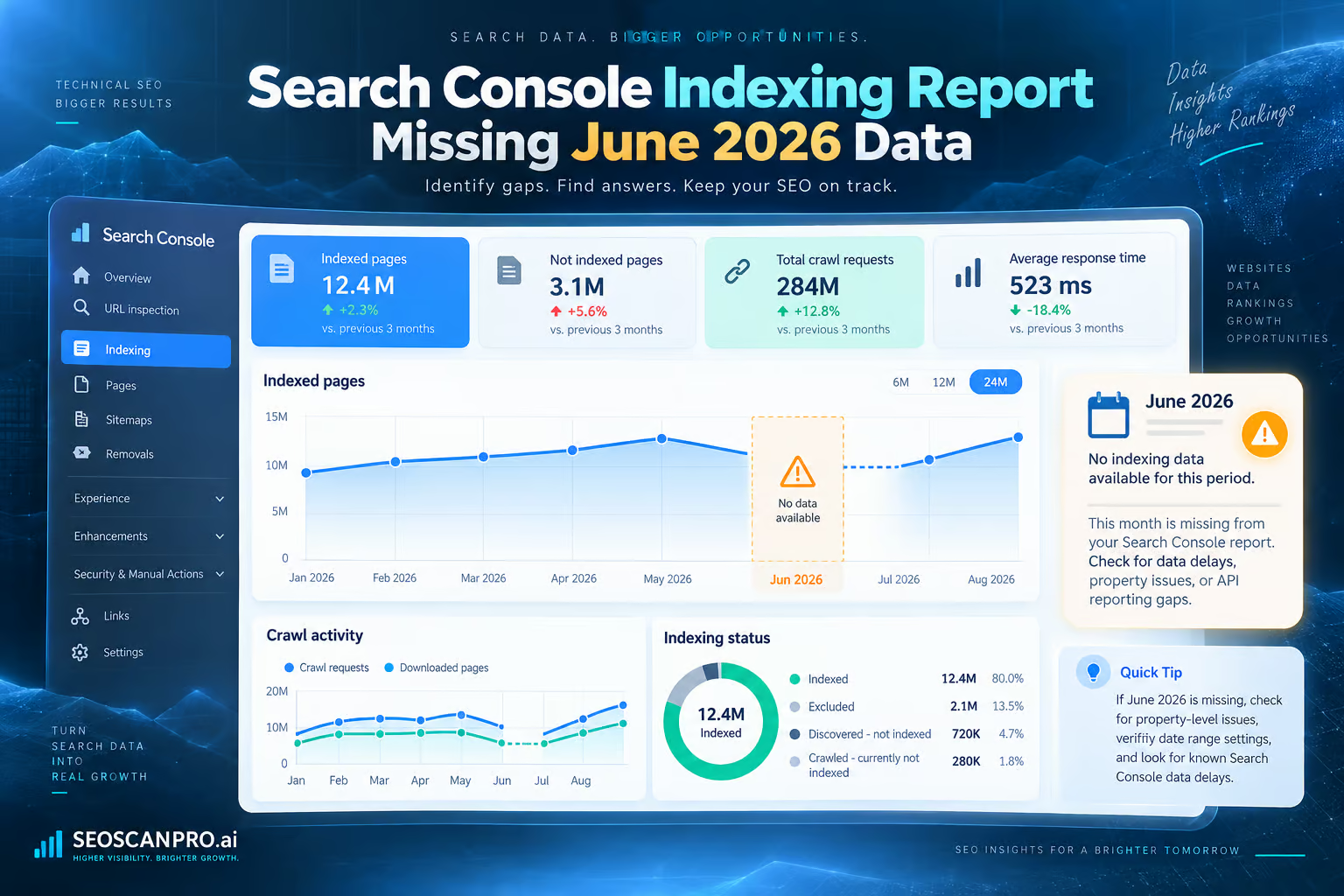
    Your pages are still indexed normally. The chart lost a chunk of June data that had been visible hours earlier, and the drop showed up across every Search Console property at once, so a gap on your account matches what everyone else is seeing.

    What changed in the indexing report?

    The same behavior appeared across multiple properties for the people who reported it, which points to a platform-wide reporting issue rather than a per-site problem.

    Why is the June data gone?

    This follows a pattern in the report. Reading the current gap as part of that reporting history, rather than as a sudden indexing failure, keeps the focus on the display layer instead of your actual index coverage.

    Was the performance report affected too?

    A working method to clear it: open a different report, such as Page Indexing, and then return to the Search Performance report, which restored normal loading. This spinner issue was harder to reproduce and appears separate from the missing June indexing data, though both surfaced on the same day.

    What should you do about it?

    Treat the missing June section as a data-availability gap and keep your normal checks running. For the days that are still reported, your index coverage numbers remain usable, and live indexing of new and updated pages continues regardless of the historical gap in the chart. If a report stalls with a spinner, switch reports and switch back before assuming a deeper fault.

    FAQ

    Is the missing June 2026 data a sign my pages were deindexed?

    It reflects the reporting layer, not the indexing of your pages.

    Will Google restore the missing June indexing data later?

    How do I fix the Search Performance report showing a loading spinner?

    Open another report, such as Page Indexing, and then return to the Search Performance report. Users found this cleared the spinning wheel and let the report load.

    Related coverage

  • The Dehumanization of SEO: Displaced by Code, Ignored by Communication

    The Dehumanization of SEO: Displaced by Code, Ignored by Communication

    People’s judgment, relationships, and clear communication still determine which SEO campaigns succeed, and these skills become more valuable as automation takes over routine tasks. SEO’s dehumanization names two pressures in the field today: automated systems and code replacing tasks specialists once did by hand, and a decline in professional communication that leaves practitioners unheard.

    What does the dehumanization of SEO mean?

    The phrase points to a shift in how search work gets done and how the people doing it are treated. On one side, scripts, platforms, and machine systems now handle tasks that once required a person: pulling reports, flagging technical errors, generating drafts, and monitoring rankings. On the other side, the humans behind the strategy are increasingly left out of decisions, updates, and basic replies. Work that used to depend on conversation and shared context now moves through dashboards and automated queues.

    When code takes over the visible work and communication becomes less frequent, the specialist’s contributions are harder to see and easier to dismiss.

    Where code is replacing hands-on SEO work

    The risk appears when the tooling replaces the person instead of supporting their judgment.

    A crawler can list broken links, but deciding which fixes matter for a specific business still calls for context. A model can produce a draft, but choosing what to say, who it addresses, and whether the content is accurate is a human task. The tasks that survive automation are the ones that still need people to interpret them, decide what matters, and stand behind the result.

    Why communication still decides SEO outcomes

    SEO typically fails because of multiple overlapping factors rather than one isolated technical cause. When messages go unanswered, decisions are made without the relevant specialist involved, or feedback goes unheard, the work drifts off course.

    Communication belongs to the technical work itself, and is not a separate layer added on top of it. Strategy gets agreed, changes get approved, and results get explained in terms a business can act on. A practitioner who can turn search data into a plain business decision may hold an edge that no automated report can match.

    How to keep the human element in SEO

    Both pressures call for the same approach: focus on scarce skills. Apply automation to repetitive tasks and use the time you recover for work that requires judgment, relationships, or explanation.

    • Treat tools as support for decisions, not substitutes for them. Keep a person accountable for what gets published and changed.
    • Protect direct communication with clients and teammates. A short, honest reply preserves trust that a queue cannot.
    • Focus your visible value on interpreting the data, explaining which numbers matter and what actions to take next.
    • Document the reasoning behind recommendations so the human logic stays part of the record.

    The specialists who stay in demand pair automation’s efficiency with the judgment and courtesy that people still expect from other people.

    FAQ

    What is the dehumanization of SEO?

    Two connected pressures are reshaping search work: automation is replacing tasks that specialists once did by hand, and weaker professional communication is excluding practitioners from decisions and updates.

    Will automation replace SEO professionals?

    Automation handles repetitive tasks such as reporting, error detection, and drafting, but it does not replace the judgment a person provides.

    Why does communication matter so much in SEO?

    The team agrees on strategy and explains results in business terms.

  • DuckDuckGo’s 30% Install Spike and the Search Fragmentation Signal for Site Owners

    DuckDuckGo’s 30% Install Spike and the Search Fragmentation Signal for Site Owners

    U.S. app installs for DuckDuckGo climbed as much as 30.5% in a single day during late May 2026, and iOS installs spiked nearly 70% on the peak day, according to figures the company shared covering May 20 through May 25. The driver was not a marketing campaign. Users were leaving Google after its annual developer conference rolled out AI-first changes to Search, and DuckDuckGo’s “no AI” search page became the clearest alternative on offer. For site owners running technical audits, the takeaway sits underneath the privacy framing: search behavior is splitting across multiple surfaces, and a one-engine playbook now leaves gaps.

    Why a 30% Spike on a Small Player Matters

    DuckDuckGo remains a minor player next to Google in U.S. search, and the company does not command a share that should trigger panic on its own. The number to watch is the direction, not the size. A measurable, sustained migration of users toward engines that allow them to switch AI off is the kind of structural shift that rewires where your next customer starts their query. Anyone who has watched a single traffic source decay year over year knows how quietly that loss compounds.

    The May 20 to May 25 window captured six straight days of growth, with a U.S. app install lift averaging 18.1% week over week against the prior week. On iOS specifically, average weekly install growth hit 33%, with a near-70% peak on the strongest day. Visits to DuckDuckGo’s AI-disabled search page grew 22.7% on average week over week, peaking on May 24. Founder and CEO Gabriel Weinberg tied the surge directly to users being “force-fed” AI features without a real opt-out, and to results he described as getting “worse, not better.” That language captures the friction, and friction is what drives switching.

    What Actually Changed in Google Search

    Google used its developer conference to push a sweeping overhaul that swaps the familiar list of blue links for AI-generated answers capable of summarizing information, completing tasks, and monitoring queries in the background. Critics have argued the AI-first design undercuts the open web by siphoning traffic away from the publishers and small businesses whose content the answers are built on. The technical audit implication is direct: when an answer engine responds without a click, the page that earned its information may never receive a visitor.

    AI Overviews now ship with follow-up chat prompts attached, which nudges even users who skip AI Mode toward a chatbot-shaped experience. The complaint is less that AI exists in search, and more that the AI surface has become hard to avoid. For site owners, that means the question of whether your content is cited inside an AI summary now competes with the older question of whether your page ranks in the classic results.

    How the Alternatives Position Themselves

    DuckDuckGo’s response was a dual play. The main app continues to grow, and the company actively promotes a dedicated “no AI” search page that disables AI-written summaries and synthetic image results by default, returning a deliberately traditional result set. That same product line still includes Duck.ai, a chatbot that routes to models from OpenAI, Anthropic, and Meta while stripping IP addresses, declining to permanently store chat histories, and refusing to use conversations for model training. The stance is control and privacy, not a blanket rejection of AI.

    Other engines are picking up traffic with different hooks:

    • Brave offers customizable result filters it calls Goggles, plus an AI on/off toggle.
    • Ecosia markets reforestation funding built into its search activity.
    • Startpage returns familiar Google results while acting as a privacy layer that does not hand over personal data.

    All three are Chromium-based, which lowers the switching cost for users because most Chrome extensions still carry over. Leaving Google no longer means abandoning a familiar toolchain, and that drop in friction is exactly what makes a fragmentation signal durable.

    What an Auditor Should Check Right Now

    If you run technical SEO audits, the install spike is a prompt to expand the surfaces you test, not a reason to abandon Google. A practical first pass covers four areas.

    Listing data consistency. Every alternative engine relies on the same underlying signals: business name, address, phone, hours, and category. Pull those fields and compare them across Google Business Profile, Apple Maps, Bing Places, Yelp, and the major data aggregators. Any mismatch becomes a candidate for incorrect answers in AI summaries or alternative SERPs.

    AI-contactability. As more queries resolve inside conversational agents, the test is whether an AI can actually surface and reach your business. Run queries that describe your service in natural language across ChatGPT, Perplexity, Google AI Overviews, and DuckDuckGo’s AI-assisted surfaces. Note which answers name your business, which cite your URL, and which return a competitor instead.

    Structured data coverage. Review your schema markup for Organization, LocalBusiness, Product, and FAQPage types. Engines that feed AI summaries lean heavily on structured data to ground their answers, so missing or inconsistent markup translates directly into missed citations.

    Brand presence across non-search surfaces. Fragmentation does not stop at search engines. Conversational agents pull from social profiles, review sites, and press coverage when forming answers. Confirm your profiles on the major platforms are active, consistent, and link back to a canonical domain.

    How to Read the Rest of 2026

    Expect the menu of alternatives to keep widening through 2026 rather than consolidating back into a single dominant surface. DuckDuckGo’s combined offering, an AI-free search page plus a privacy-first chatbot, points at the broader direction: the split is not “AI versus no AI.” It is user-controlled AI. Some visitors will ask a Google AI Overview. Some will type into DuckDuckGo’s classic results. A growing share will hand the question to a conversational agent and never visit a SERP at all.

    For site owners, that means the KPI discussion needs to widen. Raw click counts from one engine tell less of the story than they did two years ago, because zero-click answers and multi-surface discovery both pull weight. The businesses that hold up are the ones whose underlying data is clean enough that any surface, AI or classic, can find and represent them accurately.

    The Practical Takeaway

    DuckDuckGo’s install spike is small in absolute terms, but it is a leading indicator of a market that is splitting along user-controlled lines. The audit response is not to chase every new engine. It is to make the data about your business so clean, so consistent, and so well structured that any search surface can answer questions about you correctly. Optimize for being discoverable across the whole landscape, not for placement on a single company’s homepage.

    FAQ

    What did DuckDuckGo report about its U.S. app installs in May 2026?

    DuckDuckGo reported an average week-over-week increase of 18.1% in U.S. app installs for May 20 to May 25, 2026, with growth running for six straight days and peaking at a 30.5% increase on May 25. iOS installs grew an average of 33% week over week, peaking at nearly 70% on the strongest day.

    Why are users switching away from Google Search right now?

    Users are reacting to Google’s rollout of AI-first changes at its annual developer conference, including AI Overviews with follow-up chat prompts that make the experience feel like a chatbot. DuckDuckGo founder Gabriel Weinberg said users were being “force-fed” AI features without a meaningful opt-out and that results were getting “worse, not better.”

    Which search engines besides DuckDuckGo are gaining attention in 2026?

    Brave, Ecosia, and Startpage are all picking up attention. Brave offers customizable Goggles filters and an AI on/off toggle, Ecosia markets reforestation funding, and Startpage returns Google-style results without handing over personal data. All three are Chromium-based, which keeps most Chrome extensions working after a switch.