Category: SEO News

  • Google’s top ranking factors, according to 131 SEO professionals

    Google’s top ranking factors, according to 131 SEO professionals

    Search engine practitioners know where to focus their energy when they want stronger Google rankings, and a recent survey of 131 SEO professionals makes their playbook visible. The respondents weighed in on which ranking factors carry the most weight in Google’s algorithm, and the results line up closely with the signals Google itself has publicly confirmed.

    Understanding what experienced SEOs actually prioritize gives site owners a clearer view of which efforts move the needle and which ones can wait.

    What the survey covered

    The survey asked 131 SEO professionals to rank the Google ranking factors they consider most important. The goal was to map current practitioner consensus against the signals Google has confirmed influence organic rankings.

    Which factors came out on top

    The factors that ranked highest reflect a mix of content quality, technical health, and authority signals. The exact top factors identified were:

    • Content quality
    • Backlinks
    • Search intent matching
    • On-page SEO
    • Site speed and Core Web Vitals
    • E-E-A-T signals (Experience, Expertise, Authoritativeness, and Trustworthiness)
    • Mobile-friendliness
    • Internal linking
    • Structured data
    • Brand signals

    Content quality led the list, which matches Google’s long-running guidance that helpful, reliable, people-first content should be the foundation of any SEO strategy. Backlinks followed close behind, reflecting the role external links continue to play as endorsements of authority and trust.

    Search intent matching ranked highly as well, an area where many sites still struggle. Matching content to what users actually want when they type a query has become one of the clearest paths to stronger rankings.

    How these factors line up with Google’s guidance

    The top-ranked factors track closely with what Google has publicly confirmed as part of its ranking systems. Core Web Vitals, mobile-friendliness, structured data, and E-E-A-T are all signals Google has addressed directly in its documentation and developer guidance.

    This alignment matters because it turns practitioner consensus into a near-direct map of Google’s priorities. When 131 experienced SEOs independently rank the same signals that Google confirms, site owners get a practical shortlist of where to invest time and budget.

    What this means for site owners

    The survey gives site owners a clear signal: focus on the fundamentals that Google’s own systems are built to reward. Strong content, a healthy backlink profile, fast loading, mobile usability, and clear expertise signals remain the highest-leverage areas to work on.

    For teams trying to prioritize a backlog of SEO tasks, this list offers a practical starting point. The factors at the top are the ones with the broadest agreement among practitioners and the strongest confirmation from Google.

    FAQ

    What are the most important Google ranking factors?

    According to a survey of 131 SEO professionals, the most important Google ranking factors are content quality, backlinks, search intent matching, on-page SEO, site speed and Core Web Vitals, E-E-A-T signals, mobile-friendliness, internal linking, structured data, and brand signals.

    How many SEO professionals were surveyed?

    The survey collected responses from 131 SEO professionals who ranked the Google ranking factors they consider most important.

    Do these ranking factors match what Google has confirmed?

    Yes. The top factors identified by SEO professionals closely track the signals Google has publicly confirmed in its ranking systems and documentation, including content quality, Core Web Vitals, mobile-friendliness, structured data, and E-E-A-T.

    Related coverage


    This article summarizes reporting from searchengineland.com.

  • Google Search Console Indexing Report Missing June 2026 Data

    Google Search Console Indexing Report Missing June 2026 Data

    Your pages are still indexed normally: the blank stretch you may see in the Google Search Console indexing report for June 2026 comes from a reporting delay, not from anything happening to your site. The chart lost a chunk of June data that had been visible hours earlier, and the drop showed up across every Search Console property at once, so a gap on your account matches what everyone else is seeing.

    What changed in the indexing report?

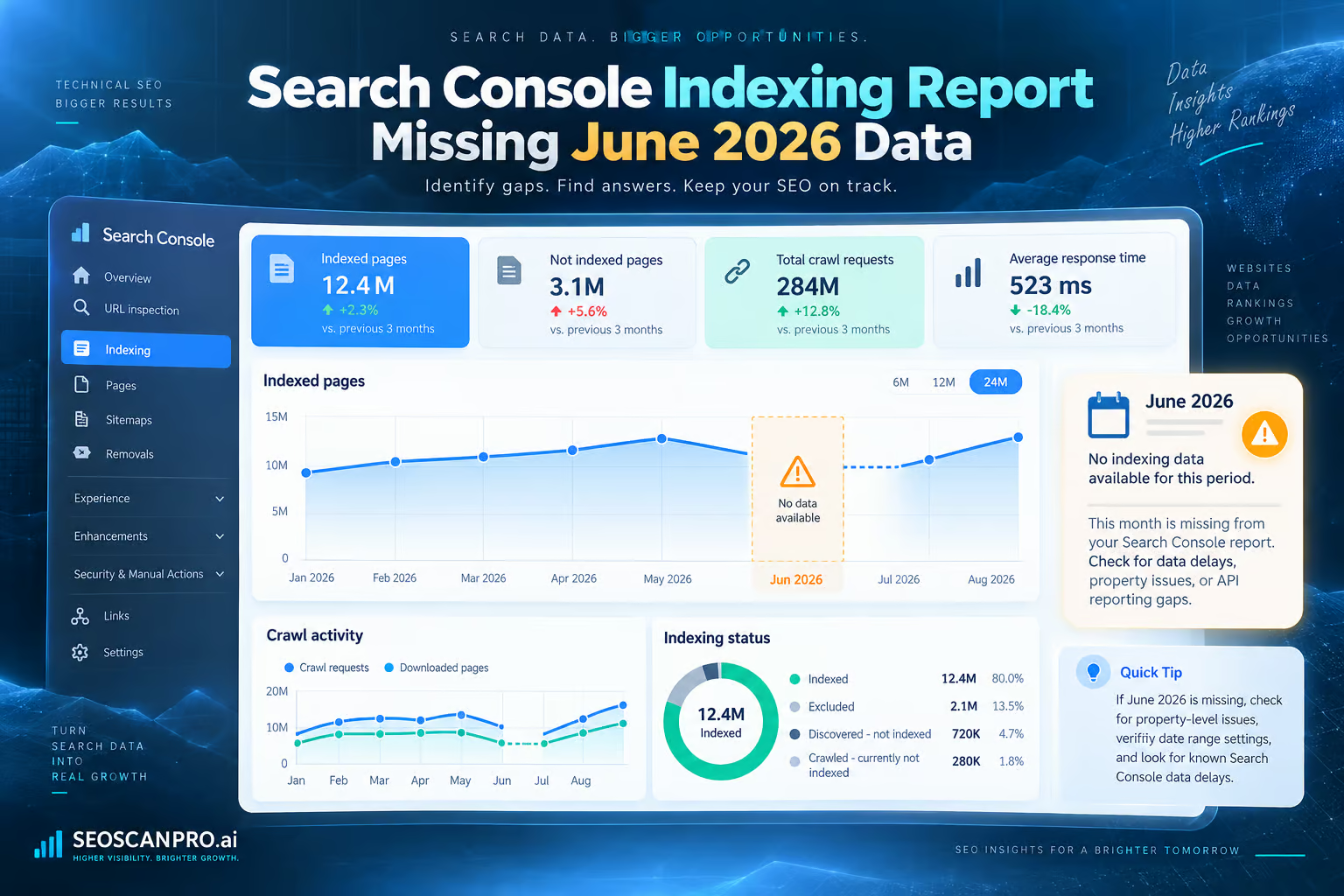
    On September 11, 2026, the page indexing report in Google Search Console dropped a large section of June 2026 data. Users compared screenshots showing the data present earlier in the day and absent a few hours later, with the missing portion sitting on the left side of the chart. The same behavior appeared across multiple properties for the people who reported it, which points to a platform-wide reporting issue rather than a per-site problem.

    Why is the June data gone?

    Google explained that the gap traces back to a period in June when the data was delayed. During that window the page indexing report was not updated, so there simply is no data recorded for those days. Google also stated that it does not backfill indexing data, meaning the empty section is expected to stay empty rather than repopulate later. Google added that it would confirm the details with the team once staff returned from holidays.

    This follows a pattern in the report. Earlier in the same week, Search Console had an indexing reporting glitch that lasted a few hours, and the report has had frequent delays over the past several months. Reading the current gap as part of that reporting history, rather than as a sudden indexing failure, keeps the focus on the display layer instead of your actual index coverage.

    Was the performance report affected too?

    Around the same time, the Search Performance report was also behaving unusually, showing a persistent loading spinner for some users. A working method to clear it: open a different report, such as Page Indexing, and then return to the Search Performance report, which restored normal loading. This spinner issue was harder to reproduce and appears separate from the missing June indexing data, though both surfaced on the same day.

    What should you do about it?

    Treat the missing June section as a data-availability gap and keep your normal checks running. Because Google does not backfill indexing data, waiting for that specific June range to return is not a productive plan. For the days that are still reported, your index coverage numbers remain usable, and live indexing of new and updated pages continues regardless of the historical gap in the chart. If a report stalls with a spinner, switch reports and switch back before assuming a deeper fault.

    FAQ

    Is the missing June 2026 data a sign my pages were deindexed?

    No. Google attributed the gap to a June period when report data was delayed and never written, so there is no data to display for those days. It reflects the reporting layer, not the indexing of your pages.

    Will Google restore the missing June indexing data later?

    Google stated that it does not backfill indexing data, so the empty section is not expected to repopulate. Google said it would verify the specifics with its team.

    How do I fix the Search Performance report showing a loading spinner?

    Open another report, such as Page Indexing, and then return to the Search Performance report. Users found this cleared the spinning wheel and let the report load.

    Related coverage


    This article summarizes reporting from seroundtable.com.

  • The Dehumanization of SEO: Displaced by Code, Ignored by Communication

    The Dehumanization of SEO: Displaced by Code, Ignored by Communication

    The judgment, relationships, and clear communication that people bring to SEO still decide which campaigns succeed, and those skills grow more valuable as automation absorbs the routine tasks. The dehumanization of SEO describes two pressures felt across the field right now: automated systems and code taking over work that specialists used to do by hand, and a steady breakdown in professional communication that leaves practitioners overlooked. Naming both pressures is the first step to protecting the part of the work that machines cannot copy.

    What does the dehumanization of SEO mean?

    The phrase points to a shift in how search work gets done and how the people doing it are treated. On one side, scripts, platforms, and machine systems now handle tasks that once required a person: pulling reports, flagging technical errors, generating drafts, and monitoring rankings. On the other side, the humans behind the strategy are increasingly left out of decisions, updates, and basic replies. Work that used to depend on conversation and shared context now moves through dashboards and automated queues.

    Both trends push in the same direction. When code handles the visible output and communication thins out, the specialist’s contribution becomes harder to see, and easier to discount.

    Where code is replacing hands-on SEO work

    Automation has real value. It removes repetitive steps, catches errors at scale, and frees time for higher-level thinking. The risk appears when the tooling is treated as a full replacement for the person rather than support for their judgment.

    A crawler can list broken links, but deciding which fixes matter for a specific business still calls for context. A model can produce a draft, but choosing what to say, who it serves, and whether it is accurate remains a human responsibility. The tasks that survive automation are the ones that require interpretation, prioritization, and accountability. Those are the skills worth protecting and sharpening.

    Why communication still decides SEO outcomes

    SEO rarely fails on a single technical detail. It fails when the people involved stop talking to each other. Clients, developers, writers, and strategists each hold a piece of the picture, and results depend on those pieces connecting. When messages go unanswered, when decisions are made without the specialist in the room, and when feedback disappears, the work drifts.

    Clear communication is not a soft extra layered on top of the technical work. It is how strategy gets agreed, how changes get approved, and how results get explained in terms a business can act on. A practitioner who can translate search data into a plain decision holds an advantage that no automated report replicates.

    How to keep the human element in SEO

    The response to both pressures is the same: lead with the skills that stay scarce. Use automation for the repetitive load, then spend the reclaimed time on judgment, relationships, and explanation.

    • Treat tools as support for decisions, not substitutes for them. Keep a person accountable for what gets published and changed.
    • Protect direct communication with clients and teammates. A short, honest reply preserves trust that a queue cannot.
    • Focus your visible value on interpretation: which numbers matter, what they mean, and what to do next.
    • Document the reasoning behind recommendations so the human logic stays part of the record.

    The specialists who stay in demand are the ones who pair the efficiency of automation with the judgment and courtesy that people still expect from other people.

    FAQ

    What is the dehumanization of SEO?

    It refers to two connected pressures in search work: automated systems and code taking over tasks that specialists once performed by hand, and a decline in professional communication that leaves practitioners left out of decisions and updates.

    Will automation replace SEO professionals?

    Automation handles repetitive tasks such as reporting, error detection, and drafting, but it does not replace the judgment, prioritization, and accountability a person provides. The work that requires interpretation and decision making stays with people.

    Why does communication matter so much in SEO?

    Results depend on clients, developers, writers, and strategists connecting their separate pieces of knowledge. When replies stop and specialists are excluded from decisions, the work drifts. Clear communication is how strategy gets agreed and how results get explained in business terms.


    This article summarizes reporting from searchengineland.com.

  • DuckDuckGo’s 30% Install Spike and the Search Fragmentation Signal for Site Owners

    DuckDuckGo’s 30% Install Spike and the Search Fragmentation Signal for Site Owners

    U.S. app installs for DuckDuckGo climbed as much as 30.5% in a single day during late May 2026, and iOS installs spiked nearly 70% on the peak day, according to figures the company shared covering May 20 through May 25. The driver was not a marketing campaign. Users were leaving Google after its annual developer conference rolled out AI-first changes to Search, and DuckDuckGo’s “no AI” search page became the clearest alternative on offer. For site owners running technical audits, the takeaway sits underneath the privacy framing: search behavior is splitting across multiple surfaces, and a one-engine playbook now leaves gaps.

    Why a 30% Spike on a Small Player Matters

    DuckDuckGo remains a minor player next to Google in U.S. search, and the company does not command a share that should trigger panic on its own. The number to watch is the direction, not the size. A measurable, sustained migration of users toward engines that allow them to switch AI off is the kind of structural shift that rewires where your next customer starts their query. Anyone who has watched a single traffic source decay year over year knows how quietly that loss compounds.

    The May 20 to May 25 window captured six straight days of growth, with a U.S. app install lift averaging 18.1% week over week against the prior week. On iOS specifically, average weekly install growth hit 33%, with a near-70% peak on the strongest day. Visits to DuckDuckGo’s AI-disabled search page grew 22.7% on average week over week, peaking on May 24. Founder and CEO Gabriel Weinberg tied the surge directly to users being “force-fed” AI features without a real opt-out, and to results he described as getting “worse, not better.” That language captures the friction, and friction is what drives switching.

    What Actually Changed in Google Search

    Google used its developer conference to push a sweeping overhaul that swaps the familiar list of blue links for AI-generated answers capable of summarizing information, completing tasks, and monitoring queries in the background. Critics have argued the AI-first design undercuts the open web by siphoning traffic away from the publishers and small businesses whose content the answers are built on. The technical audit implication is direct: when an answer engine responds without a click, the page that earned its information may never receive a visitor.

    AI Overviews now ship with follow-up chat prompts attached, which nudges even users who skip AI Mode toward a chatbot-shaped experience. The complaint is less that AI exists in search, and more that the AI surface has become hard to avoid. For site owners, that means the question of whether your content is cited inside an AI summary now competes with the older question of whether your page ranks in the classic results.

    How the Alternatives Position Themselves

    DuckDuckGo’s response was a dual play. The main app continues to grow, and the company actively promotes a dedicated “no AI” search page that disables AI-written summaries and synthetic image results by default, returning a deliberately traditional result set. That same product line still includes Duck.ai, a chatbot that routes to models from OpenAI, Anthropic, and Meta while stripping IP addresses, declining to permanently store chat histories, and refusing to use conversations for model training. The stance is control and privacy, not a blanket rejection of AI.

    Other engines are picking up traffic with different hooks:

    • Brave offers customizable result filters it calls Goggles, plus an AI on/off toggle.
    • Ecosia markets reforestation funding built into its search activity.
    • Startpage returns familiar Google results while acting as a privacy layer that does not hand over personal data.

    All three are Chromium-based, which lowers the switching cost for users because most Chrome extensions still carry over. Leaving Google no longer means abandoning a familiar toolchain, and that drop in friction is exactly what makes a fragmentation signal durable.

    What an Auditor Should Check Right Now

    If you run technical SEO audits, the install spike is a prompt to expand the surfaces you test, not a reason to abandon Google. A practical first pass covers four areas.

    Listing data consistency. Every alternative engine relies on the same underlying signals: business name, address, phone, hours, and category. Pull those fields and compare them across Google Business Profile, Apple Maps, Bing Places, Yelp, and the major data aggregators. Any mismatch becomes a candidate for incorrect answers in AI summaries or alternative SERPs.

    AI-contactability. As more queries resolve inside conversational agents, the test is whether an AI can actually surface and reach your business. Run queries that describe your service in natural language across ChatGPT, Perplexity, Google AI Overviews, and DuckDuckGo’s AI-assisted surfaces. Note which answers name your business, which cite your URL, and which return a competitor instead.

    Structured data coverage. Review your schema markup for Organization, LocalBusiness, Product, and FAQPage types. Engines that feed AI summaries lean heavily on structured data to ground their answers, so missing or inconsistent markup translates directly into missed citations.

    Brand presence across non-search surfaces. Fragmentation does not stop at search engines. Conversational agents pull from social profiles, review sites, and press coverage when forming answers. Confirm your profiles on the major platforms are active, consistent, and link back to a canonical domain.

    How to Read the Rest of 2026

    Expect the menu of alternatives to keep widening through 2026 rather than consolidating back into a single dominant surface. DuckDuckGo’s combined offering, an AI-free search page plus a privacy-first chatbot, points at the broader direction: the split is not “AI versus no AI.” It is user-controlled AI. Some visitors will ask a Google AI Overview. Some will type into DuckDuckGo’s classic results. A growing share will hand the question to a conversational agent and never visit a SERP at all.

    For site owners, that means the KPI discussion needs to widen. Raw click counts from one engine tell less of the story than they did two years ago, because zero-click answers and multi-surface discovery both pull weight. The businesses that hold up are the ones whose underlying data is clean enough that any surface, AI or classic, can find and represent them accurately.

    The Practical Takeaway

    DuckDuckGo’s install spike is small in absolute terms, but it is a leading indicator of a market that is splitting along user-controlled lines. The audit response is not to chase every new engine. It is to make the data about your business so clean, so consistent, and so well structured that any search surface can answer questions about you correctly. Optimize for being discoverable across the whole landscape, not for placement on a single company’s homepage.

    FAQ

    What did DuckDuckGo report about its U.S. app installs in May 2026?

    DuckDuckGo reported an average week-over-week increase of 18.1% in U.S. app installs for May 20 to May 25, 2026, with growth running for six straight days and peaking at a 30.5% increase on May 25. iOS installs grew an average of 33% week over week, peaking at nearly 70% on the strongest day.

    Why are users switching away from Google Search right now?

    Users are reacting to Google’s rollout of AI-first changes at its annual developer conference, including AI Overviews with follow-up chat prompts that make the experience feel like a chatbot. DuckDuckGo founder Gabriel Weinberg said users were being “force-fed” AI features without a meaningful opt-out and that results were getting “worse, not better.”

    Which search engines besides DuckDuckGo are gaining attention in 2026?

    Brave, Ecosia, and Startpage are all picking up attention. Brave offers customizable Goggles filters and an AI on/off toggle, Ecosia markets reforestation funding, and Startpage returns Google-style results without handing over personal data. All three are Chromium-based, which keeps most Chrome extensions working after a switch.