Category: Local SEO

  • How Google’s New AI Search Box Changes What Your Local Listings Must Show

    How Google’s New AI Search Box Changes What Your Local Listings Must Show

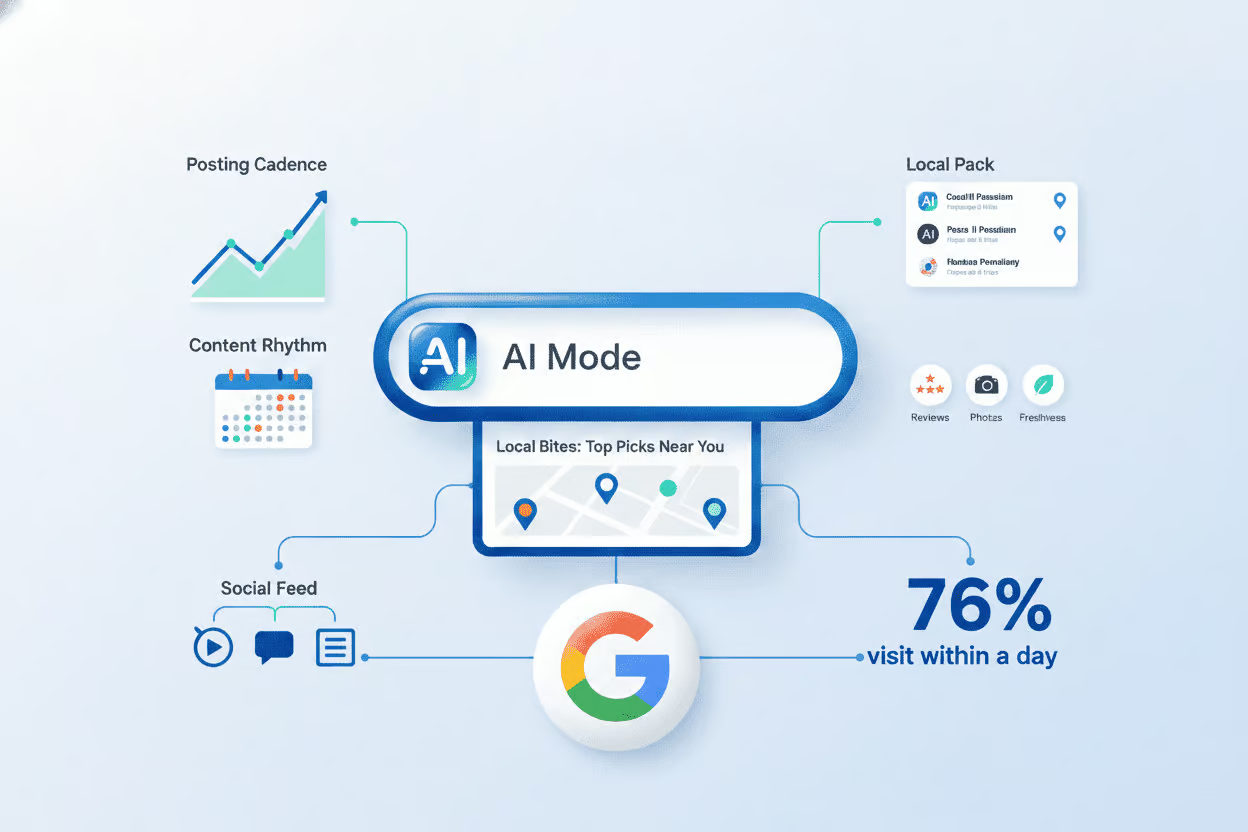
    Google has rolled out a redesigned AI-first search input that routes longer, conversational queries directly into AI Mode, bypassing the traditional ten-link results page. Layered on top of expanded local sponsorship inventory inside AI answers and fresh data showing review recency now outweighing raw star count, the change tightens the criteria for which businesses AI surfaces by name. Operators auditing their own pages have roughly a 30-day window to close the structured-data and review-velocity gaps that the new surface reads as disqualifying.

    What actually changed on the search results page?

    Three shifts are stacking on top of each other, and each one shifts the goalposts for what an audit should look for.

    The new AI search input

    The redesigned input field treats natural-language queries such as "best brunch spot near me that doesn't take reservations" as the default, then hands them to AI Mode rather than the classic blue-link SERP. The response is typically a synthesized paragraph that names two or three businesses. Selection is driven by review signals, listing completeness, and structured attributes pulled from the Google Business Profile. A thin profile is filtered out before the user ever sees an option list.

    Local sponsorship slots are growing, and they are gated by listing quality

    Google is testing more paid placements inside the local pack and inside AI answers themselves. Bid is no longer the only gate. Categories, hours, services, photos, and review velocity now feed into whether a paid local slot is eligible to compete. A sparse profile cannot outbid its way into a slot the way it could in 2024.

    Review recency is pulling more weight than star count

    The review-ROI data point that changed most sharply is the relative weight of recency. A 4.6-star business with 80 reviews in the last 90 days will routinely outrank a 4.9-star business whose last review came in six months ago. Response rate, especially owner responses inside a 24-hour window, now travels with the review as a paired signal.

    What should an audit actually verify?

    If you run technical SEO or local SEO work for service businesses, the audit checklist needs to track the signals AI Mode reads, not just the signals the classic local pack used to read.

    Listing completeness, field by field

    Treat empty fields as AI-visible negatives. Audits should confirm that the following are populated and current: a primary category plus every relevant secondary category, every applicable service or product with a description, complete hours including holiday and special hours, photos refreshed at least quarterly, weekly Google Posts, full attributes such as wheelchair access and accepted payment methods, and a website URL whose NAP matches the Business Profile line for line.

    Review velocity and response discipline

    Pull the last 90 days of reviews and the corresponding owner response timestamps. Anything older than six months without a fresh review is a flag for the auditor to surface. Target a steady cadence, roughly five new reviews per week with a 24-hour response window on every one. The recency and response pattern is what AI reads as authority, not the headline star average.

    Citation-graph NAP consistency

    Audit the top citation sources for the business's category and confirm name, address, and phone match exactly. Inconsistent NAP across the citation graph is interpreted as ambiguous entity data, which makes AI systems less willing to surface the business by name.

    Structured data on the linked website

    The Business Profile points at a website. That site needs LocalBusiness or its more specific subtype schema, with the same NAP, hours, services, and aggregate rating properties populated. An AI system that can read the profile but cannot read a matching website gets a weaker confidence signal and may skip the listing.

    What do the supporting numbers say?

    These are the figures worth pinning inside the audit report so the operator sees what is at stake:

    • 76% of users who search for something nearby visit a related business within 24 hours (Think with Google).
    • 87% of consumers read online reviews for local businesses in 2025, up from 81% the year before (BrightLocal Local Consumer Review Survey).
    • Reviews under 90 days old carry more weight in the local pack's ranking mix than reviews older than a year.
    • Analyst forecasts project more than 40% of local queries will surface inside an AI-generated answer by the end of 2026.
    • Businesses with complete Google Business Profiles, covering categories, attributes, hours, services, products, and posts, are 2.7x more likely to be selected as a top result inside AI Overviews.

    What should change in the next 30 days?

    Run a baseline scan against the top three local competitors

    Compare category coverage, attribute completeness, post cadence, photo freshness, and review velocity side by side. The competitor with the cleaner profile usually wins the AI answer even when the headline star rating looks worse.

    Check whether third-party AI surfaces can find the business by name

    Ask ChatGPT, Perplexity, and Gemini directly for "best [category] in [city]" and see whether the business appears. If it does not, the gap is usually structured-data related, and paid spend will not fix it.

    Stand up a weekly review and response cadence

    Move away from one-off email blasts. Set a weekly floor, five new reviews and a 24-hour owner response on every one. Document the cadence so the auditor can show trend lines in the next report.

    Refresh posts, photos, and attributes quarterly

    Posts feed the freshness signal directly. Photos older than a year read as stale to both users and AI systems. Attributes that were never set are read by AI as the business not offering that service, not as missing data.

    What is still emerging?

    Three trends to monitor over the next two quarters:

    • AI Mode is expected to default on for more query types, including local intent, which will push more outcomes toward zero-click answers resolved inside the search surface.
    • Google will likely add clearer attribution columns in Performance Max and Local Services Ads dashboards as paid local slots multiply inside AI answers.
    • Third-party review platforms are under pressure to feed structured data into Google's AI surfaces, while first-party review tools that push directly to a Google Business Profile are gaining emphasis.

    The throughline across all three shifts is that local discovery is being rebuilt around AI. Businesses whose listing data is clean enough for an AI to confidently name them will be surfaced; the rest will be filtered out before a user ever sees an options list, and the operator will have no signal that the filter happened.

    FAQ

    What is Google's new AI search box and how is it different from AI Overviews?

    The new AI search box is a redesigned input field that defaults longer, conversational queries into Google's AI Mode rather than the traditional ten-link results page. AI Overviews are the summarized answers that appear at the top of conventional results, while the AI search box is the entry point that increasingly routes users away from that view. For local queries, a single conversational answer may name two or three businesses based on structured listing data, review signals, and recency.

    Do recent reviews matter more than overall star rating for local rankings?

    Yes. Recency and response rate carry increasing weight in local ranking algorithms, often more than raw star count. A business with a 4.6 average and 80 reviews collected in the last 90 days will frequently outrank a 4.9-rated competitor whose last review came in six months ago. Google rewards a steady, recent stream of authentic reviews paired with timely owner responses, typically within 24 hours.

    What belongs in a complete Google Business Profile for AI search?

    A profile structured for AI consumption includes a primary and all relevant secondary categories, every applicable service or product with a description, complete hours including holiday and special hours, up-to-date photos refreshed quarterly, weekly Google Posts, full attributes such as wheelchair access and payment methods, a website URL with consistent NAP, and an active review collection and response routine. Empty fields are interpreted by AI systems as the business not offering that service, not as missing data.


  • Google Posts as a Local SEO Audit Signal: What Site Owners Should Check

    Google Posts as a Local SEO Audit Signal: What Site Owners Should Check

    Google Business Profile Posts are one of the clearest activity signals a local business can control, and they show up in the profile itself on Google Search and Maps. Yet many listings sit dormant for weeks, leaving a measurable gap in profile health. Listings that publish weekly Posts tend to score higher on local profile grading tools than identical listings that never publish, even when name, address, and phone (NAP), reviews, and categories match.

    What counts as a Google Post

    A Google Post is a free, short update that attaches directly to a Google Business Profile. Posts support an image or short video, up to 1,500 characters of text, and a call to action button such as Book, Order, or Call. Posts render in the profile carousel and, depending on type, in other surfaces across Search and Maps.

    Why Posts matter when you audit a local listing

    When grading a profile, several activity signals overlap with Post publishing:

    • Recency. An active Post tells Google the business is still operating and paying attention to its listing.
    • Engagement. Clicks and views on Posts feed back into profile quality metrics.
    • Content depth. Each Post adds indexed text and media to the listing, broadening the keyword footprint.
    • CTA usage. Posts with action buttons create direct conversion paths from the profile.
    • Format variety. Mixing image, video, and Offer Posts widens what the profile can surface.

    For a site owner, the takeaway is simple: Posts are a low-cost lever that touches multiple audit categories at once.

    Audit checklist: what to measure on your own profile

    Open the Posts tab in the Google Business Profile dashboard and run through these checks:

    1. Last publish date. If nothing has been posted in the last 14 days, the profile is decaying.
    2. CTA presence. Every Post should carry a call to action. Missing buttons waste conversion potential.
    3. Format mix. The profile should include Update, Offer, and Event Posts across the month, not a single format on repeat.
    4. Preview readability. The first line must deliver the value, since Google truncates previews around 80 to 100 characters.
    5. Video presence. At least some Posts should carry a short video clip.

    Any weak answer here is a fix that costs zero ad spend.

    What a healthy posting cadence looks like

    Update Posts carry a roughly 7-day visible shelf life before they get demoted in the carousel. Weekly publishing keeps a fresh Post in the primary slot, which is what most searchers actually see. Treat the cadence as a recurring task, not a one-time setup.

    Two tools inside the GBP dashboard make the habit sustainable:

    • Schedule This Post lets you batch a full month of content in one sitting.
    • Set On Repeat handles recurring items such as happy hour specials, weekly class schedules, or seasonal hours without re-entry.

    Matching Post type to goal

    Different Post types serve different conversion purposes:

    • Offer Posts get a colored ribbon and a conversion button, making them the strongest driver of action.
    • Event Posts surface in event-style results around the relevant date.
    • Update Posts work best for evergreen news, announcements, or general visibility.

    A diverse monthly mix outperforms a single-format strategy in profile scoring because it covers more surfaces and use cases.

    Writing Posts that survive the preview cut

    Searchers see roughly the first 80 to 100 characters of a Post before the rest is hidden behind an expand control. If that opening line is a greeting like “Hi everyone, happy Monday,” the actual offer never shows in the preview. Lead with concrete value: a price, a deadline, or a benefit. Examples that survive the cut include a discount window, a service highlight, or a clear availability statement.

    Video Posts: short clips beat polished productions

    Short video clips under 30 seconds consistently outperform longer, produced videos on profile engagement. A 20-second look at the team, the storefront, or a finished project gives searchers a vibe check. Polished long-form video tends to feel out of place in the Post carousel and rarely gets finished.

    Multi-location operations: publishing at scale

    For brands running several locations, the Copy The Update feature inside the GBP dashboard pushes one Post to every profile in a single action. For franchises, healthcare groups, and home service brands, this turns a 30-minute per-location task into a roughly 30-second task and keeps every location’s profile scoring well. The audit rule still applies: every location needs its own last-publish-date check, because a missed refresh on one profile drags the group average down.

    Where Posts fit in a broader audit

    Posts are one of several activity signals in a local listing audit. They pair naturally with:

    • NAP consistency across citations and the website.
    • Review velocity and response rate on the profile.
    • Category completeness and primary category accuracy.
    • Q&A activity on the profile.
    • Photo freshness in the profile gallery.

    Posts are often the cheapest of these to fix, which is why they are a strong starting point when an audit surfaces multiple weak signals.

    FAQ

    How often should a business publish Google Posts?

    At least once per week. Update Posts have a roughly 7-day visible shelf life in the carousel, so weekly publishing keeps fresh content in the primary slot searchers see.

    What is the character limit on a Google Post preview?

    Google truncates Post previews at roughly 80 to 100 characters. The opening line must carry the value, such as a discount or deadline, instead of a greeting.

    Can multi-location brands publish the same Post everywhere?

    Yes. The Copy The Update feature inside the Google Business Profile dashboard publishes one Post to every location profile in a single action.

  • Gemma 4 and OpenClaw: What Free Self-Hosted AI Means for Your Local Listing Audits

    Gemma 4 and OpenClaw: What Free Self-Hosted AI Means for Your Local Listing Audits

    On April 2, 2026, Google released Gemma 4 under the Apache 2.0 license, and the open-source OpenClaw framework sits beside it as a free agent layer. Together, the two let a single operator or a multi-location brand run a full local listing audit on hardware they own, with no per-token charges and no commercial restrictions. For SEO auditors, this changes what a routine citation check, NAP sweep, or competitor pack score can cost to run.

    What changed in the Gemma 4 release

    Gemma 4 is an open-weight model family, and the license is the headline. Earlier Gemma versions shipped under a restrictive custom license; Apache 2.0 lets any individual or company download the weights, run them on their own hardware, and use the output commercially. No usage caps, no royalties, no required telemetry back to Google.

    The release includes four model sizes. The 31B variant ranks third on the LMArena leaderboard among open models and outperforms some models with up to 20 times more parameters. For auditing work, that means a single mid-range GPU can handle a full pass over citation sources, review text, and structured data without falling back to a cloud API.

    Where OpenClaw fits, and what it is not

    OpenClaw is a separate project, not a Google product, and Google did not make it free. OpenClaw is an open-source framework for building and running autonomous agents that can crawl pages, call APIs, compare records, and chain those steps into a workflow. A model alone answers questions; an agent takes action across a pipeline. Gemma 4 supplies the reasoning, OpenClaw supplies the plumbing.

    The pairing is economic rather than corporate. A free local model plus a free agent framework, both running on hardware the operator controls, replaces work that previously required a paid cloud subscription. For an auditor running the same checks across hundreds of client locations, the variable cost line item for inference essentially disappears once the hardware is in place.

    Why the token tax matters for an audit workflow

    Per-call pricing on proprietary models is the hidden bill in any agentic workflow. A real listing audit pulls a long context: dozens of citation pages, review corpora, schema markup, GBP fields, and a competitor set. Each step costs tokens. Multiply that across every location a multi-site operator manages and the invoice is unpredictable, especially during a quarterly deep audit.

    Self-hosting converts that variable line into a fixed hardware cost. The model runs on a machine the auditor already owns, so the cost per audit trends toward zero once the box is paid for. For a solo practitioner, that is the difference between a flat monthly tool and surprise overages every time a full citation crawl runs. For a platform, it is the difference between premium pricing and a free score for every operator in a market.

    Which audit tasks the stack can now run locally

    Put the model and the agent together and the checks that drive local pack visibility become cheap to repeat. The practical targets for an SEO audit include:

    • NAP consistency across citation sources. The agent crawls Yelp, YellowPages, Bing Places, Apple Maps, Facebook, Foursquare, BBB, and chamber directories, then flags every mismatch on business name, address, phone, suite number, or hours.
    • Review theme and sentiment analysis. Gemma 4 clusters reviews by recurring themes such as slow service, staff friendliness, parking, or pricing, so the audit report can rank the complaints dragging down star averages and the compliments worth amplifying in owner replies.
    • Local pack competitor scoring. The agent pulls the top three to five competitors ranking in the local pack and scores their GBP fields, categories, and citation footprint against the audited business, so the gap is measured on the same axes for both sides.
    • GBP field optimization. Categories, services, attributes, photos, posts, and Q and A entries get checked against high-performing competitors in the same vertical and city, producing a prioritized fix list instead of a generic improvement note.
    • Schema and on-page citation audits. The agent validates LocalBusiness schema, hours markup, geo coordinates, and the NAP block on the homepage against the Google Business Profile record, catching silent drift between the site and the profile.

    What changes for regulated local businesses

    Because the inference happens on the auditor’s own hardware, customer data, revenue figures, and internal notes never leave the machine doing the work. That detail matters for healthcare practices, law firms, accounting offices, and other regulated local businesses that previously could not route sensitive operational data through a third-party model. A self-hosted audit pipeline is compliant by default for that category of client for the first time, which broadens the addressable market for any agency offering listing audits.

    What to verify on a site before adopting the stack

    For an SEO auditor evaluating whether a self-hosted Gemma 4 and OpenClaw setup is worth standing up, the practical checklist starts with the pages and signals that drive local pack placement:

    • Confirm the NAP block on the homepage matches the Google Business Profile record to the character, including suite numbers and abbreviated street suffixes.
    • Validate LocalBusiness JSON-LD against the live profile: hours, geo coordinates, and the same address string.
    • Pull a citation sample of the 50 most common sources for the vertical and country, and diff every field rather than just the business name.
    • Extract the last 100 reviews per platform and group by theme before writing the optimization plan; review counts alone miss the issues that drive star movement.
    • Score the top three to five local pack competitors on the same axes so the report shows rank gaps rather than absolute scores.

    These are the same checks an auditor would run through a paid tool today. With the model and the agent hosted locally, the marginal cost of running them weekly rather than quarterly drops to near zero.

    FAQ

    Is OpenClaw a Google product?

    No. OpenClaw is a separate, open-source, self-hosted platform for building autonomous AI agents. Google did not create it or release it, and the pairing with Gemma 4 is an economic match between two free projects, not a corporate one.

    Why does the Apache 2.0 license on Gemma 4 matter for local SEO work?

    Earlier Gemma versions used a restrictive custom license that limited commercial use. Apache 2.0 lets any small business, agency, or tool vendor download the weights, run them on their own hardware, and use the output commercially with no per-token charges.

    Which listing audit tasks can Gemma 4 plus OpenClaw actually automate?

    The stack can crawl 50 or more citation sources to flag NAP mismatches, cluster reviews by recurring themes, score the top three to five local pack competitors on the same axes, audit Google Business Profile fields against high-performing peers, and verify LocalBusiness schema plus hours markup against the live GBP record.