

You can hand search engines a schema.org file and still miss the queries that matter, because the entities your markup names can differ from the entities a search engine’s natural language processing actually recognizes. A structured entity audit closes that gap by mapping your marked-up entities against the entities the search engine associates with your content, producing a content roadmap built from the differences it surfaces.
Why schema alone does not guarantee understanding
Structured data gives machines a labelled view of your brand: who you are, what you offer, where you operate, and how your pages relate. It is a definition, not a guarantee of recognition, so Google’s natural language processing can still interpret your content, your competitors, and the wider web in ways that differ from the labels you picked.
The differences show up as topics your schema does not label but your audience queries, concepts your pages mention without a typed `sameAs` or `relatedTo` link, and queries where neither you nor your competitors surface because no one’s graph connects the entities. Treating schema as the finish line means the audit never gets built.
What an entity audit actually does
An entity audit treats your existing schema as the raw material for a small knowledge graph, then asks the search engine the same questions to see where its answers diverge. The comparison exposes three useful things at once: the entities you cover that competitors do not, the entities competitors cover that you do not, and the entities neither of you are clearly associated with yet.
Building it does not require a new platform. The standard approach uses schema.org markup already on the site, the Google Cloud Natural Language API to extract entities from your pages and from competing pages, and an agentic coding tool to script the comparison. Antigravity, Claude Code, and Codex are examples of coding agents that can run the queries and shape the resulting graph. The output is a queryable knowledge graph that an SEO team can filter by entity type, by coverage gap, or by competitor.
Turning the gap into a content plan
Findings turn into pages, not just lists, when each gap gets matched to a format the entity fits.
- Create content around under-recognized entities. The audit’s entity gap list flags concepts your brand should be associated with but is not; new or refreshed pages addressing each flagged concept build the topical surface that search and AI engines need to make the connection.
- Strengthen existing connections with structured data and internal links. Schema, anchor text, and on-page mentions all reinforce the same entity relationships. When they agree, NLP has more to work with.
- Make pages more retrievable and citable across search and AI engines. Clean structure, consistent entity references, and direct answers to the specific questions an audience searches for raise the chance that a page is the one an engine pulls into a generated response.
Measuring progress over time
An audit is most useful when it runs more than once. Re-running the same comparison on a schedule turns entity coverage from a one-off project into a tracked signal. Teams can watch as previously under-recognized entities get picked up, see which content moves moved the needle, and spot new gaps as competitors publish. The result is a repeatable measure of how well search engines and AI systems actually understand what the brand does, separate from how well the brand thinks it has explained itself.
For teams that want to see this kind of coverage at the keyword and page level across a whole site, a technical audit tool that reports the measured result behind each check can make the same review faster to run and easier to repeat. SEOScanPro runs a full technical audit of a site and shows the measured result behind every check, which fits a workflow where entity findings need to be cross-checked against on-page reality.
FAQ
What is an entity gap in SEO?
An entity gap is the difference between the entities a brand defines in its schema.org markup and the entities a search engine’s natural language processing actually associates with that brand. Closing the gap means creating or updating content so search engines and AI systems recognize the same entities the brand intends to be known for.
How do you run an entity audit?
Convert your existing schema into a queryable knowledge graph, run the same entity extraction on competitor pages with the Google Cloud Natural Language API, and compare the two sets. An agentic coding tool such as Antigravity, Claude Code, or Codex can automate the comparison and surface entities you cover, competitors cover, and neither brand is clearly associated with yet.
Why does entity coverage matter for AI search?
AI engines pull answers from pages they can identify and trust. Pages whose content clearly maps to the entities tied to a topic are more likely to be retrieved and cited in generated responses, which is the same mechanism that drives visibility in classic search results.
Related coverage
Try the site audit tool
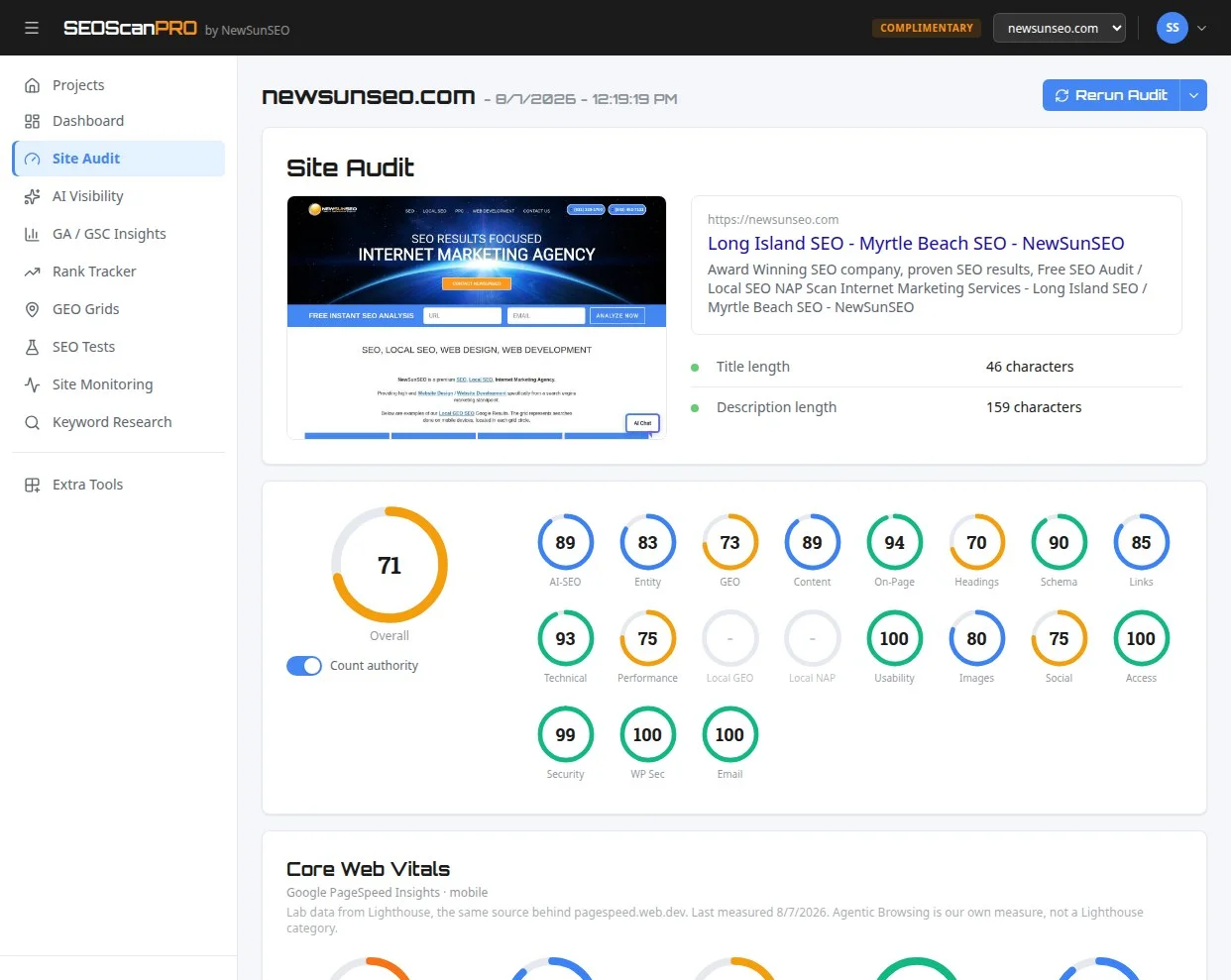
The site audit tool runs a full technical audit of a site and shows the measured result behind every check. Open the site audit tool.
This article summarizes reporting from searchengineland.com.