Category: Google Updates

  • Google Search Recap: AI Home Page Buttons, Local Pack Slop, Meta Crawling the Web

    Google Search Recap: AI Home Page Buttons, Local Pack Slop, Meta Crawling the Web

    Google’s search results continued to shift in the second week of August 2026, with new AI buttons appearing on the Google home page, AI Overviews pulling answers from low-quality local listicles, and fresh signs that Meta is building its own web search index. Advertisers also faced another round of account poaching by Google, while Microsoft Advertising and ChatGPT rolled out new ad and interface changes.

    What changed in Google Search this week

    Search ranking volatility spiked on August 12 and 13, continuing a pattern of turbulence through the summer. Google is also testing new entry points for generative AI directly on its home page, including buttons for creating images, asking about files, and brainstorming.

    AI Overviews in local results are citing low-quality listicles

    AI Overviews shown for local queries are pulling answers from thin, listicle-style pages rather than authoritative local sources. The pattern, widely shared in the SEO community, shows Google’s generative summaries inheriting the weaknesses of the pages they cite, including outdated information and weak source attribution.

    In a separate development, Google has been spotted generating images directly inside AI Overviews for some queries, extending the feature beyond text answers.

    Google Search Console adds more generative AI reporting

    Google Search Console expanded its generative AI performance reporting, giving site owners more visibility into how their content surfaces in AI-driven results. A separate Search Console bug surfaced this week, where a Google-selected canonical URL for a site appeared to be a known spammy page.

    Cloudflare misconfigurations can quietly damage SEO

    A widely discussed case showed how a misconfigured Cloudflare setup can block Googlebot, remove pages from the index, and erase search visibility without warning. Site owners were urged to audit their Cloudflare access rules and bot settings.

    A related concern: Googlebot user-agent strings report an IP in California, but Google confirmed the crawler may originate from other locations, making IP-based blocking unreliable as a verification signal.

    Expired Google employee X accounts are being claimed by SEOs

    Several former Google employees had dormant or abandoned X (Twitter) accounts that have since been re-registered by SEO practitioners. The accounts often retain old verification status and follower counts, giving the new holders an outsized voice in search industry conversations.

    Google Business Profiles tighten name rules

    Google Business Profiles now disallows repeated bilingual business names and transliterated scripts as a way to stuff extra keywords into a listing. Businesses can also now report owner responses to reviews directly through Google, a small but visible change to local profile management.

    Google Ads: agency account poaching continues

    Google is still actively contacting agencies’ advertiser clients and inviting them to manage their accounts directly, a long-running complaint from agency owners. On the product side, Google Ads will drop the manual language targeting setting in September, replacing it with automated targeting. Google Ads is also testing the display of advertiser names and favicons at the top of sponsored results, giving brands a stronger visual identity inside the ad slot.

    Google Ads and Google Analytics both gained new AI features this week, and Google Merchant Center performance reporting updates are scheduled for August 24.

    Microsoft Advertising, ChatGPT, and Meta

    Microsoft Advertising launched a new bulk-edit tool for ads and a streamlined appeal process for disapproved assets. ChatGPT Ads is testing AI-generated descriptive headlines, while OpenAI has made sources harder to find inside the ChatGPT interface, a shift that frustrates users who want to verify claims. Separately, Meta’s crawler is actively fetching web pages at scale, prompting speculation that the company is building the foundation for its own AI-powered search engine.

    Legal: Google amends its SerpAPI lawsuit

    Google filed an amended complaint in its lawsuit against SerpAPI, this time citing licensed content rather than its earlier computer-misuse arguments. The shift narrows the legal theory Google is pursuing against the scraping service.

    FAQ

    Why is Google testing AI buttons on its home page?

    Google is experimenting with home page buttons for creating images, asking about files, and brainstorming, giving users a direct path into its generative AI tools without first running a traditional search.

    What is wrong with AI Overviews in local results?

    AI Overviews shown for local queries have been observed pulling answers from thin, low-quality listicles rather than authoritative local sources, which leads to summaries built on unreliable pages.

    Is Meta building a search engine?

    Meta’s web crawler is actively fetching pages across the internet, which search industry observers read as evidence that the company is assembling the index needed to power its own AI search product.

    Related coverage


    This article summarizes reporting from seroundtable.com.
  • September 2026 Google Webmaster Report: Spam Update, AI Mode Expansion, and Search Feature Changes

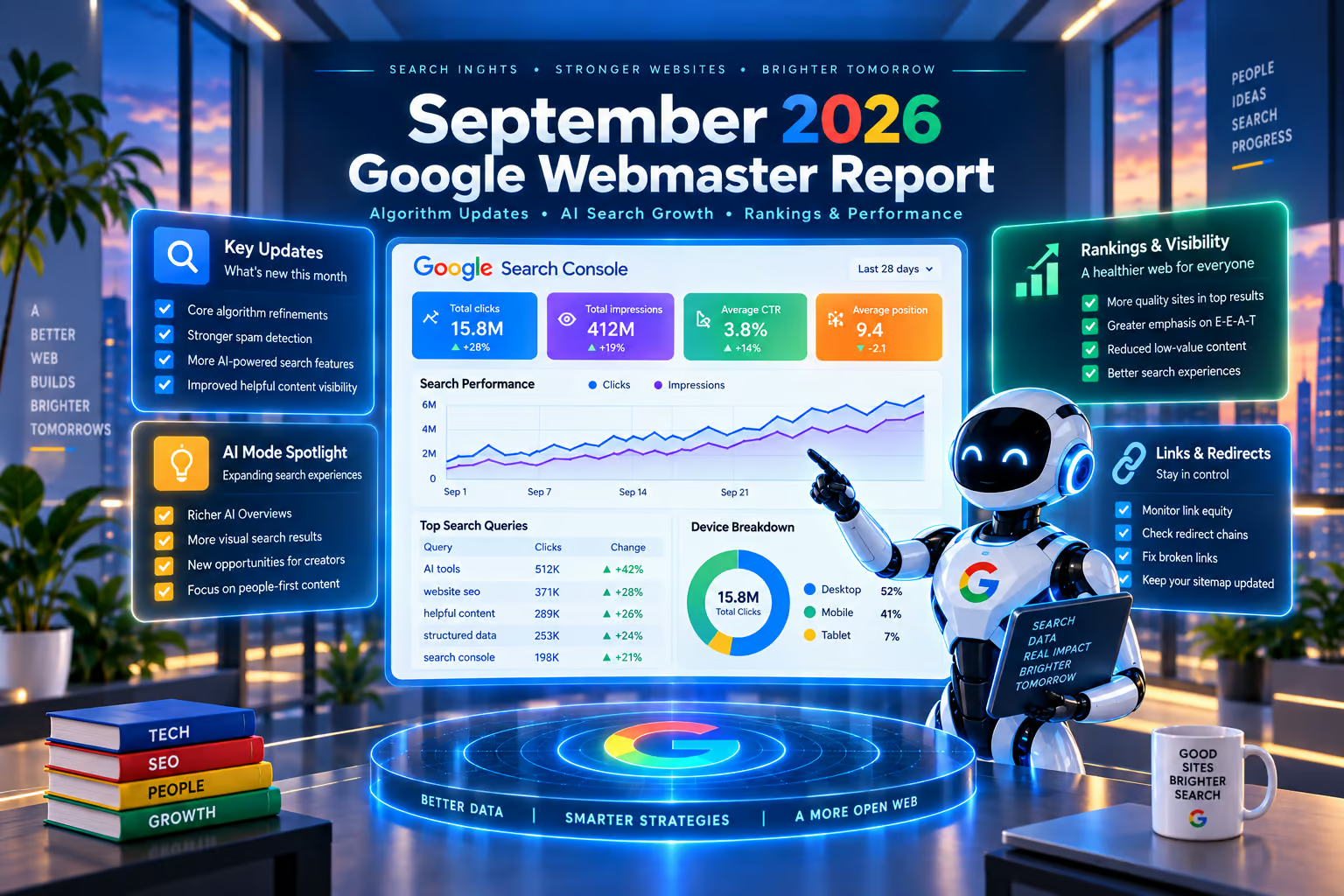
    September 2026 Google Webmaster Report: Spam Update, AI Mode Expansion, and Search Feature Changes

    Google’s August 2026 spam update rolled out from August 18 through August 21, accompanied by unconfirmed ranking volatility before and after the spam push. During the same period, Google began routing searchers from AI Overviews into AI Mode, introduced link carousel cards for developing stories, and started powering parts of AI Mode with Gemini 3.7 Flash. New google.com/goto URL parameters appeared in search results, and Search Console’s generative AI performance reports expanded to more properties.

    What changed in Google Search ranking and spam enforcement

    The headline ranking event was the Google August 2026 spam update, which started rolling out on August 18 and completed on August 21. Unconfirmed ranking volatility also spiked around August 5 to 6, August 12 to 13, and again after the spam update finished, leaving several days of noticeable movement in the search results.

    Separately, Google confirmed that it will not enforce manual actions for its site reputation abuse policy against sites whose results are shown to searchers in the EEA. Google’s explanation framed the policy change as a legal requirement rather than a ranking change.

    On the topic of transparency, Google clarified why it announces some search updates but not others, saying that only updates with actionable content for site owners get blog posts, and that the company does not intentionally time rollouts to coincide with announcements.

    How AI Mode is expanding inside Google Search

    Google began pushing searchers from AI Overviews directly into AI Mode, including dropping the “show more” button inside the overview surface. Once inside AI Mode, users now see link carousel cards designed for developing stories. Google also tested AI-generated images inside AI Overviews before pausing the test shortly after launch.

    On the model side, Google confirmed that AI Mode is partially powered by Gemini 3.7 Flash. Other AI Mode additions reported during the month include flight price tracking, airline mile rates, hotel booking, and a prompt to sign in. AI Overviews gained copyable emojis, began appearing above stock charts for stock price queries, and were observed pulling local results from low-quality listicles.

    New google.com/goto parameters, home page buttons, and source controls

    Google Search started rolling out new google.com/goto URL parameters on result links. The framing from Google is that the change helps protect its results from third-party scraping tools, and the source noted that scraping tools already have fixes ready for the shift.

    The Google home page gained test buttons for “Create Images,” “Ask About Files,” and “Brainstorm,” signaling a more assistant-oriented entry point. The Preferred Source button for publishers was improved, and Google lowered the subscriber requirement for Search Profiles. Search Profiles also now let users edit their handle.

    Other search-feature changes reported in the recap: the video carousel is showing less often, Google tested pink highlights inside featured snippets, and the Discover feed can be tailored by keywords.

    Google SEO clarifications, crawling notes, and content visibility

    Google addressed several recurring SEO questions during the month:

    • Reddit gets no special preference in Google Search rankings.
    • There is nothing special for site owners to do to optimize for generative AI responses in Search.
    • Google Search now lists the supported favicon file formats, after Google fixed a bug with favicons and crawl stats that caused complaints about disappearing favicons.
    • Search temporarily showed fewer PDF files in results, and the IRS website dropped heavily in Google before recovering.
    • Hreflang URLs are not indexed in the traditional sense, and JSON-LD extraction for Googlebot now does one pass of HTML unescaping.
    • Google says its crawlers send HTTP requests including HEAD, OPTIONS, PUT, PATCH, and DELETE, but do not parse JSON.
    • Misconfiguring Cloudflare can hurt SEO, and Googlebot may report being from California while actually being located elsewhere.

    Google Search Console updates and bugs

    The generative AI performance report in Search Console expanded to more properties. Search Console can now show AI Mode queries, though those queries do not yet appear inside the dedicated generative AI reports. Performance reports showed a drop in impressions and clicks around August 12.

    Crawl Stats missed two days of data, which Google attributed to a fix for a favicon and crawl stats bug. Search Console also sent new owner email notifications that some site owners flagged as a possible bug, and the selected canonical signal was observed showing spammy values on some sites.

    Google Business Profile and local changes

    Google acknowledged a problem with reviews missing after Google Business Profile reinstatement. Google also began bringing back Google Posts insights, specifically the “people viewed” metric, and started testing a revamped Q&A feature inside Business Profiles. On the policy side, Google Local now disallows repeated bilingual name transliterations.

    Industry and business moves around Google Search

    Google made notable AI leadership changes during the month, with Jeff Dean leaving and Demis Hassabis taking on a changed role. Google also amended its lawsuit against SerpApi over licensed content. Separately, SEOs have been taking over expired Google X accounts.

    One ecosystem change worth noting: Google Assistant is shutting down on mobile devices on September 4.

    FAQ

    When did the Google August 2026 spam update roll out?

    The spam update started on August 18, 2026 and finished rolling out on August 21, 2026, with unconfirmed ranking volatility also seen before and after the spam push.

    What is powering Google AI Mode?

    Google confirmed that AI Mode is partially powered by Gemini 3.7 Flash, and the surface now includes link carousel cards for developing stories, flight price tracking, hotel booking, and a sign-in prompt.

    What are the new google.com/goto parameters in Google Search?

    Google Search is rolling out new google.com/goto URL parameters on result links. Google described the change as protection for its search results from third-party tools, and the scraping tools named in coverage already released fixes for the change.


    This article summarizes reporting from seroundtable.com.
  • Google August 2026 Algorithm Update: Changes and Recovery Steps

    Google August 2026 Algorithm Update: Changes and Recovery Steps

    The Google August 2026 Algorithm Update is a broad core ranking recalibration that has already moved results across search. Traffic losses can appear fast, and pages with weak originality, thin evidence, or vague intent have seen larger drops than pages delivering clear value. March tracking data shows 45% of monitored sites saw their rankings shift, and sites with strong Core Web Vitals scores gained 12% to 28% more traffic while scaled AI abuse and expired domain abuse lost visibility.

    How Does the August 2026 Update Compare to Previous Core Updates?

    Comparing four dimensions from Google’s core update timeline shows where August 2026 sits and what recovery work looks like.

    • Rollout length: March 2025 lasted 14 days, June lasted 17, December lasted 18, and the August 2025 spam update lasted 27 days. The safe move is to wait for the full rollout before judging the real effect.
    • Volatility level: March 2025 was moderate, June was high, and December was very high. Sharp swings that last for days after the first drop are common during high-volatility rollouts.
    • Main quality focus: June 2025 increased the weight of E-E-A-T, and August 2025 spam targeted link spam and manipulative content. Pages need clear trust signals, clean links, and copy that reads like it helps people.
    • Who got hit most: December 2025 affected 52% of e-commerce sites, 67% of health sites, and 71% of affiliate sites, with top 3 churn reaching 66.8%. Money pages that fell are the highest-risk pages.

    How To Diagnose Affected Pages Using Search Console

    Five steps in Google Search Console surface the URLs losing the most ground after the August 2026 update.

    1. Open Performance, switch to Pages, and compare the last 28 days with the prior 28 days for a clear list of URLs with the biggest drops in clicks, views, and average position.
    2. Sort by average position change and flag the steepest drops first. A move from position 2 to 4 is small, but a fall from the top 5 to page two needs a closer look.
    3. Click each weak page and open its Queries report for the same date range to see whether some terms lost their edge and whether they fit into a single content group.
    4. Check whether the lost queries need fresh results. Google has long used QDF for searches that demand fresh data, so older pages can slip when new data, news, or releases now lead the results.
    5. Export the biggest losers into a sheet and group them by topic, template, or intent. With over 200 ranking signals in play, patterns across pages matter more than one bad URL.

    Steps To Recover Rankings After the August Update

    Five actions move a site back toward stability once the diagnosis is done.

    1. Wait for the rollout to finish before making broad site changes. The June 2025 core update brought some sites partway back on its own.
    2. Rewrite pages that lost ground around one search task and add firsthand proof. The August 2024 core update used feedback gathered after the 2023 helpful content update, and that pattern of rewarding original, lived-experience content has carried forward.
    3. Merge or prune thin pages that chase the same topic. They split signals and blur the page’s value.
    4. Tighten titles, intros, and headings so the query, the promise, and the visible proof match. Pages that read consistently for the user and the crawler build trust faster.
    5. Remove spam, weak automation, and stale claims across the site. Google reported 4,725 search changes in 2022, which leaves little room for weak pages.

    What Counts as a Content Quality Shift?

    A content quality shift is a change in how Google weighs meaning, accuracy, and usefulness. Google reported 4,781 Search changes in 2023, but the major updates are the ones that can move rankings. Good pages can drop while results are still unstable during a core update, then rise again once testing settles. Thin content has lost value repeatedly: the March 2024 Core Update cut low quality content in search results by 45%, and earlier updates like Panda and the Helpful Content Update pushed weak pages down the same way. Rankings sometimes bounce back on their own, but counting on that is risky. Changes from the August 2026 algorithm update may lock in new quality standards, so content has to match what users need, not just what keywords suggest.

    Mistakes Agencies Make During Recovery Efforts

    Five recurring mistakes slow recovery work.

    • Scope creep: Adding tasks mid-recovery blurs priorities and dilutes effort.
    • Priority keyword misses: When a term like “Handmade silver jewelry” falls out of the top 3, that is a warning sign worth investigating before broader rewrites begin.
    • Audit gaps: Hidden crawl errors can stall recovery even when content improves.
    • Content overhauls without data: Pages need clearer writing, better keywords, and fresh facts, not just a stylistic refresh.
    • Early verdicts: Tools like Google Analytics, Google Search Console, Semrush, and Google’s Core Web Vitals Report often show that the update needs more time before conclusions are reliable.

    Risks Of Ignoring Algorithm Update Signals

    Four risks grow when warning signs go unchecked.

    • Late response risk: Google makes thousands of changes each year, and waiting for a big traffic drop means the harm is often already in the SERPs.
    • Low value content exposure: The August 2024 core update was built to reward high-quality pages and push down low-value SEO content, so weak pages lose ground quickly when signals go ignored.
    • Longer recovery window: The March 2024 core update took 45 days to roll out, and Google said it cut “unhelpful” content by 40%, showing that delays compound the cost of catching up.
    • Policy and spam blind spots: Manual actions and algorithmic enforcement can go unnoticed, and the 2024 site reputation abuse actions showed that pages built to game rankings can face lasting visibility loss.

    What Realistic Recovery Looks Like

    Most sites recover by fixing quality gaps first. The August 2026 rollout rewards clear firsthand value, stable technical health, and tighter page intent matching. Thin refreshes alone will not work, and broad recoveries keep pointing to content pruning and template cleanup. Cutting weak pages can cause a short-term traffic dip, so the smart sequencing is to audit intent fit, originality, internal links, and crawl waste before rewriting everything, then start with the pages closest to revenue.

    FAQ

    What is the Google August 2026 Algorithm Update?

    The Google August 2026 Algorithm Update is a broad core ranking recalibration that changes how Google weighs originality, evidence, and intent. Traffic losses can appear fast, and pages with weak originality, thin evidence, or vague intent have seen larger drops than pages with clear value.

    How do you diagnose pages affected by the August 2026 update?

    Open Google Search Console Performance, switch to Pages, and compare the last 28 days with the prior 28 days to find URLs with the biggest drops in clicks, views, and average position. Then sort by average position change, check each weak page’s Queries report, look for queries that need fresh results, and group the biggest losers by topic or intent.

    What are the biggest recovery mistakes agencies make after a core update?

    The biggest mistakes are scope creep that blurs priorities, missing priority keyword drops like a top 3 term slipping out, audit gaps that hide crawl errors, content overhauls without data, and early verdicts drawn before the rollout finishes. Tools like Google Search Console, Google Analytics, Semrush, and Google’s Core Web Vitals Report often show that more time is needed before drawing conclusions.


    This article summarizes reporting from seovendor.co.

  • Google I/O 2026 Search Changes: What Site Owners Need to Audit Now

    Google I/O 2026 Search Changes: What Site Owners Need to Audit Now

    Google used I/O 2026 to replace the traditional search bar with a persistent, conversational interface powered by a Gemini 3.5 Flash variant. The company also embedded autonomous Search Agents into the results page and opened Gemini Apps, a no-code builder for custom AI assistants, to U.S. creators in beta. Together the announcements turn Google Search from a link list into an action layer, and they reset the criteria for what makes a web page visible to the system that now answers on the user’s behalf.

    What changed at the search box itself

    The new interface accepts text, voice, images, and video in a single thread and keeps context across long, multi-turn conversations. Rather than returning ten blue links, the box synthesizes answers from across the web and renders a results page that blends text, imagery, and action buttons. Google positioned the launch as a full rebuild of Search, not an incremental update, and tied the experience to Gemini as the connective layer.

    How Search Agents act on a user’s behalf

    Search Agents are autonomous helpers that operate inside a sandboxed browser environment. They scroll, fill forms, and click like a human while respecting site terms, and they can compare flights, find a plumber with real-time availability, book a restaurant, or place a grocery order without leaving the search interface. Any payment or irreversible action still requires explicit user approval, so the agent acts as a delegate rather than an unchecked bot.

    What Gemini Apps add to the stack

    Gemini Apps is a no-code platform for building custom AI assistants that can pull from Maps, reviews, Gmail, Calendar, and Drive with user permission. Google said apps will run inside Search, on Android, and in Chrome, and that a curated marketplace and eventual Play Store monetization path are planned.

    Rollout dates worth pinning to your audit calendar

    The rebuilt conversational box begins rolling out to English-speaking Chrome and Android users in Q3 2026, with additional languages to follow. Search Agents are still in preview, with an open beta planned by the end of 2026, starting with reservations, bookings, and comparison tasks. Gemini Apps opens to U.S. creators in beta within weeks of the keynote, with a full launch slated for early 2027. Google also committed to releasing APIs that let developers build workflows around Search Agents.

    Audit checklist: what site owners need to verify now

    The agentic layer only acts on businesses it can parse, contact, and transact with. Use this list to pressure-test your own pages and listings.

    • Google Business Profile completeness. Confirm hours, services, attributes, photos, and contact paths are current, since the agent evaluates whether a business is reachable in a single click.
    • NAP consistency across the web. Name, address, and phone number must match on every directory, social profile, and aggregator the agent might crawl.
    • Structured data for products, services, bookings, and FAQs. Schema.org markup gives the agent a machine-readable map of what you sell and how it can complete a task on your behalf.
    • Actionable commerce paths. If the agent is expected to book, reserve, or check out, the page it lands on needs a working form, a clear price, and a confirmed availability signal.
    • Indexable, crawlable content for synthesis. The box pulls from the live web, so thin pages, blocked resources, or paywalled answers risk being skipped during synthesis.
    • Permissions and robots rules. Decide which flows the sandboxed agent should be allowed to run, and make sure your terms of service and robots directives reflect that.
    • Multimodal assets. With voice, image, and video inputs now part of the input stream, alt text, transcripts, and descriptive metadata carry more weight.

    How this rewrites the definition of visibility

    For a quarter century, ranking well meant earning a click. Under the new model, the box decides which business it speaks aloud and which one it books, and it does so before any list of links appears. A page that ranks on page two but cannot be parsed, contacted, or transacted with may never appear at all, because the AI answer is the answer. The winners of this cycle will be the businesses whose digital presence is as conversational and actionable as the new Search itself.

    FAQ

    What did Google announce about Search at I/O 2026?

    Google announced a persistent conversational AI search box built on a Gemini 3.5 Flash variant, autonomous Search Agents that complete real-world tasks inside a sandboxed browser, and Gemini Apps, a no-code platform for building custom AI assistants integrated with Gmail, Calendar, Drive, and Maps.

    When will the new AI search box and Search Agents roll out?

    The conversational search box begins rolling out to English-speaking Chrome and Android users in Q3 2026, with additional languages later. Search Agents enter an open beta by the end of 2026, focused first on reservations, bookings, and comparison tasks. Gemini Apps opens to U.S. creators in beta within weeks, with a full public launch planned for early 2027.

    What should site owners audit to stay visible in the new Search?

    Audit your Google Business Profile for completeness, confirm NAP consistency across every directory, ship structured data for products, services, bookings, and FAQs, make sure commerce and booking paths are machine-readable, keep content crawlable for synthesis, and add alt text and transcripts so multimodal queries can find your assets.

  • Google I/O 2026: AI Studio Now Builds Android Apps From a Prompt

    Google I/O 2026: AI Studio Now Builds Android Apps From a Prompt

    At Google I/O 2026, Google showed an updated AI Studio that turns a plain-English prompt into a native Android app, exportable to a phone within minutes. The feature opens with a limited scope (personal utility apps only) and is the clearest mobile signal so far that prompt-driven “vibe coding” is leaving the desktop and reaching the devices most customers carry. Play Store distribution still runs through Google’s normal review process.

    For anyone who runs a website, the story matters because the same AI models that now build apps are the ones that crawl, parse, and reason about your pages. A prompt-built weather widget or job-site tracker is only as good as the data the underlying model can find, cite, and trust.

    What changed at I/O 2026

    AI Studio’s new flow accepts a written description and produces a native Android build that can be side-loaded to a device in a matter of minutes, based on Google’s demo. The model under the hood is Gemini, which means it can reason about APIs, data shapes, and interface patterns the way an engineer would, then hand back a working binary instead of a mockup.

    Two scope limits deserve attention:

    • Only personal utility apps ship in the initial release. Trackers, calculators, checklists, dashboards. Broader categories remain gated.
    • Distribution rules did not change. Anything headed to the Play Store still has to clear Google’s existing review process.

    Google also previewed AI-generated widgets at the Android Show, including examples that surface specific weather metrics or suggest recipes. These single-purpose widgets are the first concrete piece of what Google is calling a “generative UI,” where the phone composes interface elements on demand rather than the user navigating a fixed grid of icons. Android president Sameer Samat tempered the vision on stage: “While I don’t think we want to wake up every morning and have our devices have different UI, I do think there’s a level of personalization and customization to the user that could be delightful.”

    How this changes a site audit

    A site audit used to mean checking titles, schema, speed, and links. With vibe-coded apps pulling live data from your pages, three extra layers now belong on the checklist.

    1. Can the model read your structured data

    A prompt-built widget that surfaces today’s booked appointments, this week’s ad spend, or invoices past 30 days needs clean, machine-readable source material. Run your key pages through a structured-data validator and confirm that prices, dates, product names, and review counts parse without errors. If your JSON-LD throws warnings, the widget will quietly render blanks or hallucinate.

    2. Is your business entity consistent across the web

    Gemini, ChatGPT, Claude, and similar models reason about a business using the public mentions they can find. If your name, address, phone, and hours disagree between your site, your Google Business Profile, and the top directories, a vibe-coded app that tries to look you up will return a garbled answer. Audit the top ten citations for your brand and align the fields exactly.

    3. Are your contact paths reachable, not just visible

    An AI agent that wants to act on your business (booking an appointment, pulling a price, confirming stock) needs an endpoint it can call. Static contact pages with no schema, no API, and a form protected by an aggressive CAPTCHA will register as a dead end. Check that at least one contact method is reachable without JavaScript-rendered gates, and that the markup includes the right Schema.org type.

    Why Apple matters to this story

    Apple is reportedly building a prompt-driven path for iOS Shortcuts that lets users describe an automation in words (for example, “open the transit app when I get to the bus stop”) instead of assembling it block by block. iOS 27 is the expected vehicle. The mechanics differ from Google’s full-app generator, but the user-facing pattern is the same: describe the outcome, skip the assembly.

    Once both platforms treat “describe what you want” as a first-class input, internal tooling for small operators stops being a budget question and becomes a prompt-writing question. The bottleneck moves from engineering to knowing which workflow to describe first.

    What to run on your own site this week

    • Validate the structured data on every page an AI-built widget might pull from: product, service, FAQ, local business, and review schema.
    • Pull your top ten directory listings and diff the core fields against your own site. Fix every drift.
    • Open a private browsing window and ask Gemini, ChatGPT, and Claude to describe your business. Note what they get wrong; those gaps are your citation list.
    • Check that at least one contact endpoint on your site responds to a curl request without a CAPTCHA or a render-blocking script.
    • Crawl your own pages with a headless browser disabled. Anything that fails to load without JavaScript is invisible to most AI crawlers today.

    The realistic ceiling

    Reviewer Allison Johnson offered a useful caution after the I/O demos: “I’ve heard a lot of promises over the past few years from tech company execs about how AI will fundamentally change how we interact with mobile devices.” Until widgets ship at scale and survive contact with real users, the feature is a demo, not a platform shift. The build time claim (“a matter of minutes”) and the personal-utility gate are both signals that Google is keeping the scope tight on purpose.

    For site owners, that caution cuts both ways. The technology is real, the demo is real, but the gap between a working widget on a reviewer’s phone and a stable platform that other people’s apps depend on is still wide. Audit your pages as if the apps are coming, because they are, and use the lead time to make sure your data is the kind an AI can use without guessing.

    FAQ

    What did Google actually announce at I/O 2026 about building Android apps?

    Google showed an update to AI Studio that accepts a plain-English prompt and produces a native Android build, exportable to a phone within minutes. The release is limited to personal utility apps at launch, and Play Store distribution still goes through Google’s normal review process. Gemini powers the generation step, so the model can reason about APIs, data shapes, and interface patterns.

    How should a site audit change because of vibe-coded apps?

    Add three checks to a standard audit. Validate that structured data on key pages parses cleanly so AI-built widgets do not render blanks or hallucinate. Confirm that the business entity (name, address, phone, hours) is identical across your site and the major directories, since AI models reason from public mentions. Make sure at least one contact endpoint is reachable without JavaScript or CAPTCHA so an AI agent can act on the business.

    Is Apple doing the same thing for iPhone?

    Apple is reportedly building a prompt-driven path for iOS Shortcuts that lets users describe an automation in words instead of assembling it block by block. iOS 27 is the expected vehicle. The mechanic is different from Google’s app generator, but the user-facing pattern matches: describe the outcome and skip the manual assembly.