Category: AI Visibility

  • Bing Webmaster Tools AI Performance Report: What Publishers Should Audit

    Bing Webmaster Tools AI Performance Report: What Publishers Should Audit

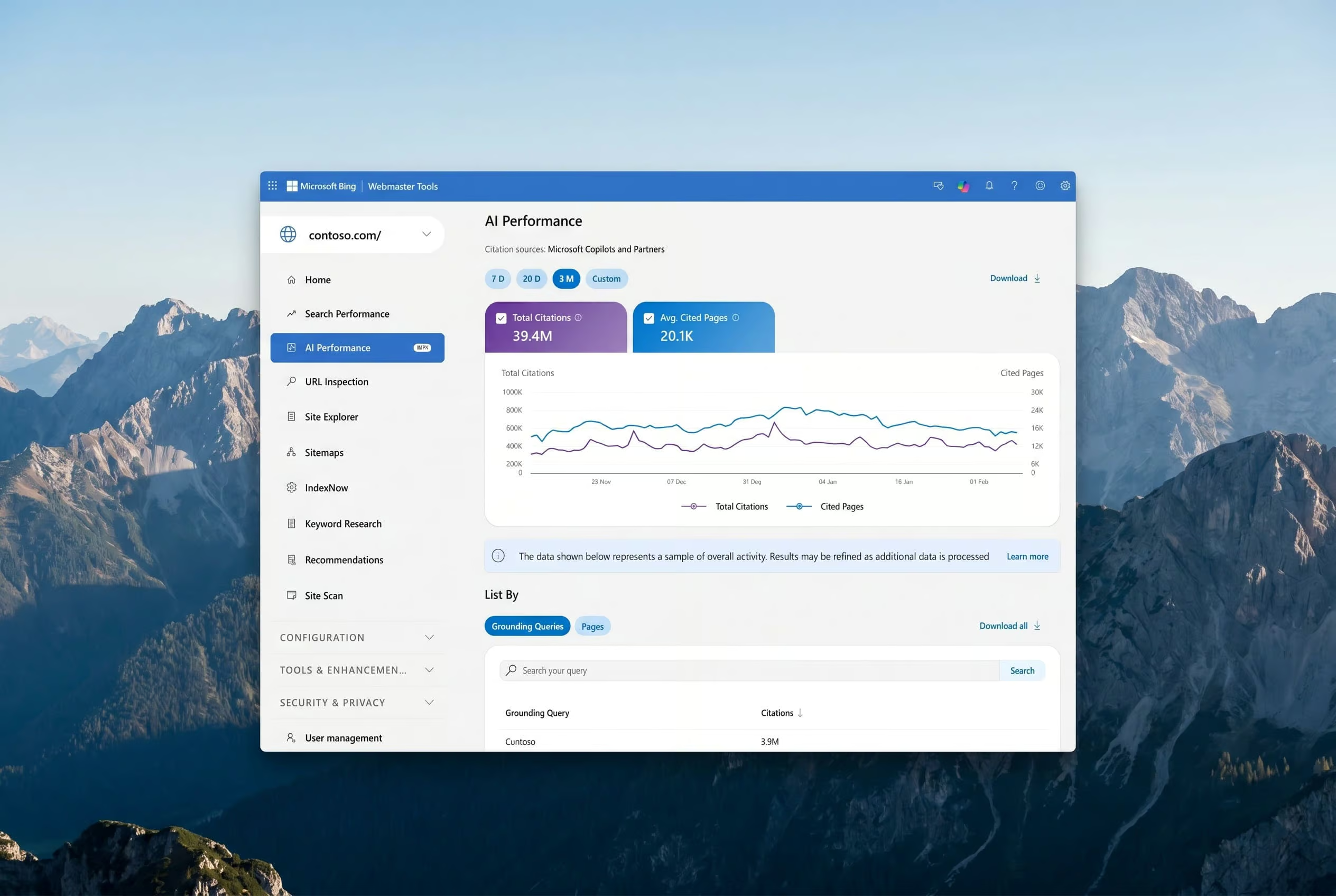
    Microsoft has rolled out a public preview of AI Performance inside Bing Webmaster Tools, giving site owners a dedicated reporting section for tracking how their pages get cited inside AI-generated answers across Microsoft Copilot, Bing’s AI summaries, and partner integrations. For technical SEO teams, the release fills a long-standing reporting gap: traditional crawl and index data did not show whether content was being referenced, or ignored, by generative systems.

    Below is a practical breakdown of each metric in the new dashboard and the audit checks that pair with it.

    Why AI citation data belongs in your audit workflow

    Search performance reports have always answered one question: how do my pages rank in blue links? Generative answers raise a second question: does my content show up at all when an AI system assembles a response? The two are not the same. A page can rank well and still never be cited, or be cited without ever holding a top organic position. Treating AI visibility as an extension of rank tracking misses that distinction, which is why a separate report category makes sense.

    For publishers running regular technical audits, the new section creates a new class of issues to check: pages that are indexed, eligible, and crawlable, yet absent from AI citations, or the reverse, pages cited frequently with thin supporting content that may need reinforcement.

    What the AI Performance dashboard actually measures

    Microsoft’s preview surfaces five core data points, all centered on citation frequency rather than ranking position.

    • Total Citations: A count of every instance the site is shown as a source in an AI-generated answer during the selected window. Each appearance counts once; the metric does not weight placement inside a response.
    • Average Cited Pages: The daily mean of distinct URLs surfaced as sources, aggregated across supported AI experiences. This is breadth, not authority per page.
    • Grounding Queries: Representative phrases that AI systems used when retrieving content that became a citation. Microsoft flags these as a sample of overall activity that will be refined as data accumulates.
    • Page-level citation activity: A URL-by-URL breakdown so publishers can see which pages are referenced most often. Again, frequency only, not prominence.
    • Visibility trends over time: A timeline view of citation activity across supported AI surfaces, useful for spotting directional shifts.

    Throughout, the dashboard honors content owner preferences expressed via robots.txt and other supported control mechanisms, so excluded pages stay excluded.

    How should publishers act on the data?

    The metrics are descriptive, not prescriptive, so the value comes from the audit work they trigger. A useful starting routine:

    1. Validate current citations. Cross-check the URLs in the page-level report against the queries they appear for. Confirm the cited content actually answers the grounding query; mismatches are a signal to rewrite, not to delete.
    2. Flag frequent references for reinforcement. Pages that appear often across AI responses are doing structural work for you. Audit them for outdated statistics, broken examples, or thin source citations, then update.
    3. Find the silent majority. Indexed, crawlable, canonical pages with near-zero citations deserve a second look at clarity, heading hierarchy, and the presence of extractable definitions or tables.
    4. Treat grounding queries as a content map. The phrases listed are a direct sample of what AI systems considered when pulling from your site. If a phrase is present but the page that should answer it is not cited, that gap is worth closing with a dedicated section.

    Structural improvements that show up in the report over time

    Several changes tend to improve the odds of being cited, and they are the same patterns technical SEO audits already look for:

    • Clear headings, tables, and FAQ blocks. Generative systems pull extractable facts. Pages with explicit question-and-answer markup make that extraction cleaner.
    • Supported claims. Original data, named sources, and concrete examples give an AI system something concrete to reuse, and reduce the chance of a confident misquote.
    • Topical depth. Pages cited for specific grounding phrases usually have a clear subject focus. Expanding adjacent subtopics on the same URL tends to widen the set of queries that page can answer.
    • Freshness. Outdated pages get cited less often. Regular updates keep the canonical version aligned with what an AI system should retrieve.
    • Format consistency. When text, images, and video describe the same entities the same way, AI systems are less likely to mix signals or pull from the wrong asset.

    Microsoft points publishers to its guide on optimizing content for inclusion in AI search answers for a deeper structural checklist, and that document is worth treating as an extension of your existing on-page audit template.

    Where IndexNow fits into the workflow

    Microsoft ties AI Performance directly to IndexNow, the protocol that notifies participating search engines when a URL is added, updated, or removed. The pitch is straightforward: if you want AI systems to cite the current version of a page, the crawler needs to know the page changed. Sites that have not enabled IndexNow can sign up at indexnow.org, and the activation step is small enough to fold into any audit deliverable. After enabling, watch whether newly updated pages appear faster in both Total Citations and page-level activity, which gives you a feedback loop for content refreshes.

    Local businesses: the extra check that matters

    For businesses with a physical presence, the audit scope widens. AI experiences increasingly answer location-based queries, and inaccurate business data is a common reason a site is not cited even when the content is strong. Microsoft recommends registering with Bing Places for Business alongside using Webmaster Tools, so address, hours, and contact details stay current and eligible for inclusion in AI responses. The same check applies to schema markup: confirm local business structured data on the page matches the listing.

    What to expect as the preview evolves

    Microsoft frames AI Performance as a step toward broader transparency between generative systems and the open web. The team behind the preview, Krishna Madhavan, Meenaz Merchant, Fabrice Canel, and Saral Nigam at Microsoft AI, is actively inviting publisher feedback, which means the metric definitions, especially around Grounding Queries, are likely to be adjusted. For audit purposes, treat the current numbers as directional rather than absolute, and revisit the dashboard after each round of refinements.

    The near-term takeaway for technical SEO work is straightforward. AI citation data is now a first-class signal inside Bing Webmaster Tools, and it deserves its own section in any audit report, alongside crawl, index, and classic search performance.

    FAQ

    What is AI Performance in Bing Webmaster Tools?

    AI Performance is a new reporting section inside Bing Webmaster Tools, opened by Microsoft as a public preview. It tracks how a publisher’s pages are cited as sources in AI-generated answers across Microsoft Copilot, Bing’s AI summaries, and select partner integrations.

    Which metrics does the AI Performance report include?

    The dashboard reports Total Citations, Average Cited Pages, Grounding Queries, page-level citation activity broken down by URL, and visibility trends over time across supported AI surfaces. The metrics count citation frequency, not ranking or placement inside any single answer.

    Who at Microsoft is building AI Performance?

    The feature is being developed by Microsoft AI. The team inviting publisher feedback includes Krishna Madhavan, Meenaz Merchant, Fabrice Canel, and Saral Nigam.

    Related coverage

  • Seedream 5.0 Pro: What Site Owners Should Check Before Using ByteDance’s New Image Model

    Seedream 5.0 Pro: What Site Owners Should Check Before Using ByteDance’s New Image Model

    ByteDance’s Seed team has released Seedream 5.0 Pro, a multimodal image creation model aimed squarely at professional production environments rather than casual one-shot generation. The Pro release extends the prior version with stronger image-text alignment, cleaner structural coherence, sharper text rendering, and broader multilingual input, with four areas the team uses to position it: complex information visualization, interactive precision editing, realistic imagery and portrait texture, and native generation across more than ten commonly used languages.

    For teams running technical SEO audits, the release matters less as a creative announcement and more as a checklist. Models that generate dense infographics, localized layouts, and pixel-level edits can quietly introduce on-page issues if the output is shipped without review. Below are the production areas the Pro version targets and the audit points each one raises.

    What changes for infographic and dense-layout generation?

    Infographics stress every part of an image model at once: data accuracy, dense text rendering, logical layout, and consistent aesthetics. Seedream 5.0 Pro is tuned for that combined load. Examples shown by the team include an Antarctic research station composite that integrates a timeline, line chart, bar chart, pie chart, and a realistic view of the station in one frame, a six-tea-category poster built around a watercolor flavor wheel, a birdwatching grid covering eight species with English and Chinese names, a vintage scroll-style holiday sale poster with multi-tiered headlines, and a 16:9 pet e-commerce homepage UI where a dog’s paw crosses the right frame to press a button on the left.

    Audit points to verify on any generated infographic:

    • Every numeric value reads correctly against the underlying source data. AI charts can produce plausible-looking figures that drift from the dataset.
    • Labels, units, and legends match the body text rather than restating it inconsistently.
    • The image carries the same alt text and on-page schema as a hand-built infographic, including any ImageObject or FAQPage markup that references chart contents.
    • Text within the image does not duplicate headings on the page, which can create keyword cannibalization and weak signals to crawlers about what the page is about.

    How does precision editing affect what gets shipped?

    The Pro release exposes a grounding layer that understands positional and regional semantics, then accepts point selection, lasso selection, box selection, and doodles as control signals for deterministic local edits. A demo built around a 2026 New Gaokao math worksheet shows the model identifying each question, locking onto the blank space below, performing the calculation, and filling the matching slot. A separate example translates a foreign menu into Chinese while preserving the layout. The team also lists practical applications: local object add or remove with surrounding-aware blending, hex color and material swatch application, region isolation within colored frames, sketch-to-render, layer separation that pulls a poster into more than ten independent layers including a parrot subject and background for free scaling, and multi-image fusion for early visual collages.

    Audit points that matter when editing replaces redrawing:

    • Crop and dimension history. Pixel-level edits can shift the visible canvas without changing the exported file size. Confirm the rendered image still matches the declared width and height attributes and the aspect ratio in srcset.
    • Layer separation output. When a model splits a poster into transparent layers, the flattened export can hide stray alpha edges. Run a contrast check against a white background and a dark background.
    • Localized edits. Menu translation and on-image copy changes are exactly the kind of work where a model can swap a unit, a price, or a currency symbol. Read every string inside the image before publishing.
    • Multi-image fusion seams. Composites can leave subtle mismatches in perspective or shadow direction. Spot-check against a reference photo of the same scene where possible.

    Which realism cues are worth verifying on a page?

    The Pro release leans into lighting, material, and skin detail. Example outputs include god rays piercing window blinds, grains of rice and fish roe suspended in a sushi poster, a panning shot where a cyclist stays sharp against horizontal background blur with rotational blur on the spokes, a storefront window with halftone print texture and layered reflections, and a coastal cliff glass villa where metal frames, glass, stone, seawater, and raw wood coordinate into one sunset composition. Portrait work is framed as faithful to skin texture, with matte lighting transitions and expressions that hold narrative tension. Multi-image compositing is offered for group photos, with consistent lighting and cohesive texture across several separately captured portraits.

    Audit points for realism-heavy imagery:

    • Compression artifacts on high-frequency detail. Suspended particles, halftone textures, and hair strands are the first things that fall apart under aggressive WebP or AVIF compression. Check the file at the actual delivery size, not the source export.
    • Color space consistency. A panning shot or a mixed-material sunset can drift between sRGB and P3 if the pipeline re-encodes through a tool that strips the ICC profile. Confirm the served image still declares its color profile.
    • People and likeness rights. Composite group photos that blend several portraits should be reviewed against the team’s consent and licensing process, especially if the image is used on a commercial landing page.
    • Lazy-loaded and LCP impact. Realism cues often push file sizes up. Check the Largest Contentful Paint candidate on the page and confirm a responsive srcset is in place so mobile visitors do not pull the desktop export.

    What does native multilingual generation change for a site audit?

    Seedream 5.0 Pro supports direct input and high-quality rendering for more than ten commonly used languages. For a site owner that means on-image text can be generated in the target language rather than overlaid after the fact. That removes one source of alignment bugs but introduces others worth checking.

    Audit points for multilingual output:

    • Locale variants. A string that renders cleanly in one language can break in another because of longer compound words or diacritics. Verify image dimensions still contain the rendered text on the longest locale variant the page targets.
    • hreflang and image variants. If the same asset is regenerated per locale, confirm the hreflang cluster still references the correct image URL and that CDN caching is not serving the wrong locale at the edge.
    • OCR-friendly rendering. Text inside generated images is invisible to crawlers. Any navigation, CTA, or pricing that lives only inside the image needs to be duplicated in real HTML or covered by structured data.

    How should this feed into a routine audit pass?

    Treat any image produced or edited by Seedream 5.0 Pro the same way you would treat a stock photo with embedded text: assume nothing about the strings, numbers, or layout until you have read them yourself. Pull each generated asset into an image QA checklist that covers alt text accuracy, declared dimensions, file size and format, color profile, OCR of on-image text, and a side-by-side comparison against the data source for any chart or infographic. Then confirm the surrounding HTML still has the structured data, internal links, and heading hierarchy the page would have carried if the asset had been hand-built.

    Additional visuals and information are available on the Seedream 5.0 Pro project page hosted by ByteDance Seed.

    FAQ

    What is Seedream 5.0 Pro?

    Seedream 5.0 Pro is a multimodal image creation model launched by ByteDance’s Seed team. It builds on the previous version and is positioned for professional production environments that need information density, editability, and realism.

    Which capability areas does the Pro release focus on?

    The team highlights four areas: complex information visualization, interactive precision editing, realistic imagery and portrait textures, and native multilingual input and generation across more than ten commonly used languages.

    Where can site owners find more information about Seedream 5.0 Pro?

    Additional visuals and information about Seedream 5.0 Pro are available on the project page hosted by ByteDance Seed.

    Related coverage

  • Anthropic’s Claude Fable 5 Free Window Runs Through July 12: How Site Owners Can Use It

    Anthropic’s Claude Fable 5 Free Window Runs Through July 12: How Site Owners Can Use It

    Anthropic has pushed the deadline for free use of its flagship Claude Fable 5 model out to July 12, 2026, giving Pro, Max, Team, and qualifying Enterprise subscribers a narrow final window of unmetered access before the model moves to prepaid credit pricing. Under the offer, subscribers can route up to half of their weekly usage through Fable 5 until the cutoff, after which the model steps off subscription plans entirely and into API-only billing at the steepest published rates Anthropic has listed for a generally available system.

    For technical SEO and audit teams, the timing matters less as a news item and more as a planning prompt: any analysis, content review, or competitive sweep that can benefit from long-context reasoning can be moved up to this deadline without touching the budget.

    What the Mythos tier changes for audit work

    Fable 5 sits in Anthropic’s Mythos class, which the company places above Opus. Anthropic has positioned the model at the top of its knowledge work benchmarks and pitched it toward long, multi-step reasoning tasks that previously called for a small team. For an audit workflow, the practical upshot is that very large dumps, such as a full crawl export, a year of Search Console data, or every page on a content silo, can be pushed into a single session and interrogated as one body of evidence rather than sliced into prompts.

    The model also lets a single reviewer sketch an agent that would otherwise require stitched-together scripts. That changes the cost calculus for ad-hoc projects like a one-time schema audit, a redirect chain review, or a content gap map.

    What closes on July 12

    After the cutoff, Fable 5 stays alive only behind prepaid usage credits: $10 per million input tokens and $50 per million output tokens. Anthropic first flagged the five-day extension on X, and a Claude Code lead engineer has said the goal is to fold Fable 5 back into standard subscriptions once capacity returns, though no return date has been set.

    If prepaid credits are not loaded before July 12, access ends for that account. Demand has stayed high and unpredictable, which is why Anthropic is rationing rather than retiring the model.

    Audit and SEO tasks worth burning the window on

    1. Full-corpus content audits

    Upload every published page, or a representative sample, and ask the model to cluster them by intent, flag cannibalization candidates, surface thin pages, and group the gaps where the site has no coverage at all. Long-context reasoning makes this kind of whole-site review usable in one pass.

    2. Log file and crawl diff analysis

    Push a week of server logs or a fresh crawl export next to the previous one and ask the model to summarize what changed: new URL patterns, dropped sections, redirect drift, and crawl-budget sinks.

    3. Schema and structured data review

    Hand over a dump of JSON-LD from a site audit tool and ask Fable 5 to flag inconsistent entity types, missing required properties, and markup that no longer matches what the page renders.

    4. Internal link graph reasoning

    Feed the model a list of internal links along with anchor text and target URLs and have it cluster orphan pages, over-linked hubs, and anchors that mislead crawlers about destination intent.

    5. Competitor content sweep

    Compile the top-ranking pages for the queries that matter to your site and ask the model to compare your coverage against each, scoring depth, freshness, and entity coverage side by side.

    6. GA4 and Search Console pattern hunt

    Drop in a quarter of Search Console data and ask for the queries, pages, and CTR anomalies that deserve manual review. The model can also propose hypotheses worth testing before anyone rewrites a title tag.

    7. Build a repeatable audit agent

    Use the window to design an agent that runs a defined audit each week: inputs, decision points, outputs, escalation rules, and failure checks. Once Fable 5 leaves the plan, the workflow can be re-targeted at a cheaper tier or kept on credits for the highest-value runs.

    8. Governance and data handling rules

    Before any client data or proprietary crawl exports go through an external model, draft a written policy on what can be uploaded, what stays internal, how output is logged, and how mistakes get caught. Doing this in the free window avoids paying for the same work later.

    9. Head-to-head benchmark against your everyday model

    Pick five recurring SEO or audit tasks and run them through Fable 5 and your usual model. Score the results on accuracy, depth, and the number of corrections needed. That benchmark will tell you which tasks justify the $10/$50 per million token rate once free access ends.

    10. Decide the post-July 12 budget

    Plan now which tasks deserve Mythos-class spending and which can stay on Opus, Sonnet, or another everyday model. Treating the cutoff as a budgeting exercise instead of a surprise keeps priorities intact after July 12.

    How to get the most out of each session

    Treat every prompt as a finite resource aimed at producing something durable. That means finishing the deliverable inside the window rather than just exploring, and saving reusable templates, agent designs, and governance docs to a library that does not depend on a free plan. The model may stop being unmetered, but a well-built prompt library keeps paying back.

    Where possible, keep inputs and outputs inside the same workspace so a follow-up prompt can reference earlier conclusions without re-uploading. For audit work, that means one session per project: one for the content audit, one for the schema sweep, one for the competitor map, and so on.

    FAQ

    When does free access to Claude Fable 5 end?

    Anthropic has extended free access through July 12, 2026. Pro, Max, Team, and qualifying Enterprise subscribers can use the model for up to 50 percent of weekly usage until that date.

    How much will Claude Fable 5 cost after the free window?

    After July 12, the model is available only through prepaid usage credits at $10 per million input tokens and $50 per million output tokens, the highest published pricing Anthropic has set for a generally available model.

    Will Fable 5 return to subscription plans later?

    Anthropic has stated that it aims to bring Fable 5 back into standard subscriptions once capacity allows, though no specific date has been announced. Until then, access remains credit-only.

    Related coverage

  • What Meta Muse Image Means for Your Instagram Photos and Your Site

    What Meta Muse Image Means for Your Instagram Photos and Your Site

    Meta has shipped an AI image tool called Muse Image, built by Meta Superintelligence Labs, that lets any user tag a public Instagram profile and generate a new picture from that account’s photos. The feature is switched on by default, which has triggered a loud reaction on X and renewed questions about consent, training data, and how to audit a site that depends on Instagram for traffic or visibility.

    For anyone running technical SEO audits or managing a brand presence on Instagram, this launch changes what you should be checking on your own pages, your embed strategy, and your public profile metadata. Below is what Muse actually does, why opt-out defaults matter, and a practical checklist for auditing your exposure.

    What Muse Image does and where it runs

    Muse Image is available through the Meta AI app, Instagram Stories, and WhatsApp. It produces cartoon-style renderings, runs preset prompts for inspiration, and supports prompt-based edits like placing a subject in front of a historical landmark, removing a photobomber, or generating a functional QR code. Meta also flagged ad creation and an interior-decorating flow that ties into Facebook Marketplace, such as previewing a secondhand couch in a garage. Use is free until a usage cap, after which a subscription applies. Meta said a video version, Muse Video, is already in development.

    The tool’s internal code name is Mango. Meta Superintelligence Labs, the company’s dedicated AI unit, built it. It is the latest in a run of AI products Meta has released over the past year, including an assistant called Creator and an app called Pocket that supports vibe-coded video games.

    The feature drawing the backlash

    The single capability causing concern is straightforward: a user tags a public Instagram profile, and Muse generates a new image using that account’s photos. Meta’s stated policy says people may be able to create content using your Instagram content through AI features at Meta, and that users will not be notified when content is created from their images. One widely shared post on X called the practice a “privacy landmine waiting to detonate.” Meta has said users have controls to disable the use of their pictures this way.

    The opt-out default is the core issue. A user has to act to prevent their public photos from being reused as raw material for generated images. That choice flips the usual consent flow, where participation requires a positive opt-in.

    Why the pattern keeps repeating at Meta

    This is not Meta’s first run-in with consent questions around user data. In 2019, the company paid a then-record $5 billion fine to the FTC after regulators found that Cambridge Analytica had improperly harvested data from tens of millions of Facebook users, without their knowledge, to build voter-targeting profiles ahead of the 2016 U.S. election. Facebook had known about the data misuse for years before it became public. In 2021, Meta shut down Facebook’s facial-recognition system, which had automatically identified people in photos and videos, amid lawsuits and regulatory pressure over its collection of biometric data.

    An opt-out default for a feature that draws on people’s photos to produce AI outputs echoes the consent questions raised in both of those cases. The same structural choice, leaving the user to object after the fact, is now being applied to generative image output.

    How to audit your own Instagram presence for Muse exposure

    Treat this like any other crawl audit. You need to know what is public, what is indexable, and what third parties can pull from your profile without permission.

    Check whether your account is public

    Muse can only pull from public Instagram profiles. If your account is private, you are outside the affected surface area for this feature. If you run a brand account and have ever switched it public for a campaign, confirm it has been returned to private, and document when.

    Review your tagged photos and tagged locations

    Other users can still tag you on their public posts even if your account is private. Audit your tagged photos and tagged locations in the Instagram app and remove anything you would not want surfaced as source material for a generated image.

    Exercise the opt-out control and verify it

    Meta has said users have controls to disable this kind of use. Find the control in your Instagram settings, toggle it, and screenshot the confirmation. Settings pages change without notice, so capture a timestamped record.

    Audit your embeds and UGC on your own site

    If you embed public Instagram posts on your own pages, those embeds can be pulled by Muse as easily as the originals. Run a crawl for Instagram embed iframes and oEmbed references, and decide which ones are worth keeping now that the underlying image may be reused in AI-generated contexts you do not control.

    Check your profile metadata for sensitive signals

    Public profile fields (bio, external link, contact buttons) are visible to Muse’s tagging flow as well as to crawlers. Remove anything you would not want a third party to copy or paraphrase into a generated image prompt.

    What site owners should watch next

    Two near-term signals matter. First, watch for any change to the opt-out default. A switch to opt-in would be a meaningful shift, and it would also reset how you audit your public assets. Second, watch for the Muse Video release. The same consent mechanics applied to video would widen the surface area considerably, including any public Reels you have shipped.

    If your traffic depends on Instagram discovery, also recheck your alt text, captions, and on-page context for any images you have published publicly. Once a photo leaves Instagram in a generated form, you may not be able to trace or remove every downstream copy.

    FAQ

    What is Meta Muse Image?

    Muse Image is an AI image generator built by Meta Superintelligence Labs, internally code-named Mango, and available for free through the Meta AI app, Instagram Stories, and WhatsApp. A video version called Muse Video is in development.

    Why is Meta Muse Image drawing privacy pushback?

    A feature lets any user tag a public Instagram profile and have Muse generate new images from that account’s photos. The feature is opt-out by default, and Meta’s policy states that users will not be notified when content is created from their images.

    Can you stop Meta from using your Instagram photos in Muse?

    Yes. Meta says users have controls to disable this kind of use of their pictures. The default is opt-out, so you need to actively toggle the setting rather than wait to be asked.

    Related coverage

  • OpenAI’s ChatGPT superapp plan and what it signals for site owners tracking AI search

    OpenAI’s ChatGPT superapp plan and what it signals for site owners tracking AI search

    OpenAI is preparing to merge ChatGPT with its image and video tools and the third party services that already run inside ChatGPT, forming a single interface that could also handle shopping and travel bookings. The Financial Times reported the consolidation effort, which is being developed alongside preparations for a potential public listing that could rank among the largest in recent years.

    For site owners running technical SEO audits, the relevant question is not the valuation math but how a more unified ChatGPT surface changes what gets measured. If transactions, media generation, and external apps collapse into one chat window, the signals a crawler can collect shrink and the surface a site has to optimize for grows.

    What a consolidated ChatGPT surface actually changes

    The reported design pulls conversational answers, native image and video generation, the existing apps marketplace, and consumer transactions such as shopping and travel under a single entry point. The pattern follows how smartphones absorbed standalone apps for routine tasks, replacing a tap into separate products with one persistent surface.

    That shift matters for audits because the optimization targets multiply. A site that previously needed to rank in web search, win clicks, and convert on its own pages now also has to be reachable as data, a callable app, or a transaction endpoint inside a chat client. Each of those surfaces has its own access rules, markup conventions, and performance ceilings.

    Where competitive pressure is pushing the strategy

    OpenAI is moving to reduce the share of revenue that depends on ChatGPT directly as rivals and open-weight models reach into adjacent territory. A superapp widens the surface where OpenAI can charge, and it raises the switching cost for users who might otherwise split tasks across separate tools.

    The same pressure also explains the agent angle. Agent based assistants that complete tasks rather than answer questions are pulling usage away from traditional search and chat. A unified interface with built in transactions is a direct response: if the assistant can book, buy, and create, the user has less reason to leave the chat surface at all.

    Why the listing question is part of the same move

    A public listing would give OpenAI a steadier funding base for the compute, research, and consumer infrastructure that a superapp requires. The FT report also flagged a possible tender offer that would let staff and early backers sell shares at a premium and could bring new institutional holders onto the cap table before a full float.

    For anyone tracking AI driven traffic, the listing itself is less important than what the capital is buying. Compute spend funds the models that decide which sites get cited, which sources get summarized, and which product feeds get surfaced as transactions inside chat. Audit checklists need to assume the model layer is going to keep scaling, not settle.

    What to add to an audit right now

    Several checks become more urgent when the destination surface is a chat client that bundles generation, apps, and commerce.

    • Map which pages feed ChatGPT and similar assistants today. Identify the URL patterns, schema types, and content formats that get surfaced as answers, citations, or source links.
    • Verify that product, pricing, and availability data is machine readable. If transactions move into chat, structured feeds and clean entity markup carry more weight than landing page copy.
    • Test whether your apps or services can be invoked through an external assistant. Document the auth model, the response shape, and any rate limits that would block agent access.
    • Track referral and crawler logs for the hostnames and user agents associated with OpenAI and comparable providers. Coverage gaps are easier to fix when they are measured.
    • Audit your content for regeneration risk. Pages that can be summarized, restated, or rendered as native media by the assistant are the ones most likely to lose clicks even if rankings hold.

    None of the moves are confirmed with a launch date. The FT report frames the superapp and the listing as actively in development, which leaves a window to instrument the right things before the surface area changes again.

    FAQ

    What is OpenAI’s reported ChatGPT superapp?

    A single interface that would combine ChatGPT, native image and video generation, third party apps that already run inside ChatGPT, and consumer transactions such as shopping and travel booking.

    Why is OpenAI considering a public listing now?

    A listing would give the company a more flexible funding base for compute, research, and consumer infrastructure, and a tender offer could let employees and early investors sell shares at a premium while bringing new institutional holders on board.

    How should site owners respond to the superapp plan?

    Audit which pages and data feeds are reachable by assistants, make product and pricing data machine readable, confirm that any apps or services can be invoked through external chat clients, and monitor crawler logs for AI user agents.

    Related coverage

  • How to Make Your Business Visible in AI Search in 2026

    How to Make Your Business Visible in AI Search in 2026

    More than two thirds of Google searches in the U.S. and EU end without a click to the open web, according to a 2024 SparkToro study. That single statistic reshapes what a technical SEO audit should look for in 2026. If your pages are still optimized only for blue-link rankings, you are auditing for a channel that is shrinking while AI assistants, including ChatGPT, Google AI Overviews, Perplexity, and Gemini, absorb the rest of the demand. For site owners, the question is no longer ‘how do I rank’ but ‘how do I make my business the cleanest, most structured answer an AI can cite.’

    This guide walks through what to check on your own site, what to clean up across the wider web, and which numbers to anchor your work against.

    Why a zero-click audit matters more than a ranking report

    Ranking tools still measure position in the classic results, but AI assistants rarely expose those positions. They synthesize a direct answer, often pulling from a mix of Google Business Profile data, structured website content, review platforms, and high-authority third-party mentions. A page can sit at position three and still be invisible to every AI that references your category. Conversely, a competitor with weaker backlinks but tighter structured facts can dominate the answer box, the AI Overview, and the spoken voice response on a phone.

    Three reference points frame the urgency:

    • 68.2% of Google searches in the U.S. and EU end without a click to the open web, per SparkToro’s 2024 zero-click research.
    • 76% of people who search on a smartphone for something nearby visit a related business within 24 hours, according to Google.
    • 23% of U.S. adults had used ChatGPT as of February 2024, a figure that doubled from the prior year, per Pew Research Center.

    Your audit checklist has to cover the surfaces AI actually reads, not just the pages Googlebot indexes.

    Which surfaces does AI pull from, and how do you audit each one?

    AI engines blend four data sources: training snapshots, live web pages, knowledge graphs fed by profiles such as Google Business Profile, and structured feeds from directories. Treat each as a separate audit layer.

    Google Business Profile completeness

    Sign in and walk the entire backend. Hours, services, products, payment methods, accessibility attributes, and service areas all need values. The business description should state plainly what you do and for whom. GBP data feeds Google’s Knowledge Graph directly, so any missing field is a missed citation.

    NAP consistency across the open web

    Pull your name, address, and phone number as written on GBP, then run a search for your business plus the word ‘listings’ or ‘directory.’ Compare each citation character by character. A stray suite number, a ‘Street’ versus ‘St’ abbreviation, or an old phone line fragments the entity in the AI’s confidence model. Use a citation audit tool or a manual spreadsheet and fix every mismatch you control.

    Structured facts on your own pages

    Open your homepage and each service page. Above the fold, in plain HTML text (not inside an image, slider, or PDF), you should be able to find a declarative sentence answering each of these: what do you do, where do you serve, what does it cost, why should a customer choose you, and how do they book. If any answer requires scrolling, opening a modal, or downloading a file, it does not count for AI parsing. A semantic triple such as ‘We service Portland, average repair cost $150, same-day appointments available’ is the cleanest pattern. Schema markup for LocalBusiness, Service, and Offer reinforces those sentences.

    Review breadth and detail

    Pull a list of every platform with a live profile: Google, Yelp, BBB, industry-specific sites such as Houzz, Avvo, or TripAdvisor, and any niche directories your category uses. A single platform with most of your reviews is a weaker signal than smaller counts spread across five or more trusted domains. Audit the language of your last twenty reviews on each platform. If customers are not mentioning service types, price ranges, or problems solved in their own words, prompt them for specifics in your next follow-up email.

    What concrete site changes move AI citation rates?

    Once the audit surfaces gaps, prioritize the fixes that compound across multiple AI engines.

    Add a five-question answer block to your homepage

    A short, visible block that names the service, the service area, a starting price, a differentiator, and a booking link gives every AI crawler a quotable fact set. Keep it in semantic HTML, wrap the booking link in a clearly labeled anchor, and avoid JavaScript-only rendering for the core answers.

    Publish structured offers through Google Posts

    Each post should lead with the offer in the first 80 characters, since many AI Overview cards truncate aggressively. Use the scheduling and repeat features for recurring promotions so the post stays live across multiple crawls. Keep attached videos under 30 seconds.

    Strengthen third-party mentions

    Search your main service plus city inside ChatGPT, Perplexity, and Google AI Overviews. Catalog the directories, blogs, news sites, and forums the AI cites for that query. Those are the surfaces where a profile, a guest post, or a press mention will most directly feed the same knowledge graph the AI is already reading. Aim for consistent NAP and a short business description on every new profile you create.

    Layer in agentic readiness

    Google I/O 2026 previewed AI agents that fill forms and place calls on a user’s behalf. For an SEO audit, that means checking whether your booking flow, pricing schema, and real-time availability are exposed in a machine-readable format. If your scheduler requires JavaScript execution that headless AI agents cannot complete, you lose the transaction even after winning the recommendation.

    How do you measure progress when there is no ranking?

    Traditional rank trackers miss most AI answers. Build a simple visibility log instead.

    1. Pick ten high-intent queries: your core service plus your city, plus variants with price or urgency modifiers.
    2. Run each query weekly in ChatGPT, Perplexity, and Google AI Overviews, ideally logged out and in incognito to avoid personalization bias.
    3. Record whether your business is named, which competitors are named alongside you, and which facts (price, hours, phone) the AI pulled.
    4. Track how many of the cited sources overlap with your citation set and your own pages.

    Over two or three months this log shows whether your structured-data and citation work is converting into citations, and which competitor is capturing the queries you want.

    What should the next audit cycle focus on?

    Voice queries are more conversational and more intent-rich than typed queries, and they lean heavily on a single structured fact the assistant can read aloud. Re-audit your service pages for one-sentence answers to questions like ‘cheapest plumber near me open now’ or ’24-hour vet within ten miles.’ If your homepage does not contain that exact fact in plain text, the voice assistant will pick whichever competitor does.

    Also revisit your schema markup. LocalBusiness, Service, Offer, FAQPage, and Review schemas all carry different weight in AI Overview extraction. Validate with Google’s Rich Results test and Schema.org’s validator, and confirm that the visible content matches the structured data so there is no contradiction the AI has to resolve.

    FAQ

    What is the fastest audit I can run to check if AI can find my business?

    Search your core service plus your city in ChatGPT, Perplexity, and Google AI Overviews. Note which competitors are cited and which details (price, hours, services) appear. Then check that your name, address, and phone number match exactly between your Google Business Profile and your top directory listings.

    Do reviews actually affect whether AI recommends my business?

    Yes. AI models count review variety across Google, Yelp, BBB, and industry-specific sites as a trust signal, and they pull specific phrases from reviews to match conversational queries like ’emergency plumber under $300.’

    What on-page change has the biggest impact on AI citation rate?

    Answering who you serve, where, what it costs, why to choose you, and how to book in plain HTML text above the fold on your homepage and service pages. Hidden content in images, PDFs, or sliders is not reliably parsed by AI crawlers.

    Related coverage

  • How Model Fusion Improves AI Search Accuracy and What Auditors Should Check

    How Model Fusion Improves AI Search Accuracy and What Auditors Should Check

    AI search engines no longer rely on a single language model to answer questions about your brand. They run ensembles of models that vote, rank, and debate each other before returning a result. Two peer-reviewed studies, one from MIT-IBM Watson AI Lab and one introducing LLM-Blender, show that combining models pushes TruthfulQA accuracy from 38.1% to 45.4% for GPT-3.5 and reaches a 60.5% win rate against GPT-3.5-turbo on AlpacaEval 2.0. The technique is already live in platforms such as Perplexity, and it changes what an SEO audit needs to confirm about the pages these systems cite.

    What model fusion actually changes on the SERP

    Single-model AI search inherits the blind spots of one model. Ensembles cancel those blind spots by forcing agreement. Multi-agent debate, the MIT-IBM Watson AI Lab setup, has multiple LLM instances answer independently, then argue for several rounds while a moderator model converges on a final answer. The 2023 study found factual accuracy improved consistently without additional training, and GPT-3.5 moved from 38.1% to 45.4% on TruthfulQA multiple choice.

    LLM-Blender, described in a 2023 paper by Dong et al., uses a different pattern: a pairwise ranker scores every response in a candidate pool, then a generative fusion module stitches the strongest elements into one polished output. Against GPT-3.5-turbo on AlpacaEval 2.0, that approach won 60.5% of head-to-head comparisons, beating every individual model in the pool.

    A third pattern, router-based ensembles, sends a query to whichever model fits its intent: factual queries to a retrieval-strong model, creative briefs to a more expressive one. The user sees single-call speed with much of the quality gain of full fusion. All three patterns are now standard infrastructure in search, code assistants, and enterprise knowledge bots.

    The numbers auditors should keep in mind

    The benchmark that tracks this space most cleanly is TruthfulQA, which measures whether models can avoid generating common falsehoods. text-davinci-002 scored 36% on multiple-choice accuracy in the original Lin et al. paper from 2021. Even frontier models have not eliminated fabrication, which is the gap fusion is built to close.

    Two concrete deltas to remember when explaining the trend to clients:

    • Multi-agent debate lifted GPT-3.5 from 38.1% to 45.4% on TruthfulQA, a 7.3-point gain with no fine-tuning.
    • LLM-Blender posted a 60.5% win rate against GPT-3.5-turbo on AlpacaEval 2.0, outperforming every solo model in its pool.

    These are not isolated results. Du et al. (2023) report consistent accuracy gains across model families, and Dong et al. (2023) note that ensembles also reduce variance, so users see fewer wild swings between a brilliant reply and a nonsense reply to the same prompt.

    Why fused AI answers change the audit checklist

    If multiple models cross-check before answering, the answer they agree on is far more likely to be the one Google AI Overviews, ChatGPT, and agentic assistants surface. That has three practical consequences for an audit.

    Inconsistent business data gets amplified, not averaged out. Five models that all scrape a wrong phone number from a directory will confidently return that wrong number. NAP consistency across every directory a brand appears in becomes a load-bearing ranking input for AI citation.

    Structured data carries more weight. When models rank and merge candidate answers, the candidates with clean schema, clear entity markup, and unambiguous author and publisher signals tend to score higher in pairwise ranking. Audit pages for complete Organization, LocalBusiness, and Product schema, plus consistent author bios for any cited expert content.

    Trust signals move up the priority list. Multi-agent debate surfaces uncertainty by design. Pages with transparent sourcing, visible review dates, and clear methodology give the moderator model something to converge on, instead of forcing it to fall back on vibes. Add last-updated timestamps, citation markup where possible, and an about page that names the organization behind the content.

    Where fusion shows up first in production

    Perplexity is the most visible consumer example: its multi-model routing is how it serves fast answers while citing sources. Cloud providers have started baking ensemble logic into API offerings for enterprise search and support bots, where a hallucinated reply has direct cost. Internal deployments inside contact centers and coding assistants are following the same pattern, since the ensembles add latency but the accuracy lift is worth it when the task is high stakes.

    Research is also moving toward model merging, which collapses several LLMs into one smaller model that keeps the combined knowledge and removes the round-trip cost of calling multiple models at inference. On-device AI will lean on trimmed ensembles that can still cross-check locally, an important shift for any audit covering mobile and embedded assistants.

    Common audit findings that get worse in a fused world

    A few recurring issues become more damaging when fusion is the consumer of the data:

    • Mismatched business hours between the website, Google Business Profile, and Yelp. Four sources agreeing on the wrong hours are worse than one source with correct hours.
    • Outdated pricing that no human notices but every model scrapes. Fused ranking tends to lock onto the most-repeated number, so update every listing or remove the field.
    • Old press releases ranking above the current leadership page. Knowledge panel data needs to reflect current executives, with schema pointing at the same Person entity across properties.
    • Duplicate service pages with thin differentiators. Pairwise rankers downgrade redundancy, and a fused system will pick one page, often not the one you wanted indexed.

    How to brief clients on the transition

    The pitch is straightforward: fused AI search rewards pages that are internally consistent, externally consistent, and easy for a model to verify. Run the same audit you already do, then add three fused-specific checks: NAP parity across every active directory, completeness of entity schema on every money page, and a freshness signal visible on every long-form article. None of those checks are exotic; they are the same hygiene items that win knowledge panels and rich results, now doing double duty as inputs to the ensembles that drive AI answers.

    FAQ

    What is AI model fusion?

    AI model fusion, also called ensembling, combines the outputs of two or more large language models into a single answer. Methods include multi-agent debate, pairwise ranking plus generative fusion (as in LLM-Blender), and router-based ensembles that pick the best model per query. The goal is to cancel out the blind spots of any individual model.

    How does model fusion cut hallucinations?

    Different LLMs tend to make different mistakes, so they are unlikely to all fabricate the same false fact. Fusion systems compare responses, discard outliers, and in debate setups force models to critique each other across several rounds. The MIT-IBM Watson AI Lab study reported a TruthfulQA gain from 38.1% to 45.4% for GPT-3.5 with no fine-tuning, and LLM-Blender reached a 60.5% win rate against GPT-3.5-turbo on AlpacaEval 2.0.

    Should audits treat fused AI search differently from standard SEO?

    Yes, in three places. Confirm NAP parity across every directory, since repetition makes wrong data more confident. Verify entity schema is complete and consistent on every money page, because pairwise rankers score structured candidates higher. Surface visible freshness signals, since moderator models in multi-agent debate converge faster when sources are clearly dated and authoritative.

    Related coverage

  • Fake Shopping Sites in AI Search Results: What Site Owners Should Audit Now

    Fake Shopping Sites in AI Search Results: What Site Owners Should Audit Now

    Fraudulent storefronts are appearing inside AI-generated answers on ChatGPT, Perplexity, and Google AI Overviews, and the same web crawlers that index legitimate e-commerce catalogs are now being weaponized to surface them. Scammers copy product images, mimic brand domains, advertise steep discounts, and disappear with credit card details within days. For site owners running technical SEO audits, the threat runs in two directions: lookalike domains may impersonate your brand, and your own pages may quietly lack the trust signals that retrieval systems need to tell real stores from fakes.

    Why e-commerce trust breaks down inside AI search

    Shoppers who ask a chatbot for the best deal on running shoes, a replacement battery, or a gift now expect a vetted shortlist. What they get is a mix of URLs ranked by retrieval models that lean on broad web crawling, embedding similarity, and large-scale content ingestion. None of those pipelines were designed to verify merchant identity or payment legitimacy.

    Online shopping fraud has been a top category in the Federal Trade Commission’s Consumer Sentinel Network for years, with reported losses climbing each cycle. Once an AI assistant strips away the visual cues, branded favicons, and familiar domain strings that a traditional results page provides, the friction that helps a shopper spot a scam almost disappears.

    How scammers get indexed in the first place

    The tactics below show up repeatedly when scam domains are reverse-engineered. Each one targets a weakness that a standard SEO audit does not always catch.

    • Aggressive SEO manipulation. Fraudulent storefronts ship with keyword-stuffed product copy, product schema, and backlink profiles built on expired domains with pre-existing authority. Some operators generate thousands of doorway pages targeting long-tail product queries.
    • Content scraping and light rewriting. Product catalogs, photography, and descriptions are lifted from legitimate retailers, then paraphrased just enough to slip past exact-duplicate filters. AI-assisted rewriting tools make unique-looking copy cheap.
    • Cloaking and dynamic rendering. The page a crawler sees is a clean storefront; the page a human sees is a stripped-down checkout form with manipulated pricing and fake trust badges.
    • Rapid domain churn. New domains are registered, used for under two weeks in many cases, and abandoned before blocklists catch up. Retrieval systems that reward freshness inadvertently help this cycle.

    What the numbers actually show

    Several patterns matter for anyone modeling risk on their own site:

    • Online shopping scams remain one of the top fraud categories in FTC Data Spotlight reports, with annual losses in the billions.
    • Security researchers have catalogued thousands of fake shopping domains appearing inside AI-generated answers, a meaningful share carrying HTTPS certificates and professional design.
    • The median lifespan of a scam shopping domain has dropped below two weeks, shorter than most blocklist refresh cycles.
    • Consumer surveys show a growing share of shoppers cannot reliably tell an AI-surfaced product link apart from a human-curated recommendation, especially when URLs are truncated inside a chat window.

    The SEO mechanics that legitimate merchants use, fresh content, keyword targeting, authority signals, are exactly what scam operations copy and accelerate.

    What AI platforms are changing under the hood

    Vendors are starting to add defensive layers. Google has tied AI Overviews to Merchant Center data and known-store verification. OpenAI has layered source attribution and domain reputation checks into ChatGPT’s browsing mode. Perplexity now labels the source domain next to each shopping suggestion so users can inspect it before clicking. Browser vendors are also pushing phishing and scam detection deeper into link handling, including links delivered through chat interfaces. Regulators at the FTC and in several legislatures have signaled that AI-generated commercial results will get more scrutiny, and proposals are circulating on disclosure rules for unverified or sponsored product listings.

    What site owners should audit right now

    If you operate a real e-commerce storefront, your audit checklist needs to expand beyond the usual on-page items. A few areas deserve a closer pass:

    • Brand consistency across the open web. Make sure your business name, address, phone number, and product catalog are identical on your own site, on Merchant Center, and on any third-party listing that retrieval systems might crawl. Inconsistent data makes it easier for a lookalike to outrank you in a similarity search.
    • Schema coverage. Product, Organization, and Merchant listings should validate cleanly. Retrieval models use structured data to confirm what a page actually sells versus what it claims.
    • Crawler-visible content. View your product pages the way a crawler sees them, with JavaScript disabled or through a fetch-and-render tool. If the rendered version differs from the crawler-visible version, you have a cloaking risk profile that scammers exploit on their own pages, and you want to confirm your version is the trustworthy one.
    • Domain monitoring. Track newly registered domains that contain your brand string or close misspellings. The same operators that build doorway pages often register typo-squats aimed at AI-curated shopping answers.
    • HTTPS and certificate hygiene. A valid certificate is table stakes, but make sure your certificate transparency logs show only domains you control. Spoofed certificates against lookalike domains are increasingly common.
    • Backlink profile review. Look for inorganic links pointing at your domain from newly registered pages; the same link farms that lift scam domains sometimes attach to legitimate ones to launder authority.

    How shoppers can verify a link before they pay

    Most of the defensive advice for end users is quick and worth repeating for any audience you publish for:

    • Check the domain registration date with a WHOIS lookup. A storefront registered in the last few weeks is a red flag.
    • Search the store name plus “review” or “scam” in a traditional search engine and read what independent shoppers report.
    • Look for a physical address and a working customer service phone number on the site itself.
    • Treat a price far below every other retailer as a signal, not a bargain.
    • Use a payment method that offers dispute resolution, and never wire money or gift cards to a store you found through a chat answer.

    The longer arc for retrieval and trust

    Researchers are testing several mitigations that, if standardized, would shift the burden back onto the platforms: real-time domain reputation APIs that retrieval systems can call before surfacing a URL, cryptographic verification of merchant identity, and browser overlays that annotate AI-generated shopping links with trust scores. None are standard yet, but adoption is moving.

    For now, the practical posture for a site owner is the same one auditors already apply to link spam and cloaking, just applied to a new surface. Treat every page that a retrieval system can fetch as a public trust artifact. Keep the data clean, keep the schema current, keep an eye on lookalike registrations, and assume that the AI assistant on the other end of the query is reading your pages without the fraud filters a human shopper brings.

    FAQ

    How are fake shopping sites getting into ChatGPT, Perplexity, and Google AI Overviews?

    AI search tools crawl the open web and rank pages by relevance signals such as keyword matches, content freshness, and domain authority. Scammers build SEO-optimized storefronts with scraped product catalogs, professional designs, and link farms, and some use cloaking to show clean content to crawlers while serving a different page to humans. Because retrieval models prioritize relevance over trust verification, these domains can rank alongside real retailers.

    Which AI search platforms have been affected by fake shopping results?

    The issue has been observed across the major platforms that use live web retrieval, including ChatGPT with browsing, Perplexity, Google AI Overviews, Microsoft Copilot, and Claude with web access. Severity varies by how aggressively each platform ingests fresh web content versus curated knowledge, and no platform is fully immune.

    What can shoppers do to verify a store surfaced by an AI answer?

    Run a WHOIS lookup to check the domain registration date, search the store name plus “review” or “scam” in a traditional search engine, and confirm a physical address and a working customer service phone number on the site. A price significantly below every other retailer is a red flag, not a bargain, and AI shopping recommendations should be treated as a starting point for research rather than a vetted endorsement.

    Related coverage

  • AI Mode vs AI Overviews: What a 1.5M-Query Study Means for Your Site

    AI Mode vs AI Overviews: What a 1.5M-Query Study Means for Your Site

    When Google surfaces an answer directly, how often does a user actually leave the page to visit a third-party site? A new analysis from seoClarity puts a number on it. Across 1.5 million anonymized search sessions logged in April 2026, AI Mode held users in conversation for almost three times longer than AI Overviews while cutting external clicks to less than a third. For anyone tracking referral traffic, the gap between these two AI surfaces is now the gap to plan around.

    What the study measured

    Researchers at the SEO platform seoClarity compared two session types side by side: searches that triggered an AI Overview sitting atop a traditional results page, and searches conducted entirely inside AI Mode, the fullscreen chat interface Google introduced as an opt-in experiment in early 2026. The dataset captured session duration, follow-up query count, external click-through behavior, and query category for each session.

    Both interfaces draw on similar underlying language models, so the contrast in user behavior comes down to interaction design rather than answer quality. That distinction is the one worth understanding before changing a content strategy.

    The click-out gap

    External click-through behavior is where the two surfaces diverge most sharply. Sessions that included an AI Overview recorded a 12% click-out rate to third-party sites. Sessions inside AI Mode produced a 4% click-out rate, a threefold reduction. Median source clicks per session followed the same pattern: 1.4 for AI Overviews, 0.3 for AI Mode.

    Even with citation links present, the conversational interface keeps the user asking the next question rather than opening a new tab. That single behavioral pattern reframes what a top placement inside an AI summary is actually worth.

    How long users stay and how deep they go

    AI Mode sessions averaged 3 minutes 12 seconds. AI Overview sessions averaged 1 minute 8 seconds. The extra time corresponds to follow-up activity: AI Mode users typed an average of 2.8 additional queries per session, building a multi-turn thread instead of a single search-and-leave action.

    Query intent also split along predictable lines. Roughly 62% of AI Mode queries were informational or exploratory. Transactional and navigational searches still gravitated toward the classic results page beneath AI Overviews, where product listings, local packs, and direct site links remain visible.

    What an audit of your own pages should now check

    Reading the study as a site operator turns the findings into a checklist. A few items deserve a fresh look the next time you run a technical audit.

    Track AI Overview impressions and clicks separately in Search Console

    Google has begun reporting AI Overview impression and click data as its own line in Search Console. Pull that report, filter to the last 90 days, and compare click-through rate against your non-AI queries. A page that historically pulled a 4% organic CTR may show something different when an AI summary sits above it, and that delta is the real signal worth watching.

    Audit your citation readiness

    AI Overviews still link out, so source credibility still matters. Crawl your top 20 pages and check whether each one includes clear author bylines, primary source links, structured headings, and a publication or update date. Pages missing those elements are less likely to be chosen as a citation source, which directly affects the 12% click-out pool.

    Confirm your brand entity is machine-readable

    AI Mode rarely clicks out, but it still names brands when answering. Search for your brand name in a knowledge graph viewer, then check that your company name, address, leadership, and product lines match across your site, Wikipedia, Wikidata, Crunchbase, and major directories. Inconsistent entity data is a quiet reason an LLM mentions a competitor instead of you inside an AI Mode reply.

    Map content to query intent, not just keywords

    The study found informational and exploratory queries dominant in AI Mode and transactional queries dominant in the standard SERP. Run your existing pages against an intent classification and split them: informational guides should be optimized for inclusion in AI answers, while product, pricing, and location pages should be optimized for the classic results that still drive clicks.

    Watch the ad roadmap

    Google has started testing ad placements inside AI Mode. If you currently buy branded search ads, revisit whether the same spend will reach users inside a chat surface. A paid placement inside AI Mode may soon be the only paid way to interrupt a conversational thread that never clicks out.

    Why the divergence is structural, not temporary

    It is tempting to file the click-out gap under “early product behavior” and assume users will start clicking more once they learn the interface. The study’s session length and follow-up data push against that read. Users are not bouncing off AI Mode; they are staying and refining. Each follow-up replaces what would have been a new search on Google, let alone a visit to another site. That substitution effect, not unfamiliarity, is what suppresses outbound clicks.

    Internal roadmap reporting suggests AI Mode could become the default mobile entry point for broad informational queries later in 2026, with AI Overviews continuing to anchor the desktop layout. If that rollout happens, the 4% click-out figure is the one to plan around, and the audit checklist above is the practical bridge.

    FAQ

    What is the difference between AI Mode and AI Overviews?

    AI Overviews are an AI-generated summary that appears at the top of a standard Google results page, with linked citations and the traditional blue links still visible below. AI Mode is a separate chat-style interface that opens a fullscreen conversation and answers follow-up questions without showing a classic results page.

    Do users click on websites more from AI Overviews or AI Mode?

    Users click out far more often from AI Overviews. The seoClarity study found a 12% external click-out rate for AI Overview sessions, compared with 4% for AI Mode sessions. Median source clicks per session were 1.4 for AI Overviews and 0.3 for AI Mode.

    How long do users stay in AI Mode compared with AI Overviews?

    AI Mode sessions averaged 3 minutes 12 seconds with 2.8 follow-up queries per session. Sessions involving an AI Overview averaged 1 minute 8 seconds. The longer time in AI Mode reflects multi-turn refinement rather than a single search action.

  • Claude Opus 4.8 Changes What Site Owners Need to Audit for AI Agent Visibility

    Claude Opus 4.8 Changes What Site Owners Need to Audit for AI Agent Visibility

    Anthropic released Claude Opus 4.8 on June 16, 2026, the company’s most capable general-purpose model to date, with a heavy emphasis on extended reasoning, autonomous tool use, and self-auditing safety layers. The release lands as a growing share of organizations experiment with AI agents, and it directly raises the bar for what those agents can do without human oversight. For site owners and technical SEOs, the practical question is not whether the model is impressive on a leaderboard, but whether the pages those agents crawl, read, and cite are clean enough to be trusted.

    Why Opus 4.8 Matters for Anyone Auditing a Website

    The newest Claude extends the model’s hidden reasoning transcript into the thousands of tokens before it answers. That depth lets it backtrack, verify sub-conclusions, and weigh counterfactuals. In parallel, Anthropic rebuilt the function-calling loop so the model plans sequences of API calls, web searches, and database queries on its own, then self-corrects when intermediate results look wrong. A new “reflect-and-resume” mechanism lets the agent pause, inspect its own state, and decide whether to keep going, pivot, or stop.

    Vision also got an upgrade: high-resolution diagrams, blueprints, and dense charts now get structural parsing rather than caption-level summaries. A parallel safety head runs during generation and flags potential policy violations or hallucinations before tokens reach the user.

    For an auditor, the consequence is concrete. A reasoning agent that can sustain thousands of internal steps and cross-reference multiple sources will surface contradictions and stale data far more reliably than earlier models did. A NAP mismatch that an older LLM would have glossed over is now a candidate for a flag.

    What the Benchmarks Actually Imply

    Anthropic reports directional gains across the standard suite. GPQA Diamond, the graduate-level reasoning test, shows clear improvement on multi-step physics, biology, and chemistry problems that demand hypothesis testing. SWE-bench Verified, which measures whether a model can resolve real GitHub issues end to end, posts a substantially higher pass rate. On τ-bench, which simulates retail and airline customer service interactions, the success rate roughly doubles compared with the previous Opus family, driven by better policy lookups, data entry, and multi-turn decision loops.

    Tool-use accuracy has tightened as well: fewer spurious or redundant API calls, because the planning and validation checks run inline. And on Anthropic’s most adversarial internal probes, harmful completions stayed below 0.5%, which the company frames as a new safety record for an unrestricted deployment.

    The relevant signal for site owners is not the absolute score. It is that Opus 4.8 holds coherent plans across long sequences of tool calls, which means an agent working through your site, your directory listings, and your third-party profiles can chain facts together in ways a shorter-context model could not.

    How to Audit Your Site for the Agent Era

    Start with the data an agent would lean on first: business identity, contact details, and service descriptions. Run an NAP consistency check across your own pages, the major directories, social profiles, and any industry listings. Earlier models would often pick one source and ignore the others. A model that sustains long reasoning is more likely to notice when your address on your site disagrees with the address on your Google Business Profile, and to discount the source it judges less trustworthy.

    Then audit your structured data. Validate schema.org markup on organization pages, service pages, and product pages. Agents that plan multi-step research will look for explicit machine-readable hints before they fall back to prose. Review pages for clarity and recency: update dates, authorship, and changelog signals help an agent decide whether to trust a piece of content. Where possible, expose a public changelog or feed so the agent has a hook for freshness rather than having to infer it.

    Audit your third-party footprint too. Reviews, citations, and directory entries are exactly the kind of cross-source signals a long-horizon agent now weighs. Pay particular attention to inconsistencies in category tags, hours, and service names, since those are the fields most often duplicated incorrectly across listings.

    Finally, check the documents an agent might pull and parse. PDFs, contracts, pricing sheets, and spec documents should be text-searchable, well-structured, and free of image-only text. The upgraded vision layer helps, but agents still prefer clean text and tagged headings when they can get them.

    What to Watch in the Next Release Wave

    Anthropic confirmed that Opus 4.8 will form the backbone of the advanced tier of Claude Assistant and the API endpoints used by enterprise developers building autonomous workflows. A streaming “thinking trace” viewer and an agent run-log dashboard are being released alongside the model to help teams debug long-running integrations.

    A distilled, lower-latency variant codenamed Opus-4.8-Nova is in early testing for on-device and edge deployments, which points toward Opus-class reasoning reaching mobile and industrial hardware within months. Anthropic’s research arm also plans to publish papers on the interpretability methods introduced with Opus 4.8, giving the community a window into how the deliberative layer decides what to surface.

    None of that changes today’s audit checklist, but it raises the cost of deferring it. As reasoning depth increases, the gap between a site that is AI-readable and one that is not widens. The pages that survive contact with an Opus-class agent are the ones whose facts are consistent across every surface an agent can reach.

    FAQ

    What is Claude Opus 4.8?

    Claude Opus 4.8 is Anthropic’s most advanced large language model, released June 16, 2026. It extends the Opus line with a much larger hidden reasoning budget, native multi-tool orchestration, upgraded vision, and a parallel safety head that audits outputs during generation.

    How does Opus 4.8 differ from earlier Claude models?

    The biggest shifts are the multi-thousand-token reasoning headroom, the rebuilt tool-use loop that plans and self-corrects, the reflect-and-resume mechanism for long-running agents, and the parallel safety monitor. Together they let the model sustain longer workflows with fewer cascading errors than Claude 3.5-era systems.

    What should site owners audit first for agent visibility?

    Start with NAP consistency across your site and every major directory, then validate schema.org on organization, service, and product pages. Confirm that PDFs and key documents are text-searchable, that authorship and update dates are visible, and that third-party listings have matching category tags and service descriptions. A long-horizon agent is more likely to flag, and to downweight, any contradiction it finds across those surfaces.

  • Content Length and AI Overview Citations: What Site Owners Should Audit

    Content Length and AI Overview Citations: What Site Owners Should Audit

    Google’s AI Overviews now appear above traditional results for many searches, pulling text from web pages and presenting a synthesized answer before users ever click a listing. Whether your pages are among those sources depends less on word count and more on whether the page hands the AI a clean, direct answer to the actual query. For site owners running technical audits, that distinction changes what to look for when reviewing content.

    Why AI Overviews Change an SEO Audit

    An AI Overview generates its summary from passages the model can extract and rephrase with confidence. If your page buries the answer several paragraphs below a heading, surrounds it with marketing copy, or mixes multiple topics into one dense block, the model has less clean material to pull from. Pages that put the answer in the first sentence after a clear heading, keep paragraphs compact, and use lists or tables give the model more quotable passages and therefore more chances to be cited.

    This is worth treating as its own audit layer. Traditional ranking checks (titles, internal links, schema coverage) still matter, but Overview visibility adds a new question: can a reader, or a model, lift the first sentence under a heading and use it as a standalone answer?

    Short Content vs. Long Content: The Real Difference

    Length is not a ranking lever in either direction. A short page gets cited when the query is short. A long page gets cited when the query demands depth. Mixing them up is the more common failure mode.

    When short pages tend to win citations

    • Definition queries ("What is X?") call for a one or two-sentence answer near the top of the page.
    • Local queries ("best X near me," "X in [city]") reward concise service descriptions with location signals.
    • Pricing queries ("how much does X cost?") perform better with direct ranges or a structured pricing block than with prose.
    • FAQ-style queries (yes/no or single-fact questions) want a direct answer followed by optional detail.

    When long pages tend to win citations

    • Comparison queries ("X vs Y") need side-by-side breakdowns. Tables and labeled sections give the model multiple extraction points.
    • How-it-works queries for technical or multi-step processes benefit from step-by-step explanation.
    • High-consideration decisions (B2B purchases, significant services) are where buyers expect case studies, process detail, and evidence.

    What to Check on Every Page You Audit

    Treat the following as checklist items during a content review, especially for pages that already rank on page one but rarely earn Overview citations.

    • First-sentence answer: Read the first sentence under each heading in isolation. If it cannot stand alone as an answer, rewrite it.
    • Paragraph length: Aim for roughly 40 to 60 words. Dense blocks reduce the number of passages the model can extract cleanly.
    • Heading specificity: Question-form or topic-specific headings ("What services does [Business] offer?") outperform generic ones ("Our Services") for extraction.
    • Structured elements: Lists, tables, and FAQ blocks are easy for AI to parse and frequently end up in Overviews.
    • Freshness: Pricing, hours, and service details should match the live business. Stale numbers reduce citation confidence.

    Don’t Forget the Listings Layer

    AI systems also pull from your Google Business Profile, directory listings, and review platforms when assembling answers about a local business. Inconsistent NAP data (Name, Address, Phone), incomplete business descriptions, and outdated category choices can suppress citations even when the site itself is well structured. A useful audit compares the name, address, and phone used on the website against the same data on the major aggregators and review sites, and flags mismatches.

    Completeness matters too. Profiles with sparse descriptions, missing service lists, or no reviews give the model less to work with than richer profiles on competing businesses.

    Putting It Together for Your Next Audit

    Run the audit with a simple pass per page: read the first sentence under each heading as if it were the only sentence you were allowed to quote, check paragraph density, verify the heading itself matches the likely query, and confirm structured elements exist where they help. Then repeat the pass on your external listings. Pages that pass both passes are the ones most likely to surface in AI Overviews for the queries that matter to your business.

    FAQ

    Does longer content always rank better in AI Overviews?

    No. AI Overviews cite the content that answers the query most directly, regardless of length. Short pages are typically cited for definition, local, pricing, and FAQ-style queries, while long pages are cited for comparison, how-it-works, and high-consideration queries.

    What page structure helps AI Overviews cite a page?

    Put the answer in the first sentence after each heading, keep paragraphs around 40 to 60 words, use question-form or specific headings, include lists, tables, and FAQ sections, and keep pricing, hours, and service details current.

    Why do business listings affect AI Overview visibility?

    AI pulls from your Google Business Profile, directory listings, and review platforms alongside your website. Inconsistent NAP data, incomplete descriptions, and stale category information can reduce citations even when your website is well structured.

  • How to Audit Your Site for AI Search Visibility

    How to Audit Your Site for AI Search Visibility

    AI assistants such as ChatGPT, Perplexity, and Google’s AI Overviews are increasingly the first stop when customers search for a business, a service, or a recommendation. Most company websites were built to rank in list-style search results, not to be selected as the answer a model writes out for a user. A practical AI visibility audit checks whether the information on your pages, in your listings, and in your structured data is something an AI system can confidently pull, parse, and cite.

    Why AI Assistants Skip Most Business Websites

    When an AI assistant builds a reply, it pulls from structured and consistent signals across the web: business listings, reviews, schema markup, and authoritative content. If your business name, address, phone number, or service descriptions are missing, inconsistent across platforms, or stored in a way a model cannot parse, the assistant has nothing reliable to cite. The outcome is silence. Your business simply does not appear in the answer.

    What the model actually needs to find

    • A consistent business identity across every listing and platform you appear on.
    • Structured data on your own pages that tells the model who you are, what you do, and where you operate.
    • Review presence on the platforms customers in your category actually use.
    • Content written in a question-and-answer shape, so a model can lift a passage directly.

    How AI Visibility Differs From Classic SEO

    Traditional SEO targets a ranking position inside a list of blue links. AI visibility targets selection: being the source an assistant names or quotes inside a generated answer. The two disciplines share a foundation, including good content, accurate information, and authority signals, but AI visibility adds three requirements that a standard technical audit rarely covers.

    • Structured data across your own pages, not just on your homepage.
    • NAP and service consistency across dozens of external listings and aggregators.
    • Content formatted in self-contained, parseable passages that answer a single question at a time.

    What to Check in Your Own AI Visibility Audit

    A focused audit walks through each layer a model might pull from and records where the signal is clean, where it is missing, and where it conflicts with other sources.

    Citation consistency

    Search your business name plus city in quotes and compare every listing that comes back. Your business name, address, phone number, hours, and service descriptions need to match exactly across your own site, major directories, industry sites, social profiles, and any aggregator that has indexed you. Inconsistent NAP data is one of the most common reasons an assistant cannot commit to citing you.

    Structured data coverage

    Pull your top pages and check whether they carry the schema markup that describes your entity. LocalBusiness, Organization, Service, Product, FAQ, and Review schema give a parser something concrete to work with. Pages with no structured data force a model to guess from prose, which usually means your page is skipped in favor of a competitor with cleaner markup.

    Review footprint

    Count your reviews on the platforms your customers actually use. A small number of reviews, or reviews only on a single platform, gives an assistant less confidence. A steady cadence of new reviews on multiple relevant platforms is a stronger citation signal than a single large batch on one site.

    Content shape

    Read your service and FAQ pages as if you were a model looking for a quotable line. Each section should answer one question in a self-contained paragraph, with the answer near the top and supporting detail below. Long narrative pages with no clear question-and-answer pairs are harder for an assistant to extract from.

    Authoritative sourcing

    Models lean on sources that look established. Check that your site has a clear About page, named authors or a named business, real contact information, and links to or mentions on third-party sites that describe who you are. A page with no author, no contact, and no external references is a weak citation candidate.

    How Long the Fix Takes

    Most focused AI visibility work shows measurable movement within 60 to 90 days, though the timeline depends on your starting point. Cleaning up citation inconsistencies can produce quick gains because the corrected data propagates as crawlers revisit the listings. Building a steady review presence takes longer, since new reviews accumulate gradually. Publishing authoritative, well-structured content is an ongoing investment that compounds as more of your pages become citable.

    FAQ

    What is an AI visibility audit?

    An AI visibility audit checks whether an AI assistant can reliably find, parse, and cite your business. It covers citation consistency across listings, structured data on your pages, review presence on relevant platforms, content shaped for direct extraction, and the authority signals a model uses to decide whether to trust a source.

    How is AI visibility different from traditional SEO?

    Traditional SEO targets a ranking position in list-style search results. AI visibility targets being cited or quoted inside the direct answer an assistant writes. The two share a foundation of good content and accurate information, but AI visibility also requires structured data, NAP consistency across many platforms, and content formatted in passages an AI can lift directly.

    How long does it take to improve AI visibility?

    Most businesses see measurable improvements within 60 to 90 days of focused work. Citation cleanup can move quickly once corrected listings are recrawled. Building review presence takes longer, and creating authoritative content is an ongoing investment that compounds over time.

  • Google AI Overviews Citation Rules: What Small Business Sites Should Audit Now

    Google AI Overviews Citation Rules: What Small Business Sites Should Audit Now

    Google has published official documentation explaining how its AI Overviews pick which businesses to cite, and the criteria look a lot like the fundamentals of local SEO, except that the AI summary now functions as the first answer a searcher sees, before the map pack, the organic listings, or any single website. Sites that earn a citation inside an AI Overview absorb the trust signal before competitors ever appear in the results.

    For a small business owner running a technical audit of their own site, the practical question is what to measure, what to fix, and what to write differently so the pages most likely to be cited are actually earning that placement.

    Why the AI Overview changed the audit checklist

    The three-pack on Google Maps used to be the top of the local funnel. AI Overviews now sit above it. Google’s documentation describes these summaries as built to cite what the company calls non-commodity content, which the guidance defines as material that carries a unique perspective, reflects genuine first-hand experience, or contains a differentiated value other sources do not. For a local business site, that is the standard the audit should be measured against. Pages that read like every other page in the vertical are, by Google’s own framing, the pages least likely to be cited.

    What Google’s guidance actually rules out

    The new documentation quietly retires three tactics that have been circulating in marketing pitches:

    • No llms.txt requirement. Google does not require a special file to make pages eligible for AI Overviews.
    • No schema stuffing. Layering many structured data types onto every page is not a citation strategy. Schema still has a role, but volume is not the lever.
    • No chunking for its own sake. Google states that its systems evaluate the integrity of the full piece, not isolated snippets, so restructuring content into atomic blocks does not buy visibility on its own.

    Any vendor selling one of those as the secret to AI placement is selling something the documentation does not back up.

    What the documentation says actually moves the needle

    The pattern Google describes for citable pages matches what good local SEO has rewarded for years, with the bar raised. Four areas are worth auditing directly on a small business site.

    First-hand experience on service pages

    Service pages are the most likely candidates for AI Overview citation because they answer the kind of questions searchers actually type. The audit question is whether those pages include anything only the operator of that business would know. Process details, mistakes the company sees customers make, decisions made for specific reasons, and trade-offs explained in plain language all count. If a page could be swapped with a competitor’s page and nobody would notice the difference, it is commodity content by Google’s definition.

    Original operational data

    Average job times, typical price ranges, seasonal patterns, response times, before-and-after numbers, and any other figures drawn from the business’s own records are inherently non-commodity because no other site has the same dataset. Pages that include these numbers and show their source are stronger citation candidates than pages that recycle generic ranges found on every competitor site.

    Service area specificity

    AI Overviews are heavily location-aware, so a site that names the neighborhoods, landmarks, drive times, and local conditions it serves gives the AI more to work with for location-specific queries. Pages that name the city and nothing else are weaker candidates than pages that reference the parts of town the business actually covers.

    Listing and review consistency

    Google’s systems cross-reference a website against business listings across the web and against the review profile. A site that looks credible on its own but contradicts its listings, has no review presence, or shows stale review counts is less likely to be cited. Listing accuracy and review recency now function as AI search inputs, not just local SEO housekeeping.

    The credibility cross-check most audits miss

    The part of Google’s framing that deserves the most attention in an audit is the triangulation step. AI Overviews do not pull from a single page in isolation. Google’s systems compare what the website says against third-party listings, reviews, press mentions, and competitor benchmarks. A page that is well written but unsupported across the rest of the web is at a disadvantage against a less polished page that is corroborated everywhere.

    For a small business audit, this means the technical review cannot stop at on-page factors. The checklist should include the consistency of the business name, address, and phone number across Google, Bing, Apple, Yelp, and the major data aggregators, plus the recency and volume of reviews. Every consistent citation and every recent review is a vote of confidence the AI weighs when choosing which site to cite.

    What to check on your own site this week

    Three audits move the needle most:

    • Listings consistency sweep. Compare the business profile on Google, Bing, Apple, Yelp, and the major aggregators. Fix any drift in name, address, phone, hours, or category.
    • Service page rewrite. Pick the top five service pages and rewrite each one with first-person experience, specific examples from real jobs, and the business’s own numbers.
    • Review pipeline. Recency and volume both matter to the credibility cross-check. Build a steady cadence of new reviews rather than relying on a backlog.

    FAQ

    What did Google say about optimizing for AI Overviews?

    Google’s official guidance states that AI Overviews are built to cite non-commodity content, which it defines as material with a unique perspective, genuine first-hand experience, or differentiated value that other sources do not provide.

    Do small business sites need an llms.txt file or extra schema markup to appear in AI Overviews?

    No. Google’s documentation does not require a special llms.txt file, does not recommend stacking many schema types on a page, and evaluates the full piece rather than isolated chunks of content.

    How can a local business website get cited in Google AI Overviews?

    The audit checklist is to write service pages from first-hand experience, include original operational data, name the specific neighborhoods and landmarks in the service area, and keep business listings and review profiles consistent across Google, Bing, Apple, Yelp, and the major data aggregators.