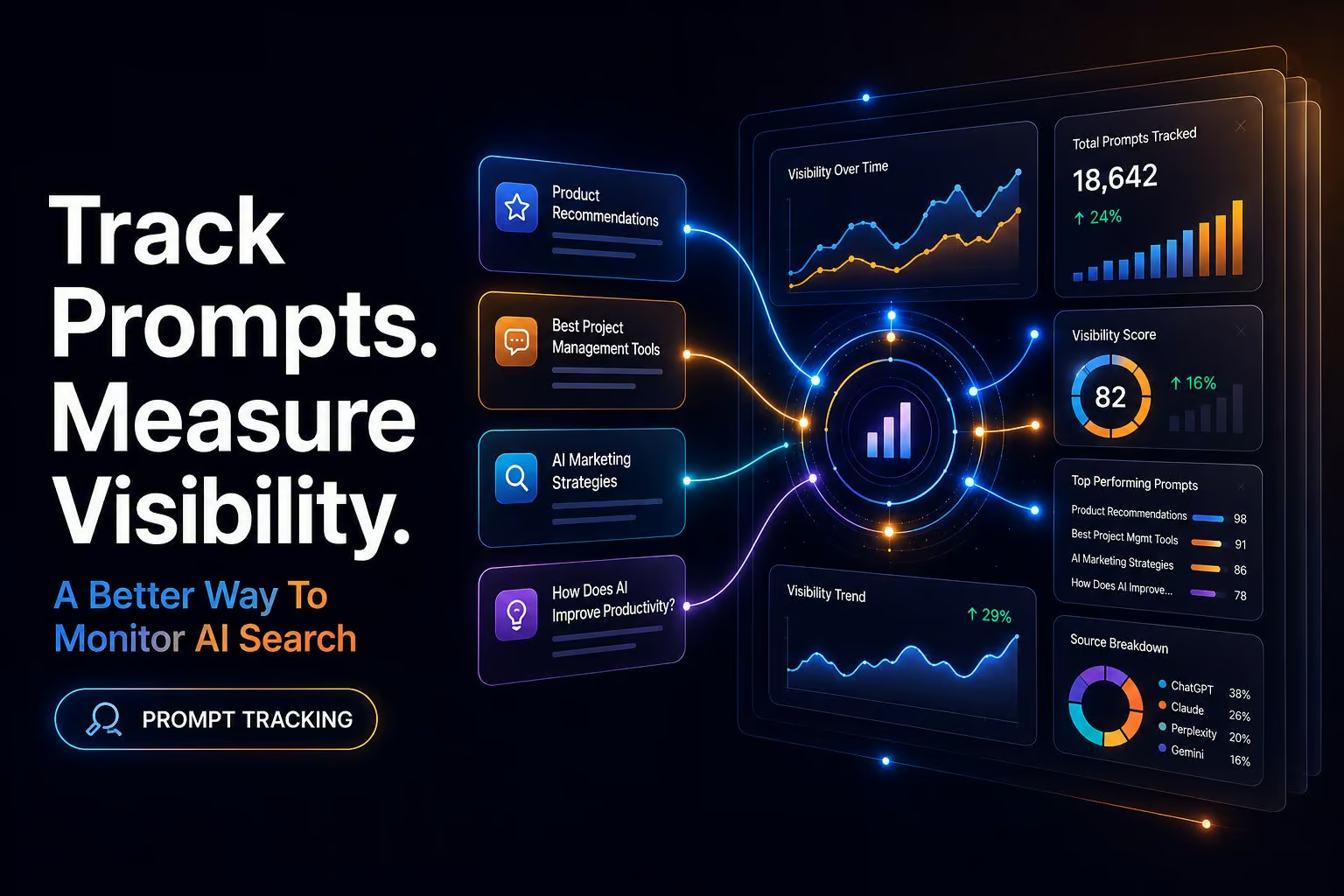
Backlinko published a study on LLM prompt tracking that measures how often brands get cited when real buyer questions go into ChatGPT, Perplexity, and Google AI Overviews. The core finding is straightforward: tracking which prompts trigger a citation in each large language model is now a more useful signal for AI search visibility than legacy rank tracking alone.
The study introduces a workflow that goes well beyond running a keyword rank report and hoping for the best. It maps prompts to the AI engines that answer them, records whether the engine cited the brand or skipped it, and then turns those answers into a fix list that an SEO or content team can act on.
Why LLM prompt tracking is different from rank tracking
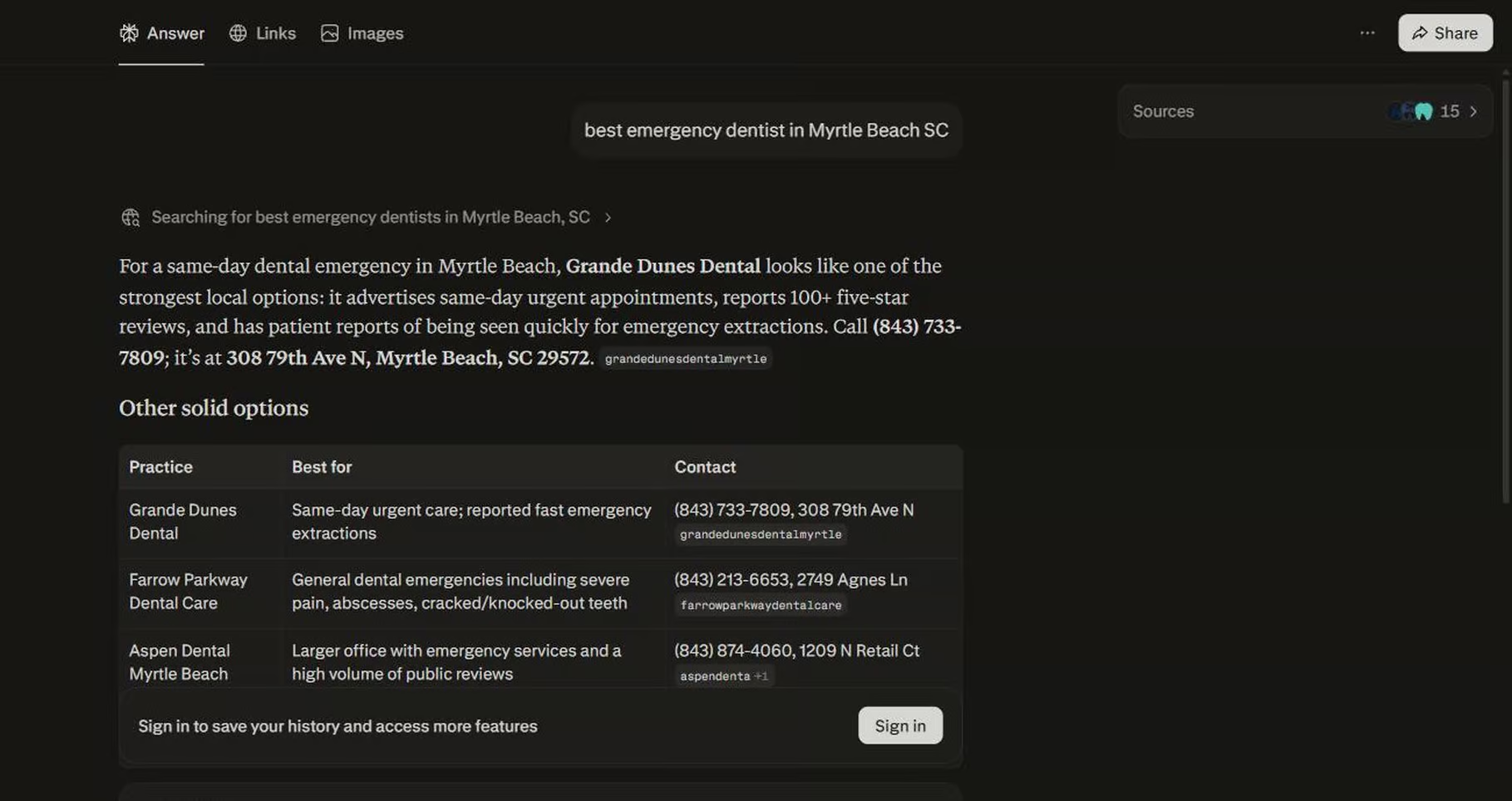
Ranking tools measure one thing: where a URL sits in a list of blue links. AI assistants do not return a list. They return a written answer, sometimes with a citation, often without one. A site that ranks fourth on Google can be the only brand named in a Perplexity answer, and a site that ranks first on Google can be missing from the ChatGPT reply entirely.
The Backlinko research highlights three patterns:
- Citations in AI answers do not track with traditional rankings. A page that ranks on page two can outcite a page that ranks on page one for the same query.
- AI engines pull from different surfaces. Google AI Overviews lean on Google’s own index. ChatGPT leans on its own retrieval stack plus live browsing. Perplexity behaves like a research engine with citations on most sentences.
- A small set of pages, mostly listicles, reviews, and directories, accounts for a large share of citations across many prompts.
What Backlinko measured
The study ran a set of buyer-intent prompts through ChatGPT, Perplexity, and Google AI Overviews and recorded which brands were named, which URLs were cited, and how those answers changed prompt to prompt. The prompts were commercial in nature, the kind a buyer types when they are close to a decision. The output was a citation report per engine, per prompt.
Backlinko also pulled in third-party context. The Orbit Media annual survey gives the long view on how SEO teams spend their time. The Airops benchmark gives a snapshot of which AI engines brands appear in most often. G2’s category data rounds out the picture by showing how review platforms influence which product gets recommended. Together these sources make a case that AI citation tracking needs its own measurement layer.
How to run an LLM citation audit
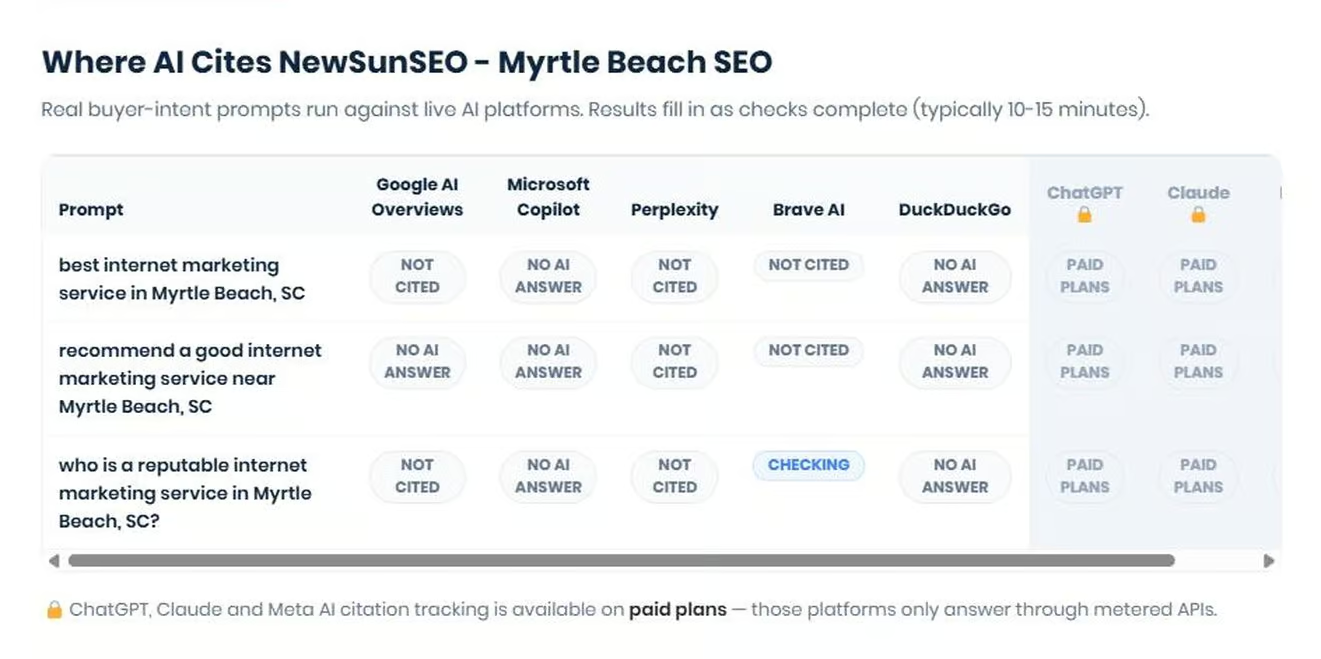
A practical audit follows four steps.
1. Build a prompt list from real buyer questions
Pull questions from sales calls, support tickets, Reddit threads, and the People Also Ask box. Group them by intent: comparison, best of, how to, near me, pricing. Each prompt becomes a row in a tracking sheet.
2. Run each prompt in each AI engine
Send every prompt to ChatGPT, Perplexity, Google AI Overviews, and any other engine the brand cares about. Record whether the brand is cited, which URL is cited if any, and which competitors are named.
3. Score visibility, not just presence
Being mentioned is not the same as being recommended. Count first-position recommendations, count mentions inside the body of the answer, and count appearances in cited source lists. The Backlinko work treats these as distinct outcomes.
4. Turn the audit into a fix list
Most citation gaps come from the same handful of issues: pages that AI crawlers cannot reach, structured data that is missing or malformed, content that does not answer the prompt directly, and weak third-party presence on the directories AI leans on.
What blocks a brand from being cited
AI engines can miss content for technical reasons.
- Robots rules that block AI crawlers. OpenAI runs three crawlers that do different jobs: GPTBot collects training data, OAI-SearchBot indexes pages for ChatGPT Search, and ChatGPT-User fetches a page when a user asks ChatGPT to look something up. Each obeys its own robots.txt rule, so blocking GPTBot alone leaves the other two free, while a blanket
Disallow: /for every user agent shuts out all three and keeps a brand out of citations even when the content is good. - Missing or thin llms.txt. llms.txt is a proposed standard, and support for it varies by engine; Google has said it does not use the file. It is cheap to publish, so treat it as a small extra rather than a fix on its own.
- No structured data. FAQ schema, Organization schema, and Product schema give AI engines fast access to the facts they need to cite a brand confidently.
- Weak third-party footprint. Review platforms, business directories, and Wikipedia entries often determine which brand an AI assistant names. A brand with strong content and no third-party presence gets passed over.
How to measure AI visibility in practice
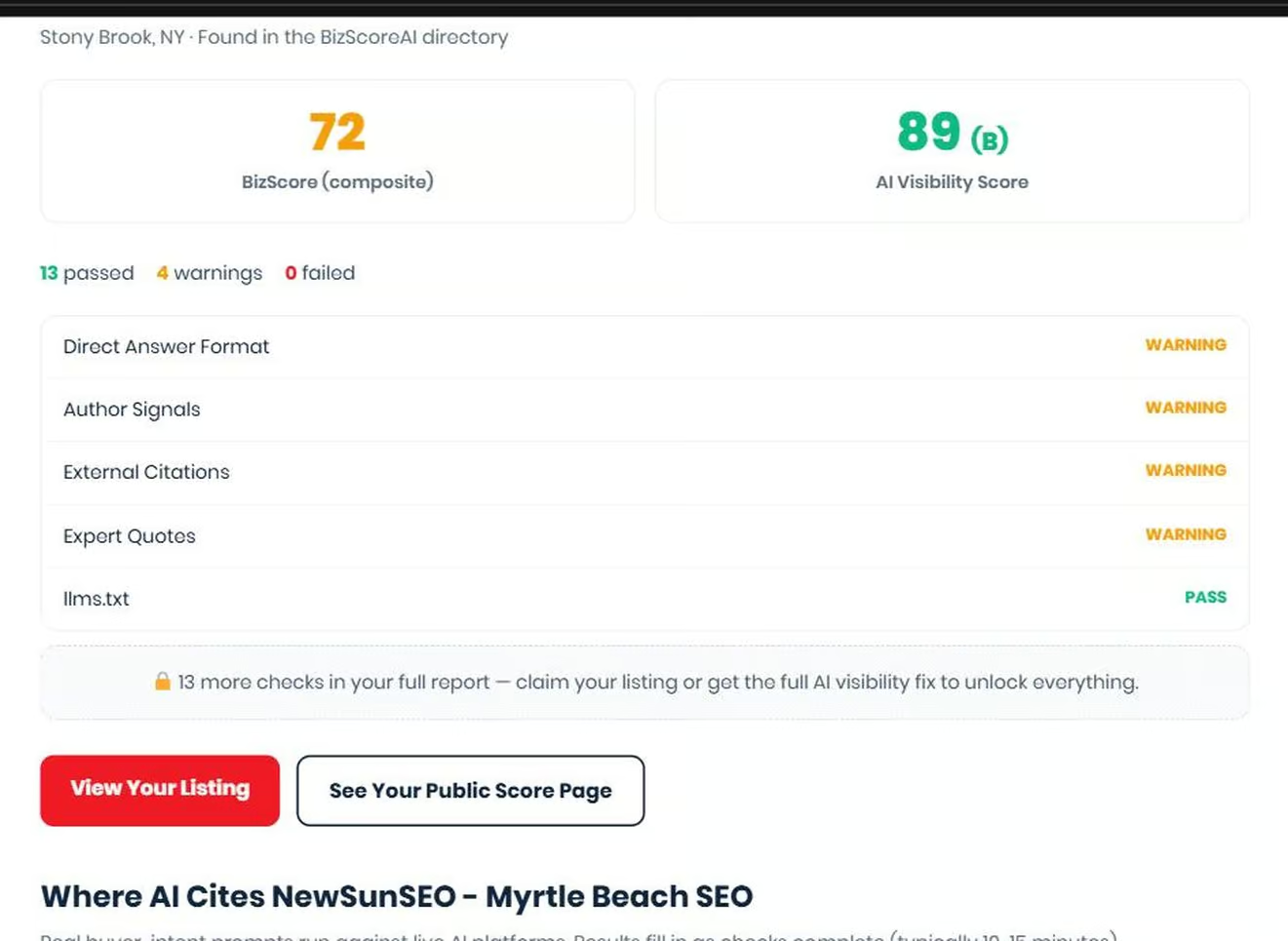
The fastest way to see whether AI engines can read a site is a free scan that checks the technical layer. BizScoreAI runs checks across AI search, SEO, local SEO, and directory accuracy, then sends real buyer-intent prompts into platforms like Google AI Overviews, Microsoft Copilot, Perplexity, Brave AI, and DuckDuckGo and may report cited or not cited for each platform. The free scan takes under a minute and shows which fixes will move the score fastest.
For a deeper review, the BizScoreAI AI Audit takes the scan further with a prioritized fix list and hands-on changes applied to the site. Pair that with the SEOScanPro AI Visibility tool, which its publisher says scores the technical layer across AI Discovery, AI Trust Signals, Structured Data, and Content Readiness and can tie each score to a measured value on the page. Together they cover both the citation question and the underlying crawlability question.
Where local SEO fits in
Local searches are where AI engines lean hardest on directories and review platforms. A brand that wants to be cited for “best plumber near me” needs consistent NAP data, strong reviews, and a claimed listing on every directory an AI assistant checks.
The SEOScanPro SEO audit can cover a broad set of technical checks across several categories and may show the measured value behind every score, including structured data, crawlability, and content depth. For service-area businesses, the SEOScanPro GEO Grids tool measures ranking from dozens of points across the map rather than one city average, so a brand can see exactly where it shows up and where it does not. Rank tracking through SEOScanPro Rank Tracker fills in the keyword movement that AI citations do not yet capture.
What to do this week
The Backlinko research points to a short list of moves that pay off fastest:
- Audit robots.txt for each AI crawler by name rather than as a block.
- Add or fix structured data on the pages that answer buyer questions directly.
- Claim and complete every directory listing that the AI engines read.
- Build a prompt-to-citation report for the ten questions buyers ask most, and refresh it monthly.
Each of these can be checked in under an hour with the right scan, and the gap between a brand that has done them and one that has not shows up in citation reports.
FAQ
What is LLM prompt tracking?
LLM prompt tracking is the practice of sending real buyer questions to large language models like ChatGPT, Perplexity, and Google AI Overviews and recording whether the brand is cited, which URL appears, and which competitors are named. The Backlinko study frames it as a separate measurement layer from rank tracking because AI answers do not behave like search result pages.
How is AI citation tracking different from rank tracking?
Rank tracking measures position in a list of links. AI citation tracking measures whether a brand is named or linked inside a written answer, and if so where in the answer. The same page can rank well in Google and still be absent from the ChatGPT reply for the same query, which is why the two need to be tracked separately.
What blocks a site from being cited by AI engines?
The most common blockers are robots.txt rules that block AI crawlers by mistake, missing or malformed structured data, content that does not answer the prompt directly, and a weak third-party footprint on the directories AI engines lean on. A free AI visibility scan can identify which of these apply to a specific site.
Related coverage