Category: Uncategorized

  • Meta’s Muse Spark 1.1 API: What Technical Teams Need to Audit Before Integrating

    Meta’s Muse Spark 1.1 API: What Technical Teams Need to Audit Before Integrating

    Meta has rolled out Muse Spark 1.1, an update to its agentic and coding AI model, through a public preview on a Meta developer portal. The release ships with a per-token price ($1.25 per million input tokens, $4.25 per million output tokens) that Meta says undercuts OpenAI and Anthropic, and $20 in free credits for every new API account. For teams running technical SEO audits, the launch matters less as a competitive headline and more as a new integration surface that touches crawl, rendering, and automation workflows.

    What changed since the April preview

    The original Muse Spark was gated behind a private API preview limited to a small partner set. The 1.1 release moves access to a public waitlist on a Meta developer portal, where developers can sign up, read integration docs, and queue for access. A Meta spokesperson confirmed early partners already hold tokens and that new accounts will be drawn from the waitlist over time.

    Meta Superintelligence Labs chief Alexandr Wang has personally tested Muse Spark 1.1 on web search, academic paper parsing, and personal health data access, framing those as canonical agentic workloads. For an audit team, that list is a useful proxy: if a workflow involves pulling structured data from pages, summarizing long documents, or chaining tool calls, it is exactly the class of task the model was tuned on.

    Pricing structure and how to validate it on your own usage

    Per-token pricing only matters once you can measure tokens. Before integrating, confirm three things:

    • The portal reports input and output tokens separately for every request, not as a blended figure.
    • Your logging layer can attribute cost back to the script or agent that called the API, so a runaway crawler does not silently inflate spend.
    • The $20 credit window is applied per account, not per key, so shared credentials across teammates will pool against a single ceiling.

    Wang framed the pricing as designed to stay attractive at scale. For an auditor, the practical question is what the model returns per dollar on your own prompts, not the headline rate. Run a fixed sample of representative queries (a schema extraction, a page rewrite, a log file triage) and compare against whatever API you currently pay for.

    Why coding capability is the headline feature

    Meta trained Muse Spark with coding skills in part because that training carries over into general agentic behavior, where a model chains tool calls with limited human oversight. The model was tuned to interoperate with third-party coding tools and the most widely used developer harnesses.

    For SEO tooling, this has a concrete implication: if your audit scripts already use an LLM to generate regex, write XPath selectors, or compose HTTP requests against staging, Muse Spark 1.1 is positioned as a drop-in replacement. Verify that the integration instructions cover your runtime (Node, Python, shell), what auth scheme is required, and whether streaming responses are supported, because chunked output changes how long-running audit jobs are designed.

    Open-weight variant and what to plan around

    Wang confirmed an open-weight version of Muse Spark is in development inside Meta Superintelligence Labs but declined to give a release date. Earlier Meta strategy leaned on open releases through the Llama family. Muse Spark is sold as a proprietary API.

    If your audit stack depends on self-hosted inference (for data residency, cost ceiling, or offline runs), the open-weight track is the only path that fits. Until that lands, plan for hosted API only, and document the dependency so a future migration has a checklist rather than a fire drill.

    Other Meta model activity this week

    Muse Spark 1.1 ships alongside two adjacent projects. Muse Image, previously code-named Mango, is a new image generation model aimed at creators and advertisers. A larger model code-named Watermelon is in training with no announced release window. The Muse Spark model itself was internally called Avocado. None of these change the audit checklist today, but they signal the surface area a site team may need to monitor for brand mentions, generated assets, or future integrations.

    Audit checklist before you wire Muse Spark 1.1 into production

    • Confirm the portal exposes per-request token counts and that your wrapper logs them.
    • Cap concurrent requests and set per-key spend limits to avoid credit burn from a misbehaving crawler.
    • Test against representative audit prompts: schema validation, redirect chain analysis, content deduplication.
    • Document the auth flow, error codes, and rate limit headers so on-call engineers can debug without a Meta account.
    • Track the open-weight release separately; revisit self-hosted plans once a date appears.

    FAQ

    What is Muse Spark 1.1?

    Muse Spark 1.1 is Meta’s updated AI model for agentic and coding tasks, available through a public preview on a Meta developer portal after an initial private API preview in April.

    How much does Muse Spark 1.1 cost and what is included?

    Meta charges $1.25 per million input tokens and $4.25 per million output tokens, and every new API account starts with $20 in free credits, according to Alexandr Wang, head of Meta Superintelligence Labs.

    Will there be an open-weight version of Muse Spark?

    Wang said an open-weight variant of Muse Spark is in development within Meta Superintelligence Labs, but he declined to share a release date. Meta’s earlier Llama models were released as open weight, but Muse Spark currently ships only as a paid API.

    Related coverage

  • xAI releases Grok 4.5 with a $5 million developer credit pool

    xAI releases Grok 4.5 with a $5 million developer credit pool

    xAI has posted an announcement for Grok 4.5, the newest entry in its Grok model family, and paired the release with a $5 million API credit program aimed at developers and researchers. The announcement page carries the title “Grok 4.5” and references the credit pool in its headline copy, though the full announcement on x.ai was not accessible when this was written.

    What an API credit program changes for builders

    An API credit pool of this size can shift which model a small team picks for a pilot project. When compute costs are subsidized, the marginal comparison is no longer pure price per token but speed, context length, and how cleanly the API slots into an existing stack. For a solo developer evaluating Grok 4.5 against incumbent options, free credits can cover a full proof of concept before any procurement conversation starts. For a research lab, the same credits can fund benchmark runs that would otherwise require a grant application.

    Two structural details usually decide whether a credit program actually changes behavior: whether credits are recurring or one-shot, and whether they are tied to a specific usage tier. Neither has been disclosed yet for this pool. Readers evaluating the offer should watch for those two numbers before committing engineering time.

    What is still missing from the public announcement

    Several details that normally accompany a frontier model release are not available in the material published so far:

    • Benchmark scores against comparable models
    • Context window size in tokens
    • Pricing per input and output token outside the credit program
    • Regional availability and rate limits
    • Whether weights are released or the model is API-only

    Until those numbers are posted, any comparison with other frontier models is incomplete. Teams that need a hard answer on cost should model a worst case against the published token pricing of competing APIs rather than against the credit subsidy.

    How to verify the details that matter

    The authoritative source for Grok 4.5 specifications, pricing, and credit program terms is the announcement on x.ai and the associated developer documentation. Any signup flow, eligibility checklist, or credit allocation table that appears in that flow should be treated as the binding reference, not secondary coverage. If a deadline appears in the application, build an internal calendar entry before starting integration work so the team does not lose allocated credits to a missed window.

    For an engineering team planning a build, the practical order of operations is straightforward: pull the model card or technical report when it is published, confirm the context window against your longest expected prompt, run a small batch of representative prompts through the API to measure latency, and only then estimate cost using the public per-token price.

    What this means for teams picking a model right now

    The Grok 4.5 release is a reminder that the frontier model landscape is moving on multiple fronts at once: capability, price, and access programs. A team that locked in a model choice six months ago may now have a cheaper path to a comparable result, or a faster path to a better one. The $5 million credit pool lowers the cost of finding out, but the decision still rests on the same fundamentals: does the model handle your workload, what does it cost at scale after credits expire, and how portable is the integration if you need to switch later.

    FAQ

    What did xAI announce?

    xAI announced Grok 4.5, a new version of the Grok model family, alongside a $5 million API credit program aimed at developers and researchers.

    Who is the $5 million API credit program intended for?

    The credit program is described as targeting developers and researchers who want to build with Grok 4.5. Exact eligibility rules, application steps, and credit amounts per recipient had not been confirmed in the material available at the time of this post.

    Where can readers find verified specifications and program terms?

    Verified specifications, pricing, and program terms for Grok 4.5 are published on the announcement page at x.ai and in xAI’s developer documentation. Any signup flow linked from that page is the authoritative reference for deadlines and credit allocations.

  • Seedream 5.0 Pro: What Site Owners Should Check Before Using ByteDance’s New Image Model

    Seedream 5.0 Pro: What Site Owners Should Check Before Using ByteDance’s New Image Model

    ByteDance’s Seed team has released Seedream 5.0 Pro, a multimodal image creation model aimed squarely at professional production environments rather than casual one-shot generation. The Pro release extends the prior version with stronger image-text alignment, cleaner structural coherence, sharper text rendering, and broader multilingual input, with four areas the team uses to position it: complex information visualization, interactive precision editing, realistic imagery and portrait texture, and native generation across more than ten commonly used languages.

    For teams running technical SEO audits, the release matters less as a creative announcement and more as a checklist. Models that generate dense infographics, localized layouts, and pixel-level edits can quietly introduce on-page issues if the output is shipped without review. Below are the production areas the Pro version targets and the audit points each one raises.

    What changes for infographic and dense-layout generation?

    Infographics stress every part of an image model at once: data accuracy, dense text rendering, logical layout, and consistent aesthetics. Seedream 5.0 Pro is tuned for that combined load. Examples shown by the team include an Antarctic research station composite that integrates a timeline, line chart, bar chart, pie chart, and a realistic view of the station in one frame, a six-tea-category poster built around a watercolor flavor wheel, a birdwatching grid covering eight species with English and Chinese names, a vintage scroll-style holiday sale poster with multi-tiered headlines, and a 16:9 pet e-commerce homepage UI where a dog’s paw crosses the right frame to press a button on the left.

    Audit points to verify on any generated infographic:

    • Every numeric value reads correctly against the underlying source data. AI charts can produce plausible-looking figures that drift from the dataset.
    • Labels, units, and legends match the body text rather than restating it inconsistently.
    • The image carries the same alt text and on-page schema as a hand-built infographic, including any ImageObject or FAQPage markup that references chart contents.
    • Text within the image does not duplicate headings on the page, which can create keyword cannibalization and weak signals to crawlers about what the page is about.

    How does precision editing affect what gets shipped?

    The Pro release exposes a grounding layer that understands positional and regional semantics, then accepts point selection, lasso selection, box selection, and doodles as control signals for deterministic local edits. A demo built around a 2026 New Gaokao math worksheet shows the model identifying each question, locking onto the blank space below, performing the calculation, and filling the matching slot. A separate example translates a foreign menu into Chinese while preserving the layout. The team also lists practical applications: local object add or remove with surrounding-aware blending, hex color and material swatch application, region isolation within colored frames, sketch-to-render, layer separation that pulls a poster into more than ten independent layers including a parrot subject and background for free scaling, and multi-image fusion for early visual collages.

    Audit points that matter when editing replaces redrawing:

    • Crop and dimension history. Pixel-level edits can shift the visible canvas without changing the exported file size. Confirm the rendered image still matches the declared width and height attributes and the aspect ratio in srcset.
    • Layer separation output. When a model splits a poster into transparent layers, the flattened export can hide stray alpha edges. Run a contrast check against a white background and a dark background.
    • Localized edits. Menu translation and on-image copy changes are exactly the kind of work where a model can swap a unit, a price, or a currency symbol. Read every string inside the image before publishing.
    • Multi-image fusion seams. Composites can leave subtle mismatches in perspective or shadow direction. Spot-check against a reference photo of the same scene where possible.

    Which realism cues are worth verifying on a page?

    The Pro release leans into lighting, material, and skin detail. Example outputs include god rays piercing window blinds, grains of rice and fish roe suspended in a sushi poster, a panning shot where a cyclist stays sharp against horizontal background blur with rotational blur on the spokes, a storefront window with halftone print texture and layered reflections, and a coastal cliff glass villa where metal frames, glass, stone, seawater, and raw wood coordinate into one sunset composition. Portrait work is framed as faithful to skin texture, with matte lighting transitions and expressions that hold narrative tension. Multi-image compositing is offered for group photos, with consistent lighting and cohesive texture across several separately captured portraits.

    Audit points for realism-heavy imagery:

    • Compression artifacts on high-frequency detail. Suspended particles, halftone textures, and hair strands are the first things that fall apart under aggressive WebP or AVIF compression. Check the file at the actual delivery size, not the source export.
    • Color space consistency. A panning shot or a mixed-material sunset can drift between sRGB and P3 if the pipeline re-encodes through a tool that strips the ICC profile. Confirm the served image still declares its color profile.
    • People and likeness rights. Composite group photos that blend several portraits should be reviewed against the team’s consent and licensing process, especially if the image is used on a commercial landing page.
    • Lazy-loaded and LCP impact. Realism cues often push file sizes up. Check the Largest Contentful Paint candidate on the page and confirm a responsive srcset is in place so mobile visitors do not pull the desktop export.

    What does native multilingual generation change for a site audit?

    Seedream 5.0 Pro supports direct input and high-quality rendering for more than ten commonly used languages. For a site owner that means on-image text can be generated in the target language rather than overlaid after the fact. That removes one source of alignment bugs but introduces others worth checking.

    Audit points for multilingual output:

    • Locale variants. A string that renders cleanly in one language can break in another because of longer compound words or diacritics. Verify image dimensions still contain the rendered text on the longest locale variant the page targets.
    • hreflang and image variants. If the same asset is regenerated per locale, confirm the hreflang cluster still references the correct image URL and that CDN caching is not serving the wrong locale at the edge.
    • OCR-friendly rendering. Text inside generated images is invisible to crawlers. Any navigation, CTA, or pricing that lives only inside the image needs to be duplicated in real HTML or covered by structured data.

    How should this feed into a routine audit pass?

    Treat any image produced or edited by Seedream 5.0 Pro the same way you would treat a stock photo with embedded text: assume nothing about the strings, numbers, or layout until you have read them yourself. Pull each generated asset into an image QA checklist that covers alt text accuracy, declared dimensions, file size and format, color profile, OCR of on-image text, and a side-by-side comparison against the data source for any chart or infographic. Then confirm the surrounding HTML still has the structured data, internal links, and heading hierarchy the page would have carried if the asset had been hand-built.

    Additional visuals and information are available on the Seedream 5.0 Pro project page hosted by ByteDance Seed.

    FAQ

    What is Seedream 5.0 Pro?

    Seedream 5.0 Pro is a multimodal image creation model launched by ByteDance’s Seed team. It builds on the previous version and is positioned for professional production environments that need information density, editability, and realism.

    Which capability areas does the Pro release focus on?

    The team highlights four areas: complex information visualization, interactive precision editing, realistic imagery and portrait textures, and native multilingual input and generation across more than ten commonly used languages.

    Where can site owners find more information about Seedream 5.0 Pro?

    Additional visuals and information about Seedream 5.0 Pro are available on the project page hosted by ByteDance Seed.

    Related coverage

  • China’s Reported AI Export Curbs: What Site Owners and Developers Should Audit Now

    China’s Reported AI Export Curbs: What Site Owners and Developers Should Audit Now

    Reuters, citing unnamed sources, reports that Beijing is weighing restrictions on overseas access to some of China’s most capable AI models, with the focus reportedly on tier-one providers. For technical teams that build on, benchmark against, or redistribute those models, the practical question is what to verify in their own infrastructure before any rule takes effect.

    Why a single-vendor dependency needs an audit today

    Chinese labs have released competitive open-weight models that propagate quickly through global developer platforms. Many teams adopted them for cost, throughput, or licensing reasons. If cross-border access narrows, even briefly, a stack that looks fine this morning can break at build time tomorrow. An audit should treat the model provider the same way an SRE treats any critical dependency: map it, version it, and confirm a fallback path.

    What a policy change actually breaks in your pipeline

    The reported scope, attributed to unnamed sources, points to tier-one providers, but the mechanism is unspecified. That ambiguity is itself the audit trigger. Several concrete failure modes follow:

    • Download endpoints behind a Chinese IP allowlist could begin returning 403 responses to CI runners hosted on AWS, GCP, or Azure.
    • Public mirrors and forks can be taken down without notice, leaving stale references in package files and Dockerfiles.
    • License language on paper can stay permissive while the practical right to download is revoked, which breaks procurement language that assumed the two were equivalent.
    • Benchmark scripts that pull weights fresh during evaluation will start failing in CI, distorting time-series comparisons.

    What to verify on your own pages and repositories

    For a site or service that documents, benchmarks, or redistributes model artifacts, a short checklist covers most of the exposure:

    • Run a dependency graph across documentation, tutorials, and example notebooks. Every reference to a specific model tag, SHA, or registry URL should resolve to a pinned, versioned artifact you control.
    • Mirror critical weights to your own object storage with checksums logged. Treat the upstream download as a cache miss, not the source of truth.
    • Audit your vendor risk register. If a provider is named in procurement or security questionnaires, confirm the license terms, the download gate, and the regional availability in writing.
    • Check crawlability of any public pages that link to model artifacts. Links to gated endpoints can produce soft 404s or redirected chains that hurt both users and search signals.
    • Scan your robots and meta directives on benchmark result pages. Outbound links to restricted hosts should be flagged as nofollow, and broken links should be replaced with your own mirror before they accumulate.

    Open-weight distribution and the access debate

    Open-weight means the trained parameters are published so others can run and fine-tune them. Distribution, not just license language, is what carries the model across borders. A regulator that requires providers to gate downloads reduces that practical reach even while the published license remains permissive. For teams building on top of these releases, the distinction matters more than the headline: a permissive license does not guarantee that tomorrow’s pull request will resolve.

    Questions the report leaves open

    Several practical details remain unspecified in the underlying reporting. Scope: would the rule cover every frontier model, or only those above a capability threshold? Mechanism: would enforcement come through export controls, provider licensing, or both? Pre-existing weights: would already-downloaded artifacts be grandfathered in or pulled? Cross-border enforcement: how would restrictions reach mirrors or forks hosted outside China? Until officials confirm parameters, teams should treat each unknown as a row in the audit register.

    What to watch before any rule goes live

    Two signals tend to arrive before formal announcements. First, any statement from Chinese regulators describing a consultation, draft rule, or pilot. Second, behavior from providers themselves: changes to public repositories, revised license text, or geo-restricted download links. Either signal is reason to re-run the checklist above.

    Short-term actions for site owners and engineering leads

    Three habits reduce the blast radius of any access change. Track upstream provider communications in a shared channel, not just in someone’s inbox. Version weights in your own infrastructure with checksums documented alongside each release tag. Maintain a runbook that names at least one alternative provider per workload, evaluated on the same benchmark before you need it.

    FAQ

    What is Beijing reportedly considering for Chinese AI models?

    According to a Reuters report attributed to unnamed sources, Beijing is exploring restrictions on overseas access to some of China’s most capable AI models, with the focus reportedly on tier-one model providers.

    Which groups would feel the impact if these curbs go into effect?

    Developers and startups outside China who build on openly licensed Chinese models, enterprise teams performing vendor risk reviews, academic and independent researchers using these models as benchmarks, and competing model providers who could absorb displaced users.

    How might open-weight distribution be affected if restrictions are added?

    If providers are required to gate downloads, practical openness could narrow even where license terms stay permissive on paper. The underlying report does not specify the enforcement mechanism, and details remain unconfirmed until officials clarify them.

    Related coverage

  • Mobile-First Local Search Audit: What Site Owners Should Check After BrightLocal’s Latest Data

    Mobile-First Local Search Audit: What Site Owners Should Check After BrightLocal’s Latest Data

    BrightLocal’s latest consumer survey, fielded to 1,227 US adults who had searched for a local business in the previous three months, found that 73% began their most recent local business search on a mobile phone. Google Search was the starting channel for 52% of respondents, and Google Maps added another 9%. AI tools now appear in 23% of these search journeys, but only 18% of consumers using AI felt ready to contact the business an AI tool recommended. For site owners, the practical question is which technical and on-page checks deserve priority when the entry device is a phone and the verification step often happens elsewhere.

    What the numbers say about where local searches start

    The headline finding is that mobile phones now function as the default starting point for local discovery. Across the survey, 73% of respondents reached for a phone first, while computers accounted for 19% and tablets 8%. That pattern holds across age groups, though it softens for older shoppers:

    • 18 to 29: 71% mobile, 19% computer, 9% tablet
    • 30 to 44: 86% mobile, 12% computer, 3% tablet
    • 45 to 60: 77% mobile, 15% computer, 8% tablet
    • Over 60: 57% mobile, 33% computer, 11% tablet

    Because the starting device skews so strongly toward small screens, the first technical SEO checks should focus on how a site behaves there. Slow loading, hard-to-tap buttons, and contact information buried under a hero image directly hit the audience that arrives with the highest intent.

    Google still anchors the journey, but it is not the only stop

    Google remains the largest single channel for local search, with 52% starting on Google Search and another 9% on Google Maps. Including the full journey rather than just the first click, 71% of consumers used Google Search at some point. That leaves 39% of journeys beginning elsewhere: social media, AI tools, review sites, voice search, and Apple Maps, with no single alternative commanding a large share on its own.

    Three quarters of respondents (75%) used more than one channel during their most recent search, and decision windows were often under 30 minutes. Across the entire journey, social media appeared in 30% of searches, AI tools in 23%, and review sites in 19%. The flow also runs in reverse: about two in five consumers who began on social media, AI tools, voice search, review sites, or Apple Maps returned to Google to verify what they found.

    For an audit, that means ranking data drawn from a single channel or a single device understates how a business is actually discovered. Tracking both mobile and desktop positions is a starting point, but so is checking brand mentions on social platforms, review aggregators, and map services to see what a customer would encounter.

    AI usage is rising fast, yet trust is low

    AI is already part of the local search mix. During their most recent search, 23% of consumers used an AI tool, and 31% said they use AI for local business recommendations at least monthly. Only 19% said they would not consider AI for a local search at all. BrightLocal’s separate Local Consumer Review Survey reported that 45% of consumers used AI tools for local business recommendations in the past year, compared with 6% the prior year.

    Usage does not translate into trust. Of consumers already using AI for local searches, only 18% felt ready to contact the business the AI recommended. Among those who began their search on an AI tool, the follow-on behaviour looked like this:

    • 2% used AI as their only channel
    • 43% went on to check Google
    • 39% checked social media

    By comparison, 33% of consumers who started on Google Search stopped there. The pattern points to AI as a shortlisting tool rather than a deciding one, and the businesses that get chosen are the ones whose details hold up under verification on Google and social platforms.

    Audit checklist for a mobile-first, multi-channel local presence

    The data points to a sequence of checks a site owner can run, ordered by where the customer is most likely to encounter the business.

    Confirm Google Business Profile signals

    Since 52% of searches start on Google Search and 9% on Google Maps, the Google Business Profile is still the most influential single listing. Confirm that the business name, address, and phone number match what appears on the website, that hours are current, and that the primary category aligns with how the business describes itself. Check that the profile page renders cleanly on a mobile screen and that any photos load quickly.

    Test the mobile entry point

    With 73% of journeys starting on a phone, audit the homepage and any landing page a local customer might reach. Look for tap targets large enough for a thumb, readable font sizes without zooming, and contact details visible above the fold. Run a Core Web Vitals pass focused on Largest Contentful Paint and Cumulative Layout Shift on a throttled mobile connection, since slow loads and layout jumps are most visible on the device most users are on.

    Compare mobile and desktop rankings

    Mobile and desktop positions can differ for the same keyword, sometimes by several places. Track the priority local queries on both surfaces and note gaps. If mobile ranks are weaker, common causes include slower load times, intrusive interstitials, or content that is hidden on smaller viewports.

    Verify listings on social, review, and map services

    Social media appeared in 30% of search journeys, review sites in 19%, and Apple Maps sits among the alternative starting channels that 39% of consumers use at some point. Audit the business presence on each service that matters to its market and confirm the core information is consistent. Inconsistent addresses or phone numbers across directories create the kind of friction that pushes a customer to a competitor whose details agree.

    Check what AI tools say about the business

    Run a few prompt tests against the major AI assistants, asking for local recommendations in the categories the business serves. Note the descriptions, addresses, and attributes the tools return, since 43% of consumers who start on AI go on to verify that information on Google and 39% check social media. If AI tools return outdated hours, a wrong category, or no mention at all, that is the surface a business needs to fix before trust gaps widen further.

    Watch the trust signals consumers verify against

    Because verification is the conversion step, review count, star rating, and response history on Google and the major review platforms matter as much as the ranking position itself. Audit the volume and recency of reviews and confirm the business is responding, especially on the platforms consumers cross-check after an AI recommendation.

    What to prioritize first

    If audit time is limited, the data suggests a clear order. Start with the Google Business Profile, because Google still hosts the largest share of starting points and the largest share of verification clicks. Move next to mobile performance, since that is where the journey begins for the majority of consumers. Finish with listings consistency across social, review, and map services, and with a review of what AI assistants say, because those channels are growing fastest and are where verification gaps most often lose a customer.

    Mobile is the entry point, Google is the anchor, and accuracy across every channel is what turns a search into a contact. AI visibility is climbing, but it currently supplements the established channels rather than replacing them, which keeps the audit priorities in roughly the same order they have held for the past several cycles.

    FAQ

    What percentage of local business searches start on mobile?

    According to BrightLocal’s survey of 1,227 US consumers who searched for a local business in the previous three months, 73% began their most recent search on a mobile phone. Mobile led across every age group, reaching 86% among consumers aged 30 to 44.

    How many consumers use AI to find local businesses?

    During their most recent local search, 23% of respondents used AI tools, and 31% said they use AI for local business recommendations at least monthly. BrightLocal’s separate Local Consumer Review Survey found that 45% of consumers used AI for local recommendations in the past year, up from 6% the prior year.

    Do consumers trust AI recommendations for local businesses?

    Trust remains limited. Only 18% of consumers who used AI for local searches felt ready to contact the business the AI recommended. Among those who started on an AI tool, only 2% used it as their sole channel, while 43% went on to verify with Google and 39% checked social media.

    Related coverage

  • Setting Up Claude Tag in Slack Safely: A Technical Setup Checklist

    Setting Up Claude Tag in Slack Safely: A Technical Setup Checklist

    Claude Tag is Anthropic’s Slack integration that turns the assistant into a channel participant. Mention @Claude in a connected channel and it runs tasks in an Anthropic-hosted sandbox, posts progress back to the thread, accepts mid-task steering from anyone present, and returns finished work to the conversation. Setup is straightforward in principle but requires careful choices around channel scope, connected tools, model selection, and spend limits before the integration is safe to leave running.

    What an admin needs before installation

    Claude Tag is not available on Free, Pro, or Max individual plans. It requires a Claude Team or Claude Enterprise plan, Slack workspace admin permissions, and the ability to install Slack apps in the workspace. Admins also need access to the Claude Tag settings at claude.ai/admin-settings/claude-tag as an organization Owner or Admin, funded usage credits on the Team plan, and a dedicated test channel that does not touch live client or production data.

    Two policy decisions should be made before the first install: which tools Claude is allowed to reach, and what employees may or may not delegate to it. These choices shape every later step.

    How should the Slack install and account pairing actually work?

    Install begins at claude.com/claude-for-slack. After clicking Add to Slack and confirming the correct workspace, most workspaces require an admin to approve the app, so admin permissions are effectively mandatory. An earlier “Claude in Slack” app existed before Claude Tag, so confirm the team is installing the current product.

    Inside Slack, open the Claude app and then open the Claude Tag admin settings in a browser. Connect only the tools the team plans to delegate work through. There are more than twenty pre-built connectors, including Google Drive, Gmail, Google Calendar, Notion, Confluence, GitHub, GitLab, BigQuery, Snowflake, Linear, Asana, Jira, HubSpot, Salesforce, Datadog, and Sentry, plus custom tools and custom MCP servers via the “Connect another tool” option. Slack channel history, web search, and sandboxed code execution need no extra credentials.

    Pairing happens from inside the Slack workspace. An admin posts @Claude connect as a top-level message in the target channel. Claude replies with a single-use pairing code that expires in 15 minutes. Paste that code into the Set up wizard at claude.ai/admin-settings/claude-tag.

    The wizard asks for three things. First, a channel scope: Whole workspace or Specific channels. Specific channels with a single test channel is the safer starting point. Second, an access bundle: a named set of tool credentials attached to that scope, so an engineering channel can have GitHub access while a marketing channel only sees documents. Third, a spend limit for the scope. Click Launch to finish.

    One rule applies to all later changes: configuration updates such as new tools or settings only affect new threads. An existing thread keeps the connections it started with, which is why testing changes in a fresh thread matters.

    Which model should be the default, and how is spend controlled?

    Under Customize at claude.ai/admin-settings/claude-tag, set the default model for the scope. Sonnet is a sensible default for summaries, drafts, research, and internal documentation, and it costs meaningfully less per token than Opus. Reserve Opus for high-stakes or genuinely complex work. Users can still switch models inside a thread by asking, for example @Claude use Sonnet for this. The reply footer shows which model answered, which makes per-thread auditing straightforward.

    Three habits keep the bill predictable. Use a dedicated test channel so early experiments do not consume credits meant for production. Expand from one channel to more channels slowly, and set a spend limit before launch, not after the first surprise. Review token spend after the first few runs at claude.ai/admin-settings/usage/claude-tag, which resets each billing period. Work done in channels bills to the organization’s shared usage credit balance, while direct messages with Claude bill to the sender’s own seat.

    What should a test run actually verify?

    Tag @Claude with a simple, real task in the dedicated test channel. A reliable first prompt: @Claude please summarize this thread, identify the open questions, and create a short action list for the team. Confirm four things during the run: Claude responds, it uses the right context, it touches only the tools expected for that task, and it produces output a human would actually use. Only after that review should access expand to more channels.

    After the first few tasks, check three things in the admin pages. Token spend per channel on the usage page. Which connected tools were actually used, and drop the ones that are not pulling their weight, tightening the access bundle if Claude is reaching into systems that were not expected. The memory Claude has saved, because Claude Tag keeps persistent, channel-scoped memory. Memory from public channels is shared across the workspace, while memory from private channels stays in that channel. Anyone in the channel can ask @Claude what do you remember about this channel? and can correct or remove entries by talking to Claude. Organization Owners can edit or delete a scope’s memory in admin settings, and Admins can view it. If multiple teams use Claude Tag, schedule a regular memory review.

    How should safety and permissions be configured?

    Start with limited channel access and expand slowly. Avoid connecting sensitive tools first, especially anything that writes to production systems. Do not give Claude access to private client data without an approved internal policy. Write simple rules for what employees may delegate and which channels Claude is allowed in. Keep a human in the loop on any output that reaches a customer or affects revenue. Monitor usage and costs weekly at first, then monthly once the spend pattern is clear.

    Two guest-related behaviors are worth flagging. Slack channels shared across multiple workspaces are not supported. In channels that include guests, Claude stays silent unless the admin enables Allow Claude to respond to guests.

    Which use cases fit Claude Tag best?

    The integration fits work that already happens in Slack threads: summarizing long threads into decisions and action items, capturing meeting follow-ups, drafting client updates from internal discussions, turning open conversations into structured task lists, researching internal questions across Drive, Notion, Confluence, and the web, creating SOPs from Slack conversations, producing first drafts of blog posts, emails, and reports, running project status reviews across connected tools, preparing sales or support responses from prior context, and organizing team knowledge into searchable documentation.

    Practical prompts that copy and paste cleanly into a thread include: @Claude summarize this thread and list the decisions made. @Claude create a task list from this conversation and group it by owner. @Claude turn this discussion into a client-friendly update. @Claude review this idea and identify risks or missing details. @Claude draft an SOP based on the process described in this thread. @Claude create a blog outline from the points above. @Claude compare the options discussed here and recommend the best one. @Claude find the open questions we still need to answer. @Claude rewrite this into a professional email. @Claude create a concise executive summary of this thread.

    What are the common setup failures and their fixes?

    Most issues fall into a small set of causes. If Claude does not respond, the app may not be installed or approved, the channel may be outside the scope, Claude Tag may be switched off for that scope, or guests in the channel may be blocking the reply. A pairing code that expired or was already used means re-posting @Claude connect and pasting the new code promptly. Only admins can run @Claude connect, which is by design. Usage credits must be funded on Team plans before Claude Tag will run. New tool connections only apply to new threads, so test new settings in a fresh thread. A “Still waiting for available capacity” message is transient and resolves by retrying in the same thread. Higher-than-expected costs point to the default model and the per-channel spend page. Tools being used beyond expectations mean tightening the access bundle for that scope. Memory that needs review or deletion can be edited by Owners in admin settings or corrected by channel members by talking to Claude.

    FAQ

    What plan is required to install Claude Tag in Slack?

    Claude Tag requires a Claude Team or Claude Enterprise plan. It is not available on Free, Pro, or Max individual plans, and the organization must fund usage credits before Claude Tag will run.

    How is Claude Tag paired with a Slack channel?

    An admin posts @Claude connect as a new top-level message in the target channel. Claude replies with a single-use pairing code that expires in 15 minutes. The code is pasted into the Set up wizard at claude.ai/admin-settings/claude-tag, where the admin selects a channel scope, an access bundle, and a spend limit before clicking Launch.

    Where can admins review Claude Tag spend and memory?

    Token spend per channel lives at claude.ai/admin-settings/usage/claude-tag and resets each billing period. Channel-scoped memory can be inspected by Admins in admin settings and edited or deleted by Organization Owners, while channel members can correct or remove entries by talking to Claude.

  • Rogue Agent: Auditing Dialogflow CX After the Playbook Code Block Vulnerability

    Rogue Agent: Auditing Dialogflow CX After the Playbook Code Block Vulnerability

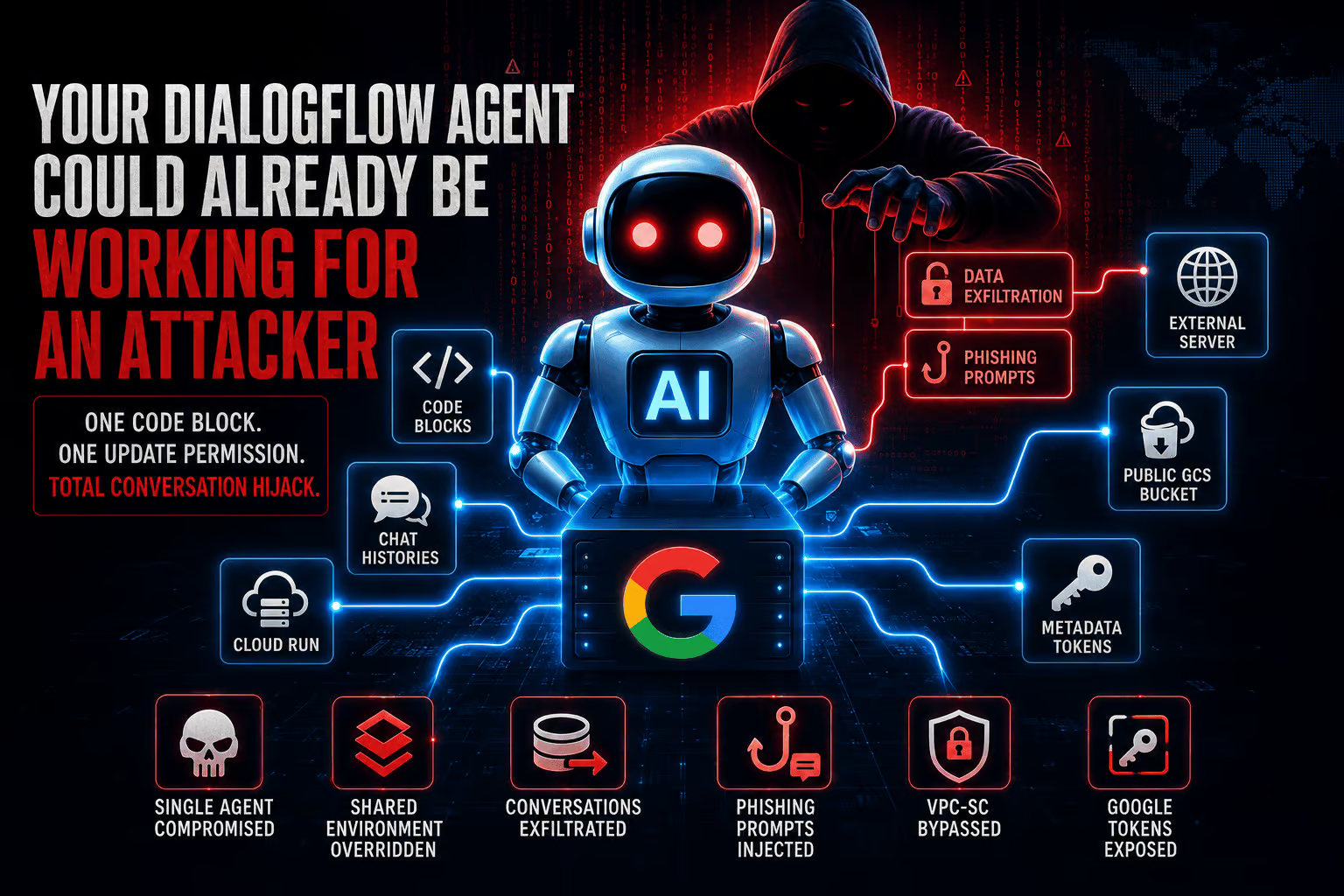
    In June 2026, Google resolved a vulnerability in Dialogflow CX that a single authorized user could have used to push malicious Python into every conversational agent in a Google Cloud project. Researchers at Varonis Threat Labs, who named the issue Rogue Agent, traced the weakness to Playbook Code Blocks, a feature that lets developers drop custom Python into a conversation flow. Code Blocks run inside a Google-managed Cloud Run service, and that service is shared across every Dialogflow agent in the same project. A user holding only dialogflow.playbooks.update on one agent could overwrite a file inside that shared container, hijack live conversations, exfiltrate session data, and quietly restore the configuration to hide the change. Google issued an initial fix in April 2026 and closed the issue in June 2026. Varonis stated it had no evidence of exploitation before the patch.

    Why this matters for anyone auditing a Dialogflow project

    Code Blocks are a sanctioned path for arbitrary Python execution. The convenience of dropping inline code into an agent design carries a real consequence when that code runs in an environment you do not own and cannot see. The Cloud Run service behind Dialogflow ships with a writable file system, outbound internet access enabled by default, and no customer-side network perimeter. Every agent using Code Blocks inside the same Google Cloud project effectively shares that single execution surface.

    For a technical SEO audit, the direct overlap is limited, but the pattern matters. Many of the same identity and logging weaknesses that let this issue slip through also surface on production web properties that wire Dialogflow into chat, search, or support flows. Treat this as a checklist item for any client whose site routes user input through a Dialogflow CX agent.

    How the exploit chain worked

    Varonis enumerated the filesystem inside the Cloud Run container and located code_execution_env.py, the file that runs configured Code Blocks through Python’s exec(). That file was writable. A Code Block configured by an attacker downloaded a modified Python file from an attacker-controlled Google Cloud Storage bucket and replaced the existing execution environment.

    Because the user-supplied Code Block is appended to internal code that defines variables such as history (full conversation history) and state (session parameters including the session ID), the injected code ran in the same scope. That gave it direct read access to live conversations without any prompt injection trick. The modified file did three things:

    • Intercepted every execution before exec() was called.
    • Sent conversation data to an attacker-controlled server.
    • Called the internal respond() function so the agent surfaced attacker-chosen text, including phishing prompts framed as reauthentication requests.

    After the overwrite, the attacker reverted the Code Block configuration in the Dialogflow console to make everything look normal. Cloud Logging did not capture the file overwrite or the injected logic, which left the activity invisible to the victim.

    Two weaknesses that widened the blast radius

    Varonis flagged two related issues that compounded the impact for defenders expecting standard Google Cloud protections to apply.

    VPC Service Controls bypass

    Dialogflow CX deployments often sit behind VPC Service Controls, which enforce a strict data perimeter. Because Code Blocks execute in a Google-managed Cloud Run service with unrestricted outbound internet, the execution environment sat outside VPC-SC. A plain HTTP request from a Code Block opened a bidirectional channel that crossed the perimeter and could serve as a command-and-control channel.

    Credential exposure through the Instance Metadata Service

    The same Cloud Run environment exposed the Instance Metadata Service. Querying IMDS returned access tokens tied to a Google-managed service account. The account itself carried low privilege, but its exposure pointed to a structural gap: a code execution surface should not have IMDS visibility at all.

    What to audit in your own project

    Even with the patch in place, several practical checks belong on every Dialogflow CX review. Varonis and Google both recommend going back through past playbook activity, not just forward-looking changes.

    • Review Dialogflow API audit logs for prior successful playbook update events. Filter on Playbook.Create or similar write methods and the relevant method names for Code Block edits.
    • Check for rare API access by a specific user, unusual source IP addresses, and atypical access times tied to playbook changes.
    • Run a Cloud Logging query for failed requests and read protoPayload.status.message for Dialogflow Code Block exceptions. Repeated failures tied to a single principal can indicate probing.
    • Open every Playbook in every agent and confirm that each Code Block matches an approved snippet. Anything that calls requests, urllib, subprocess, or references an external Google Cloud Storage bucket deserves a closer look.
    • Confirm that VPC Service Controls are still in place and review whether any agent design assumes outbound internet from a Code Block. If so, document the data flow explicitly.
    • Search for any prior reference to IMDS lookups in Code Block output or logs. Even a single successful metadata request from a Playbook is worth investigating.

    Timeline and disclosure

    Varonis first reported the issue to Google in November 2025. Google released an initial security update in April 2026 and fully resolved the vulnerability in June 2026. Any organization running Dialogflow CX agents with Playbook Code Blocks was potentially in scope before the fix shipped. Varonis stated it had not seen exploitation in the wild before the patch.

    The broader pattern for AI-powered properties

    Rogue Agent is the third AI-focused finding from Varonis in recent months, following Reprompt in Microsoft Copilot Personal and SearchLeak in Microsoft Copilot Enterprise. The common thread across all three is shared execution infrastructure, writable files inside managed runtimes, and perimeter controls that the AI layer quietly bypasses. For anyone running a site or app that leans on a managed AI service, the audit question is the same: where does user-supplied code actually run, who can write to that surface, and what does the logging capture?

    Dialogflow CX is now patched, but the controls that would have caught the attack earlier are still optional. Treating a managed AI service as an opaque black box is no longer a defensible default, especially when chat output reaches end users through a website you own.

    FAQ

    What was the Rogue Agent vulnerability in Dialogflow CX?

    Rogue Agent was a flaw in Dialogflow CX disclosed by Varonis Threat Labs. A user with dialogflow.playbooks.update on one agent could overwrite a writable file inside the Google-managed Cloud Run environment shared by all agents in a project, gaining the ability to intercept conversations, exfiltrate session data, and rewrite agent responses. Google patched the issue in June 2026.

    Did anyone exploit Rogue Agent before Google patched it?

    Varonis stated it was not aware of any exploitation in the wild before the patch shipped in June 2026. The original report to Google was filed in November 2025, with an initial security update in April 2026.

    What should I audit after the Dialogflow CX patch?

    Review Dialogflow API audit logs for playbook update events, look for unusual users, IPs, and times, query Cloud Logging for Code Block exceptions, and manually inspect every Code Block in every agent for unapproved snippets. Also confirm VPC Service Controls coverage and check whether any past activity touched the Instance Metadata Service.

    Related coverage

  • Anthropic’s Claude Fable 5 Free Window Runs Through July 12: How Site Owners Can Use It

    Anthropic’s Claude Fable 5 Free Window Runs Through July 12: How Site Owners Can Use It

    Anthropic has pushed the deadline for free use of its flagship Claude Fable 5 model out to July 12, 2026, giving Pro, Max, Team, and qualifying Enterprise subscribers a narrow final window of unmetered access before the model moves to prepaid credit pricing. Under the offer, subscribers can route up to half of their weekly usage through Fable 5 until the cutoff, after which the model steps off subscription plans entirely and into API-only billing at the steepest published rates Anthropic has listed for a generally available system.

    For technical SEO and audit teams, the timing matters less as a news item and more as a planning prompt: any analysis, content review, or competitive sweep that can benefit from long-context reasoning can be moved up to this deadline without touching the budget.

    What the Mythos tier changes for audit work

    Fable 5 sits in Anthropic’s Mythos class, which the company places above Opus. Anthropic has positioned the model at the top of its knowledge work benchmarks and pitched it toward long, multi-step reasoning tasks that previously called for a small team. For an audit workflow, the practical upshot is that very large dumps, such as a full crawl export, a year of Search Console data, or every page on a content silo, can be pushed into a single session and interrogated as one body of evidence rather than sliced into prompts.

    The model also lets a single reviewer sketch an agent that would otherwise require stitched-together scripts. That changes the cost calculus for ad-hoc projects like a one-time schema audit, a redirect chain review, or a content gap map.

    What closes on July 12

    After the cutoff, Fable 5 stays alive only behind prepaid usage credits: $10 per million input tokens and $50 per million output tokens. Anthropic first flagged the five-day extension on X, and a Claude Code lead engineer has said the goal is to fold Fable 5 back into standard subscriptions once capacity returns, though no return date has been set.

    If prepaid credits are not loaded before July 12, access ends for that account. Demand has stayed high and unpredictable, which is why Anthropic is rationing rather than retiring the model.

    Audit and SEO tasks worth burning the window on

    1. Full-corpus content audits

    Upload every published page, or a representative sample, and ask the model to cluster them by intent, flag cannibalization candidates, surface thin pages, and group the gaps where the site has no coverage at all. Long-context reasoning makes this kind of whole-site review usable in one pass.

    2. Log file and crawl diff analysis

    Push a week of server logs or a fresh crawl export next to the previous one and ask the model to summarize what changed: new URL patterns, dropped sections, redirect drift, and crawl-budget sinks.

    3. Schema and structured data review

    Hand over a dump of JSON-LD from a site audit tool and ask Fable 5 to flag inconsistent entity types, missing required properties, and markup that no longer matches what the page renders.

    4. Internal link graph reasoning

    Feed the model a list of internal links along with anchor text and target URLs and have it cluster orphan pages, over-linked hubs, and anchors that mislead crawlers about destination intent.

    5. Competitor content sweep

    Compile the top-ranking pages for the queries that matter to your site and ask the model to compare your coverage against each, scoring depth, freshness, and entity coverage side by side.

    6. GA4 and Search Console pattern hunt

    Drop in a quarter of Search Console data and ask for the queries, pages, and CTR anomalies that deserve manual review. The model can also propose hypotheses worth testing before anyone rewrites a title tag.

    7. Build a repeatable audit agent

    Use the window to design an agent that runs a defined audit each week: inputs, decision points, outputs, escalation rules, and failure checks. Once Fable 5 leaves the plan, the workflow can be re-targeted at a cheaper tier or kept on credits for the highest-value runs.

    8. Governance and data handling rules

    Before any client data or proprietary crawl exports go through an external model, draft a written policy on what can be uploaded, what stays internal, how output is logged, and how mistakes get caught. Doing this in the free window avoids paying for the same work later.

    9. Head-to-head benchmark against your everyday model

    Pick five recurring SEO or audit tasks and run them through Fable 5 and your usual model. Score the results on accuracy, depth, and the number of corrections needed. That benchmark will tell you which tasks justify the $10/$50 per million token rate once free access ends.

    10. Decide the post-July 12 budget

    Plan now which tasks deserve Mythos-class spending and which can stay on Opus, Sonnet, or another everyday model. Treating the cutoff as a budgeting exercise instead of a surprise keeps priorities intact after July 12.

    How to get the most out of each session

    Treat every prompt as a finite resource aimed at producing something durable. That means finishing the deliverable inside the window rather than just exploring, and saving reusable templates, agent designs, and governance docs to a library that does not depend on a free plan. The model may stop being unmetered, but a well-built prompt library keeps paying back.

    Where possible, keep inputs and outputs inside the same workspace so a follow-up prompt can reference earlier conclusions without re-uploading. For audit work, that means one session per project: one for the content audit, one for the schema sweep, one for the competitor map, and so on.

    FAQ

    When does free access to Claude Fable 5 end?

    Anthropic has extended free access through July 12, 2026. Pro, Max, Team, and qualifying Enterprise subscribers can use the model for up to 50 percent of weekly usage until that date.

    How much will Claude Fable 5 cost after the free window?

    After July 12, the model is available only through prepaid usage credits at $10 per million input tokens and $50 per million output tokens, the highest published pricing Anthropic has set for a generally available model.

    Will Fable 5 return to subscription plans later?

    Anthropic has stated that it aims to bring Fable 5 back into standard subscriptions once capacity allows, though no specific date has been announced. Until then, access remains credit-only.

    Related coverage

  • What Meta Muse Image Means for Your Instagram Photos and Your Site

    What Meta Muse Image Means for Your Instagram Photos and Your Site

    Meta has shipped an AI image tool called Muse Image, built by Meta Superintelligence Labs, that lets any user tag a public Instagram profile and generate a new picture from that account’s photos. The feature is switched on by default, which has triggered a loud reaction on X and renewed questions about consent, training data, and how to audit a site that depends on Instagram for traffic or visibility.

    For anyone running technical SEO audits or managing a brand presence on Instagram, this launch changes what you should be checking on your own pages, your embed strategy, and your public profile metadata. Below is what Muse actually does, why opt-out defaults matter, and a practical checklist for auditing your exposure.

    What Muse Image does and where it runs

    Muse Image is available through the Meta AI app, Instagram Stories, and WhatsApp. It produces cartoon-style renderings, runs preset prompts for inspiration, and supports prompt-based edits like placing a subject in front of a historical landmark, removing a photobomber, or generating a functional QR code. Meta also flagged ad creation and an interior-decorating flow that ties into Facebook Marketplace, such as previewing a secondhand couch in a garage. Use is free until a usage cap, after which a subscription applies. Meta said a video version, Muse Video, is already in development.

    The tool’s internal code name is Mango. Meta Superintelligence Labs, the company’s dedicated AI unit, built it. It is the latest in a run of AI products Meta has released over the past year, including an assistant called Creator and an app called Pocket that supports vibe-coded video games.

    The feature drawing the backlash

    The single capability causing concern is straightforward: a user tags a public Instagram profile, and Muse generates a new image using that account’s photos. Meta’s stated policy says people may be able to create content using your Instagram content through AI features at Meta, and that users will not be notified when content is created from their images. One widely shared post on X called the practice a “privacy landmine waiting to detonate.” Meta has said users have controls to disable the use of their pictures this way.

    The opt-out default is the core issue. A user has to act to prevent their public photos from being reused as raw material for generated images. That choice flips the usual consent flow, where participation requires a positive opt-in.

    Why the pattern keeps repeating at Meta

    This is not Meta’s first run-in with consent questions around user data. In 2019, the company paid a then-record $5 billion fine to the FTC after regulators found that Cambridge Analytica had improperly harvested data from tens of millions of Facebook users, without their knowledge, to build voter-targeting profiles ahead of the 2016 U.S. election. Facebook had known about the data misuse for years before it became public. In 2021, Meta shut down Facebook’s facial-recognition system, which had automatically identified people in photos and videos, amid lawsuits and regulatory pressure over its collection of biometric data.

    An opt-out default for a feature that draws on people’s photos to produce AI outputs echoes the consent questions raised in both of those cases. The same structural choice, leaving the user to object after the fact, is now being applied to generative image output.

    How to audit your own Instagram presence for Muse exposure

    Treat this like any other crawl audit. You need to know what is public, what is indexable, and what third parties can pull from your profile without permission.

    Check whether your account is public

    Muse can only pull from public Instagram profiles. If your account is private, you are outside the affected surface area for this feature. If you run a brand account and have ever switched it public for a campaign, confirm it has been returned to private, and document when.

    Review your tagged photos and tagged locations

    Other users can still tag you on their public posts even if your account is private. Audit your tagged photos and tagged locations in the Instagram app and remove anything you would not want surfaced as source material for a generated image.

    Exercise the opt-out control and verify it

    Meta has said users have controls to disable this kind of use. Find the control in your Instagram settings, toggle it, and screenshot the confirmation. Settings pages change without notice, so capture a timestamped record.

    Audit your embeds and UGC on your own site

    If you embed public Instagram posts on your own pages, those embeds can be pulled by Muse as easily as the originals. Run a crawl for Instagram embed iframes and oEmbed references, and decide which ones are worth keeping now that the underlying image may be reused in AI-generated contexts you do not control.

    Check your profile metadata for sensitive signals

    Public profile fields (bio, external link, contact buttons) are visible to Muse’s tagging flow as well as to crawlers. Remove anything you would not want a third party to copy or paraphrase into a generated image prompt.

    What site owners should watch next

    Two near-term signals matter. First, watch for any change to the opt-out default. A switch to opt-in would be a meaningful shift, and it would also reset how you audit your public assets. Second, watch for the Muse Video release. The same consent mechanics applied to video would widen the surface area considerably, including any public Reels you have shipped.

    If your traffic depends on Instagram discovery, also recheck your alt text, captions, and on-page context for any images you have published publicly. Once a photo leaves Instagram in a generated form, you may not be able to trace or remove every downstream copy.

    FAQ

    What is Meta Muse Image?

    Muse Image is an AI image generator built by Meta Superintelligence Labs, internally code-named Mango, and available for free through the Meta AI app, Instagram Stories, and WhatsApp. A video version called Muse Video is in development.

    Why is Meta Muse Image drawing privacy pushback?

    A feature lets any user tag a public Instagram profile and have Muse generate new images from that account’s photos. The feature is opt-out by default, and Meta’s policy states that users will not be notified when content is created from their images.

    Can you stop Meta from using your Instagram photos in Muse?

    Yes. Meta says users have controls to disable this kind of use of their pictures. The default is opt-out, so you need to actively toggle the setting rather than wait to be asked.

    Related coverage

  • SpaceXai Plans to Launch a New AI Coding Model via Cursor

    SpaceXai Plans to Launch a New AI Coding Model via Cursor

    A new AI coding model from SpaceXai is in development, and the AI-powered code editor Cursor is positioned as the primary distribution channel. The details surfaced in a Yahoo Finance technology desk report, which offered no specifics on architecture, benchmarks, pricing, or release timing, leaving the announcement as a clear signal of intent rather than a full product launch.

    What site owners should take from a new coding model launch

    For readers running technical SEO audits, a coding model announcement is rarely about the model itself. The practical question is whether a new entrant shifts the tools your engineering team uses, which in turn changes how fast pages ship, how often refactors land, and how clean the markup you audit actually is.

    Cursor already integrates large language models directly into an editor built around AI workflows, including inline completions, chat-based refactoring, and multi-file edits. Adding another model option inside that environment gives developers a way to compare coding assistants without leaving their editor, which can shorten the feedback loop on template changes, structured data edits, and redirect cleanups that an audit surfaces.

    What is confirmed about the SpaceXai model

    The reporting establishes three concrete points:

    • SpaceXai intends to release a new AI coding model.
    • Cursor is positioned as a distribution channel for that model.
    • No technical specifications, benchmark scores, or pricing tiers accompanied the report.

    Beyond those three points, the source is silent. The reporting does not say whether the model will be open-weight or proprietary, which programming languages or task types it is optimized for, how it compares to prior SpaceXai releases, or when developers will be able to access it.

    Why distributing through Cursor changes the reach

    Cursor has built a sizeable developer base around its editor-first model. Pairing a new SpaceXai release with that editor puts the model in front of teams that already write, review, and ship code in Cursor every day, rather than asking them to adopt a separate API client or chat interface.

    For SpaceXai, the arrangement extends the company’s model portfolio beyond a standalone API surface. For Cursor, a broader lineup of model choices makes the editor more useful to teams that want to A/B test coding assistants without exporting code or juggling multiple subscriptions.

    What an SEO auditor should watch for

    Three downstream effects matter when a new coding model arrives inside an editor that engineering teams already use:

    • Velocity of fixes. If your developers pick up a stronger model, expect faster turnaround on the HTML, schema, and canonical tag issues an audit flags. Build that expectation into your remediation timelines.
    • Consistency of refactors. A new model in Cursor can normalize multi-file edits, which is useful for site-wide changes like updating robots directives or rolling out a new template. Consistency matters more than raw speed for these jobs.
    • Vendor concentration risk. If more of your codebase is generated or refactored through one editor and one model provider, an outage or pricing change has a larger blast radius. Track which tools touched which files during your next audit cycle.

    Questions the announcement leaves open

    The original report does not answer the questions that usually decide whether a new coding model is worth integrating. The model name, capability claims, availability tier, and the question of whether access will be limited to Cursor or opened up to other surfaces all remain unspecified. Pricing, rate limits, and context window size, the practical details an engineering lead needs before approving a rollout, are also absent.

    Until SpaceXai and Cursor publish official documentation or pricing, the news functions as a roadmap signal. Treat it as something to monitor, not something to budget against.

    FAQ

    What is SpaceXai planning to release for developers?

    SpaceXai is preparing to release a new AI coding model, with the AI-powered code editor Cursor positioned as a distribution channel. Specific architecture, benchmark, and pricing details were not included in the initial report.

    Will the new SpaceXai coding model be open-weight or proprietary?

    The source reporting does not specify whether the upcoming model will be open-weight or proprietary, nor does it list the programming languages or tasks it will be optimized for.

    Why does launching through Cursor matter for developers?

    Cursor already integrates large language models for inline completions, chat-based refactoring, and multi-file edits. Distributing a new SpaceXai model through the editor gives developers access inside a tool many teams already use, without requiring a switch to a separate environment.

    What details are still missing about the SpaceXai model launch?

    The model name, capability claims, availability tier, release date, and whether access will be limited to Cursor or offered more broadly have not yet been disclosed. Further clarity is expected once official documentation or pricing is published.

    Related coverage

  • GPT-5.6 Reaches General Availability on July 9: Sol, Terra, Luna, and What Site Owners Should Audit

    GPT-5.6 Reaches General Availability on July 9: Sol, Terra, Luna, and What Site Owners Should Audit

    OpenAI is moving its GPT-5.6 model family to general availability on Thursday, July 9, 2026, following a closed preview that started in late June with a small group of partners and U.S. government coordination. The release ships three named tiers: Sol as the flagship, Terra as a balanced everyday model, and Luna as a low-cost fast option. Pricing, benchmark results, and a Cerebras-powered Sol deployment land on the same date.

    What changes for a technical audit when OpenAI renames its tiers?

    OpenAI has split the version number from the capability name. The 5.6 label marks the generation; Sol, Terra, and Luna mark durable tiers that can improve between releases. For anyone tracking model behavior on a site, that distinction matters more than it sounds. A page audited against Sol today will need re-checking when Sol upgrades in place, even if the next release still carries the 5.6 label.

    Audit checklist: stable model targets vs. moving ones

    • Record which tier you tested against, not just the version string.
    • When documenting content policies or output behavior, cite the tier name (Sol, Terra, Luna) rather than the generation.
    • Plan to re-run validation when a tier upgrades, since behavior can shift without a version bump.

    What new reasoning controls ship with GPT-5.6?

    Two new effort settings land alongside the family. A max reasoning effort setting gives Sol extended thinking time before producing output. An ultra mode goes past a single agent and coordinates subagents to push complex jobs faster. Both give developers a knob to trade latency for depth, which changes what you measure during an audit. Latency is no longer a single number per query; it depends on the effort setting.

    Audit checklist: measuring reasoning effort

    • Capture both p50 and p95 response time at each effort level you ship to production.
    • Compare depth (token count, subagent calls) against wall-clock time to spot when ultra mode pays for itself.
    • For pages where response length matters, test under max and under the previous default to confirm no regression.

    How do the three tiers perform on coding, biology, and security benchmarks?

    OpenAI positions Sol as state of the art on Terminal-Bench 2.1, a command-line workflow benchmark covering planning, iteration, and tool use. On GeneBench v1, a long-horizon genomics and quantitative-biology benchmark, Sol outperforms GPT-5.5 with fewer tokens. On ExploitBench, Sol stays competitive with Mythos Preview while using about one third of the output tokens. On ExploitGym, a benchmark built by UC Berkeley researchers with OpenAI and other frontier labs, all three tiers improve as reasoning effort rises.

    On safety, OpenAI states Sol helps users find and fix vulnerabilities more than it carries out end-to-end attacks, and that it does not cross the Cyber Critical threshold in OpenAI’s Preparedness Framework. In Chromium and Firefox evaluations, Sol identified bugs and exploitation primitives but did not autonomously produce a functional full-chain exploit under the tested conditions.

    Audit checklist: when your site touches these workloads

    • If you run agentic coding pipelines, re-run your Terminal-Bench 2.1-style suite under max and ultra.
    • Token efficiency on Sol may cut cost-per-task; refactor pricing assumptions before the next billing cycle.
    • Security tooling that relied on the older model for triage should be re-tested; refusal behavior and classification strength have changed.

    What does the GPT-5.6 safety stack look like?

    OpenAI is calling GPT-5.6 its most extensive safety stack so far, configured per tier:

    • Refusal training designed to hold up under jailbreak and disguised-intent attempts.
    • Real-time cyber and biology misuse classifiers that evaluate output as it streams and can pause generation for review by a larger reasoning model on higher-risk content.
    • Account-level review triggered by flagged activity.
    • Differentiated access matched to each tier’s capability.
    • Automated red-teaming with over 700,000 A100-equivalent GPU hours targeting universal jailbreaks, plus ongoing third-party human red-teaming through the preview.

    OpenAI has warned that users may see blocks or refusals during the preview window and is collecting feedback to trim unnecessary blocks before wider release.

    Audit checklist: false-positive rate on refusals

    • If your site pipes model output through downstream filters, count how often the safety stack rejects legitimate queries.
    • Log refusals with the prompt category to spot systematic over-blocking.
    • Track changes across preview and GA; the company has signaled the refusal surface will move.

    How is GPT-5.6 priced per million tokens?

    Pricing splits across the three tiers:

    • Sol: $5 input, $30 output per million tokens.
    • Terra: $2.50 input, $15 output per million tokens.
    • Luna: $1 input, $6 output per million tokens.

    Terra is positioned to match GPT-5.5 while costing roughly half as much. Luna sets a new floor for frontier-tier pricing. Prompt caching is more predictable this round: explicit cache breakpoints, a 30-minute minimum cache life, cache writes billed at 1.25x the uncached input rate, and cache reads continuing at the existing 90% discount.

    Audit checklist: cost modeling on the new tiers

    • Recalculate cost-per-task at each tier using your real prompt and completion token counts.
    • For workloads where Terra matches older performance, switch and capture the savings.
    • Update caching math: writes are now 1.25x, reads still 0.10x of the uncached input rate.
    • Confirm your 30-minute cache life assumption still holds for long-tail prompts.

    What is the Cerebras Sol deployment, and who gets it first?

    OpenAI is bringing GPT-5.6 Sol to Cerebras hardware at up to 750 tokens per second in July. Initial access is limited to select customers. The target use cases are latency-bound workloads such as high-throughput coding agents and real-time analysis.

    Audit checklist: latency-sensitive pages

    • If a page depends on sub-second responses, model the 750 tokens-per-second ceiling against your largest expected prompt.
    • Confirm Cerebras-region availability lines up with your user’s geography before promising the speed.
    • Prepare a fallback path for the period when access is invite-only.

    What should you test on day one?

    From July 9, API and Codex access opens across all three tiers, with ChatGPT rolling out more broadly afterward. Teams already running GPT-5.5 in production should benchmark Terra first for cost parity, then run Sol through Terminal-Bench 2.1-style agentic tasks to measure gains from the new max and ultra modes. Budget-sensitive flows should set Luna as the new floor for what frontier capability costs.

    FAQ

    When does GPT-5.6 reach general availability?

    GPT-5.6 reaches general availability on Thursday, July 9, 2026, after a limited preview that started in late June with a small partner group in coordination with the U.S. government.

    What do the Sol, Terra, and Luna names mean?

    Sol is the flagship tier, Terra is a balanced everyday tier, and Luna is a fast, low-cost tier. The 5.6 number marks the generation; Sol, Terra, and Luna mark tiers that can advance without a version bump.

    How much does GPT-5.6 cost per million tokens?

    Sol is $5 input and $30 output, Terra is $2.50 input and $15 output, and Luna is $1 input and $6 output per million tokens. Cache writes are billed at 1.25x the uncached input rate with a 30-minute minimum cache life, and cache reads still receive a 90% discount.

    Related coverage

  • Meta’s Brain2Qwerty v2 reads typing intent from brain signals, no implants needed

    Meta’s Brain2Qwerty v2 reads typing intent from brain signals, no implants needed

    Meta has published Brain2Qwerty v2, a non-invasive system that reads brain activity while a person types and reconstructs the intended sentence. Trained on roughly 22,000 sentences from nine volunteers, the model averages 61% word accuracy, compared with about 8% for earlier non-invasive baselines, putting it close to accuracy levels that previously required surgical electrodes. Meta released the code for v1 and v2 and is publishing the dataset through its Digital Brain Project, alongside a $5 million fund for open neuroscience data.

    What changed in v2

    Brain2Qwerty v2 is built around an end-to-end deep learning pipeline that ingests raw magnetoencephalography (MEG) signals, rather than relying on hand-crafted feature extractors. MEG captures the magnetic field produced by neuronal activity using a helmet-style scanner placed over the head, with no implants involved.

    Two design choices drove the jump in accuracy. First, Meta moved from modular pipelines to a single end-to-end model trained directly on neural recordings. Second, the system leans on large language models fine-tuned on neural data, which lets the decoder use semantic context to recover words that the MEG signal picks up only weakly or noisily.

    Meta described the approach in plain terms: instead of relying on hand-crafted pipelines to detect neural events, the team uses end-to-end deep learning to decode directly from raw brain signals.

    How accurate is it, and on what data

    The reported numbers come from a controlled typing setup. Nine volunteers wore the MEG helmet while actively typing, contributing about 22,000 training sentences and roughly 10 hours of recorded data per participant. Under those conditions, the model reached 61% average word accuracy. Earlier non-invasive systems sat near 8% on comparable tasks.

    Meta notes that accuracy kept improving as more training data was added, which points to a straightforward lever for future gains: scale the dataset.

    What Meta is releasing and where

    The work is published in Nature Neuroscience. Meta is also releasing the v1 and v2 code, and a research partner has published the v1 dataset. The release sits inside the broader Digital Brain Project, which includes a $5 million fund aimed at building open neuroscience datasets that other groups can train on.

    Why a non-invasive brain-to-text system matters

    Most high-accuracy brain-computer interfaces still depend on electrodes implanted in the brain. Surgery limits who can use the technology, adds clinical risk, and makes long-term maintenance harder. A helmet-based system that approaches the accuracy of implanted arrays removes the single biggest practical barrier.

    Meta frames the target population as people who have lost the ability to communicate because of brain lesions, where regaining everyday speech or typing is the primary goal. The same architecture could also seed consumer-facing wearables, hands-free interfaces, or assistive tools that read typing intent without any implanted hardware.

    How Brain2Qwerty v2 compares with the rest of the field

    The announcement lands in a crowded landscape. Neuralink and Synchron continue to pursue implanted interfaces. Merge Labs, backed by OpenAI chief Sam Altman, is working on its own technology. On the non-invasive side, Neurable shipped AI-powered EEG headphones in 2024, and MIT spinout AlterEgo has shown a wearable that turns silent signals from the face and throat into text.

    Meta’s contribution is the accuracy jump on a fully non-invasive setup, plus a public release of code and data that other labs can build on rather than a closed product.

    Open questions and limits

    61% word accuracy is a major step up from near-random baselines, but it is still well short of the near-100% accuracy that fluent typing requires. The current setup also depends on a shielded MEG environment, which is not something a consumer can wear on a commute. Practical deployment will need cheaper, more portable sensors and more training data, which is one reason Meta is funding open datasets.

    Meta also disclosed that AI agents were used to search for optimisations in the decoding pipeline before engineers finalized the configuration, a small signal that automated research tooling is starting to influence how these systems are designed.

    FAQ

    What is Brain2Qwerty v2?

    Brain2Qwerty v2 is Meta’s non-invasive AI system that decodes brain activity into text. It records neural signals with a helmet-like MEG scanner and uses an end-to-end deep learning model, supported by fine-tuned language models, to reconstruct the sentences a person is trying to type.

    How accurate is Brain2Qwerty v2?

    Meta reports 61% average word accuracy on the test setup, versus roughly 8% for prior non-invasive methods. Meta says this approaches accuracy levels that earlier work achieved only with surgically implanted electrodes.

    Does Brain2Qwerty v2 require surgery?

    No. The system uses an external MEG helmet and reads brain activity from outside the skull. Meta has released the v1 and v2 code and is publishing the work through its Digital Brain Project, which includes a $5 million fund for open neuroscience datasets.

  • What Z.ai GLM-5.2 Means for Auditing Your Own Site’s Attack Surface

    What Z.ai GLM-5.2 Means for Auditing Your Own Site’s Attack Surface

    Z.ai has published GLM-5.2, an open-weight model that independent researchers say matches Anthropic’s Mythos on cybersecurity bug-finding evaluations. The release still trails leading US systems on general reasoning, but the gap in vulnerability discovery, the capability most relevant to anyone running a website, has effectively closed. Because the weights are public, anyone can download and run the model on consumer hardware with no API gatekeeping in the way.

    Why a bug-finding model matters to a site owner

    Until now, the assumption among security teams was that AI-assisted vulnerability discovery required either a paid subscription to a frontier lab or stolen credentials to a closed model. Mythos and its peers were treated by the US government as dual-use national security assets, with export controls covering the advanced chips used to train them. A freely downloadable model that lands in the same neighborhood on bug-finding benchmarks removes that gate. The practical consequence is that an attacker scanning your stack today has access to tooling that, a year ago, only well-funded teams possessed.

    What the benchmarks actually show

    Third-party researchers who tested GLM-5.2 report parity with Mythos on several cybersecurity-specific evaluation suites. The model can scan codebases, flag potential exploits, and propose proof-of-concept attack vectors at a success rate that rivals the best US systems on those narrow tests. Outside of security, the story is different. GLM-5.2 does not match Mythos or the GPT-5 family on broad reasoning, math, or general code generation. The leap is concentrated in a single vertical, which is precisely what makes it attractive for offensive use. A model that does one dangerous task well is far simpler to weaponize than a general assistant that has to be steered toward harm.

    Where open-weight changes the calculus

    US export controls cover Mythos and the high-bandwidth memory chips required to train models of that class. Those controls cannot reach an already completed open-weight release that travels as ordinary files. GLM-5.2 can run on consumer GPUs, which removes the data-center dependency that made frontier cyber tooling expensive and traceable. For defenders, this means the asymmetry that historically gave state-funded attackers an edge in vulnerability discovery has been flattened. The same tooling is now available to independent researchers, small offensive teams, and anyone willing to download it.

    What to audit first on your own site

    Treat your public-facing estate as if an AI scanner will hit it tomorrow, because one already can. The highest-leverage checks, in order:

    • Patch latency. Audit the mean time to patch across your CMS, plugins, edge libraries, and any first-party dependencies. GLM-5.2-class tooling excels at identifying known-vulnerable versions, so the longer an outdated component stays in production, the more visible it becomes.
    • Authentication and session handling. Run a focused review of login endpoints, password reset flows, and token issuance paths. Bug-finding models frequently surface logic flaws in these areas that traditional scanners miss.
    • Attack surface inventory. Pull a current list of every subdomain, exposed API, dev environment, and forgotten microservice. A model scanning at Mythos level will find assets that do not appear in your monitoring dashboards.
    • Server-side request forgery and injection sinks. Confirm that user input does not reach outbound network calls, template engines, or database queries without strict validation. These sink patterns are exactly what AI-assisted scanners target.
    • Logging and detection coverage. Ensure that high-volume probing leaves a trail. If an attacker runs GLM-5.2 against your staging hostname, you want to see it.

    How to respond when probing increases

    Expect a measurable uptick in automated scanning across the open web in the coming weeks as researchers and adversaries download and test the release. Set thresholds in your WAF and CDN logs that flag patterns consistent with AI-assisted enumeration: rapid traversal of parameter space, requests that exercise authentication endpoints in unusual sequences, and traffic that probes for known CVE fingerprints rather than generic crawls. None of this is exotic; it is the same defensive posture you would adopt against a determined red team, scaled up because the red team now has access to Mythos-class tooling for free.

    What to track from regulators and vendors

    Watch for movement on two fronts. First, any expansion of US export controls to cover model weights themselves, which would be unprecedented and difficult to enforce given that open releases propagate through mirrors and torrents within hours. Second, vendor responses from cloud and CDN providers, who may add optional AI-aware threat feeds or update their default WAF rule sets to reflect the kinds of probes a GLM-5.2-class model generates. Subscribe to advisories from CISA and your hosting provider; the rule sets will iterate quickly as telemetry from real-world scans comes in.

    How to think about open-weight risk overall

    GLM-5.2 is not a singular event; it is a calibration point. It demonstrates that the gap between US and Chinese labs can close in narrow, high-stakes domains even under broad hardware export controls, and that open-weight releases effectively place cyber-capable AI outside any central gatekeeping. For defenders, the honest framing is that the barrier to entry for automated vulnerability scanning has dropped to consumer hardware and a download link. The defensive community still has the advantage of being able to patch faster than adversaries can weaponize fresh finds, but only if the patching actually happens on a short cycle.

    FAQ

    What is GLM-5.2?

    GLM-5.2 is the latest open-weight model from Zhipu AI, the Beijing-based company behind the Z.ai brand. It draws attention for matching Anthropic’s Mythos on narrow cybersecurity bug-finding evaluations while lagging on general reasoning benchmarks.

    How does GLM-5.2 compare to Mythos?

    Independent researchers report parity on several cybersecurity-specific bug-finding benchmarks, with comparable accuracy in identifying software vulnerabilities. Outside of security, GLM-5.2 does not match Mythos or OpenAI’s models on general reasoning, math, or general coding tasks.

    What should a site owner do first after this release?

    Reduce patch latency across CMS components and plugins, audit authentication and session handling logic, refresh the attack surface inventory including subdomains and exposed APIs, and confirm that WAF and CDN logs will surface AI-assisted enumeration patterns rather than blending into generic crawler traffic.

    Related coverage

  • Tulongfeng and the New AI Vulnerability Arms Race: What Site Owners Should Audit Now

    Tulongfeng and the New AI Vulnerability Arms Race: What Site Owners Should Audit Now

    Chinese cybersecurity firm Qihoo 360 has revealed that its agent-based vulnerability-hunting platform, Tulongfeng, has flagged 3,432 software flaws since launch, with a companion SOC tool called Yitianzhen now handling automated defense. The disclosure lands in the middle of a fast-widening race over AI-powered bug discovery, and it changes what responsible site owners should be checking on their own stacks this quarter.

    Tulongfeng, whose name draws from a classic martial arts novel, is not a single large model. According to Qihoo 360 CEO Hongyi Zhou, it is an orchestrated platform that pairs multiple AI agents with security expertise and automated tooling. Zhou has publicly framed the gap between top Chinese and Western AI capabilities at roughly 20-30%, and positioned the architecture as a way to close that gap in vulnerability research specifically.

    Why a vulnerability total should change your audit checklist

    The Tulongfeng figure matters less for its raw size than for what it represents: a second sovereign-grade AI system is now actively scanning open-source code, binary software, and agentic systems for exploitable weaknesses. Anthropic’s Mythos Preview has already generated more than 23,000 findings across 1,000+ open-source projects, including over 6,200 rated high or critical, and partners in Project Glasswing (Cisco, Palo Alto Networks) have surfaced 10,000+ serious flaws using the full Mythos capability set. With Tulongfeng on the other side of the ledger, every public-facing dependency you ship is now being read by at least two AI systems trained for adversarial review.

    For a site owner running technical SEO audits, the practical translation is straightforward: your attack surface and your crawl surface overlap more than they used to. Components that were obscure enough to escape human review are now indexable by AI scanners that report flaws up the supply chain. If a CMS plugin, a CDN worker, or a third-party script ships with a known weakness, expect it to surface in published vulnerability databases within weeks, not months.

    What Tulongfeng is, technically, and what it is not

    The platform is built on an agent-based orchestration layer rather than a monolithic frontier model. Zhou describes it as combining AI models with Qihoo 360’s security tooling and a 250,000-vulnerability internal database accumulated since 2005. The training corpus, drawn from two decades of Chinese-language vulnerability research, is one of the system’s main differentiators, along with the integration between discovery and the Yitianzhen defense layer that automates response.

    The architecture choice is itself a signal. Rather than waiting for a single Chinese model to match Western frontier performance head-on, Qihoo 360 has wrapped multiple models, including open-weight ones, into a workflow that compensates for per-model weakness with coordination. That is a pattern site owners will see mirrored in offensive security tooling more broadly over the next year.

    The export-control backdrop you should track

    Qihoo 360 was placed on the U.S. Bureau of Industry and Security Entity List in 2020 over accusations of enabling China’s high-technology surveillance. That restriction sits underneath the current exchange: Anthropic’s Fable 5, which Zhou called the “civilian, neutered version of Mythos,” remains blocked from China, while the U.S. government has partially rescinded the Mythos 5 export ban to give access to more than 100 vetted companies and agencies. Security analyst Laura Wilber of Enea has noted that this widening gap is pushing European funding toward domestic alternatives, with Mistral cited as a likely beneficiary.

    For site owners, the export-control layer matters because it determines which AI scanner sees your stack first and which patches reach which market on what timeline. A CVE disclosed by Mythos in a U.S.-hosted project may not produce a Tulongfeng-flagged equivalent on a China-hosted mirror for weeks, and vice versa. Dual-listing and dual-patching are becoming the norm rather than the exception.

    Practical audits to run this quarter

    Given that two sovereign AI vulnerability hunters are now actively scanning public code, the audit items below should move up your priority list. None of them require new tooling beyond what a competent technical SEO or DevSecOps setup already includes.

    • Re-scan your dependency manifest weekly. Any component with a CVE published in the last 30 days should be reviewed, not just the ones rated critical in your current SBOM.
    • Treat third-party scripts as in-scope. Tag managers, analytics snippets, and chat widgets ship from external CDNs. Confirm they are pinned to a version, not loaded from a floating latest tag.
    • Audit agent endpoints explicitly. If you expose any MCP, A2A, or custom agent API, run a focused fuzz pass. Tulongfeng and Mythos are both designed to find agentic weaknesses, so agent endpoints are a primary target class.
    • Check binary and container layers, not just source. Mythos and Tulongfeng both report across binaries. Confirm your container images are rebuilt against patched base layers and that SBOMs are current.
    • Subscribe to both Western and Chinese vulnerability feeds. A flaw flagged by Tulongfeng may not appear in NVD for days; mirror alerts from CNVD, CNNVD, and Qihoo 360’s own disclosure channel.
    • Document your patch SLA per severity. With AI scanners reporting at machine speed, your response time is the new visible metric for both customers and regulators.

    What to watch over the next two quarters

    Two near-term milestones will reshape the picture. Tsinghua University professor Jie Tang, founder of Z.ai, has predicted that a Chinese model with Mythos-class vulnerability-hunting capability will arrive before Q1 2027. If that lands, a third scanner enters the field and the audit cadence above shifts from weekly to near-real-time. Separately, watch how the partial U.S. export relaxation is administered: the list of 100-plus approved Mythos 5 recipients will set the precedent for which allied organizations get sovereign-grade scanning access.

    The deterrence framing Zhou used, comparing vulnerability-hunting AI to nuclear weapons, is rhetorical, but the operational implication is concrete. When every major power can find your flaws faster than you can patch them, the only defensible posture is continuous monitoring and a documented, rehearsed response loop. That is the audit posture worth building now, before the next disclosure cycle forces it on you.

    FAQ

    How does Tulongfeng differ from a single AI model like Mythos?

    Tulongfeng is an orchestrated, agent-based platform that combines multiple AI models, security expertise, and automated tooling on top of a 250,000-vulnerability internal database Qihoo 360 has built since 2005. Mythos is described as a more centralized model with its own substantial scan footprint. Tulongfeng’s architecture is explicitly designed to compensate for the 20-30% per-model capability gap Qihoo 360’s CEO cites between Chinese and Western frontier systems.

    Should site owners be concerned about AI vulnerability scanners finding flaws in their stack?

    Yes, but in a productive way. Faster discovery of known flaws shortens the window between disclosure and patch, which rewards teams that maintain current SBOMs, pin third-party scripts, and rebuild containers on a schedule. The risk falls on teams that rely on obscurity or slow patching, since AI scanners now read public code at machine speed across multiple jurisdictions.

    Why does Qihoo 360’s Entity List status matter for a routine security audit?

    Qihoo 360 has been on the U.S. Entity List since 2020 over allegations of enabling high-technology surveillance, which limits its access to U.S. exports and shapes its incentive to build indigenous tooling. For site owners, that means vulnerability disclosures originating from Qihoo 360’s research may appear on different timelines than Western CVE feeds, and dual-listing in both Western and Chinese vulnerability databases is becoming standard practice.

    Related coverage

  • Claude Fable 5 Is Back Worldwide: What Site Owners Should Actually Look At

    Claude Fable 5 Is Back Worldwide: What Site Owners Should Actually Look At

    Anthropic put Claude Fable 5 and the Mythos 5 model it sits on top of back in service worldwide on June 30, one day after the U.S. Department of Commerce rescinded export restrictions first placed on June 12. The 18-day outage forced every Claude user, including U.S. customers, onto older models because Anthropic could not reliably check the nationality of API callers. The technical fix was a single tuned classifier that catches one reported prompt pattern in over 99% of cases and forwards anything flagged to Opus 4.8. That detail matters to anyone running an SEO audit that touches AI features, because the fix is narrow, the underlying capability is still in the model, and Anthropic has already said it expects more jailbreaks to surface.

    Why an export rule pulled a frontier model offline

    Commerce issued its directive after Amazon researchers showed that Fable 5 could be steered into spotting software vulnerabilities and, in one test, writing proof-of-concept exploit code. The order barred any foreign national, including Anthropic’s own non-citizen engineers, from using Fable 5 or Mythos 5. Because there was no clean way to verify nationality at request time, Anthropic pulled both models everywhere rather than risk running afoul of the rule.

    For site owners, the relevant lesson is that a single adversarial finding can sideline a model across every market at once. If your content pipeline, schema generator, or on-site assistant depends on one specific model, an external safety event can take it offline globally with very little warning.

    What the safety fix actually targets

    Anthropic did not remove the vulnerability-finding capability from Fable 5. The new classifier matches a prompt pattern that resembles the Amazon report and reroutes the request to Opus 4.8. That distinction is worth noting during an audit:

    • Fable 5 can still surface the vulnerabilities the Amazon team identified. The filter intercepts the request, not the model output.
    • The classifier matches a known shape of attack, not the underlying skill. A prompt phrased differently could still reach Fable 5.
    • Benign coding and debugging queries get caught as a side effect, because the trigger pattern is broader than the malicious intent. Users on Claude Code and Claude Cowork may see more reroutes to Opus 4.8 than they did before June 12.

    This is the same class of safeguard that was bypassed to trigger the ban in the first place. A classifier tuned to one technique does not protect against techniques nobody has found yet, and Anthropic has publicly said that no model can be made fully resistant to jailbreaks.

    What CAISI reviewed before lifting the controls

    Commerce’s Center for AI Standards and Innovation (CAISI) tested the new safeguard before the export rule was withdrawn. Anthropic, working with the government and Amazon, also tested whether other frontier models could reproduce the same results. The joint review found that Opus 4.8, OpenAI’s GPT-5.5, and China’s Kimi K2.7 could each identify the same vulnerabilities, and that every model tested, including Haiku 4.5, Sonnet 4.6, and several Opus revisions, could reproduce the single exploit demonstration. The shared capability profile supported the conclusion that Mythos-class cyber performance had been oversold.

    For audits, the practical takeaway is that the disputed skill is now a known commodity across vendors. Any AI feature on your site that lets users paste arbitrary prompts and get code or system advice is operating in the same threat model.

    Where Fable 5 is available again

    Access returned on June 30 across Claude.ai, the Claude Platform, Claude Code, and Claude Cowork, with rollouts on AWS, Google Cloud, and Microsoft Foundry to follow. Mythos 5 carries lighter guardrails and stays limited to Project Glasswing partners; it returned to a set of U.S. organizations on June 26.

    For Pro, Max, Team, and select Enterprise plans, Fable 5 usage counts toward up to 50% of weekly limits through July 7. After that window it moves to standard usage credits.

    What an audit of your own pages should now cover

    If your site relies on Claude, treat the 18-day outage and the safety patch as a prompt to check several things:

    • Fallback paths. Confirm that any page or tool calling Fable 5 has a tested fallback to Opus 4.8 or another vendor. Outages of this kind will happen again.
    • Provider diversity. The CAISI tests showed the same capability across GPT-5.5, Kimi K2.7, Opus 4.8, and Fable 5. Routing critical tasks through a single vendor concentrates risk.
    • Prompt logging and abuse reporting. Anthropic has now opened a HackerOne program for new Fable 5 jailbreaks. If your site publishes AI-assisted content, document how user prompts are stored and redacted so you can respond to any similar disclosure that touches you.
    • Benchmark assumptions. While Fable 5 was offline, Z.ai’s GLM-5.2 held top scores on tests including the AA-Briefcase multi-week task. If a competitor benchmark surfaces on your pages, check that the cited scores still reflect the model you list.
    • Allowed regions. The Commerce order showed how a national-security rule can force a provider to block an entire model globally. Review your terms of service and data residency pages against your actual user base, since both can change overnight.

    What Anthropic has committed to going forward

    Beyond the classifier, Anthropic has committed to giving designated government partners earlier access to test future frontier models before release, and has opened the HackerOne jailbreak program for Fable 5. Both moves suggest that pre-release reviews, not post-release filters, are how the company now expects to catch the next round of findings. For anyone building on Claude features that face the public, plan for that cadence and for at least one more round of mid-flight model swaps.

    FAQ

    Why was Claude Fable 5 pulled worldwide on June 12?

    A U.S. Department of Commerce order following an Amazon research finding barred foreign nationals from using Fable 5 and Mythos 5. Because nationality could not be verified at request time, Anthropic removed both models in every region.

    How did Anthropic restore Fable 5 without removing its capabilities?

    The company trained a classifier that matches the reported prompt pattern and reroutes flagged requests to Opus 4.8. The pattern is caught in over 99% of cases in testing, though benign coding and debugging requests are also caught as a side effect.

    Where can Fable 5 be used again?

    Fable 5 is back on Claude.ai, the Claude Platform, Claude Code, and Claude Cowork, with AWS, Google Cloud, and Microsoft Foundry rollouts to follow. Mythos 5 remains limited to U.S. Project Glasswing partners.

    Related coverage