
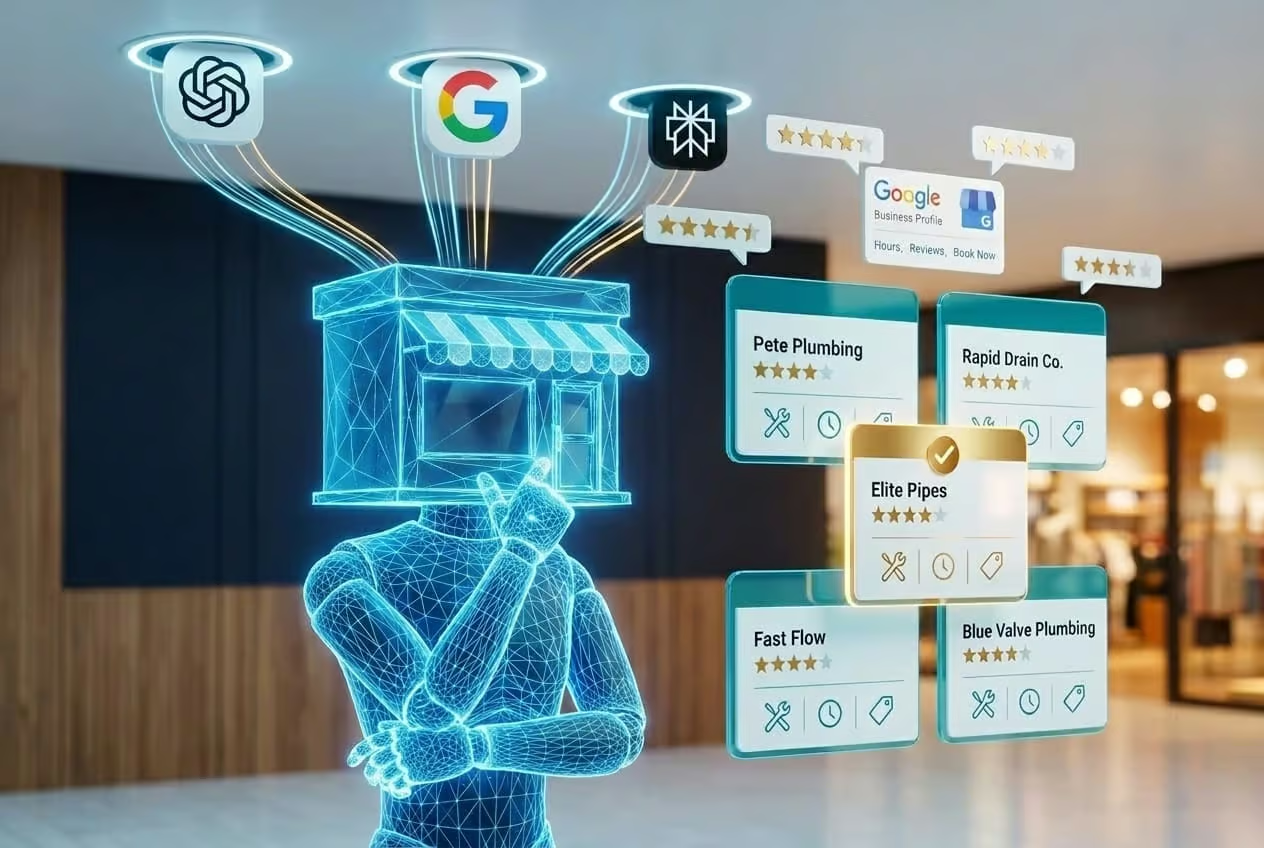
More than two thirds of Google searches in the U.S. and EU end without a click to the open web, according to a 2024 SparkToro study. That single statistic reshapes what a technical SEO audit should look for in 2026. If your pages are still optimized only for blue-link rankings, you are auditing for a channel that is shrinking while AI assistants, including ChatGPT, Google AI Overviews, Perplexity, and Gemini, absorb the rest of the demand. For site owners, the question is no longer ‘how do I rank’ but ‘how do I make my business the cleanest, most structured answer an AI can cite.’
This guide walks through what to check on your own site, what to clean up across the wider web, and which numbers to anchor your work against.
Why a zero-click audit matters more than a ranking report
Ranking tools still measure position in the classic results, but AI assistants rarely expose those positions. They synthesize a direct answer, often pulling from a mix of Google Business Profile data, structured website content, review platforms, and high-authority third-party mentions. A page can sit at position three and still be invisible to every AI that references your category. Conversely, a competitor with weaker backlinks but tighter structured facts can dominate the answer box, the AI Overview, and the spoken voice response on a phone.
Three reference points frame the urgency:
- 68.2% of Google searches in the U.S. and EU end without a click to the open web, per SparkToro’s 2024 zero-click research.
- 76% of people who search on a smartphone for something nearby visit a related business within 24 hours, according to Google.
- 23% of U.S. adults had used ChatGPT as of February 2024, a figure that doubled from the prior year, per Pew Research Center.
Your audit checklist has to cover the surfaces AI actually reads, not just the pages Googlebot indexes.
Which surfaces does AI pull from, and how do you audit each one?
AI engines blend four data sources: training snapshots, live web pages, knowledge graphs fed by profiles such as Google Business Profile, and structured feeds from directories. Treat each as a separate audit layer.
Google Business Profile completeness
Sign in and walk the entire backend. Hours, services, products, payment methods, accessibility attributes, and service areas all need values. The business description should state plainly what you do and for whom. GBP data feeds Google’s Knowledge Graph directly, so any missing field is a missed citation.
NAP consistency across the open web
Pull your name, address, and phone number as written on GBP, then run a search for your business plus the word ‘listings’ or ‘directory.’ Compare each citation character by character. A stray suite number, a ‘Street’ versus ‘St’ abbreviation, or an old phone line fragments the entity in the AI’s confidence model. Use a citation audit tool or a manual spreadsheet and fix every mismatch you control.
Structured facts on your own pages
Open your homepage and each service page. Above the fold, in plain HTML text (not inside an image, slider, or PDF), you should be able to find a declarative sentence answering each of these: what do you do, where do you serve, what does it cost, why should a customer choose you, and how do they book. If any answer requires scrolling, opening a modal, or downloading a file, it does not count for AI parsing. A semantic triple such as ‘We service Portland, average repair cost $150, same-day appointments available’ is the cleanest pattern. Schema markup for LocalBusiness, Service, and Offer reinforces those sentences.
Review breadth and detail
Pull a list of every platform with a live profile: Google, Yelp, BBB, industry-specific sites such as Houzz, Avvo, or TripAdvisor, and any niche directories your category uses. A single platform with most of your reviews is a weaker signal than smaller counts spread across five or more trusted domains. Audit the language of your last twenty reviews on each platform. If customers are not mentioning service types, price ranges, or problems solved in their own words, prompt them for specifics in your next follow-up email.
What concrete site changes move AI citation rates?
Once the audit surfaces gaps, prioritize the fixes that compound across multiple AI engines.
Add a five-question answer block to your homepage
A short, visible block that names the service, the service area, a starting price, a differentiator, and a booking link gives every AI crawler a quotable fact set. Keep it in semantic HTML, wrap the booking link in a clearly labeled anchor, and avoid JavaScript-only rendering for the core answers.
Publish structured offers through Google Posts
Each post should lead with the offer in the first 80 characters, since many AI Overview cards truncate aggressively. Use the scheduling and repeat features for recurring promotions so the post stays live across multiple crawls. Keep attached videos under 30 seconds.
Strengthen third-party mentions
Search your main service plus city inside ChatGPT, Perplexity, and Google AI Overviews. Catalog the directories, blogs, news sites, and forums the AI cites for that query. Those are the surfaces where a profile, a guest post, or a press mention will most directly feed the same knowledge graph the AI is already reading. Aim for consistent NAP and a short business description on every new profile you create.
Layer in agentic readiness
Google I/O 2026 previewed AI agents that fill forms and place calls on a user’s behalf. For an SEO audit, that means checking whether your booking flow, pricing schema, and real-time availability are exposed in a machine-readable format. If your scheduler requires JavaScript execution that headless AI agents cannot complete, you lose the transaction even after winning the recommendation.
How do you measure progress when there is no ranking?
Traditional rank trackers miss most AI answers. Build a simple visibility log instead.
- Pick ten high-intent queries: your core service plus your city, plus variants with price or urgency modifiers.
- Run each query weekly in ChatGPT, Perplexity, and Google AI Overviews, ideally logged out and in incognito to avoid personalization bias.
- Record whether your business is named, which competitors are named alongside you, and which facts (price, hours, phone) the AI pulled.
- Track how many of the cited sources overlap with your citation set and your own pages.
Over two or three months this log shows whether your structured-data and citation work is converting into citations, and which competitor is capturing the queries you want.
What should the next audit cycle focus on?
Voice queries are more conversational and more intent-rich than typed queries, and they lean heavily on a single structured fact the assistant can read aloud. Re-audit your service pages for one-sentence answers to questions like ‘cheapest plumber near me open now’ or ’24-hour vet within ten miles.’ If your homepage does not contain that exact fact in plain text, the voice assistant will pick whichever competitor does.
Also revisit your schema markup. LocalBusiness, Service, Offer, FAQPage, and Review schemas all carry different weight in AI Overview extraction. Validate with Google’s Rich Results test and Schema.org’s validator, and confirm that the visible content matches the structured data so there is no contradiction the AI has to resolve.
FAQ
What is the fastest audit I can run to check if AI can find my business?
Search your core service plus your city in ChatGPT, Perplexity, and Google AI Overviews. Note which competitors are cited and which details (price, hours, services) appear. Then check that your name, address, and phone number match exactly between your Google Business Profile and your top directory listings.
Do reviews actually affect whether AI recommends my business?
Yes. AI models count review variety across Google, Yelp, BBB, and industry-specific sites as a trust signal, and they pull specific phrases from reviews to match conversational queries like ’emergency plumber under $300.’
What on-page change has the biggest impact on AI citation rate?
Answering who you serve, where, what it costs, why to choose you, and how to book in plain HTML text above the fold on your homepage and service pages. Hidden content in images, PDFs, or sliders is not reliably parsed by AI crawlers.